


Committee Chairman
8. Pat Hentgen
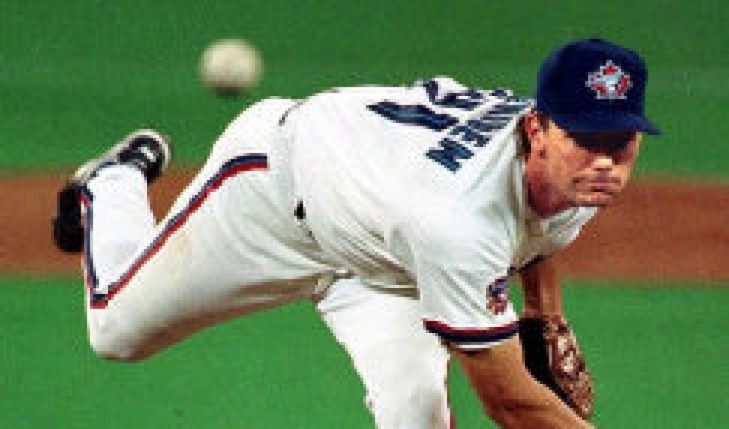
Originally selected by the Toronto Blue Jays in the fifth round of the 1986 draft, Pat Hentgen embarked on a gradual progression through the minor leagues. He made a brief three-game appearance in late 1991 and established a versatile role, appearing in 28 games as a reliever during the historic 1992 World Championship season. Although he was not included on the 1992 postseason roster, the front office recognized his potential as a foundational player. When a spot in the rotation became available the following spring, Hentgen secured it with a determined, competitive spirit that would characterize the next decade of Toronto baseball.
Hentgen’s official breakout during the 1993 season was remarkable. Establishing a reputation for confidently challenging hitters with a robust, sinking fastball and a sharp curveball, he earned a place on the American League All-Star team in his very first summer as a full-time starting pitcher. He achieved an impressive 19–9 record during the regular season, serving as a key component of manager Cito Gaston's rotation. In addition to his outstanding win-loss record, advanced metrics and league voters extensively acknowledged his dominance during that period, resulting in the 24-year-old receiving a distinguished sixth-place ranking in the American League Cy Young Award voting. Unlike the previous autumn, Hentgen was a pivotal factor when October arrived, delivering a masterful six-inning performance to secure the critical Game 3 victory against the Philadelphia Phillies and contribute to Toronto's second consecutive World Series championship.
In the years that followed, the championship core fractured as high-profile veterans departed and the Blue Jays slid into a prolonged mid-1990s rebuild. Yet, Hentgen remained the immovable, local highlight of the entire organization. He beautifully validated his frontline status with a second consecutive All-Star nod during the strike-shortened 1994 campaign, eating up valuable volume while the roster transformed around him.
Everything culminated in his absolute professional masterpiece during the legendary 1996 season. Operating as the undisputed, old-school ace of a rebuilding squad, Hentgen put together an astonishing exhibition of durability. He led all of Major League Baseball by racking up a massive, volume-dense 265.2 innings pitched across 35 starts, throwing an incredible ten complete games and three shutouts. He paired that suffocating workload with a brilliant 20–10 record and 177 strikeouts to comfortably edge out Andy Pettitte for the 1996 American League Cy Young Award, while also claiming The Sporting News Pitcher of the Year honors.
He carried that precise momentum into the 1997 campaign, earning his third career All-Star selection while leading the major leagues yet again in complete games (9), shutouts (3), and total batters faced (1,114). The sheer physical toll of those massive, back-to-back workloads eventually caught up to him over the next two summers, as his efficiency dipped and the front office ultimately traded the veteran workhorse to the St. Louis Cardinals in November 1999. Following successful interleague detours that included an All-Star comeback with Baltimore, Hentgen beautifully returned to Toronto in 2004 to pitch one final, emotional season before officially retiring in a Blue Jays uniform.
His numbers in Toronto showed a 107–85 record, a 4.28 ERA, and 1,028 strikeouts across 307 games. In 2016, he was deservedly enshrined in the Canadian Baseball Hall of Fame.
7. Jimmy Key
Looking at the early days of the Toronto Blue Jays’ rise in competitiveness, it's tempting to think of their exciting, heavy-hitting offenses. However, the true foundation of their journey from an expansion team to a force in the American League was actually built on the quiet strength of a humble, steady left-hander from Alabama. Jimmy Key didn't need a blazing fastball or dramatic mound antics; he simply outsmarted major-league hitters with careful precision, perfect control, and remarkable mental calmness. He started in 1984 as a flexible rookie reliever, earning ten saves, but the team quickly saw his real potential as a starting pitcher. When he moved into the full-time rotation the next spring, Key became the quietly reliable, highly effective cornerstone of the entire organization.
Key’s emergence as a key front-line pitcher became clear during the groundbreaking 1985 season. In his first summer as a regular starter, the southpaw baffled American League hitters to a 14–6 record, earning his first All-Star selection and leading the Blue Jays to their first-ever American League East division pennant. This breakthrough put him in the spotlight, but his true masterpiece came in the legendary 1987 season. Relying on a devastating slider and a sinking fastball that caused endless weak contact, Key dominated the Junior Circuit. He won the American League ERA Title with a low 2.76 and posted a league-leading 1.057 WHIP, finishing with a solid 17–8 record to place second in the AL Cy Young Award voting and earning The Sporting News Pitcher of the Year honor.
After his outstanding 1987 season, Key had to demonstrate his strong competitive spirit rather than just rely on his usual efficiency. In May 1988, an elbow injury threatened his progress, leading to arthroscopic surgery to remove bone chips. Although he was sidelined for ten weeks, Key made a quick comeback by adjusting his pitching style to overcome any lingering discomfort. He finished the season with an impressive 12–5 record, providing stability for a pitching staff in dire need of his workload.
By 1989, Key pitched a total of 216 innings over 33 starts, securing 13 wins and acting as the steadying force that helped lead the team to the postseason. While players like Dave Stieb made headlines nationally, Key stayed focused on his performance, leading to a personal best of 16 wins in 1990 and anchoring the rotation for a team that was actively building a championship-ready roster.
That consistent development led to a standout 1991 season. With the Midsummer Classic hosted in Toronto, Key achieved his second All-Star nod and was the winning pitcher in the 1991 All-Star Game, played before his home crowd at the newly opened SkyDome. Although Key’s regular-season contributions provided essential stability, his most significant moment came in October 1992. In his last games with the team, he pitched an exceptional Game 4 and secured an important relief win in the 11th inning of Game 6 against Atlanta, giving Toronto its first-ever world championship banner.
Following his 1992 Fall Classic victory, Key entered free agency and signed a four-year deal with the Yankees, maintaining his elite performance with two All-Star selections, a league-leading 17 wins in 1994, and another World Series title in 1996. He finished his 15-year career with the Orioles. His nine-year Toronto stint included a 116–81 record, 3.42 ERA, and 944 strikeouts over 317 appearances.
5. Tony Fernandez
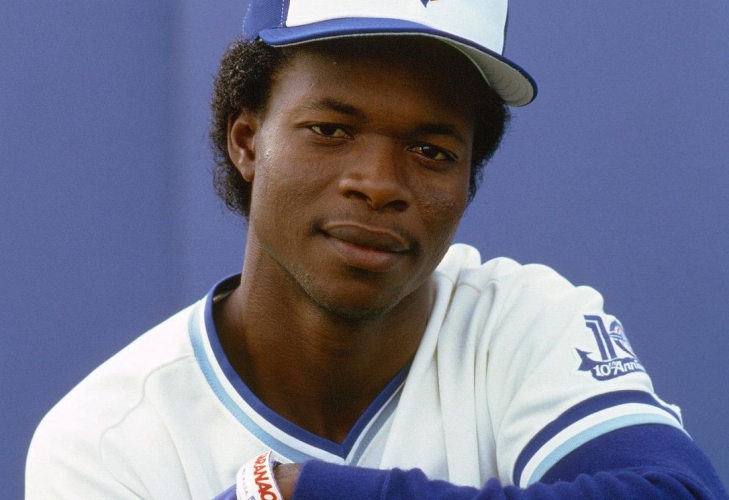
Having discovered and signed out of the renowned shortstop sanctuary of San Pedro de Macorís, Tony Fernandez arrived in Toronto as a slender, highly agile adolescent, destined to redefine the position for an ascending franchise. Making his Major League debut in late 1983, he spent a year in a part-time capacity before definitively assuming the everyday shortstop role in 1985. His timing was impeccable; his first full season at the helm coincided directly with the Blue Jays’ historic breakthrough to their first American League East division title, thereby immediately establishing him as a central figure in the team's transformation from an expansion underdog to a legitimate powerhouse.
From 1985 to 1988, Fernandez established a distinguished period of shortstop performance that garnered the attention of the entire baseball community, earning him consistent votes for the American League Most Valuable Player award. He exemplified exceptional consistency at the plate, achieving at least 160 hits and maintaining a batting average well above .280 in each of those four consecutive seasons. Notably, his 1986 season was extraordinary, during which he recorded a career-high 213 hits—a record for a shortstop in Major League Baseball at that time. His distinctive, low-hand stance and highly disciplined approach rendered him a formidable challenge for opposing pitchers seeking to complete innings.
Although his batting was impressive, it was his defensive prowess on the artificial turf of Exhibition Stadium that elevated his status to that of an icon. Equipped with exceptional flexibility and a unique, sidearm flick throwing motion, Fernandez demonstrated an extraordinary range that enabled him to field ground balls deep in the hole and execute throws across his body with ease. This exceptional defensive skill earned him four consecutive Gold Glove Awards from 1986 to 1989, marking him as the first infielder in Blue Jays history to receive this accolade and supporting a sophisticated defensive strategy that contributed significantly to the success of Toronto's pitching staff.
Fernandez, a three-time All-Star during his initial tenure in Canada, was reluctantly transferred to San Diego following the 1990 season in a major trade intended to reacquire Roberto Alomar and Joe Carter. Nonetheless, his career remained profoundly connected to Ontario. In June 1993, the Toronto Blue Jays orchestrated a mid-season trade to reinstate their cherished shortstop for the final stages of the season. Fernandez responded positively by batting .306 during the concluding period and delivered an exceptional performance in the 1993 World Series, where he set a shortstop record with nine runs batted in, culminating in his first championship victory.
The later stages of his career turned into a nomadic journey through Cincinnati, New York, and Cleveland, but the pull of the True North always brought him back. Fernandez returned for a third stint in 1998, defying Father Time by batting a brilliant .321, followed by a sizzling .328 mark in 1999 that earned him his fifth and final career All-Star appearance. After a brief foray into Japanese baseball, he came full circle in 2001, returning to Toronto one last time to finish his 17-year major league journey exactly where it began, wearing his iconic number 1 uniform.
The Infielder compiled 1,583 Hits, 172 Stolen Bases, and a .297 Batting Average as a Blue Jay and would later be inducted into the Canadian Baseball Hall of Fame. Fernandez is also a member of the Blue Jays Level of Excellence.
4. Carlos Delgado
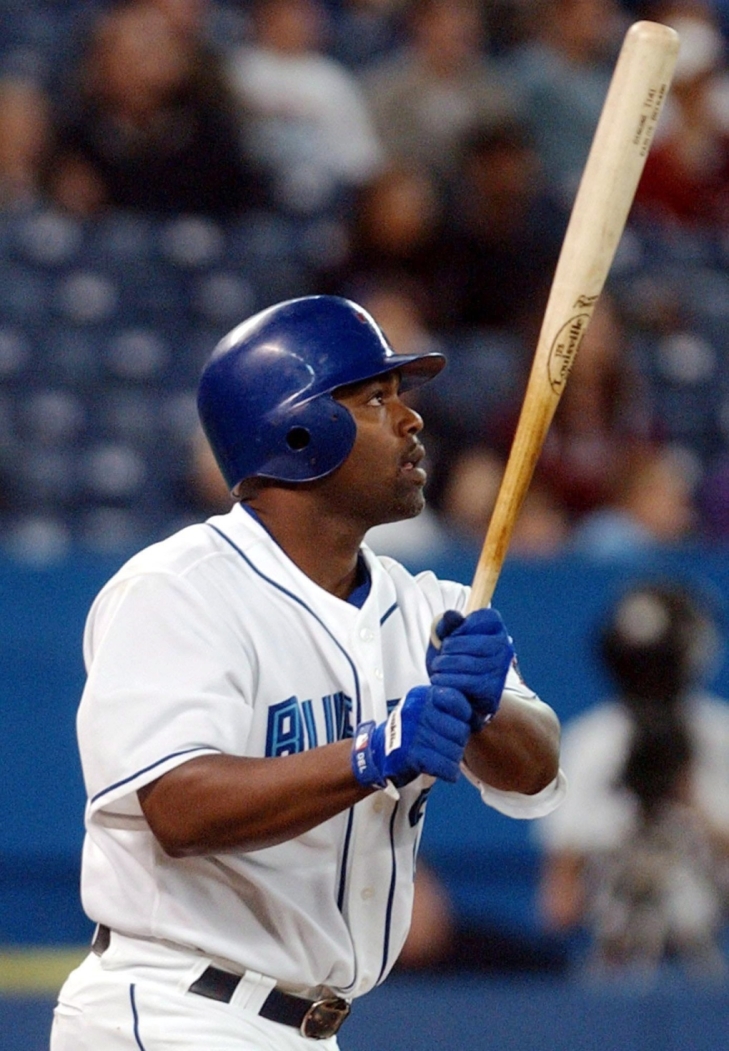
Having departed from Puerto Rico as a teenager in 1988, Carlos Delgado did not merely drift into the middle of the lineup; he had to meticulously analyze and reconstruct his identity to unlock his full competitive potential. Originally recognized as a highly rated catcher, he made brief appearances during the historic 1993 World Championship run—earning a championship ring despite participating in only two regular-season games—and spent the subsequent two summers transitioning through left field and designated hitter roles while adjusting to minor league requirements. Once he firmly secured the first base position ahead of the 1996 season, he evolved into an exceptional force, functioning as the steadfast and elite leader of Toronto’s offense for nearly a decade.
His introductory phase as an everyday threat quickly set a foundation of intense and exciting run production. Delgado made facing major-league pitching a regular part of his daily routine, enjoying an impressive ten-year streak of hitting at least 30 home runs in 1997. He systematically overwhelmed American League lineups, combining powerful swings with an excellent eye, and he surpassed the 100-RBI mark six times while playing for the Blue Jays.
His advanced efficiency filters wowed during a historic 2000 showcase, when he hit .344, 41 home runs, and led with 57 doubles to win the Hank Aaron Award.
He was even more electric in the 2003 season. Delgado delivered an outstanding display of power and skill, especially on a historic September night against Tampa Bay, when he became the only player in baseball history to hit four home runs in a game with just four at-bats. That remarkable season saw him lead Major League Baseball with an impressive 145 runs batted in, along with 42 home runs and a powerful 1.019 OPS. His exceptional performance earned him the prestigious Sporting News Major League Player of the Year Award, his third Silver Slugger, and a very close second for the American League MVP.
While Delgado was an absolute superstar anchoring the middle of the order, the franchise fell into a sharp structural decline following the legendary 1993 triumph, failing to build a legitimate postseason contender around their premier slugger. Despite his historic run production, he never got to experience a single playoff frame north of the border.
By the conclusion of the 2004 contract schedule, the organization was aggressively shedding payroll to engineer a total roster reconstruction under general manager J.P. Ricciardi. With management lacking the fiscal volume to match his elite market valuation, the front office initiated a definitive business exit by letting their icon walk into the open market, paving the way for him to sign a lucrative free-agent deal with the Florida Marlins before cementing his late-career legacy with the New York Mets.
Delgado made 1,423 appearances as a Blue Jay, with 1,413 hits, 343 doubles, and a notable career slash line of .282/.392/.556. He holds franchise records in several categories, including offensive bWAR (39.4), plate appearances (6,018), runs scored (889), home runs (336), and RBIs (1,058). In July 2013, his banner was raised into the Toronto Blue Jays Level of Excellence, and in 2015, he was inducted into the Canadian Baseball Hall of Fame.
