


Committee Chairman
Our All-Time Top 50 Houston Astros have been revised to reflect the 2022 Season
Yes, we know that this is taking a while!
As many of you know, we here at Notinhalloffame.com are slowly generating the 50 of each major North American sports team. That being said, we have existing Top 50 lists out and we always consistently look to update them when we can and based on necessity. As such, we are very happy to present our post 2022 revision of our top Houston Astros.
As for all of our top 50 players in basketball we look at the following:
1. Advanced Statistics.
2. Traditional statistics and how they finished in the American League.
3. Playoff accomplishments.
4. Their overall impact on the team and other intangibles not reflected in a stat sheet.
Last year, Houston won their second World Series, and they are blessed with young talent, two of which make their first appearance on this list.
As always, we present our top five, which was not impacted by last season:
1. Jeff Bagwell
2. Craig Biggio
3. Jose Altuve
5. Cesar Cedeno
You can find the entire list here.
Despite his good year, Altuve was unable to pass Biggio for #2.
Justin Verlander, who won the Cy Young, and is now with the New York Mets, jumped from #19 to #11; an impressive feat considering the relative brevity of his Astros career.
Infielder, Alex Bregman, moved up two spots to #14.
Yuli Gurriel also moved up by two, with a new rank of #35.
Designated Hitter, Yordan Alvarez, makes his debut at #37 and Outfielder, Kyle Tucker, comes in at #45.
We welcome your input and comments and as always, we thank you for your support.
23. Kyle Tucker
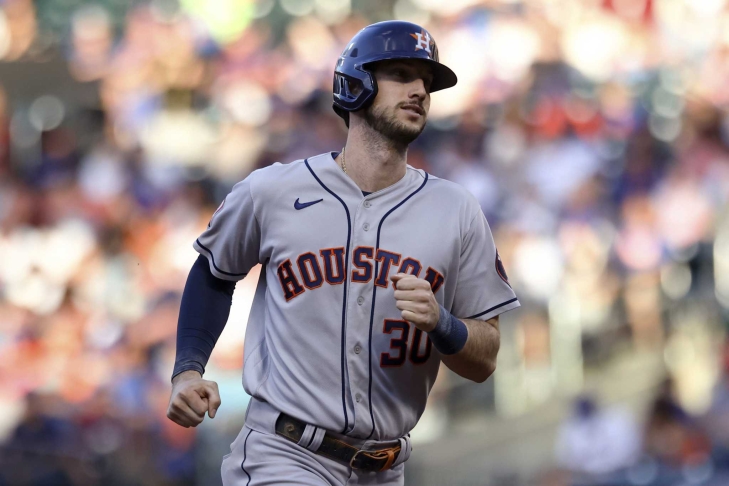
Kyle Tucker first made his mark in Houston as a highly touted fifth-overall pick, though his initial taste of the big leagues in 2018 was a difficult stretch where he struggled to find his rhythm. After a more promising 2019 cameo, he secured his place in the lineup for good during the shortened 2020 campaign. For seven seasons, he patrolled right field with a specialized, smooth left-handed swing and a deceptive speed that made him one of the most efficient all-around threats in the American League.
Tucker’s emergence in Houston reached a historic breakout during the 2021 and 2022 seasons. After leading the league in triples in 2020, he transitioned into a premier middle-of-the-order force, launching 30 home runs in back-to-back years. He demonstrated a focused intensity on both sides of the ball, pairing his offensive efficiency with an elite glove that earned him a Gold Glove in 2022. He showed the organization that he was a foundational piece of a world-title squad, recording 107 RBIs and earning a Silver Slugger as the Astros captured the 2022 World Series championship.
In 2023, Tucker reached a career peak for individual dominance, leading the American League with 112 RBIs and finishing fifth in the MVP voting. He possessed a specialized ability to combine power and discipline, narrowly missing a 30-30 season while earning his second straight All-Star nod and a third consecutive All-MLB selection. Despite a 2024 campaign that was interrupted by a frustrating injury, he remained a statistical force when healthy, securing his third straight All-Star selection before a shifting organizational strategy led to a change in direction.
Following the 2024 season, the Astros traded their star outfielder to the Chicago Cubs. He left behind a statistical footprint that reflected his status as one of the most balanced players in franchise history, amassing 125 home runs and 615 hits during his tenure.
Our All-Time Top 50 Texas Rangers have been revised to reflect the 2022 Season
Yes, we know that this is taking a while!
As many of you know, we here at Notinhalloffame.com are slowly generating the 50 of each major North American sports team. That being said, we have existing Top 50 lists out and we always consistently look to update them when we can and based on necessity. As such, we are very happy to present our post 2021 revision of our top Texas Rangers.
As for all of our top 50 players in basketball we look at the following:
1. Advanced Statistics.
2. Traditional statistics and how they finished in the American League.
3. Playoff accomplishments.
4. Their overall impact on the team and other intangibles not reflected in a stat sheet.
Last year, Texas signed some talent, but was not able to do much in regards to the standings and were basement dwellers. There was a returnee, that allowed a new entrant to the Top 50, but that did not impact the upper tier.
As always, we present our top five, which was not impacted by last season:
5. Frank Howard
You can find the entire list here.
The only new entrant on the list is All-Star and Starting Pitcher, Martin Perez, who debuts at #45.
We welcome your input and comments and as always, we thank you for your support.
17. Yordan Alvarez
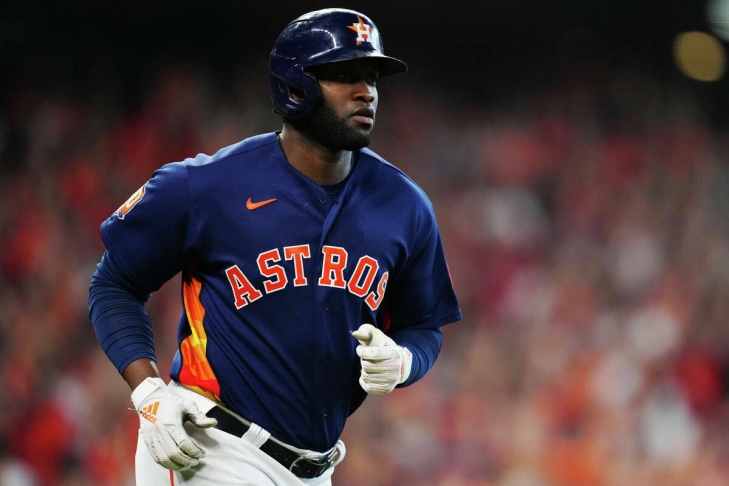
Yordan Alvarez arrived in Houston as a quiet acquisition from the Dodgers, a player traded before he even suited up for his original club. It did not take long for that transaction to become one of the most lopsided in modern history. Since his debut, the man known as "Air Yordan" has functioned as a pure force of nature in the heart of the order, providing a left-handed power threat that feels like a throwback to the most feared sluggers of the previous century.
Yordan Alvarez arrived in Houston as a quiet acquisition from the Dodgers, a player traded before he even suited up for his original club. It did not take long for that transaction to become one of the most lopsided in modern history. Since his debut, the man known as "Air Yordan" has functioned as a pure force of nature in the heart of the order, providing a left-handed power threat that feels like a throwback to the most feared sluggers of the previous century.
Alvarez’s rise in Houston began with a 2019 debut that shattered rookie expectations. Despite only receiving 369 plate appearances, he reached a career-defining breakout by launching 27 home runs and posting a massive .655 slugging percentage. He was the unanimous American League Rookie of the Year, signaling a transition from a promising prospect to an elite middle-of-the-order anchor. He possessed a focused intensity at the plate even in the highest stakes, batting .412 during the World Series that fall and proving he was already a championship-caliber hitter.
The heart of his time in Houston has been marked by a surge into the top tier of global superstars, occasionally interrupted by the physical toll of his massive frame. After a dominant 2021 in which he drove in 104 runs, he reached a career peak in 2022. Finishing third in the MVP voting, Alvarez provided the definitive moment of the franchise’s second title, a towering three-run blast in Game 6 of the World Series that remains a local legend. He followed that with another high-frequency offensive year in 2023, smacking 31 homers and earning his second straight All-Star nod.
The story in Houston took a difficult turn between 2024 and 2025. He maintained his elite status in 2024 by launching 35 home runs to reach a career total of 164, but his 2025 campaign was largely erased by injury. He managed to add 6 home runs in limited action before being sidelined, bringing his career tally to 170. This forced him to navigate a frustrating plateau while the team fought for position without its primary engine. As he prepares to enter the 2026 season, the focus is entirely on his health and the power he brings back to the lineup. He remains the most potent bat on a perennial contender, a player whose exit velocity and plate discipline make him a nightmare for any pitching staff.
