

33. Speedy Duncan

When a guy carries the nickname “Speedy,” you can safely assume he wasn’t often getting caught from behind. Leslie Herbert “Speedy” Duncan went undrafted out of Jackson State in 1964 by both the NFL and the AFL, then signed with the San Diego Chargers and quickly showed why the name fit. He saw limited action as a rookie, but by 1965 he had become a starting cornerback and a dangerous return man on both punts and kicks. At 5-foot-10 and about 180 pounds, he had the speed to cover receivers and the quickness and vision to make defenders miss in the open field once he got the ball.
From 1965 through 1967, he was an AFL All-Star every year. In 1965 he led the league in both punt-return yards and yards per return (15.5 average on 30 returns, including two touchdowns), and he repeated as the yards-per-return leader the following season. In 1966, he also had his best year as a defender, picking off seven passes—including three in one game against the Raiders—and in 1967 he took one interception back 100 yards for a score, the longest in AFL history at the time. He returned four punts for touchdowns during his Chargers years and was so effective that opposing punters started aiming for height and field position instead of pure distance just to keep the ball out of his hands. He was the rare dual-threat who could shut down a receiver one play and flip the field the next.
Duncan stayed with the Chargers through the 1970 season before signing with the Washington Redskins. Across his seven years in San Diego, he finished with 21 interceptions and more than 5,300 combined return yards, production that made him one of the most explosive playmakers the early Chargers ever had.
In 1995, the franchise inducted him into its Hall of Fame, and he was later named to both the Chargers’ 40th and 50th Anniversary Teams, recognizing the speedy cornerback and return specialist who turned special teams into a weapon during the AFL years.
32. Woodrow Lowe

Woodrow Lowe arrived in 1976 as a fifth-round pick out of Alabama after a three-time All-American career under Bear Bryant, and he immediately won the starting right linebacker job as a rookie. He kept that spot for nearly his entire 11-year run in San Diego, starting 151 of his 164 games and missing only one contest. At about 6-foot and 227 pounds, he was a solid run defender who could also drop into coverage, and that ability showed up in 21 interceptions—an unusually high number for a linebacker—four of which he returned for touchdowns.
His best seasons lined up with the Air Coryell years. In 1979, he picked off a career-high five passes and returned two for scores. The next year he became a team captain, a role he held for seven seasons, and he earned Second-Team All-AFC honors while the Chargers reached the AFC Championship Game. He was still productive later on, picking off three passes in both 1984 and 1985 and adding 15 career sacks. He was the kind of linebacker who could hold the edge against the run, then jump routes or sit in a zone and create turnovers when the offense attacked his area. One of the more memorable (and unfortunate) moments of his career came in the 1978 “Holy Roller” game against the Raiders, when he was the defender closing in on Ken Stabler as the controversial fumble-forward play unfolded.
Lowe retired after the 1986 season. Throughout his career with the Chargers, he was one of the steadiest, longest-tenured defenders of that era, finishing with 21 interceptions and a reputation as a durable, reliable starter who rarely missed time.
After his playing days, he was named to both the Chargers’ 40th and 50th Anniversary Teams, and in 2009 he was inducted into the College Football Hall of Fame, recognition for the three-time All-American who had spent more than a decade anchoring the Chargers’ linebacking corps.
14. Leslie O'Neal
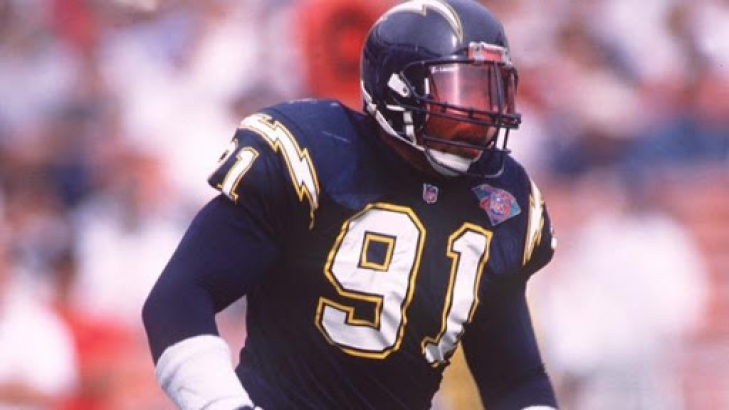
Drafted eighth overall in the 1986 NFL Draft out of Oklahoma State—where he was a two-time consensus All-American—Leslie O'Neal immediately delivered one of the most explosive introductory stretches by a pass rusher in league history. Stepping into the starting lineup for the San Diego Chargers, he terrorized opposing backfields right out of the gate, compiling an astonishing 12.5 sacks in his first 13 professional games to capture AP Defensive Rookie of the Year honors and earn a spot on the PFWA All-Rookie Team.
However, what promised to be a legendary rookie campaign turned tragic in Week 14 against St. Louis, when O'Neal suffered a devastating knee injury that tore multiple ligaments. The severe damage forced him into a grueling rehabilitation process that stripped away his entire 1987 season and kept him sidelined for the first half of 1988.
After returning full-time, O'Neal shifted to outside linebacker and rewarded San Diego's patience in 1989 with an explosive full-season comeback. With his trademark burst off the edge, he racked up 12.5 sacks and earned his first Pro Bowl selection, instantly reaffirming his place among the game's premier defenders.
Moving back to his natural defensive end spot in 1992, O'Neal kicked off a dominant four-year run of Pro Bowl selections from 1992 through 1995. He reached double-digit sacks in five distinct seasons for the Bolts, headlined by a career-high 17.0 sacks in 1992 that co-led the entire NFL. In 1994, he anchored a fierce defensive unit that carried San Diego to an AFC Championship and the franchise's first Super Bowl appearance (Super Bowl XXIX).
Following nine active seasons in Southern California, O'Neal departed in 1996 for St. Louis, playing two years with the Rams and spending his final two seasons with the Kansas City Chiefs. He retired with 132.5 career sacks, tied for 14th on the NFL's all-time official leaderboard. In 2014, the Chargers formally enshrined his legendary status by inducting him into the Chargers Hall of Fame. With the Chargers, O’Neal compiled 105.5 sacks (franchise record), 517 combined tackles, 22 forced fumbles, and 13 fumble recoveries.
10. Charlie Joiner
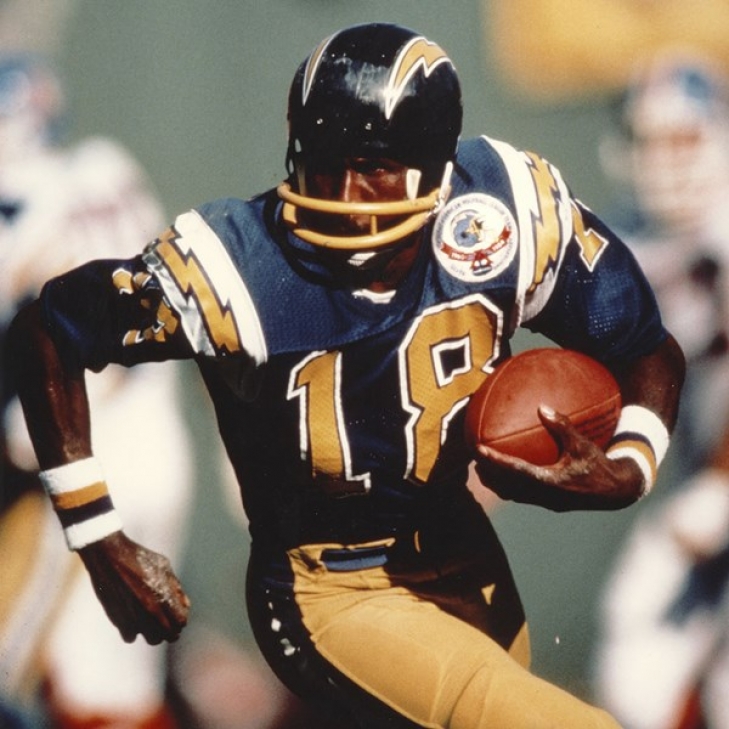
Drafted in the fourth round of the 1969 AFL-NFL Draft out of Grambling State, Charlie Joiner launched his professional football journey with the Houston Oilers. After four years in Texas, the Bengals traded him to Cincinnati midway through the 1972 season, where he stayed through 1975. By the time the Bengals dealt him to San Diego before the 1976 season, the 28-year-old receiver had logged seven solid seasons and accumulated 2,943 receiving yards. It was a respectable total, but it paled in comparison to the historic explosion that awaited him in Southern California.
In San Diego, Joiner found the ideal offensive environment under visionary head coach Don "Air" Coryell. As the vertical passing revolution took hold, Coryell and Hall of Fame quarterback Dan Fouts aired it out at a volume unprecedented in professional football. Joiner became the tactical focal point of the scheme—a cerebral third-down converter and deep-route specialist who exploited intermediate zones while Kellen Winslow and John Jefferson stretched defenses vertically.
Operating as Fouts’ most trusted target, Joiner earned three Pro Bowl nods in lightning bolts (1976, 1979, 1980) and posted four 1,000-yard receiving campaigns (1976, 1979–1981). His ultimate weapon was not pure track speed, but exquisite, razor-sharp route running and elite spatial awareness. Because his game relied on craft, intelligence, and flawless execution rather than raw acceleration, Joiner appeared virtually ageless on the field, producing at a high level well into his late thirties.
Joiner rarely made mental errors, and his ability to absorb physical hits while maintaining precise timing made him a fixture of San Diego’s offense for 11 seasons. By the time he retired following the 1986 campaign at age 39, he had accumulated nearly 10,000 receiving yards in a Chargers uniform alone. His sheer longevity stood as a testament to his preparation, structural discipline, and deep understanding of secondary coverages. When he finally hung up his cleats, his 750 career receptions, 12,146 receiving yards, and 239 games played were all NFL records for a wide receiver.
The franchise recognized his immense contributions by inducting him into the Chargers Hall of Fame in 1993 and retiring his No. 18 jersey. Canton called three years later when Joiner was enshrined in the Pro Football Hall of Fame as part of the Class of 1996. In powder blue, Joiner had 9,203 yards with 47 touchdowns.
11. John Hadl
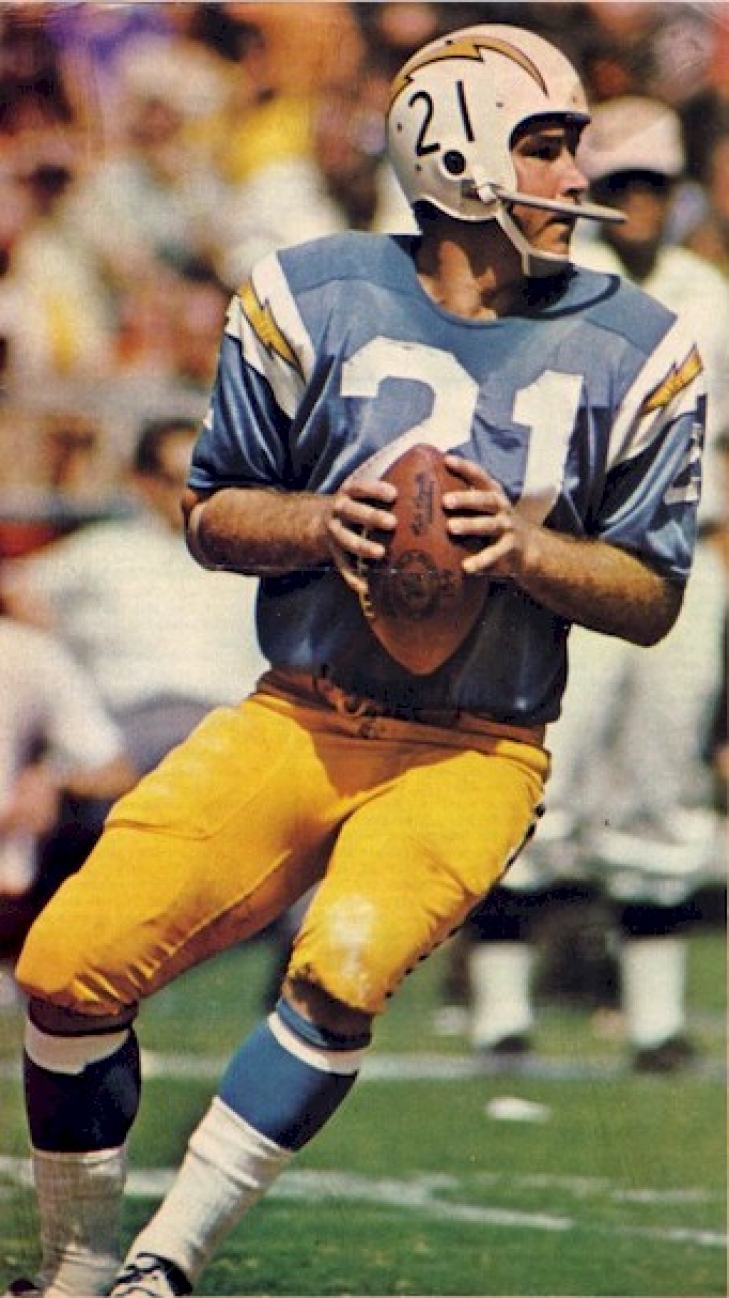
Selected 10th overall in the first round of the 1962 AFL Draft out of Kansas, where he was a two-time All-American, John Hadl chose Sid Gillman’s San Diego Chargers over the NFL’s Detroit Lions. In the Chargers’ explosive offense, Hadl initially split time and backed up veteran Tobin Rote during his first two seasons, helping San Diego win the 1963 AFL Championship with a dominant 51–10 victory over Boston.
After becoming the primary starting quarterback in 1964, Hadl quickly justified Gillman's faith in him. That season, he earned his first AFL All-Star selection and led the Chargers back to the AFL title game. In 1965, he led the AFL in passing yards (2,798) and earned his second All-Star nod. Hadl continued to build on that production, throwing for 2,846 yards in 1966 and 3,365 in 1967. In 1968, he led the league in both passing yards (3,473) and touchdown passes (27), while also topping the interception leaderboard with 31 in his high-risk, high-reward passing style.
Hadl’s deep-ball prowess made the Chargers' offense one of the most feared aerial attacks in pro football history. Pairing with Hall of Fame receiver Lance Alworth, Hadl mastered the deep post and wheel routes that defined Air Coryell’s predecessor. In 1971, Hadl delivered another stellar campaign, once again leading the league in passing yards (3,075) and touchdown passes (21). He closed out his 11-year run in San Diego with a Pro Bowl campaign in 1972, demonstrating his staying power through the AFL-NFL merger.
Traded to the Los Angeles Rams in 1973, Hadl earned First-Team All-Pro honors in LA before finishing his 16-year career with the Packers and Oilers. Yet his legacy remains forever anchored in Southern California, where his #21 jersey and high-flying arm helped build the Chargers' modern offensive identity.
In 1983, the franchise officially recognized his massive contributions by inducting Hadl into the Chargers Hall of Fame. As a Charger, Hadl threw for 26,938 passing yards, 201 passing touchdowns, 211 interceptions, and 1,241 rushing yards with 16 rushing touchdowns.
28. Ed White

Ed White came to the Chargers before the 1978 season in a trade that sent running back Rickey Young to the Minnesota Vikings. After nine years in Minnesota—where he had already made three Pro Bowls—the veteran guard stepped into the starting right-guard spot in San Diego and stayed there. At a thick 6-foot-1 and around 270 pounds, he was a powerful, physical blocker who could drive defenders off the ball in the run game and hold his ground in pass protection. He started 117 of his 119 games with the Chargers, missing only two contests over eight seasons, and earned his fourth career Pro Bowl nod in 1979 as the team began a stretch of four straight playoff appearances under Don Coryell.
Those years lined up with the peak of the Air Coryell offense. With White anchoring the right side next to center Don Macek, the line helped Dan Fouts lead the NFL in passing yards four straight seasons and kept the sack rate low enough that the unit ranked among the league’s best in protection from 1981 to 1983. The Chargers won three consecutive AFC West titles from 1979 to 1981 and reached the AFC Championship Game twice. White was named the team’s Lineman of the Year three straight times from 1983 to 1985, even as the overall results cooled, and teammates and opponents alike noted how tough he was to move. Fouts has repeatedly said White was one of the most feared linemen he ever played with, the kind of guard who made life miserable for the defensive tackles across from him.
White retired after the 1985 season. Over his eight years in San Diego, he was one of the most durable and consistent pieces of the offensive line during the franchise’s most prolific passing era.
The Chargers later inducted him into their Hall of Fame in 2004, recognizing the veteran guard who had helped keep Dan Fouts upright and the Air Coryell attack rolling for nearly a decade.
26. Paul Lowe

Paul Lowe was undrafted out of Oregon State in 1959 and didn’t stick with the 49ers in training camp, but the brand-new American Football League gave him a fresh shot in 1960. He landed with the Los Angeles Chargers and immediately made noise as the starting halfback. As a rookie, he ran for 855 yards on just 136 carries—an eye-popping 6.3 yards per attempt that led the league—while also hauling in 23 passes for 377 yards. He earned First-Team All-AFL honors and showed the kind of speed and elusiveness that would make him a problem for defenses for years.
Once the team moved to San Diego, Lowe kept producing. In 1961, he led the AFL with nine rushing touchdowns and ripped off an 87-yard score that still stands as a Chargers record. He missed all of 1962 with a broken arm, then bounced back in 1963 with 1,010 rushing yards and another eight touchdowns as the Chargers won the AFL Championship; in that title game he ran for 94 yards, including a 58-yard touchdown, in the 51-10 blowout of Boston. Two years later he had his biggest season, leading the league with 1,121 rushing yards and six scores while earning AFL Player of the Year honors from The Sporting News and another First-Team All-AFL selection. Sid Gillman once compared his speed and change of pace to Gale Sayers, and Lowe’s ability to hit the outside on toss plays made him a constant threat.
He played another year-plus in San Diego before the Chargers released him in 1968. Across his time with the franchise, he finished with 4,972 rushing yards, 1,045 receiving yards, and 45 total touchdowns, numbers that made him one of the most productive backs the early Chargers ever had.
The team later inducted him into its Hall of Fame in 1979, recognizing the elusive halfback who had helped define the franchise’s first championship run and spent the better part of a decade wearing out opposing defenses.
4. Dan Fouts
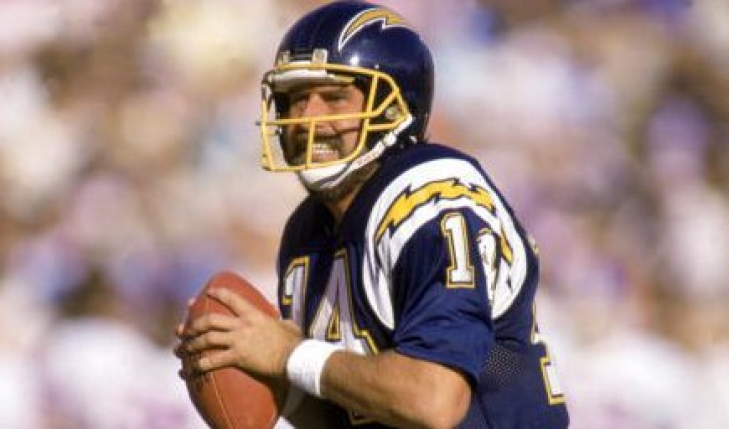
Selected in the third round (64th overall) out of Oregon in the 1973 NFL Draft, Dan Fouts stepped into a San Diego Chargers franchise struggling to establish a modern offensive identity. Through his first five seasons in Southern California, Fouts produced steady if unspectacular results while adjusting to the harsh realities of professional defenses. However, everything changed in 1978 when the franchise hired visionary head coach Don Coryell, setting the stage for a tactical revolution that would reshape the modern NFL passing game.
Under Coryell’s high-octane "Air Coryell" architecture, Fouts was given complete freedom to unleash his quick release, fearless pocket presence, and pinpoint downfield ball placement. Operating with weapons like Kellen Winslow, Charlie Joiner, and John Jefferson, Fouts transformed the position. Between 1979 and 1982, he embarked on the most prolific passing stretch in football history up to that point, leading the NFL in passing yards in four consecutive seasons.
Fouts shattered conventional passing limits, becoming the first player in NFL history to throw for over 4,000 yards in three consecutive seasons. In 1979, he broke the NFL single-season record with 4,082 passing yards and 24 touchdowns, carrying San Diego to its first playoff spot in 14 years. He erased his own mark the very next season in 1980 by throwing for 4,715 yards and 30 touchdowns, leading the Chargers to the AFC Championship Game.
In 1981, Fouts set the record for a third straight year with an astounding 4,802 passing yards and 33 touchdowns, driving San Diego back to the AFC Title Game after orchestrating a 41–38 overtime classic against Miami in the "Epic in Miami." His peak individual brilliance came during the strike-shortened 1982 campaign: in just nine regular-season games, Fouts threw for 2,883 yards (an incredible 320.3 yards per game) and 17 touchdowns, earning both the PFWA NFL Most Valuable Player Award and AP Offensive Player of the Year honors while posting a staggering 22 Approximate Value.
Even as age and injuries began to take their toll in the mid-1980s, Fouts remained an elite downfield distributor. He earned his sixth Pro Bowl selection in 1985 after throwing for 3,638 yards and 27 touchdowns, and he led the NFL in passing yards per game for a sixth and final time in 1986 (262.2 yards per game). Across his eight seasons operating the Air Coryell offense from 1978 through 1985, Fouts averaged over 3,800 passing yards per 16 games, establishing a standard for aerial volume that was decades ahead of its era.
Retiring following the 1987 season, Fouts spent his entire 15-year career in a San Diego uniform, setting every major franchise passing record. When he hung up his helmet, his 43,040 career passing yards ranked second in NFL history behind only Fran Tarkenton. He also threw for 254 touchdowns.
30. Louie Kelcher

Louie Kelcher joined the Chargers as a second-round pick out of SMU in 1975 and immediately became a massive presence in the middle of the defensive line. At 6-foot-5 and often listed at 280–300 pounds, he was one of the biggest interior linemen of his era, using that bulk to clog running lanes and push the pocket. As a rookie, he earned All-Rookie honors, then settled into a long run as a starter. In 1977, he was voted the team’s Most Valuable Player after helping the defense record 44 sacks, and the next year he earned First-Team All-Pro honors and his second Pro Bowl nod.
The best stretch came in the late 1970s and early 1980s alongside Fred Dean, Gary “Big Hands” Johnson, and Leroy Jones—the group that became known as the Bruise Brothers. Kelcher made three Pro Bowls (1977, 1978, and 1980) and earned Second-Team All-Pro honors in 1977, 1980, and 1981. In 1980, even after missing most of the previous season with a knee injury, he returned and helped the defense lead the NFL with 60 sacks. He was the kind of space-eating tackle who could occupy multiple blockers, disrupt the run, and still generate pressure up the middle when the play called for it. In the 1980 AFC Championship Game, he finished with 20 tackles, and in the famous “Epic in Miami” playoff the following year, he forced a fumble that helped keep the Chargers alive.
After the 1983 season, the Chargers traded him to the San Francisco 49ers, where he played one final year and won a Super Bowl. Across his nine seasons in San Diego, he had piled up roughly 40 unofficial sacks along with two interceptions and eight fumble recoveries.
The franchise later inducted him into its Hall of Fame in 2003, recognizing the big, physical defensive tackle who had been a cornerstone of the Chargers’ front during the late Air Coryell era.
16. Gary Johnson
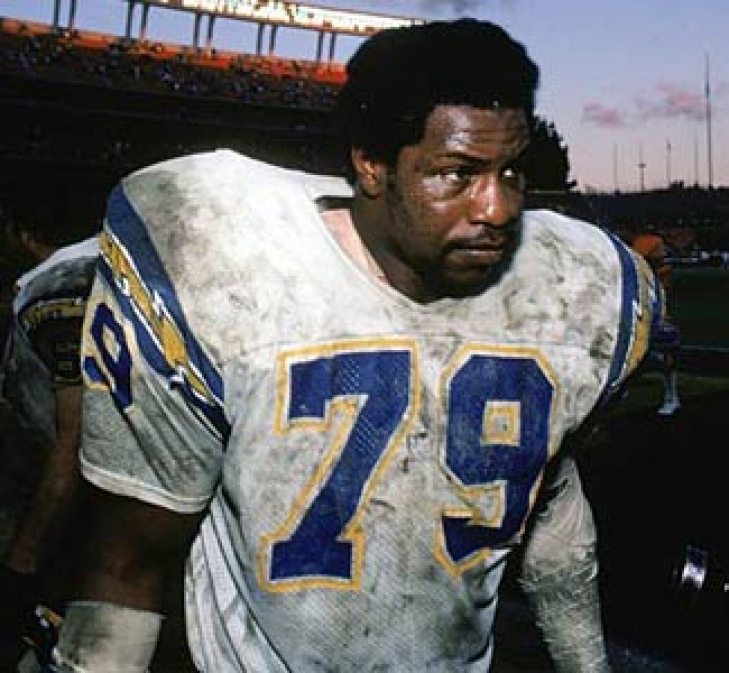
Gary “Big Hands” Johnson arrived in San Diego as the eighth overall pick in the 1975 draft out of Grambling, and the nickname stuck for a reason—a junior-high coach once told him to keep his big hands off a basketball. At 6-foot-2 and around 250 pounds, he wasn’t the biggest defensive tackle, but he was strong enough to bench-press 460 pounds and quick enough to chase down plays. He made the All-Rookie team right away, then really found his footing once defensive line coach Jerry Smith arrived; by 1977 he was up to 13.5 unofficial sacks and starting to look like a problem for opposing quarterbacks.
Everything clicked in 1980. Johnson led the whole league with 17.5 sacks—still the Chargers’ single-season record—and the defense piled up a league-high 60. He teamed with Fred Dean, Louie Kelcher, and Leroy Jones on a front four that got nicknamed the Bruise Brothers, and he walked away with First-Team All-Pro honors plus the AFC Defensive Lineman of the Year award from the players. One of those sacks, which knocked Eagles quarterback Ron Jaworski out of a game, was so loud that someone called Chargers owner Gene Klein and threatened Johnson’s life. He followed it up with another First-Team All-Pro season in 1981 (10 more unofficial sacks) while the Chargers stacked consecutive division titles and Johnson stacked four straight Pro Bowls from 1979 through 1982.
The Chargers shipped him to the 49ers early in the 1984 season. By the time he left, he had racked up roughly 67.5 unofficial sacks in San Diego—a franchise mark at the time—plus a couple of interceptions and a handful of fumble recoveries, all before sacks even became an official stat in 1982.
The team finally put him in the Chargers Hall of Fame in 1999, a nice nod to the guy who spent nearly a decade making life miserable for quarterbacks in the middle of the Air Coryell era.
13. Russ Washington
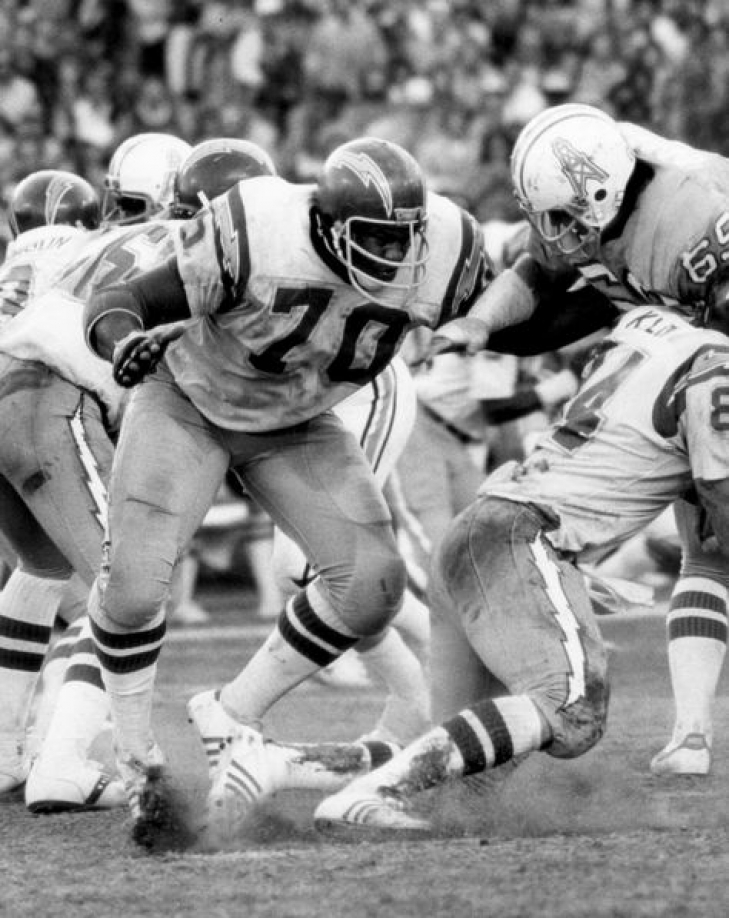
Selected fourth overall in the 1968 AFL Draft out of Missouri—where he was a standout lineman and Big Eight Player of the Year—Russ Washington arrived in San Diego, expected to anchor the defensive front. Standing 6-foot-6 and weighing nearly 300 pounds, he lined up primarily at defensive tackle during his first two seasons and earned AFL All-Rookie Team honors. However, a position switch in his third year altered the trajectory of both his career and the franchise's offensive line.
Moving to right tackle in 1970, Washington found his true calling as an impenetrable pass blocker. Opponents quickly dubbed him "Mt. Washington" due to his massive frame, low center of gravity, and immovable base. Pass rushers couldn’t drive through him or get around his long reach. His insertion at right tackle gave signal-callers like John Hadl and later Dan Fouts an absolute wall on the edge, creating the deep pockets Sid Gillman and Don Coryell needed to stretch defenses downfield.
Washington’s dominance at tackle earned him national acclaim across multiple coaching eras. He was selected to five Pro Bowls (1974, 1975, 1977, 1978, and 1979) and earned First-Team All-Pro honors from the NEA in 1974, along with multiple Second-Team All-Pro recognitions. When Coryell unleashed the historic "Air Coryell" passing offense in the late 1970s, Washington and left tackle Doug Wilkerson held down the edges, allowing Fouts to drop back and rewrite the NFL passing records.
Beyond his individual accolades, Washington was an absolute pillar of durability. Over 15 seasons in San Diego, he played in 200 regular-season games, starting 196. He anchored the line through 148 consecutive games at one point, serving as an indisputable team leader during San Diego's back-to-back AFC Championship Game appearances in 1980 and 1981.
When Washington retired following the 1982 season, he held the franchise record for most games played in a Chargers uniform (a mark later passed by Junior Seau and Philip Rivers). His fifteen years of selfless, elite service were permanently recognized in 1995 when he was enshrined in the Chargers Hall of Fame.
6. Kellen Winslow
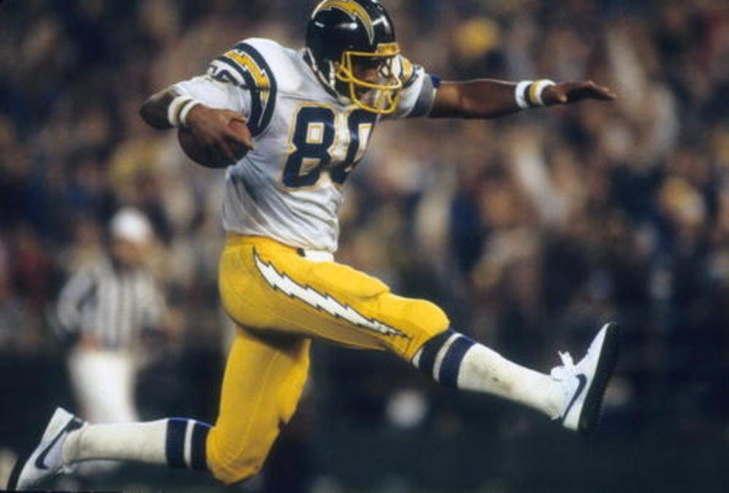
The San Diego Chargers utilized their first-round pick (13th overall) in the 1979 NFL Draft to select Kellen Winslow, a towering tight end out of the University of Missouri. A severe knee injury limited the rookie to just seven games in his debut campaign, but once healthy, he exploded onto the national scene. Over the next four seasons, Winslow redefined the tight end position entirely, establishing himself as the indisputable gold standard of pass-catching threats across the National Football League.
From 1980 through 1983, Winslow embarked on an unprecedented run of dominance, earning four consecutive Pro Bowl honors and three straight First-Team AP All-Pro selections (1980–1982). He crossed the 1,000-yard receiving mark in three of those four campaigns, and undoubtedly would have cleared it in all four had the 1982 strike not shortened the regular season to nine games. Decades ahead of his era, Winslow set a single-season tight end receiving record with 1,290 yards in 1980—a benchmark that stood for 31 years until Rob Gronkowski surpassed it in 2011.
Head coach Don Coryell deployed Winslow as the ultimate weapon in his "Air Coryell" passing scheme, routinely lining him up in motion, in the slot, or wide on the boundary to create brutal schematic mismatches for opposing linebackers and safeties. That offensive wizardry peaked in January 1982 during the legendary "Epic in Miami" playoff clash against the Dolphins. Winslow delivered one of the most heroic postseason performances in NFL history, hauling in 13 passes for 166 yards and a touchdown, while also blocking a potential game-winning field goal at the end of regulation to send the game into overtime despite suffering from severe exhaustion and dehydration.
Devastating knee injuries began to take a heavy toll in 1984, severely limiting his availability over his final few campaigns. Nevertheless, Winslow persevered to earn a fifth and final Pro Bowl selection in 1987 before lingering knee complications ultimately forced him to retire. A two-time NFL receptions leader (1980, 1981), he concluded his playing days with 6,741 receiving yards and 45 touchdowns—phenomenal cumulative stats for a tight end in his era.
The Chargers inducted Winslow into their Hall of Fame in 1989 for his impact, and he was enshrined in the Pro Football Hall of Fame in 1995. His influence also earned him spots on the NFL 1980s All-Decade Team, the NFL 75th and 100th Anniversary All-Time Teams.
Over his career, Winslow had 541 receptions for 6,741 receiving yards and 45 receiving touchdowns.
7. Ron Mix
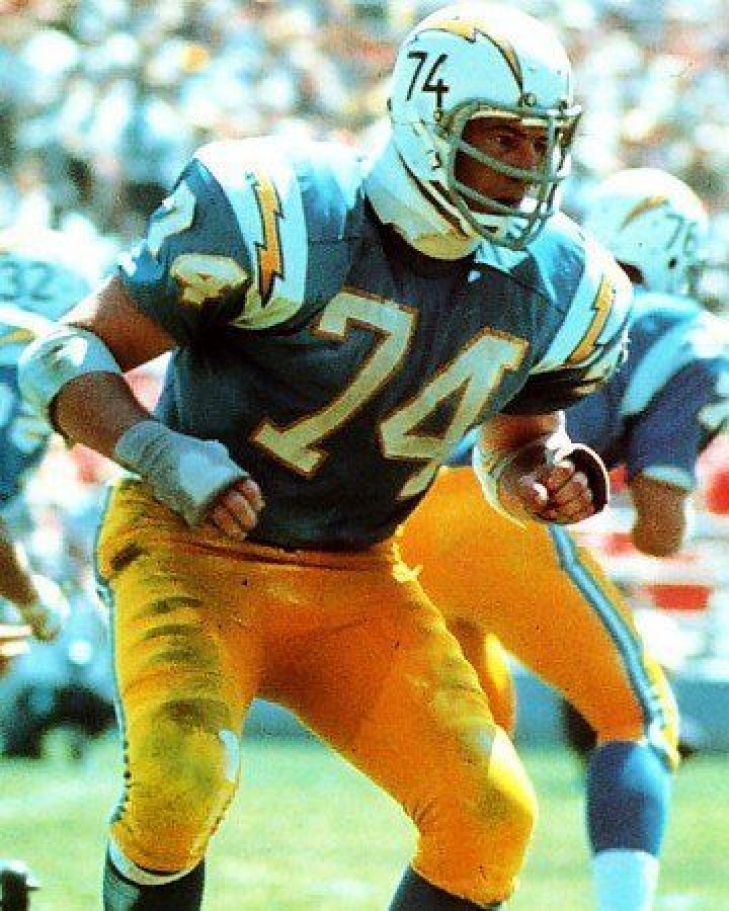
After a stellar collegiate career at USC, Ron Mix was an obvious first-round talent in the 1960 professional drafts. The NFL's Baltimore Colts selected the Los Angeles native tenth overall, but Mix preferred to remain on the West Coast close to home. Though the Boston Patriots originally held his AFL rights, a trade sent him to the newly formed Los Angeles Chargers, instantly establishing him as the cornerstone of the franchise's offensive line.
The move proved transformative for both player and franchise, as Mix built a case as the greatest offensive lineman in American Football League history. Primarily lining up at right tackle, Mix was named a First-Team All-AFL selection in each of his first nine professional seasons (1960–1968) and earned eight AFL All-Star nods. Renowned for his technique, mobility, and leverage, Mix protected his quarterbacks and opened running lanes with unmatched discipline—famously being penalized for holding only twice across his decade in San Diego.
Mix’s impact extended beyond his elite play on the field into the broader cultural landscape of the era. Prior to the 1965 AFL All-Star Game scheduled for New Orleans, he became the first white player to join Black teammates in a boycott of the host city, standing in firm solidarity against civil rights abuses, systemic discrimination, and segregation. His principled leadership helped force the AFL to relocate the game to Houston, marking a landmark moment in professional sports history.
After struggling through an injury-plagued 1969 campaign—his only subpar year in a Chargers uniform—Mix initially announced his retirement from football. He subsequently returned for one final professional season in 1971 with the rival Oakland Raiders, bringing his decorated 11-year playing career to a close after appearing in 12 games for Oakland.
Recognized as a top blocking force of his generation, Mix was named to the AFL All-Time Team and inducted into the Chargers Hall of Fame in 1978. In 1979, he reached gridiron immortality by being enshrined in the Pro Football Hall of Fame in Canton, becoming the second player mainly linked to the AFL to be inducted.
24. Fred Dean
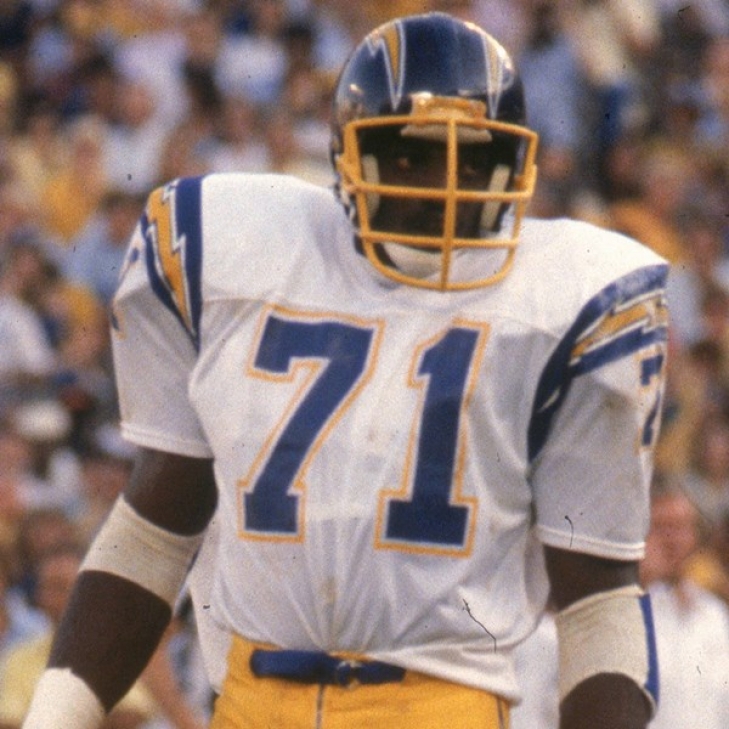
Fred Dean arrived in San Diego as a second-round pick out of Louisiana Tech in 1975 and stepped right into the starting lineup at defensive end. At roughly 6-foot-3 and 230 pounds, he was light for the position by NFL standards, yet that never slowed him down. His explosive first step, long arms, and ability to dip under bigger tackles or club them out of the way made him a nightmare on the edge. As a rookie, he already looked the part, recording seven sacks and a career-high 93 tackles while showing the kind of pass-rush juice that would define his career.
His best years came in the late 1970s and into 1980. In 1978, he put up 15.5 unofficial sacks as the team found its footing under Don Coryell. The next season he added nine more and earned his first Pro Bowl nod while the Chargers won the AFC West and allowed the fewest points in the conference. Then in 1980, even after missing the first two games because of a holdout, he still finished with 10.5 sacks, made First-Team All-Pro, and returned to the Pro Bowl. Lined up alongside Gary “Big Hands” Johnson, Louie Kelcher, and Leroy Jones, the front four earned the nickname the Bruise Brothers and helped the defense lead the entire NFL with 60 sacks. Quarterbacks felt him coming; his combination of speed and leverage let him win even when teams tried to double him.
The 1981 season began with continued contract tension. Dean played only a handful of games for the Chargers before becoming disgruntled with his pay relative to his production and other defensive linemen. Early in the season (October 2), San Diego traded him to the San Francisco 49ers. While some contemporary accounts had highlighted his earlier pass-rushing excellence as AFC Defensive Player of the Year-level production, his full 1981 campaign and major individual honors came after the trade.
In 2008, Dean was inducted into both the Pro Football Hall of Fame and the Chargers Hall of Fame, a dual recognition for the undersized edge rusher who had spent the Air Coryell years making life miserable for opposing quarterbacks before the trade sent him north.
1. Junior Seau
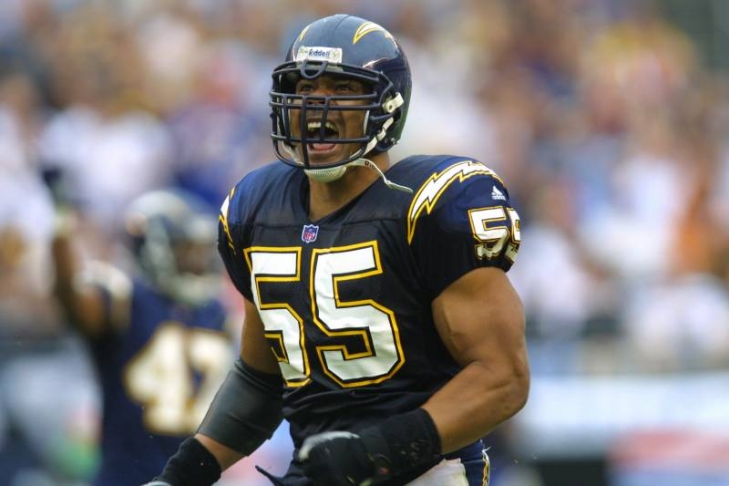
Born and raised in nearby Oceanside before starring at USC, Tiaina Baul "Junior" Seau Jr. did not just sign with the San Diego Chargers as the fifth overall pick in the 1990 NFL Draft—he inherited a kingdom that already claimed him as its own. When the local franchise turned in his card, it forged a bond between a native son and a region that would redefine Chargers football culture for more than a decade.
Seau wasted no time establishing his presence on the field, stepping into the starting lineup as a rookie and showcasing a kinetic style of play that earned him the moniker "The Tasmanian Devil." Blessed with rare closing speed, sideline-to-sideline range, and uncannily accurate pre-snap instincts, Seau played middle linebacker with an infectious, uncontrolled intensity. He did not merely diagnose plays; he shot gaps, blew up blocking schemes, and met ball-carriers in the backfield before development could even begin.
By his second season in 1991, Seau earned his first Pro Bowl selection, beginning one of the most dominant individual runs in NFL history. He became the unquestioned emotional heartbeat and physical engine of the Chargers defense, leading San Diego to a division title in 1992 and earning NFL Defensive Player of the Year honors from the Newspaper Enterprise Association (NEA). His passionate leadership transformed the locker room culture, instilling a fierce defensive identity that defined the franchise throughout the decade.
The high-water mark of Seau's team success arrived during the magical 1994 campaign. Serving as the primary captain and leader of a gritty Chargers squad, Seau delivered an iconic postseason performance in the AFC Championship Game against the Pittsburgh Steelers. Playing through a severe pinched nerve in his neck, Seau recorded a staggering 16 tackles, single-handedly keying a goal-line stand and pulling off a dramatic 17–13 upset to propel San Diego to Super Bowl XXIX—the first and only Super Bowl appearance in franchise history.
Seau’s individual accolades during his time in San Diego place him among the elite linebackers ever to play the game. From 1991 through 2002, he was selected to 12 consecutive Pro Bowls in a Chargers uniform. He earned First-Team AP All-Pro honors six times (1992–1996, 1998) and Second-Team honors twice more, firmly establishing himself as the premier linebacking force of his era alongside contemporaries like Mike Singletary and Ray Lewis.
Off the field, Seau was equally revered in San Diego for his philanthropy and civic engagement. Through the Junior Seau Foundation, established in 1992, he raised millions of dollars to support child abuse prevention, drug and alcohol awareness, and educational programs for underprivileged youth across Southern California. His selfless community work earned him the prestigious Walter Payton NFL Man of the Year Award in 1994, cementing his status as a beloved civic icon.
After 13 glorious seasons in San Diego, the Chargers traded Seau to the Miami Dolphins in 2003, where he spent three seasons before closing his storied 20-year NFL career with four years as a respected veteran leader for the New England Patriots. Across his two decades in the league, Seau appeared in 268 regular-season games (243 starts), making two Super Bowl appearances and earning a spot on the NFL 1990s All-Decade Team.
Tragedy struck the football world in May 2012 when Seau died by suicide at age 43. Subsequent brain tissue studies revealed he suffered from Chronic Traumatic Encephalopathy (CTE), a degenerative brain disease linked to repetitive head impacts. His tragic death sparked nationwide conversations regarding player safety and long-term neurological health, while his family and foundation continued advocating for head trauma research in his memory.
The Chargers inducted Seau into their Hall of Fame in 2011 and retired his No. 55 jersey in 2012 after his passing. He was posthumously enshrined in the Pro Football Hall of Fame in 2015 and named to the NFL 100th Anniversary All-Time Team in 2019.
With the Chargers, Seau compiled 1,480 combined tackles (1,185 solo, 293 assists), 47.0 sacks, 15 interceptions, 14 forced fumbles, and 11 fumble recoveries.
9. Walt Sweeney

The San Diego Chargers struck gold in the first round of the 1963 AFL Draft (second overall) when they selected Syracuse standout offensive lineman Walt Sweeney. A towering, imposing figure at 6-foot-4, Sweeney was a self-professed hard drinker off the gridiron and universally recognized by opponents as a hard-hitting enforcer on it. Stepping into a championship environment as a rookie, he secured an AFL Championship ring in 1963 before settling into the starting right guard spot, quickly evolving into one of the most feared interior line blockers of his era.
Sweeney quickly established total dominance along the line of scrimmage, embarking on an incredible streak of six consecutive AFL All-Star selections from 1964 through 1969. Operating with raw physical power and a nasty, relentless edge, he earned First-Team All-AFL honors in back-to-back seasons (1967 and 1968), opening up massive running lanes for San Diego’s backfield while providing stellar interior pass protection for quarterback John Hadl.
After the 1970 AFL-NFL merger, when the leagues consolidated, Sweeney proved his elite standing wasn’t bound to a single league. He earned three consecutive NFL Pro Bowl selections from 1970 to 1972, bringing his grand total to nine straight all-star selections across both leagues. His extraordinary iron-man durability became legendary in Southern California, as he started 140 consecutive regular-season games for the Chargers between 1964 and 1973.
After 11 seasons anchoring San Diego’s interior line, Sweeney joined the Washington Redskins in 1974 for two final professional seasons, starting another 27 consecutive games in the nation's capital before retiring. Beyond his stellar play on the field, Sweeney later became widely known for his groundbreaking, courageous legal battle against the NFL, filing a high-profile lawsuit regarding the league's prescription practices that contributed to his severe addiction to pain medication and drugs during his playing days.
The Chargers honored his legacy by inducting him into the Hall of Fame in 1981. Sweeney was also named to the 50th Anniversary Team and as a second-team guard on the All-Time AFL Team, cementing his status among top interior blockers.
12. Keenan Allen
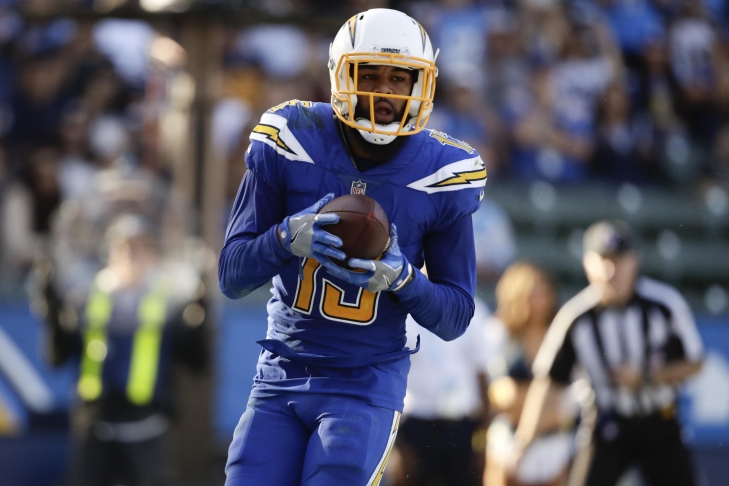
When the San Diego Chargers selected Keenan Allen in the third round (76th overall) of the 2013 NFL Draft out of Cal, few predicted how quickly the smooth route-running specialist would seize control of the team's aerial attack. Stepping into a prime role as a rookie, Allen erupted for 71 receptions, 1,046 yards, and eight touchdowns, earning PFWA All-Rookie Team honors and instantly becoming Philip Rivers’ most trusted target.
Despite that electric start, Allen soon ran into a brutal string of bad luck. After a quieter sophomore year, he was on pace for a career season in 2015, logging 67 catches through eight games before a severe kidney injury cut his campaign short. Misfortune struck again in the 2016 opener when he suffered a season-ending torn ACL, raising questions about his long-term durability.
Allen answered those doubts with a triumphant performance in 2017—the franchise's inaugural year in Los Angeles. He played all 16 games, catching 102 passes for 1,393 yards and six touchdowns to sweep AP and PFWA Comeback Player of the Year honors and earn his first Pro Bowl selection. That launched a dominant five-year Pro Bowl streak through 2021. In 2023, he set a single-season Chargers record with 108 receptions for 1,243 yards, earning his sixth Pro Bowl nod.
Contract negotiations led to a trade to the Chicago Bears for the 2024 season, where Allen posted 70 catches for 744 yards and seven touchdowns. But the separation from Southern California didn't last long. In August 2025, Allen returned home to the Chargers on a one-year deal. His reunion season proved historical: in Week 5 against Washington he became the fastest player in NFL history to reach 1,000 career receptions (159 games), and in Week 10 against Pittsburgh he officially passed Antonio Gates as the Chargers' all-time career receptions leader. He finished his 2025 homecoming season with 81 catches for 777 yards and four touchdowns. He joined the Indianapolis Colts for the 2026 season.
With the Bolts, Allen caught 985 passes for 11,307 yards and 63 touchdowns.
#49 Overall, Keenan Allen, Indianapolis Colts, #8 Wide Receiver
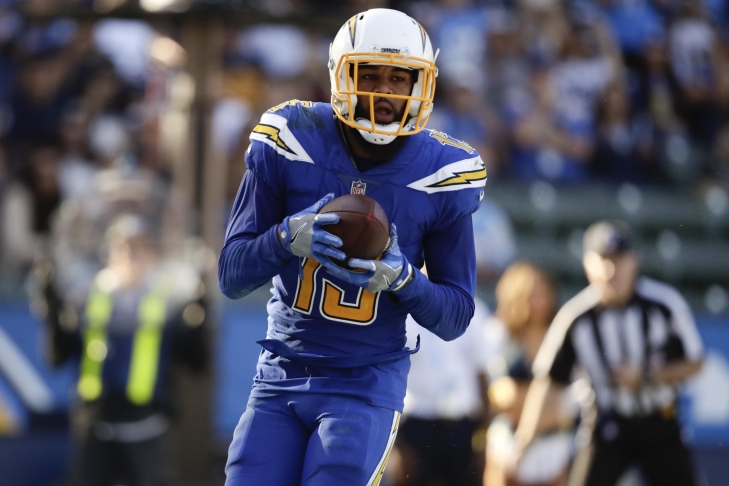
2025 Pre-Season Rank #46, 2024 Pre-Season Rank #41, 2023 Pre-Season Rank #45, 2022 Pre-Season Rank #48, 2021 Pre-Season Rank #66, 2020 Pre-Season Rank #82. Peak Period: 2017-21
We have said for years that Keenan Allen’s path to Canton would have to be through longevity and compiling as many yards and touchdowns as possible. While he is a six-time Pro Bowl selection and the Chargers’ WR1 for years, he wasn't the enigmatic, dynamic force that took your breath away.
What he is, however, is a consistent producer who passed 12,000 yards and reached 70 touchdowns last season, but how many times have we said how high the bar is for Wide Receivers? Time is running out for Allen, but if he can remain on the field for a few more years, it is not impossible, and this year, he will see what he can do to help his third franchise, the Indianapolis Colts.
He should receive some type of post-career acknowledgment from the Chargers when all is said and done.
#13 Overall, Khalil Mack: Los Angeles Chargers, #5 Defensive Lineman/Linebacker: Pass Rusher
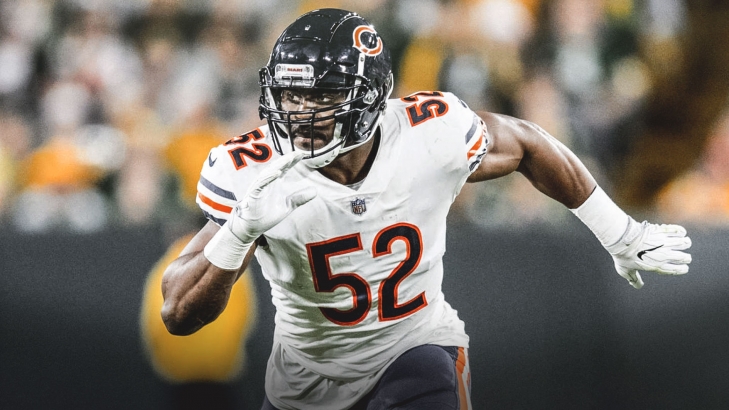
2025 Pre-Season Rank #8, 2024 Pre-Season Rank #12, 2023 Pre-Season Rank #14, 2022 Pre-Season Rank #19, 2021 Pre-Season Rank #26, 2020 Pre-Season Rank #29. Peak Period: 2015-19.
Oakland. Chicago. Los Angeles.
Everywhere Khalil Mack goes, Khalil Mack dominates.
The Outside Linebacker made history last season as the first player to secure three Pro Bowls on three different teams, when he added Pro Bowl number nine in year three with the Chargers. The celebrated pass-rusher has 113 career Sacks, a Defensive Player of the Year Award (2016 with the Raiders), the longevity, the consistency, and the dominance that the PFHOF would want.
He may not dominate the defensive headlines like he used to, but Mack remains the “Mack.”
