

Tyler Clippard

Tyler Clippard was a decent Relief Pitcher over 16 years, though like many bullpen specialists, he played for multiple organizations.
Clippard began (and ended) his career with the Washington Nationals, and in his first run in D.C., he was twice an All-Star (2011 & 2014) and had a 32-Save campaign in 2012. That first run with the Nationals was his peak, but he would later play for Oakland, New York (NL), Arizona, New York (AL), Chicago (AL), Houston, Toronto, Cleveland, Minnesota, and a second stint with Arizona and Washington.
Overall, Clippard appeared in 807 Games, had a record of 56 and 48 with 74 Saves.
Steven Strasburg
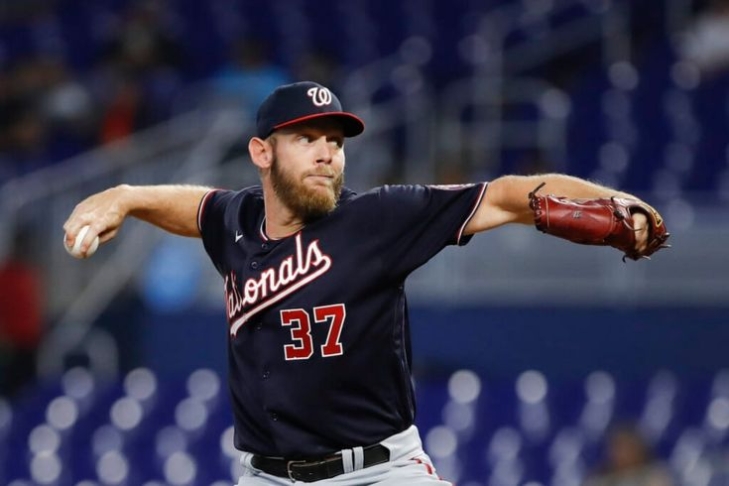
Stephen Strasburg had an intriguing career that set the precedent for managing pitcher's arms in the modern era. He was the First Overall Pick in 2009 and debuted for the Nationals the following year, in what was arguably the most highly anticipated pitching debut by an American player. However, he only appeared in 17 games in his first two years as he underwent Tommy John Surgery. Despite this, he was effective in his limited work and showed what he was capable of.
In 2012, the Nationals made it known that they would be monitoring Strasburg’s innings. He went on to be an All-Star that year, going 15-6 with 197 strikeouts. It could have been a lot more, but Washington shut him down on September 12, including the playoffs, where the Nats were eliminated in the Divisional Round. Strasburg had a decent 2013 (8-9, 191 SO, 3.00 ERA) and 2014, he was ninth in Cy Young voting and led the National League in strikeouts with 242.
Strasburg continued to show why he was worth the investment, and he was an All-Star again in 2016 and 2017, with the latter being the better season. He led the NL in FIP (2.72), had a career-low ERA (2.52), and was third in Cy Young voting. After another solid season, Strasburg went 18-6, fanned 251 batters, and was fifth in Cy Young balloting. Even better, Strasburg led the Nationals to their first World Series win, going 5-0 in the playoffs, including two wins in the Fall Classic, where he was named the World Series MVP. He signed what was then the largest contract for a pitcher (7 years/$245 million), but disaster was about to strike.
Strasburg succumbed to a nerve issue in his pitching hand that held him to only three batters in 2020. Diagnosed with thoracic outlet syndrome, Strasburg managed only 21.2 innings in 2021. It was even worse for Strasburg, who had to be shut down after one game, and he never pitched again.
As promising as his talents were, Strasburg was a hell of a talent when he was healthy, but sometimes it is not meant to be.
Ryan Zimmerman
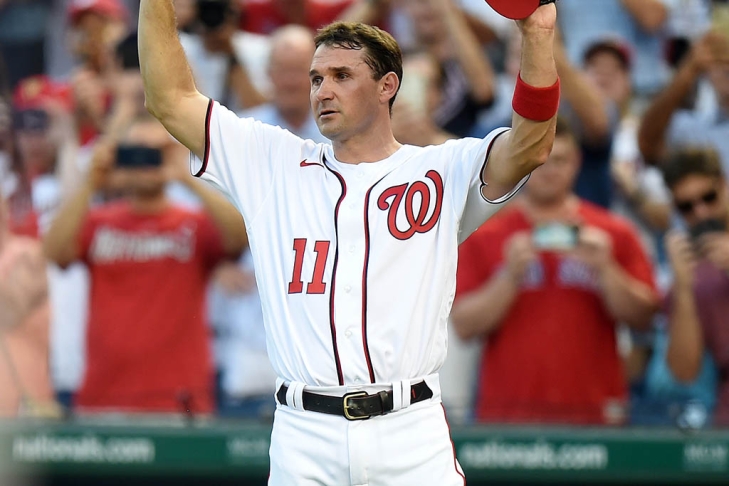
Ryan Zimmerman has been a constant player for the Washington Nationals in Major League Baseball for the past sixteen years. He has been a valuable asset to the team, providing power and a solid batting average. While he may not be considered an elite player, he has performed better than the average Major League Baseball player. He has earned two Silver Sluggers, one Gold Glove, and made two All-Star Game appearances.
Zimmerman was a member of the Washington Nationals team that won the 2019 World Series Championship. He currently holds the record for the most games played (1,799), runs scored (964), hits (1,846), doubles (417), home runs (284), and RBIs (1,061) in the franchise's history.
Although he may not be inducted into the Baseball Hall of Fame, the Nationals should honor him in some way for his contributions to the team.
Jordan Zimmerman
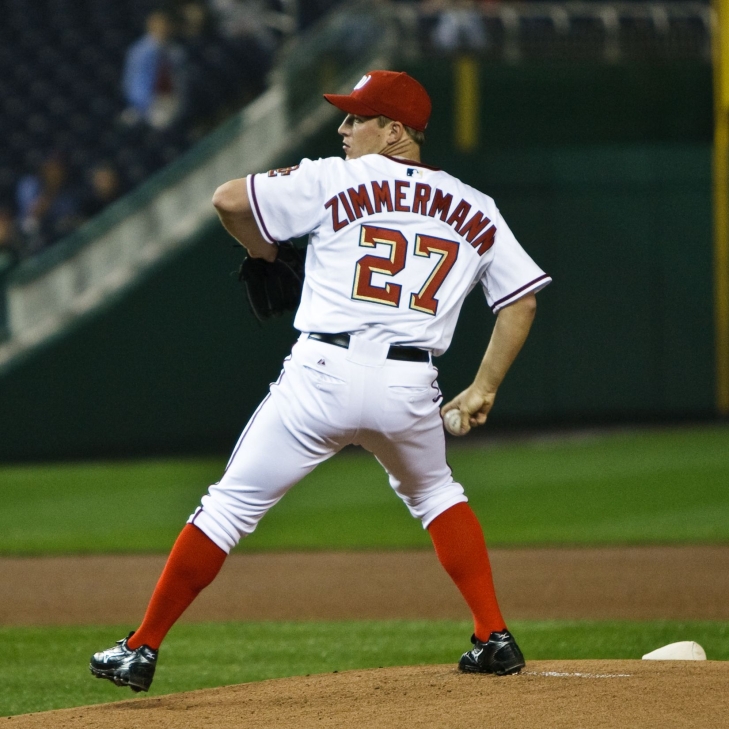
Jordan Zimmerman first made it to the majors in 2009 as the fifth starter in the bullpen of the Washington Nationals. However, his debut was short-lived as he underwent Tommy John Surgery after 16 starts and was unable to return until late 2010.
In 2011, Zimmerman was healthy and used his three-pitch arsenal to record a 3.18 ERA, but his record was losing (8-11). The following season, he improved his performance (12-8, 2.94 ERA), but it was in the next two seasons that he became one of the best players in the National League.
Zimmerman was an All-Star in both 2013 and 2014, leading the National League in Wins (19) in 2013, and BB/9 in 2014 (1.3). He finished seventh and fifth, respectively, for the Cy Young award.
After a decent 2015, Zimmerman signed with the Detroit Tigers. However, his performance deteriorated, and he had a 5.63 ERA over 99 games in Detroit. He attempted a comeback with Milwaukee in 2021, but he retired after only two games.
Although Zimmerman's career was not long, and he had less than 100 wins, he is currently in the top one hundred all-time in BB/9 (1.9) and SO/BB (3.67). Zimmerman will not make it to the Hall of Fame, but we appreciate pitchers who rarely allow free passes, especially in an era where walks are celebrated.
Our All-Time Top 50 Washington Nationals have been revised to reflect the 2023 Season
Yes, we know that this is taking a while!
As many of you know, we at Notinhalloffame.com are slowly generating the top 50 of each major North American sports team. That being said, we have existing Top 50 lists, and we always consistently look to update them when we can and based on necessity. As such, we are very happy to present our post-2023 revision of our top 50 Washington Nationals.
As for all of our top 50 players in baseball, we look at the following:
1. Advanced Statistics.
2. Traditional statistics and how they finished in Major League Baseball.
3. Playoff accomplishments.
4. Their overall impact on the team and other intangibles that are not reflected in a stat sheet.
Last year, the Nationals had another awful season and were not close to the playoffs. The poor year did not generate any changes in the Top 50, but as always, we acknowledge that we considered the 2023 Season.
As always, we present our top five, which (obviously) saw no changes:
1. Gary Carter
2. Tim Raines
3. Max Scherzer
4. Andre Dawson
5. Steve Rogers
You can find the entire list here.
We thank you for your continued support of our lists on Notinhalloffame.com.
Our All-Time Top 50 Washington Nationals have been updated to reflect the 2022 Season
Yes, we know that this is taking a while!
As many of you know, we here at Notinhalloffame.com are slowly generating the 50 of each major North American sports team. That being said, we have existing Top 50 lists out and we always consistently look to update them when we can and based on necessity. As such, we are very happy to present our post 2022 revision of our top Washington Nationals.
As for all of our top 50 players in baseball we look at the following:
1. Advanced Statistics.
2. Traditional statistics and how they finished in the National League.
3. Playoff accomplishments.
4. Their overall impact on the team and other intangibles not reflected in a stat sheet.
Last year, Washington was one of the worst teams in baseball, and the only player they had they improved his rank, was traded during the season.
As always, we present our top five, which was not affected by the last season:
1. Gary Carter
2. Tim Raines
3. Max Scherzer
4. Andre Dawson
5. Steve Rogers
You can find the entire list here.
Outfielder, Juan Soto, who was traded to San Diego during the season, moved to #14 from #17.
We welcome your input and comments and as always, we thank you for your support.
Gio Gonzalez
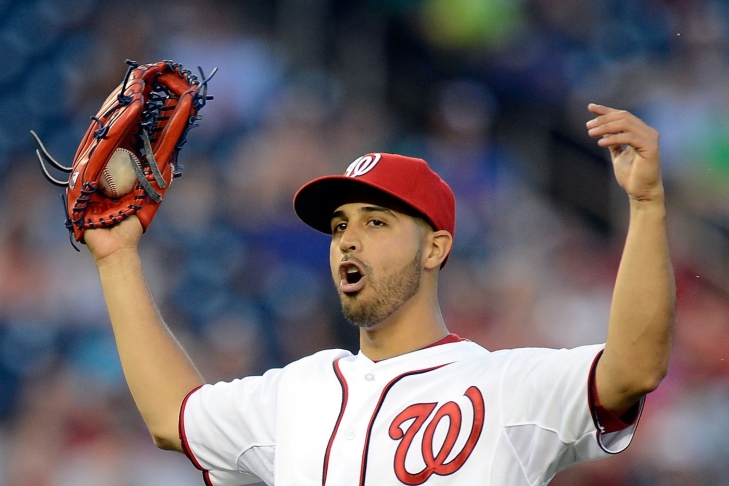
Despite being a First Round Pick, Gio Gonzalez was traded three times before he made his Major League debut, which was with Oakland in 2008. Gonzalez's first two years were nothing special, but he broke out in 2010, going 15-9 with a 3.23 ERA, and he was better in 2011, going to the All-Star Game and finishing the year at 16-12 with a 3.12 ERA. As typical with the A's, Gonzalez was traded away, as Oakland knew they could not afford him in the future. The Washington Nationals would become their long-term home for Gonzalez.
In Gonzalez's first year in the National League, he had the best year of his career, leading the league in Wins (21), adding a second All-Star Game, while also finishing first in FIP (2.82) and SO/9 (9.3) and fanning 203 batters. Gonzalez was third in Cy Young voting, but this would be his highwater mark, not a building block. Over the next five years, Gonzalez mainly was a middle-of-the-road starter, though he was sixth in Cy Young voting in 2017 when he was 15-9 and had a 2.96 ERA.
Gonzalez was traded to Milwaukee during the 2018 Season, but he declined the following year and battled with injuries. After a year with the White Sox and an attempted comeback with Miami in 2021, his career ended with a decent record of 131-101 and 1,860 Strikeouts.
Ryan Zimmerman Retires
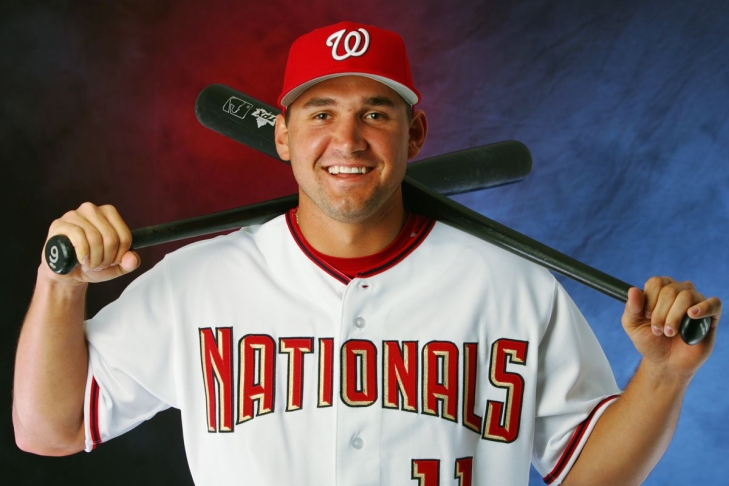
As was expected, one of the all-time Washington Nationals greats, Ryan Zimmerman, announced today that he is retiring from Baseball.
Drafted in the First Round in 2005, Zimmerman made the big leagues that year, and remained with the Nationals for all of his sixteen seasons.
An All-Star in 2009 and 2017, Zimmerman was a solid power hitter, who had seven 20-Home Run years with a pair of Silver Sluggers (2009 & 2010). Batting .277 lifetime for Washington, Zimmerman was a veteran presence on the 2019 team that won the World Series, the first for the organization.
Zimmerman was a member of the Washington Nationals 2019 World Series Championship Team, and is at present the all-time franchise leader in Games Played (1,799), Runs Scored (964), Hits (1,846), Doubles (417), Home Runs (284) and RBIs (1,061).
Zimmerman is Hall of Fame eligible in 2027, though is unlikely to make it past the first ballot, though he is a prime candidate to be honored by the Nationals in the future.
We here at Notinhalloffame.com would like to wish Ryan Zimmerman the best in his post-playing career.
Our All-Time Top 50 Washington Nationals have been updated to reflect the 2021 Season
Yes, we know that this is taking a while!
As many of you know, we here at Notinhalloffame.com are slowly generating the 50 of each major North American sports team. That being said, we have existing Top 50 lists out and we always consistently look to update them when we can and based on necessity. As such, we are very happy to present our pre-2022 revision of our top 50 Washington Nationals.
As for all of our top 50 players in hockey we look at the following:
1. Advanced Statistics.
2. Traditional statistics and how they finished in the National League.
3. Playoff accomplishments.
4. Their overall impact on the team and other intangibles not reflected in a stat sheet.
Please note, that this is our first revision, reflective of the last year.
The Nationals went into full rebuilding mode, trading many of their stars during the season. There were no new entries, but were some rank elevations.
As always, we present the top five immediately, which has no changes.
1. Gary Carter
2. Tim Raines
3. Max Scherzer
4. Andre Dawson
5. Steve Rogers
You can find the entire list here.
Scherzer almost supplanted Raines at #2, and he completed the season with the Nationals, he likely would have.
Ryan Zimmerman moves up from #9 to #6. This could be the end of the climb for Zimmerman, as it is speculated that he might soon retire.
Infielder, Trea Turner, was traded to the Los Angeles Dodgers during the season. Despite, not playing all of the year with Washington, he was fantastic this year, and moves up to #14 from #22.
Juan Soto, who was this year’s National League MVP runner-up, rockets up to #17 from #36.
We welcome your input and comments and as always, we thank you for your support.
14. Juan Soto
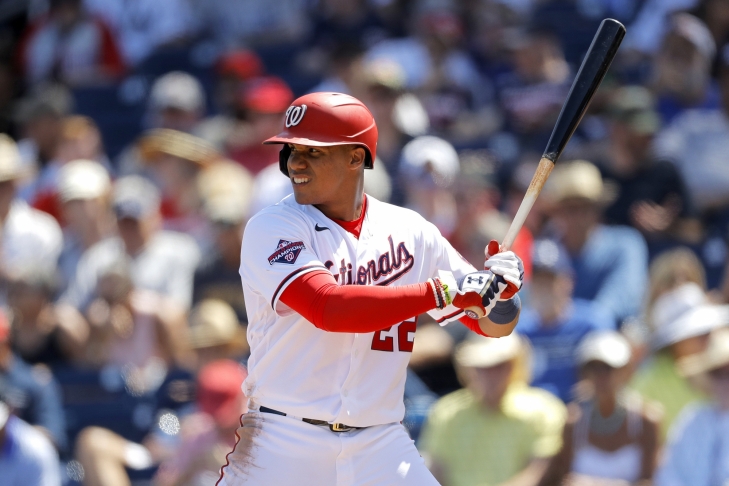
Juan Soto made his debut for the Washington Nationals in May 2018 at just 19, quickly making an impact that reshaped major league history. Known for his exceptional plate discipline—often compared to Ted Williams—he skipped typical rookie development stages. With his distinctive 'Soto Shuffle’ and remarkable left-handed swing, he rapidly became the team’s offensive star during a pivotal moment.
Soto's debut 2018 campaign demonstrated exceptional rookie efficiency. In just 116 games, he dominated National League pitching by hitting 22 home runs and drawing 79 walks, finishing narrowly second for the NL Rookie of the Year Award. He built on that success in 2019, hitting 34 home runs and driving in 110 RBIs while sustaining an impressive .949 OPS, solidifying his role at the heart of Washington's batting lineup.
That sophomore showcase set the stage perfectly for a memorable October run that made stars. As Washington navigated a challenging postseason, Soto made the 2019 playoffs his own arena. During the World Series against the Houston Astros, which coincided with his 21st birthday, he tore apart top-tier pitching to hit .333, with three significant home runs and a 1.178 OPS. His crucial, high-pressure hits helped lead the team to a seventh game, securing Washington's first-ever world title and earning him the Babe Ruth Award as co-MVP of the postseason, shared with Stephen Strasburg.
Rather than suffering a championship hangover, Soto achieved his peak individual performance in the abbreviated 2020 season. At only 21, he posted an impressive .351 batting average, making him the youngest player in Senior Circuit history to win the National League batting title. He also topped the league with a.490 on-base percentage and a .695 slugging percentage, demonstrating an unbeatable offensive strategy. In 2021, he continued his excellence by drawing 145 walks—leading all of baseball.—while hitting .313 with 29 home runs, His outstanding season earned him an All-Star selection, a Silver Slugger award, and a close second-place finish in the NL MVP voting.
As the franchise shifted its focus to a major roster overhaul and the star player refused a record contract extension, the front office executed a transformative trade in August 2022, sending the young superstar to the San Diego Padres. Soto later starred on multi-million dollar stages across Southern California, the Bronx, and Queens, ultimately securing a historic $765 million contract with the New York Mets.
With Washington, Soto accrued 569 hits, 108 doubles, 119 home runs, and 358 RBIs. He also generated a magnificent .291/.406/.538 slash line—good for an elite 160 OPS+.
Our All-Time Top 50 Washington Nationals have been revised
Yes, we know that this is taking a while!
As many of you know, we here at Notinhalloffame.com are slowly generating the 50 of each major North American sports team. That being said, we have existing Top 50 lists out and we always consistently look to update them when we can and based on necessity. As such, we are very happy to present the fourth revision of our top 50 Washington Nationals of all-time.
As for all of our top 50 players in baseball we look at the following:
1. Advanced Statistics.
2. Traditional statistics and how they finished in the National League.
3. Playoff accomplishments.
4. Their overall impact on the team and other intangibles not reflected in a stat sheet.
Please note that this is the latest update since the end of the 2018 season, and needless to say, the first since the Nationals won the 2019 World Series.
Remember, this is ONLY based on what a player does on that particular team and not what he accomplished elsewhere and also note that we have placed an increased importance on the first two categories, which has altered the rankings considerably.
This list is updated up until the end of the 2018-19 Season.
The complete list can be found here, but as always we announce our top five in this article. They are:
1. Gary Carter
2. Tim Raines
3. Max Scherzer
4. Andre Dawson
5. Steve Rogers
A significant change has taken place in the top five, as Max Scherzer has rocketed up from #9 to #3. While this may seem incredibly high for a player who has only been with the team for five seasons, it also reflects how we look at how a player performs in individual seasons equally to their overall tenure. Scherzer has won two Cy Youngs, with the other three years also seeing him finish in the top five in voting. If this isn’t the best half-decade in franchise history, then what is?
There were other significant ranking changes based on 2019.
Stephen Strasburg, the 2019 World Series MVP moves from #11 to #6. Anthony Rendon, who was third in MVP voting rocketed from #22 to #12. He left the Nationals to join the Angels in the off-season. There is a debut in Trea Turner, who makes his first appearance at #35.
As always, we thank you for your support.
15. Trea Turner
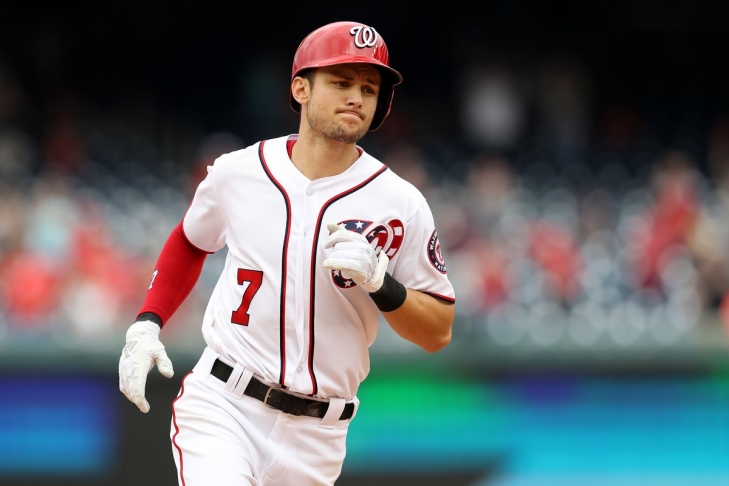
Trea Turner's departure from the Washington Nationals is still a topic that sparks a lot of discussion and change in the team's history. If the team hadn't decided to make big changes at the 2021 trade deadline, he probably would have been a key player for many years. Coming from North Carolina State, Turner was an incredible athlete with lightning-fast speed that kept the opposing team on their toes and made Washington’s batting lineup a real challenge.
His journey to Washington involved an unusual wait. Drafted in the first round of 2014 by San Diego, he was soon traded to the Nationals in a large three-team deal. He had to wait until June 2015 due to a technicality involving a "Player to be Named Later.’ After a brief 40-at-bat introduction in August, Turner delivered a remarkable rookie season in 2016. Ignoring traditional development paths, he hit .342 with 13 homers and 33 stolen bases in just 73 games, playing both second base and center field—finishing as a close runner-up to Corey Seager for NL Rookie of the Year.
Once permanently installed at his natural shortstop position, Turner became the ultimate elite table-setter. He weaponized his elite speed to swipe 46 bases in 2017, then commanded the entire National League in 2018 by leading the league in plate appearances (740), at-bats (664), and stolen bases (43). His relentless baseline chaos became a fundamental gear during the legendary 2019 World Series run; Turner hit a robust .298 and stole 35 bases, providing an indispensable spark at the top of the order that carried the Nationals directly to their historic first-ever World Series banner.
While the strike-shortened 2020 schedule forced a compressed calendar, Turner completely paralyzed Senior Circuit pitching by leading all of baseball with 78 hits, pacing the league with four triples, and finishing an impressive seventh in the NL MVP voting.
In the 2021 season, he reached a historic peak with his offensive performance. Turner compiled an impressive .322 batting average and 21 steals over 96 games, earning his first career All-Star selection after years of waiting. However, with free agency approaching and the team undergoing a full rebuild, the front office traded the star shortstop and ace pitcher Max Scherzer to the Los Angeles Dodgers in a blockbuster deal in July. Turner carried his hot streak to Southern California, securing the 2021 National League batting title with a.328 average and leading the league with 195 hits.
As a National, Turner had 769 hits, 128 doubles, 32 triples, 93 home runs, and 293 RBIs. He posted a .300/.356/486 slash line (121 OPS+) and stole 192 bases.
Our Top 50 All-Time Washington Nationals have been updated
As always, we here at Notinhalloffame.com continue to update our existing lists.
As we slowly put together our Top 50 all-time players for every major team we constantly continue to update our existing ones. For the second time, we are updating the first franchise 50 we ever posted, the Washington Nationals.
Since the last time we revised our Washington Nationals two things have changed.
The first is that since our last revision in two and a half years ago, we have relaxed the dependence on advanced statistic and put a higher reward on individual seasons. We think this allows for a more equitable balance on traditional and advanced metrics.
The second and of course obvious change is that two full seasons have passed. This list is now up until the end of the 2017 Season.
The entire list can be found here and we certainly encourage you to take a look at it and let us know your thoughts and opinions.
Prior to that we wanted to make you aware of a few major changes on the list since the last revision.
Max Scherzer debuts at #9. While his tenure with Washington has certainly been brief, three All Stars and two Cy Youngs already make him one of the most successful hurlers in Nationals history.
2014 Silver Slugger Anthony Rendon makes his first appearance at #22.
Other debuts on current Nationals are Daniel Murphy (#31) and Tanner Roarke (#35).
Other jumps in active Washington Nationals include Bryce Harper from #9 to #8, Steven Strasburg goes from #29 to #11 and Gio Gonzalez moves from #28 to #16.
Other debuts based on our revisions are Moises Alou (#38), Dan Schatzeder (#45) and Wilson Ramos (#47).
As you may have deduced, the entire list has been shuffled.
We will be unveiling the Top 50 All-Time Dallas Stars next.
45. Wilson Ramos
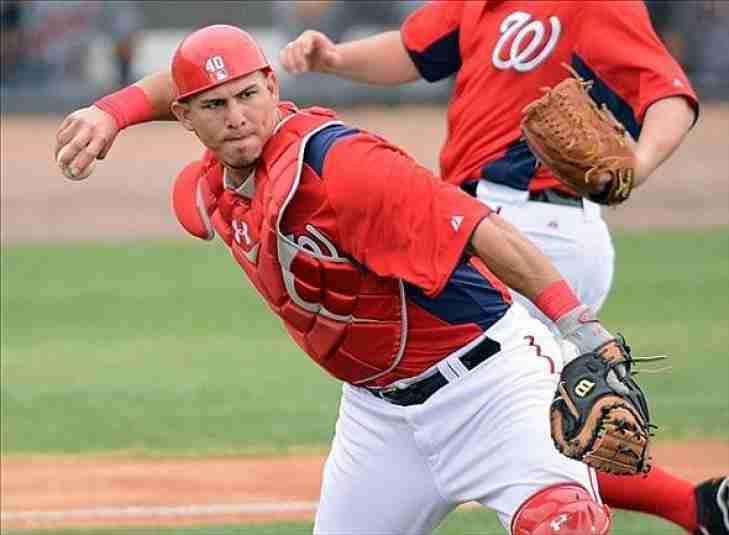
Catching is physically demanding, and Wilson Ramos's Washington experience was a true test of endurance. Acquired from the Minnesota Twins in a trade for Matt Capps in 2010, this Venezuelan catcher—nicknamed "The Buffalo" for his strong, muscular build—had some of the best raw power among catchers. However, during his seven years with the Nationals, his potential was often hindered by serious injuries, including knee injuries, hamstring tears, and hand fractures, which led to him being platooned and sidelined during key periods. But when he was healthy, Ramos was the undisputed physical anchor behind the plate for a perennial contender, culminating in one of the most spectacular individual walk-year performances in recent memory.
Before his significant breakout, Ramos showed flashes of strength, though inconsistently. In his first full season with Washington in 2011, he hit 15 home runs and added 16 more in only 78 games in 2013, demonstrating his potential for great offensive output when healthy. Defensively, he built an excellent connection with the Nationals' top pitchers, leveraging his sizable frame to block pitches and using a powerful arm to prevent opponents from scoring.
In 2016, everything finally aligned for Ramos. With a rebuilt lower half and a highly disciplined approach, he delivered an outstanding offensive performance, devastating National League pitchers. He became a key middle-of-the-lineup force for Washington, achieving a career-high .307 batting average and posting personal bests with 148 hits, 22 home runs, and 80 RBIs. He led all National League catchers in nearly every major offensive category. His exceptional season earned him his first All-Star selection, a Silver Slugger Award, and a seventeenth-place finish in NL MVP voting.
Tragically, the injury bug delivered another harsh blow. Just days before the 2016 postseason started, Ramos tore his ACL while jumping for a throw at the plate, ending his hopes for the season in pain and forcing him to watch Washington's playoff run from the dugout.
With free agency looming and Ramos facing another long rehab, the Nationals reluctantly let the veteran backstop walk that winter. While the injury prevented him from receiving the massive contract he had rightfully earned on the field, his legacy as one of the premier offensive catchers in franchise history was already secure.
With the Nationals, Ramos tabulated 558 hits, 82 doubles, 83 home runs, and 321 RBIs. While generating a strong .268/.313/.430 slash line.
39. Daniel Murphy
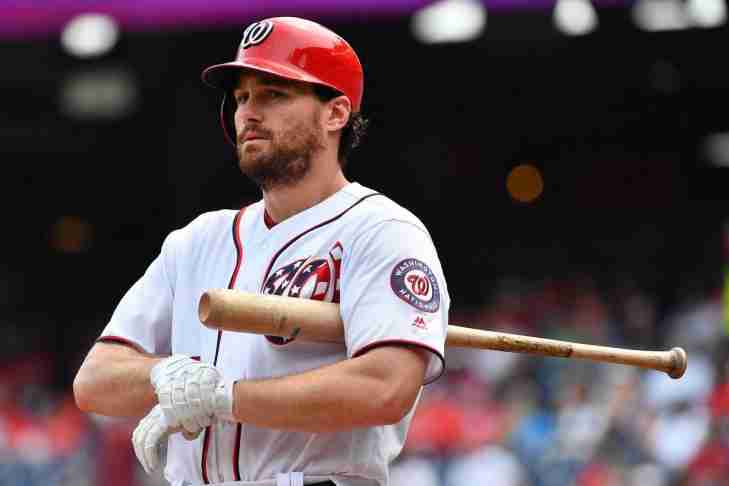
Some free-agent signings aim to develop the team for the future, while others serve as powerful accelerants. When the Washington Nationals signed Daniel Murphy to a three-year, $37.5 million deal in December 2015, they expected a seasoned hitter emerging from a remarkable postseason with the New York Mets. Instead, they experienced two and a half seasons of some of the most precise and efficient hitting ever seen in the nation's capital. From his first day in a Nationals uniform, Murphy established himself as a surgical offensive specialist, approaching the batter's box with the finesse of an artist.
Murphy's 2016 debut campaign in Washington was a showcase of exceptional offensive skill. Using a newly optimized, launch-angle-focused strategy that reduced wasted swings, he overwhelmed National League pitchers. He maintained a batting average around .350 well into summer, ultimately finishing with a remarkable .347 to win the National League hits title. That season, he hit a career-best 25 home runs, drove in 104 RBIs, and led the Major Leagues with a .595 slugging percentage and 47 doubles. His clutch hitting and offensive prowess earned him his first Silver Slugger Award and a narrow second place behind Kris Bryant in the NL MVP voting.
Instead of declining after his standout season, Murphy maintained his elite level in 2017. He posted a remarkable .322 batting average, hit 23 home runs, accumulated 43 doubles, and drove in 93 RBIs to defend his Silver Slugger award. He was named an All-Star in consecutive years while playing for the Nationals, acting as a formidable, high-contact hitter in the lineup that compelled pitchers to pitch to Bryce Harper and Ryan Zimmerman.
Eventually, the intense physical strain from his demanding swing took a toll on him. Murphy had microfracture knee surgery after the 2017 postseason, which postponed his 2018 debut and visibly affected his lateral movement. As Washington dropped out of the playoff race and Murphy neared free agency, the front office traded the veteran second baseman to the Chicago Cubs in August 2018.
In two years in D.C., Murphy had 427 hits, 97 doubles, 54 home runs, and 225 RBIs. With 103 walks and 137 strikeouts, he posted a .329/.380/543 line and a 139 OPS+.
43. Dan Schatzeder
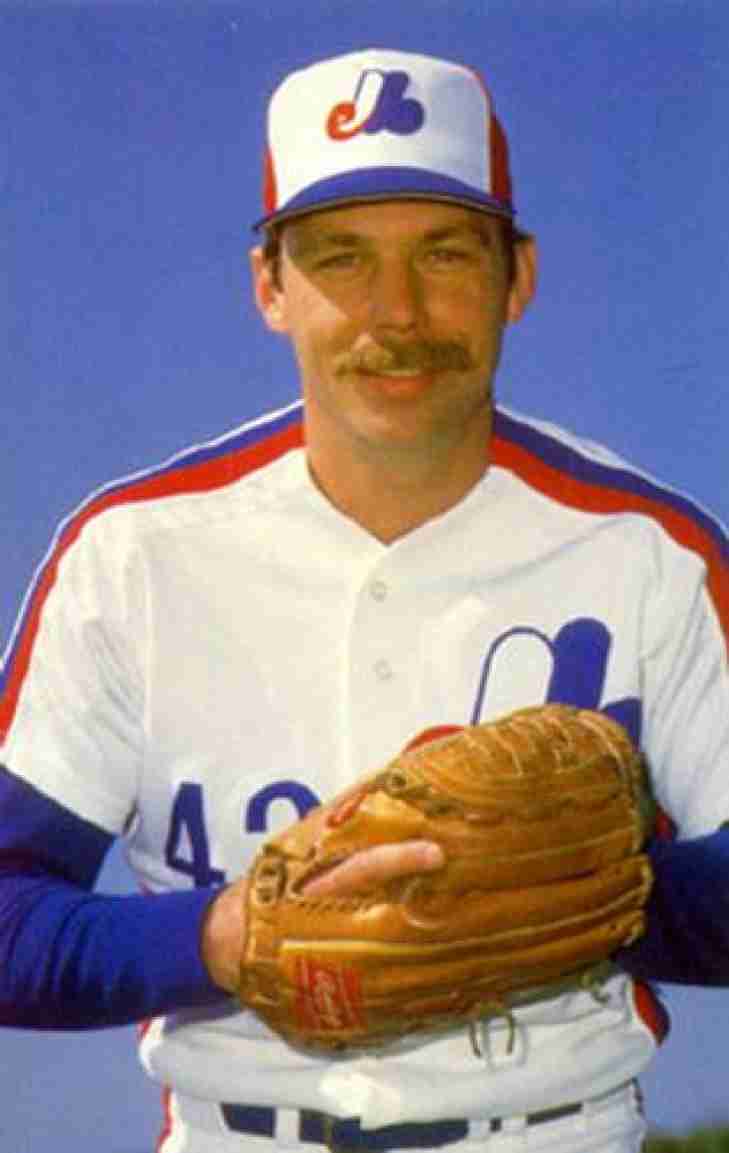
While star players and award-winning closers often make headlines, the true backbone of championships and competitive eras is built by versatile pitchers who fill every role on the staff. For eight seasons, spanning two separate periods with the Montreal Expos, left-hander Dan Schatzeder proved to be the ultimate utility pitcher. Whether stepping in to start unexpectedly, covering multiple innings out of the bullpen, or facing a tough left-handed hitter in a critical late-game situation, "Schatz" consistently responded with a dependable, hard-working style that exceeded what his basic stats might suggest.
His first stint with the Expos in the late 1970s showcased remarkable versatility. Drafted in the third round of 1976, the young southpaw rapidly advanced to the majors, taking on a vital swingman role. His standout achievement from this period was during the impressive 1979 season, where Schatzeder completely shut down National League hitters. He split his time between starting and relieving, finishing with a 10–5 record and a stellar 2.83 ERA over 162 innings. His effectiveness greatly contributed to a 95-win Montreal team that pushed the eventual champion "We Are Family" Pirates to their limits.
Despite his value, the Expos traded Schatzeder to Detroit after the 1979 season. After brief stints in Detroit and San Francisco, he returned "home" to Montreal in 1982 to begin his second, highly productive five-year residency. During this second chapter, Schatzeder transitioned more permanently into a high-volume reliever and spot starter. He routinely absorbed heavy innings loads and proved far more valuable than his surface wins and losses suggested, consistently posting solid ERA+ marks that kept the Expos competitive in a tough NL East.
What truly set Schatzeder apart in Quebec was his exceptional skill with a bat. Before the widespread use of designated hitters, he was recognized as one of the best hitting pitchers in baseball. As a real offensive threat, Schatzeder posted an impressive .260 batting average in Montreal and was often used as a pinch-hitter in crucial moments. His competence at the plate provided his managers with significant tactical options late in games, offering an extra layer of value that typical pitching statistics may miss.
The Expos traded veteran lefty Schatzeder to Philadelphia in 1986, and he won a World Series with Minnesota in 1987. As an Expo, he appeared in 213 games (79 starts), with a 37–31 record, 3.52 ERA, and 1.29 WHIP. Over 692.2 innings, he struck out 401 batters.
35. Moises Alou
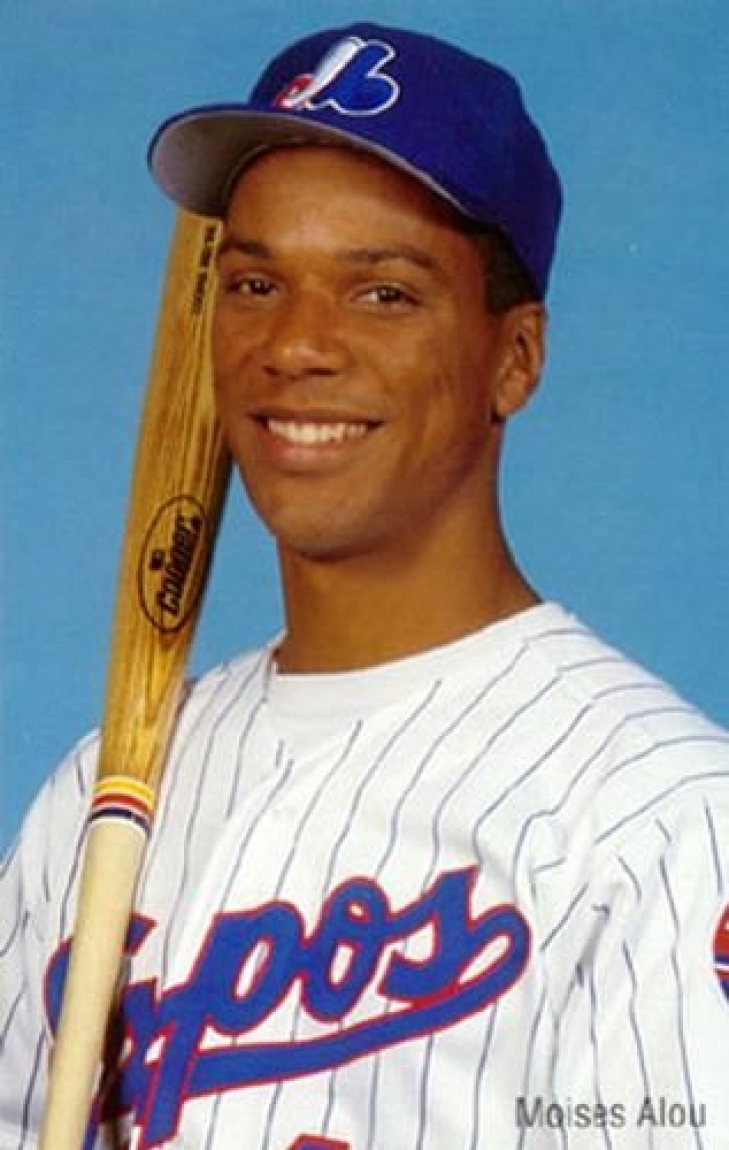
This transaction stands out as one of the most notable footnotes in franchise history. In August 1990, the Montreal Expos traded pitcher Zane Smith to the Pittsburgh Pirates for Moises Alou, who was initially listed as the "Player to be Named Later." At that moment, Alou was a promising but inexperienced prospect, having only played two major league games. By the time he left Montreal six years later, he had become widely known and had secured his role as the focal point of an exceptional, world-class outfield, guided directly by his father, legendary manager Felipe Alou.
Alou’s rise in Montreal showcased exceptional bat speed and physical resilience. After recovering from a severe ankle injury in 1993 that ended his season, he returned in 1994 to deliver a standout performance. He dominated National League pitching, hitting .339 with 31 doubles, 22 home runs, and 78 RBIs in just 107 games. His outstanding offense earned him his first All-Star appearance, a Silver Slugger Award, and a third-place finish in NL MVP voting, helping the Expos maintain baseball’s best record before the strike brought play to a halt.
Far from a single-summer peak, Alou remained a premier, high-leverage force in the middle of the order. He backed up his breakout campaign by hitting .273 with 21 home runs in 1996, helping guide a transitioning Expos roster to a highly competitive 88-win season. He possessed a beautifully balanced right-handed swing and a rare knack for delivering in critical situations, routinely punishing pitchers who dared to challenge him with runners on base.
However, as was common during this period of Montreal baseball, the financial constraints of a small-market team ended his tenure early. Knowing they couldn't compete with the high offers from free agency, the team saw their star outfielder leave after the 1996 season. Alou then signed with the Florida Marlins, contributing immediately to their 1997 World Series victory, and went on to have an outstanding 17-year career in Major League Baseball.
Alou played 594 games with the Expos, amassing 598 hits, 122 doubles, 84 home runs, and 335 RBIs. He stole 51 bases and posted a .292/.354/483 slash line with a 124 OPS.
37. Tanner Roark
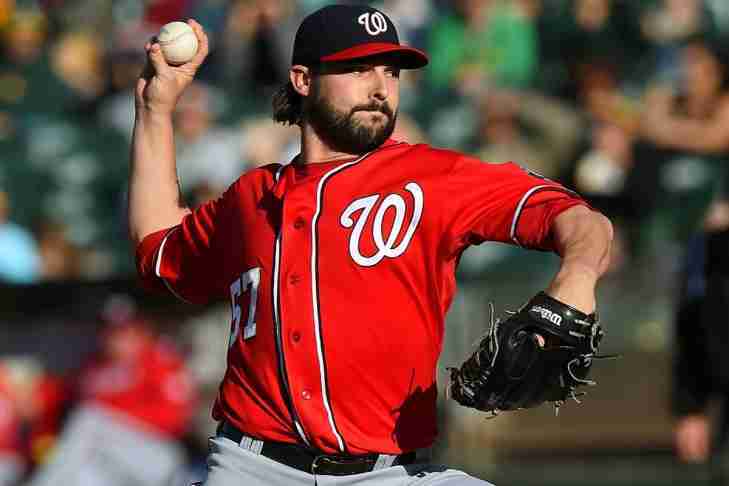
Every memorable pitching staff features its high-priced aces and highly touted prospects. However, a sustained championship run relies on underrated, gritty workhorses. In Washington, Tanner Roark exemplified that quiet dependability. Traded in 2010 from the Texas Rangers for Cristian Guzman, the right-hander was known for his heavy sinker, sharp slider, and no-nonsense attitude, earning him the nickname "The Diesel." Though often overshadowed by stars like Max Scherzer and Stephen Strasburg, Roark reliably took on vital innings to anchor the Nationals' rotation during their most successful period.
His rise in Washington exemplifies a strategic opportunity turn. After a strong bullpen debut in late 2013, Roark secured a rotation spot in 2014 and experienced an outstanding breakout year. He dominated National League hitters, finishing 15–10 with an impressive 2.85 ERA and a tiny 1.092 WHIP, ranking eighth in the league. When the Nationals added Max Scherzer the next winter, Roark was willingly moved back to the bullpen for much of 2015 to make room for the star-studded rotation. Instead of complaining, he stayed prepared, adapting to different roles and eventually regaining his spot as a starter.
The 2016 campaign marked Roark's finest individual achievement in the Nation’s Capital. Returning to the rotation full-time, he pitched with intense focus and high leverage, setting a career high with 16 wins and logging 210 innings during the regular season. His excellent performance resulted in a 2.83 ERA, earning him tenth place in the National League Cy Young Award voting and confirming his status as a top-tier, front-of-the-rotation starter.
Although his efficiency slightly declined in his last two summers in the District—leading to higher walk rates and more hits allowed—his competitive spirit never faltered. He consistently proved to be a durable, ball-distributing player who often kept Washington in the game. After the 2018 season, as the franchise shifted to a new pitching strategy, the Nationals traded the veteran right-hander to the Cincinnati Reds for Tanner Rainey.
With the Nationals, Roark appeared in 182 games (141 starts), posting a 64–54 record, 3.59 ERA, and 1.20 WHIP. He pitched 930.1 innings, struck out 732, and had a 114 ERA+.
12. Anthony Rendon
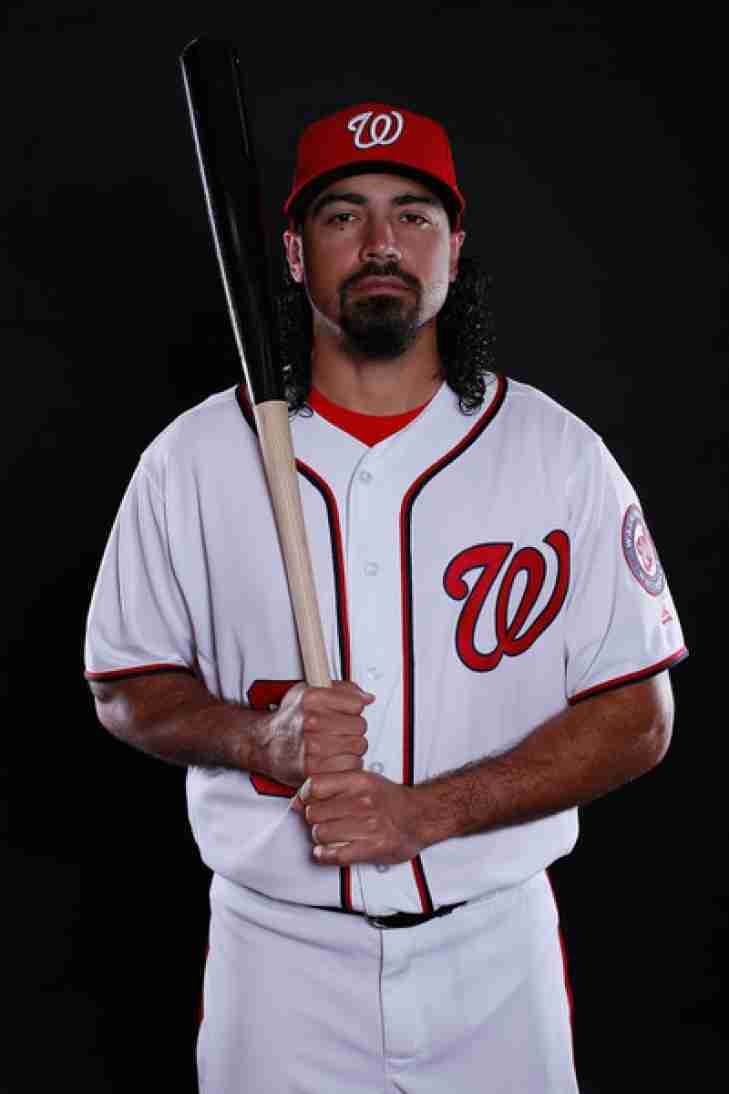
Anthony Rendon was selected sixth overall by the Washington Nationals in 2011, carrying significant expectations. A polished college standout from Rice University and Dick Howser Trophy winner, he was a quiet yet skilled infielder with a comprehensive baseball skill set. Within two years, he secured a permanent role in the Nationals’ infield, becoming the reliable, high-impact core of a franchise aiming for long-term success.
His rise to elite status was exemplified by a standout 2014 sophomore season. Taking on a significant role on the field, Rendon overwhelmed National League pitchers by hitting 21 home runs, driving in 83 RBIs, and leading the league with 111 runs scored. His exceptional offensive performance was matched by his technical skill, as he played both second and third base, resulting in a league-leading 6.5 bWAR among NL position players. This achievement earned him his first Silver Slugger Award and placed him fifth in MVP voting.
Despite a challenging 2015 season marred by injuries that temporarily slowed his statistical progress, Rendon’s resilience prepared him for a swift and impressive comeback. In 2016, he recovered perfectly, earning the NL Comeback Player of the Year award after hitting 20 home runs. By 2017, he had elevated his game further, demonstrating exceptional efficiency at third base and using his compact right-handed swing to hit .301 with 100 RBIs. His stellar performance also placed him sixth in MVP voting, making him a dependable superstar central to Washington's lineup.
His crowning achievement in D.C. was a legendary 2019 season, regarded as one of the greatest individual campaigns in district sports history. Known as "Tony Two Bags" for his relentless gap-to-gap hitting, Rendon led the National League with 44 doubles and 126 RBIs. He achieved career highs in all aspects of the slash line, batting .319/.412/.598 with 34 home runs. These feats earned him his first All-Star selection, a second Silver Slugger award, and a third-place finish in MVP voting.
Rendon was not content with just regular-season success and extended his exceptional form into October. Throughout the 2019 postseason, he was a relentless force, producing memorable high-pressure hits, including a vital home run in Game 7 of the World Series against Houston, which helped the Nationals secure their first-ever world championship title.
That emotional mountain peak served as his definitive swan song in Washington. In December 2019, the coveted free agent opted for a move to the West Coast, signing a massive multi-year contract with the Los Angeles Angels. While his subsequent years in Anaheim would be heavily fragmented by injuries, his seven-year residency in Washington remains an untarnished blueprint of championship excellence.
With the Nationals, Rendon accumulated 1,048 hits, 245 doubles, 136 home runs, and 546 RBIs while generating a stellar .290/.369/.490 slash line (126 OPS+).
3. Max Scherzer
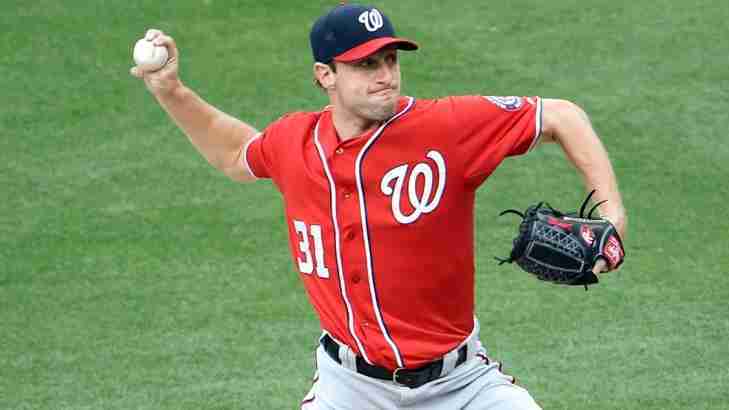
When looking at how a franchise has evolved competitively over different eras and locations, it really takes a standout, exceptional figure to change the story. For a long time, local historians naturally believed that hometown heroes like Bryce Harper or Stephen Strasburg would be the first to lead the modern chapter of Washington D.C. baseball after moving. However, it was an intense, uniquely eyed right-hander who came into the capital and completely changed the game. Before the 2015 season, Max Scherzer signed a significant seven-year free-agent deal. He didn’t just meet expectations; he made every game he pitched a must-see, high-speed event. Over an incredible six-and-a-half seasons, 'Mad Max' set a new standard for pitching excellence, becoming the anchor of a championship-winning era.
His first season in D.C. truly changed the expectations around the National League East. Scherzer embraced the challenge of long, intense innings as part of his daily routine. He finished fifth in the Cy Young race and led the league with an impressive 8.12 strikeout-to-walk ratio. That summer, he made an unforgettable mark in the local baseball history by pitching two separate no-hitters—just narrowly missing a perfect game against Pittsburgh on a controversial hit-by-pitch, and ending the season with an incredible game where he struck out 17 batters against the Mets.
The pinnacle of his hardware-certified legacy shined brightly over the next two summers. In 2016, Scherzer delivered an outstanding performance, showcasing front-line intimidation by tying the historic major-league record with 20 strikeouts in a single nine-inning game against his former Detroit teammates. That summer, he finished with 20 wins, a league-best 0.968 WHIP, and 284 strikeouts, earning his second Cy Young award and joining a distinguished group of pitchers who have won the award in both leagues.
He impressively followed up that performance with an equally remarkable 2017 encore, thoroughly dominating seasoned batters to top the league with 268 strikeouts and an impressive 0.902 WHIP. This achievement comfortably earned him a consecutive Cy Young Award, making him only the tenth pitcher in Major League Baseball history to win at least three in his career.
He finished as the close Cy Young runner-up in 2018, during a historic 300-strikeout campaign, cementing a phenomenal run in which he led the National League in strikeouts for three consecutive summers.
As good as he had been, Scherzer’s 2019 had to be the sweetest in that uniform. Finishing third in the Cy Young balloting, Scherzer anchored the Nationals to an improbable, resilient run through the postseason—famously overcoming severe neck spasms that required a cortisone shot to dynamically take the mound and battle through five gutsy frames in the deciding Game 7 of the World Series, guiding the organization to its first-ever world title.
After a strong and efficient season during the COVID-shortened 2020 year, Scherzer entered the final year of his contract in 2021. Although he was named an All-Star for the seventh time as a National League player, the team's rosters, which were aging and injury-prone, couldn’t keep up in the competition. Committed to a full rebuild, the front office decided to make some major moves at the trade deadline, including a high-profile fire sale. They executed a blockbuster business exit in July 2021, trading their iconic ace alongside Trea Turner to the Los Angeles Dodgers for a prospect package centered on Keibert Ruiz and Josiah Gray, bringing a poignant, abrupt end to the greatest pitching run in franchise history.
With Washington, Scherzer compiled a spectacular 92–47 record alongside 1,610 strikeouts over his 1,225.2 innings.
