

17. Matt Blair

Minnesota inducted Blair into their Ring of Honor in 2012.
11. Kevin Williams

Kevin Williams spent more than a decade as one of the league’s most reliable defensive tackles, yet his name rarely surfaces in the same conversations as the era’s louder stars. Drafted ninth overall by the Vikings in 2003 out of Oklahoma State, he stepped in as a full-time starter immediately and posted 10.5 sacks as a rookie. He continued the next year, adding 11.5 sacks and earning his first first-team All-Pro selection.
Once Pat Williams arrived in 2005, the two formed the Williams Wall. Kevin played the under tackle in Minnesota’s 4-3 scheme while Pat handled the nose. Together they helped the Vikings post the NFL’s best run defense for three straight seasons from 2006 through 2008. Offenses knew they'd face a physical, disruptive interior that rarely gave ground.
Williams earned five first-team All-Pro honors between 2004 and 2009 and made six Pro Bowls during his time in Minnesota. He earned those selections while also batting down passes at an unusual rate for an interior lineman and scoring four defensive touchdowns. The production was steady rather than flashy, which may explain why he often sat outside the national spotlight even as the numbers accumulated.
He remained a starter through the 2013 season. After that year, he left Minnesota as a free agent, spent one season with the Seattle Seahawks, and closed his career with the New Orleans Saints in 2015. He had already done most of his best work with the Vikings.
With Minnesota, he finished with 60 sacks, five interceptions, and 13 fumble recoveries across 171 games. Those totals, paired with the five All-Pro seasons, place him among the franchise’s strongest defensive tackles. He also earned a spot on the NFL’s 2000s All-Decade Team. The Vikings placed him in their Ring of Honor in 2021.
13. Paul Krause

Paul Krause arrived in Minnesota in 1968 after four seasons with the Washington Redskins and immediately became the centerpiece of the Vikings’ secondary. He had already led the NFL in interceptions as a rookie and earned All-Pro honors twice in Washington, but the bulk of his long career would unfold in purple. For the next twelve seasons, he patrolled the deep middle and gave the defense a reliable ball hawk behind the Purple People Eaters.
Krause relied more on range and instincts than pure physicality. He read routes quickly, closed on the ball in the air, and rarely took bad angles. That style produced consistent interceptions without requiring him to be a hard-hitting enforcer in the box. In his first year with the Vikings, he picked off seven passes. The following season he added five more, including a touchdown return, as Minnesota reached its first Super Bowl.
He started in all four of the team’s Super Bowl appearances in the 1970s and remained a fixture through every playoff run of that era. His presence forced quarterbacks to account for the free safety on every deep throw. Krause earned six Pro Bowl selections while in Minnesota and collected his third career first-team All-Pro honor in 1975. That season he intercepted ten passes for 201 yards, the second time in his career he reached double digits.
Those numbers matched another strong Vikings defense and another Super Bowl trip. He continued producing into the late 1970s even as the team’s championship window began to close, still relying on the same ball-hawking approach that had defined him from the start. Krause played through the 1979 season and retired after that final year.
In his last campaign, he recorded three interceptions, the final two of which pushed his career total past the previous record. With the Vikings, he finished with 53 interceptions across 12 seasons. Those picks, combined with the 28 he had recorded earlier in Washington, gave him the all-time NFL mark of 81, a record that still stands.
The Pro Football Hall of Fame inducted him in 1998, the same year the Vikings placed him in their Ring of Honor.
14. Chris Doleman

Few defensive ends arrived in Minnesota with higher expectations than Chris Doleman. Selected fourth overall in the 1985 draft out of Pittsburgh, he spent his first two seasons adjusting to the NFL. The Vikings initially used him at outside linebacker before shifting him to defensive end late in his second year. Once he settled into that role as a full-time starter in 1987, the production followed immediately. He posted 11 sacks that season, earned his first Pro Bowl selection, and began a stretch in which he became one of the league’s most consistent pass rushers.
The peak arrived in 1989 when Doleman led the NFL with 21 sacks. That total earned him first-team All-Pro honors and remains one of the highest single-season marks in Vikings history. He followed with another strong year in 1990 and then a second first-team All-Pro season in 1992, when he added 14.5 sacks, forced six fumbles, and returned an interception for a touchdown. Those years lined up with some of the Vikings’ better defensive stretches of the era, and Doleman was the constant threat off the edge.
He played with power and a long first step that made it difficult for tackles to stay in front of him. His combination of size and speed let him set the edge against the run while still generating consistent pressure on the quarterback. From 1987 through 1993, he remained a starter and earned six Pro Bowl selections while in Minnesota. The production stayed high even as the team cycled through different schemes and supporting casts.
After the 1993 season, the Vikings traded Doleman to the Atlanta Falcons. He spent two years there, then three more with the San Francisco 49ers, where he continued to produce double-digit sacks. In 1999, he returned to Minnesota for one final season and added eight more sacks before retiring. With the Vikings, he finished with 96.5 sacks across his two stints. Those totals, paired with the All-Pro and Pro Bowl recognition, placed him among the franchise’s strongest defensive ends.
The Pro Football Hall of Fame inducted him in 2012. Five years earlier, the Vikings placed him in their Ring of Honor.
4. Adrian Peterson

For those who grew up in this generation, it's impossible to think about the Minnesota Vikings without Adrian Peterson as the first player that comes to mind. Peterson came out of the University of Oklahoma and took the NFL by storm, as many knew that he would. The Vikings selected him seventh overall in 2007, and he immediately became the offense's centerpiece.
His rookie season set the tone. Peterson rushed for 1,341 yards and 12 touchdowns in 14 games, including a single-game NFL record of 296 yards against the Chargers. He earned Offensive Rookie of the Year honors and made the Pro Bowl. His physical running style and breakaway speed were evident from the start, and he quickly became one of the league’s most feared backs.
The following year, he led the NFL in rushing with 1,760 yards and 10 touchdowns on 363 carries. That total established a then-franchise single-season record and earned him first-team All-Pro honors. Peterson continued to pile up big games in 2009 with 1,383 yards and a league-leading 18 rushing touchdowns. The production across those early seasons showed both volume and scoring ability.
The 2012 season was his best. Coming off a torn ACL and MCL from the previous year, he returned and rushed for 2,097 yards and 12 touchdowns on 348 carries, finishing just nine yards short of the single-season record. He averaged 6.0 yards per attempt while carrying the Vikings to a playoff berth. Peterson earned consensus MVP and Offensive Player of the Year honors. The comeback and near-record performance made it one of the most remarkable individual seasons in recent NFL history.
He suffered a setback that took him out most of 2014 but returned in 2015 to win the rushing title again with 1,485 yards and 11 touchdowns on 327 carries. That performance earned another first-team All-Pro selection. Injuries limited him again in 2016, and he played only three games. The Vikings did not exercise his option for 2017, ending his decade-long run in Minnesota.
Peterson signed with the New Orleans Saints the following season and continued his career with several other teams. He remained productive in short stints but never matched the sustained dominance of his years in purple. His departure marked the end of an era in which he was the clear face of the Vikings offense.
With the Vikings, he finished with 11,747 rushing yards and 97 rushing touchdowns across 123 games. He also added 1,945 receiving yards and five more touchdowns. Peterson became the third-youngest player to reach 10,000 rushing yards, and all of that production came in Minnesota. The numbers cemented him as the franchise’s all-time leading rusher by a wide margin.
He earned seven Pro Bowl selections and four first-team All-Pro honors, and won three rushing titles during his time with the team. Peterson led the league in rushing three times and in rushing touchdowns twice. His individual awards and team impact left little doubt about his place among the greatest backs the Vikings have ever had.
Peterson looks to be a future Hall of Fame entrant, and his Vikings years form the core of that case. The explosive runs, the MVP season, and the longevity in the face of injuries defined a generation of Minnesota football. For many fans, he remains the first player who comes to mind when they think of the franchise.
8. Randy Moss

Maybe this rank is too low, as Randy Moss is the man many called the greatest pure athlete of his generation. The wide receiver arrived in Minnesota with a combination of size, speed, and leaping ability that forced defenses to invent new ways to cover him. The “Randy Ratio” became shorthand for the idea that the Vikings needed to get him the ball early and often if they wanted any real chance to win. When he was locked in, few players in the league were more dangerous.
Maybe this rank is too high, because the same talent came with off-field problems and diva-like moments that made him a distraction. He was not always the consummate teammate, and by the end of his first run in Minnesota, the relationship had soured enough for the team to move on. The debate over where he ranks is fair. What is not up for debate is that his years with the Vikings produced some of the most electric football the franchise has ever seen.
The Vikings selected Moss 21st overall in 1998 out of Marshall, and he wasted no time proving the pick correct. In his rookie season, he caught 69 passes for 1,313 yards and a league-leading 17 touchdowns, setting the NFL record for receiving scores by a first-year player. He was named Offensive Rookie of the Year, earned first-team All-Pro honors, and helped the Vikings post a 15-1 record while scoring a then-record 556 points. A Thanksgiving Day performance against Dallas—three catches, 163 yards, three touchdowns—announced him as must-watch television.
He stayed at that level for several more seasons. In 2000, he posted 1,437 yards and 15 touchdowns. In 2003, he set personal bests with 111 receptions for 1,632 yards and another 17 scores. Those years produced more Pro Bowl selections and first-team All-Pro recognition. Moss led the NFL in receiving touchdowns three times during his Vikings tenure and consistently ranked among the league leaders in yards. Opposing coordinators spent entire weeks game-planning specifically for him.
The other side of the story was harder to ignore. Moss collected fines for altercations with officials, left the field early in a loss to Washington, and was involved in off-field incidents, including a traffic stop in Minneapolis. His habit of taking plays off when he was frustrated became a talking point. The relationship with the organization frayed, and after the 2004 season the Vikings traded him to the Oakland Raiders for a first-round pick and a linebacker. The move ended his first and most productive chapter in Minnesota.
He returned briefly in 2010 after a trade from New England, but the second stint lasted only a few games before he was waived. The spark was gone, and the fit with the coaching staff never clicked. The short reunion did little to change the overall picture of his Vikings career.
With Minnesota, he finished with 9,316 receiving yards and 92 touchdowns on 587 receptions across his primary years. He went to five Pro Bowls and earned three first-team All-Pro selections while wearing purple. Those numbers rank among the best in franchise history and form the core of his Hall of Fame case.
The Pro Football Hall of Fame inducted Moss in 2018. The year before, the Vikings placed him in their Ring of Honor. Both honors recognized a player whose greatest feats occurred in Minnesota, even if the full career was more complicated than the highlight reels suggested.
For pure must-watch moments, few players in Vikings history sit higher. The long touchdowns, the contested catches, and the way he changed games in a single play created memories that still define an era. The distractions and the eventual departure keep him from the very top of some rankings, but the production and the spectacle remain impossible to dismiss. Moss was both the reason the Vikings were dangerous and the reason they eventually decided they had seen enough.
9. Ron Yary

Guarding the right side of the Vikings’ offensive line for 14 seasons, Ron Yary protected his quarterbacks and carved out holes for running backs while building one of the strongest individual résumés of any tackle from his era. The USC product arrived as the first offensive lineman ever selected first overall in the NFL Draft, and he quickly showed he belonged.
Yary was taken No. 1 in 1968 after the Vikings acquired the pick in the trade that sent Fran Tarkenton to the Giants. He won the Outland Trophy at USC and helped the Trojans to a national title. Once in Minnesota, he worked his way into the starting lineup and by 1970 was locked in at right tackle. From there, he became a constant through the franchise’s most successful stretch.
Between 1971 and 1976, he earned six consecutive first-team All-Pro selections. He went to the Pro Bowl seven straight years from 1971 through 1977 and was named All-NFC eight years in a row. Those honors lined up with Minnesota’s peak: 11 division titles during his tenure, the 1969 NFL championship, and NFC titles in 1973, 1974, and 1976. Yary started in all four Super Bowls the Vikings reached in that span.
He was also named the NFLPA NFC Offensive Lineman of the Year three times. The recognition reflected the consistency he brought week after week, whether he kept Tarkenton upright or opened lanes for Chuck Foreman and the rest of the backfield. Injuries rarely slowed him; he missed only two games due to injury across his long run in Minnesota.
With the Vikings, he played in 199 regular-season games and started most of them. His durability and string of All-Pro and Pro Bowl seasons made him the clear anchor on the right side of one of the league’s best lines in the 1970s. After 14 seasons in Minnesota, he was traded to the Los Angeles Rams in 1982, played one final year, and retired.
The Pro Football Hall of Fame inducted him in 2001. That same year, the Vikings placed him in their Ring of Honor. Both honors recognized a player whose best work came in Minnesota, where he spent the bulk of a 15-year career as one of the most reliable tackles of his generation.
6. John Randle

It takes a special player to go from undrafted to the Hall of Fame. John Randle was a special player. He signed as an undrafted free agent out of Texas A&M-Kingsville in 1990 as an undersized defensive tackle whose only real asset was a relentless motor. The Vikings gave him a chance, and he made the most of it.
Randle spent his rookie season as a rotational player. By his second year, he had worked his way into the starting lineup and posted 9.5 sacks. In 1992, he crossed the 10-sack threshold for the first time with 11.5. That mark became the floor, not the ceiling. He reached double-digit sacks in seven of the next eight seasons, establishing himself as one of the league’s most consistent interior pass rushers.
The peak arrived in the mid-to-late 1990s. From 1993 through 1998, he earned six consecutive first-team All-Pro selections and six straight Pro Bowl nods. In 1994 he led the NFC with 13.5 sacks. In 1997 he topped the entire NFL with 15.5. Those years lined up with some of the Vikings’ strongest defensive stretches of the decade, and Randle was the constant pressure point in the middle of the line.
He played with an intensity that stood out even among other high-motor defensive linemen. The face paint, the trash talk, and the nonstop pursuit became part of his identity. Offensive linemen knew they'd face him on every snap, and his production reflected it. He forced fumbles at a high rate and rarely came off the field.
Randle remained a starter through the 2000 season. After that year, the Vikings released him, ending an 11-season run in Minnesota. He signed with the Seattle Seahawks and played three more years before retiring. He had already done the bulk of his work—and nearly all of his best work—in the state of Minnesota.
As a Viking, he finished with 114 sacks across 176 games. That total ranks among the highest in franchise history. He also recorded the large majority of his career forced fumbles and tackles while in Minnesota. Those numbers came from a player who never stopped working after going undrafted.
The Pro Football Hall of Fame inducted him in 2010. Two years earlier, the Vikings placed him in their Ring of Honor. Both honors recognized a player whose path from free-agent camp to Canton was built almost entirely on what he did while wearing the white horns.
10. Cris Carter

Cris Carter arrived in Minnesota as a reclamation project and left as one of the franchise’s most productive receivers. The former Philadelphia Eagle had been cast aside after three uneven seasons, yet the Vikings saw enough in his hands and route-running to take a chance. What followed was a sustained run of production that rewrote the team’s record books and eventually led to Canton.
The Vikings claimed him off waivers in 1990 for $100 after the Eagles released him. Buddy Ryan’s famous line—“all he does is catch touchdowns”—was meant as a knock, but it also described a player who already knew how to find the end zone. Carter spent his first year in Minnesota in a limited role, then gradually became the primary target.
By 1993, he had his first 1,000-yard season and his first Pro Bowl. The next year he set an NFL record with 122 receptions for 1,256 yards. He matched the 122-catch total in 1995 while adding a career-high 1,371 yards and a league-leading 17 touchdowns. Those back-to-back seasons established him as one of the league’s most reliable possession receivers and earned him first-team All-Pro recognition.
He continued at that level through the rest of the decade. Carter led the NFL in receiving touchdowns three times (1995, 1997, and 1999) and posted eight straight 1,000-yard seasons from 1993 to 2000. He went to the Pro Bowl every year from 1993 through 2000. When Randy Moss arrived in 1998, the two formed one of the most productive receiving duos the Vikings have ever had, with Carter remaining the consistent chain-mover alongside the deep threat.
After the 2001 season, he exercised an out clause in his contract and left Minnesota as a free agent. He briefly returned to play five games for the Miami Dolphins in 2002 before retiring for good. With Minnesota, he finished with 1,004 receptions for 12,383 yards and 110 touchdowns across 12 seasons. Those totals rank among the best in franchise history and form the core of his Hall of Fame case. He led the Vikings in receptions for 10 straight years and was still productive into his mid-30s. The Pro Football Hall of Fame inducted him in 2013. A decade earlier, Minnesota retired his number 80 and placed him in the Ring of Honor. Both honors recognized a player whose best work—and the large majority of his career production—came with the Vikings.
12. Jim Marshall

We talked about the star and muscle of the “Purple People Eaters” (Alan Page and Carl Eller), but Jim Marshall was the heart of the unit. He joined the expansion Vikings in their first season and became the constant presence that held the defense together for nearly two decades.
Marshall arrived in Minnesota via trade from the Cleveland Browns before the 1961 season. He stepped into the starting lineup immediately and never left it. From then on, he started every game the Vikings played through the end of 1979, a stretch of 270 consecutive starts that stood as an NFL record at the time of his retirement. The durability alone set him apart, but he was far more than a body in the lineup.
His most productive seasons came in the late 1960s. He earned second-team All-Pro honors in 1964, then peaked again in 1968 and 1969 with back-to-back Pro Bowl selections and additional second-team All-Pro recognition. Those years lined up with the rise of the Purple People Eaters and the Vikings’ first Super Bowl appearance. He remained a steady pass rusher and run defender through the 1970s, contributing to the three more Super Bowl runs that followed.
The one play that still defines him in the public mind came on October 25, 1964, against the San Francisco 49ers. Marshall recovered a fumble and ran 66 yards the wrong way into his own end zone, resulting in a safety. Minnesota still won the game, and Marshall’s teammates and coaches moved on, but the moment followed him for the rest of his career. It remains the most famous single play of his time in Minnesota.
He played in every major stretch of Vikings success in the 1960s and 1970s. The team reached four Super Bowls during his tenure, and Marshall started in all of them. He served as a team captain for much of that span and was the last member of the original 1961 expansion roster still active when the decade closed.
Marshall remained with Minnesota through the 1979 season and retired after that final year. By the time he left, he had appeared in every game the franchise had ever played. With the team, he finished with 270 consecutive starts, 127 unofficial sacks, and 29 fumble recoveries. The Vikings retired his number 70 and enshrined him in their Ring of Honor in 1999. Both honors recognized a player whose longevity, production, and presence on the defensive line made him the enduring heart of Minnesota’s most iconic era.
2. Randall McDaniel

Arguably the greatest offensive lineman in Vikings history, Randall McDaniel took over the starting left guard position almost immediately after being drafted 19th overall from Arizona State in 1988. He started 15 of 16 games as a rookie and quickly showed the combination of speed, strength, and technique that would define his career. McDaniel was known throughout the NFL for his versatility at the position, handling both run blocking and pass protection at a high level from the start.
In his sophomore season, he made the Pro Bowl and did so again in each of the next 10 seasons with Minnesota. He earned first-team All-Pro honors seven times during that stretch, including a long run of consecutive selections in the 1990s. That consistency set him apart even among the era’s other strong offensive linemen.McDaniel started every regular-season game for the Vikings from 1990 through 1999 and put together a streak of 202 consecutive starts that carried into his final years. He occasionally lined up as a fullback in short-yardage and goal-line situations, adding another dimension to an already versatile skill set. His ability to get to the second level and create running lanes helped multiple Vikings backs reach 1,000 yards.
The 1998 season stood out even by his standards. McDaniel allowed only 1.5 sacks that year while the Vikings set a then-record for points scored. He continued to anchor the line through the late 1990s as Minnesota remained a consistent playoff team. His presence on the left side gave the offense a reliable foundation week after week.
The Vikings released him after the 1999 season in a salary-cap move. He signed with the Tampa Bay Buccaneers and played two more seasons there, making one final Pro Bowl in 2000. McDaniel retired after the 2001 season, ending a 14-year career defined by durability and production.
With the Vikings, he started 188 games across 12 seasons and earned 11 Pro Bowl selections. He was a seven-time first-team All-Pro and part of the NFL’s 1990s All-Decade Team. The numbers reflected a level of sustained excellence that few offensive linemen have matched.McDaniel entered the Pro Football Hall of Fame in 2009, a year after his induction into Minnesota’s Ring of Honor. He was also named to the Vikings’ 40th Anniversary Team and the 50 Greatest Vikings list. His longevity, Pro Bowl streak, and All-Pro recognition left little doubt about his place among the franchise’s best.
7. Mick Tinglehoff

Mick Tingelhoff was the ultimate farm kid who never got the draft memo. The University of Nebraska center went undrafted in 1962, signed with the Vikings as a free agent, and somehow talked his way into the starting lineup as a rookie. He then refused to give the job back until he walked away after the 1978 season. Seventeen years, zero missed games. The undrafted path made it even more ridiculous.
He started every single regular-season game across those 17 seasons. Two hundred forty consecutive starts, a streak that ranked among the longest in NFL history at the time. The man simply showed up, snapped the ball, and blocked whoever needed blocking. Teammates called him “Quick Mick” for a reason.
By 1964, he had already become one of the best centers in the league. Pro Bowls and first-team All-Pro nods rolled in from 1964 through 1966, then again in 1968 and 1969. In 1969, the 1,000-Yard Club even named him the NFL’s top blocker. Those peak years lined up perfectly with Minnesota finally figuring out how to win.
The 1969 campaign produced the franchise’s first Super Bowl trip. The Vikings went 12-2, won the NFL Championship, and reached Super Bowl IV, where the Kansas City Chiefs ruined the party. Tingelhoff started at center in that game, and in every Super Bowl the team reached after it. He stayed the rock through the 1970s, when Minnesota added NFC titles in 1973, 1974, and 1976.
Those runs produced three more Super Bowl appearances. The Vikings lost to the Miami Dolphins in Super Bowl VIII, the Pittsburgh Steelers in Super Bowl IX, and the Oakland Raiders in Super Bowl XI. Tingelhoff started all four. The results were mixed, but the offensive line he led kept Fran Tarkenton upright and the run game moving for most of the decade.
With the Vikings, he started all 240 regular-season games and 19 playoff games. He recovered 13 fumbles along the way. The consecutive-start streak and the sustained All-Pro recognition set him apart among centers of his generation.
The quiet Nebraska farm boy who led the Vikings’ offensive line for seventeen seasons finally got the Canton call in 2015 as a Senior Nominee. That induction came fourteen years after Minnesota retired his number 53 and put him in the Ring of Honor. That late recognition didn’t change the fact that he was one of the franchise’s most durable and decorated linemen.
5. Fran Tarkenton

Had it not been for five prime years with the New York Giants, Fran Tarkenton could easily have been number one on this list. Hell, we are not convinced that he won’t get there eventually after more analysis. His time in Minnesota defined both the player and the franchise’s rise in the 1970s.
Tarkenton was drafted by the expansion Vikings in the third round in 1961 out of Georgia and quickly became their starting quarterback. He spent his first six seasons in purple, showing the dual threat of accuracy and scrambling that set him apart from most passers of the era. The team struggled early, and tensions with coach Norm Van Brocklin led to a trade to the Giants in 1967.
He returned to Minnesota in 1972 via another major trade, and the second stint proved far more successful. Tarkenton’s ability to extend plays with his legs while still delivering accurate throws made him ahead of his time. While the Vikings were known for the Purple People Eaters defense, his offense gave the team the balance needed for sustained success.
From 1973 to 1976, he led Minnesota to three NFC Championships and Super Bowl appearances. The peak came in 1975, when he was named the consensus MVP after completing 273 of 425 passes for 2,994 yards, 25 touchdowns, and 13 interceptions with a 91.8 rating. He started all 14 games as the Vikings finished 12-2, and he also earned first-team All-Pro and Offensive Player of the Year honors that season. The numbers reflected both volume and efficiency during the team’s strongest regular-season stretch of the decade.
Tarkenton never won that elusive Super Bowl, but he did everything he could to get the Vikings there often. He appeared in three Super Bowls during his second run in Minnesota and started nearly every game once he returned. His scrambling kept defenses off balance even as the team’s defense carried much of the load.
He continued to play at a high level into the late 1970s, including a 1978 season in which he led the NFL in passing yards. Age and wear eventually caught up, and Tarkenton retired after the 1978 campaign. He left Minnesota as the clear face of the offense during the franchise’s most competitive stretch of that era.
With the Vikings, he finished with 33,098 passing yards, 239 touchdowns, and 194 interceptions across 177 games. He also rushed for more than 1,800 yards during his time in Minnesota and completed 57.7 percent of his passes. He accumulated most of the major quarterback records he held at retirement as a Viking. Tarkenton entered the Pro Football Hall of Fame in 1986, and the Vikings retired his number 10 in 1979, right after his retirement. He was also among the first group of players inducted into the Vikings Ring of Honor in 1998. His production, Super Bowl runs, and lasting impact left little doubt about his place among the franchise’s greatest players.
3. Carl Eller

We were so close to putting Carl Eller at the top of this list. Actually, that is how we had it for a while before Alan Page took over. While we elected not to keep Eller at the top, there is no doubt that we are talking about a legend here.
Eller was drafted sixth overall by the Vikings in 1964 out of Minnesota and quickly became a starting defensive end. Extremely quick and mobile for his size at 6-foot-6 and around 250 pounds, he excelled against both the run and the pass. He started nearly every game from the beginning and became a key piece of what became the Purple People Eaters.
The front four of Eller, Page, Jim Marshall, and Gary Larsen defined Minnesota’s defense through the late 1960s and 1970s. Eller was the muscle of the group, a powerful edge presence who could collapse the pocket or chase down plays from behind. His combination with the others created matchup problems few teams could solve.
His peak years came in the late 1960s and early 1970s. In 1969, he recorded a career-high 15 unofficial sacks and co-led the league while helping the Vikings win the NFL championship. Two years later, in 1971, he was named the NEA Defensive Player of the Year as the defense again ranked among the league’s best. Eller was a first-team All-Pro in 1968, 1969, 1970, 1971, and 1973, and he made the Pro Bowl six times during that stretch.
He was a five-time first-team All-Pro and a six-time Pro Bowl selection overall. The Newspaper Enterprise Association voted him the Defensive Player of the Year in 1971, the same year Page won the AP MVP. Eller had seven seasons with more than 10 unofficial sacks and finished as the Vikings’ all-time leader with 130.5. He recovered 23 fumbles during his career and remained a starter through the franchise’s Super Bowl years.
Eller played in all four of Minnesota’s Super Bowls and was a major reason the defense stayed dominant even as the team fell short of a championship. He continued to produce at a high level into the mid-1970s, including stretches where he piled up double-digit sacks. The consistency and physicality never faded during the peak years of the Purple People Eaters.
After 15 seasons with the Vikings, he was traded to the Seattle Seahawks in 1979. He played one final year there before retiring. The move closed a career spent almost entirely in Minnesota, where he had been a fixture on the defensive line for more than a decade.
In Minnesota, he is credited with 130.5 sacks, 23 fumble recoveries, and starts in most of the games he played. He earned five first-team All-Pro selections and six Pro Bowl nods while helping the team reach four Super Bowls. The unofficial sack total remains the franchise record. Eller entered the Pro Football Hall of Fame in 2004, two years after his induction into the Vikings Ring of Honor. He was also named to the NFL’s 1970s All-Decade Team and the Vikings’ 50 Greatest list.
1. Alan Page

There are so many cases for who should be at the top of this all-time Minnesota Vikings list. Carl Eller for the star power he brought to the Purple People Eaters. Jim Marshall for his unequaled longevity. Fran Tarkenton, who, when he retired, held every major quarterback record. Adrian Peterson, the superstar running back.
In the end, we went with Alan Page. While his teammate Carl Eller won the NEA Defensive Player of the Year Award in 1971, Page won the inaugural AP Defensive Player of the Year Award that same year. He became the first defensive player to win the AP Most Valuable Player of the Year, a recognition that remains rare.
Page arrived as a first-round pick in 1967 out of Notre Dame and quickly moved into the starting lineup on the defensive line. He joined Marshall, Eller, and Gary Larsen as one of the Purple People Eaters, a group that defined the Vikings defense for years. His quickness off the ball set him apart even among that talented front.
Over his time in Minnesota, he earned nine straight Pro Bowl selections from 1968 through 1976 and was a six-time first-team All-Pro. He was the heart of a defense that helped the Vikings reach four Super Bowls. Page’s ability to disrupt the passer and control the line of scrimmage made him one of the finest defensive linemen of his day. He recorded roughly 108.5 sacks with the Vikings and recovered 19 fumbles during his years in purple. The numbers reflected consistent production across more than a decade as a starter. He played in 160 games for Minnesota and started nearly all of them once he locked down the position.
Page’s peak came in 1971 when he was named both the AP Most Valuable Player and the inaugural AP Defensive Player of the Year. That season he started all 14 games and helped the Vikings defense allow the fewest points in the NFL for the third straight year. He finished with 109 tackles, nine sacks, three fumble recoveries, and two safeties, including one on a blocked punt against Detroit. The performance made him the first defensive player ever to win MVP, a distinction only Lawrence Taylor has matched since. It was the clearest statement of how dominant he had become in the middle of the Purple People Eaters.
He remained a core piece through the mid-1970s even as the team’s Super Bowl appearances continued. Page played in all four of Minnesota’s Super Bowls (IV, VIII, IX, and XI) and was one of only 11 Vikings to appear in every one of them. His presence forced offenses to account for him on every snap, and the combination with Eller and Marshall created matchup problems few teams could solve. He stayed a first-team All-Pro in 1973, 1974, and 1975 while continuing to pile up Pro Bowl selections. Page’s motor and technique kept him effective year after year, even as the Super Bowl losses never diminished that front four's dominance.
The Vikings released him midway through the 1978 season after a disagreement with coach Bud Grant over his reduced weight and training methods. The Chicago Bears claimed him off waivers, and he finished his career there. The departure ended an 11-plus-year run that had shaped the franchise’s defensive identity.
Page entered the Pro Football Hall of Fame in 1988, the same year Minnesota retired his number 88. In 1998, he was among the first players inducted into the Vikings Ring of Honor. With the team, he was a nine-time Pro Bowler, six-time All-Pro, and the rare defensive player to win MVP.
As good as he was on the field, Page was regarded as an even finer human being. He later became a lawyer and served on the Minnesota Supreme Court. His impact extended well beyond the sack totals and the Super Bowl appearances that defined his years in Minnesota.
Defensive Tackle, Kevin Williams Retires

Defensive Tackle, Kevin Williams retired after signing a one-day contract with the Minnesota Vikings, the team in which he started 171 Games with. Williams was drafted by the Vikings in the first round (9th overall) in 2003 and immediately became a starter for the team. Over his eleven years in Minnesota, Williams would record 60 Quarterback Sacks and was chosen as a First Team All-Pro five times as well as six Pro Bowls. He would play his last two seasons with the Seattle Seahawks and New Orleans Saints respectively.
While Kevin Williams is not someone whose name seems to be associated with a Pro Football Hall of Fame induction his overall resume is not out of line with a discussion about his merits. He will be eligible for the Hall in 2021 and will likely make the bottom half of our Notinhalloffame.com Football list.
We here at Notinhalloffame.com would like to thank Kevin Williams for his career and we wish him the best with his post gridiron career.
Jared Allen Retires
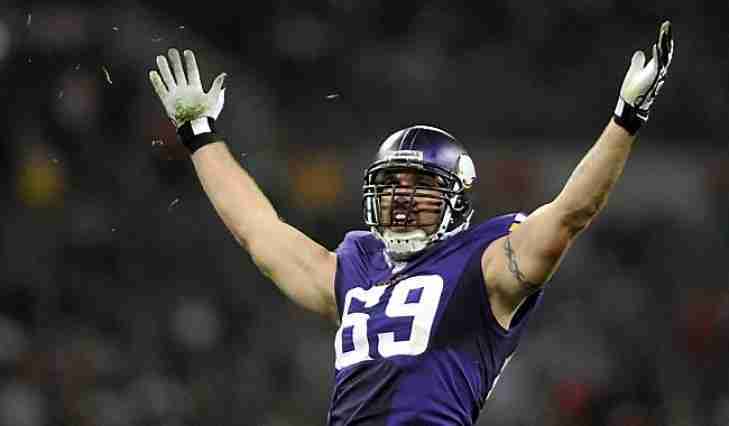
Allen was drafted in the fourth round by the Kansas City Chiefs in 2004 out of Idaho State. The Defensive End would quickly become a starter and would become a fan favorite known for his quirk mannerisms and mullet hairstyle. In 2007, which would be his last season with Kansas City, Allen would make his First Team All Pro roster, first Pro Bowl and would lead the NFL in Sacks. He would also win the prestigious NFL Pass Rusher of the Year Award.
Allen would be traded to the Minnesota Vikings and would sign what was then the largest contract in NFL history for a defensive player. In Minnesota, the accolades kept coming. He made three more First Team All Pro Selections (2008, 2009 & 2011), won the NFL Alumni Defensive Alumni Player of the Year in 2009 and was named the NFC Defensive Player of the Year in 2011. In that season, Allen had 22 Sacks, which remains a Minnesota Vikings record.
He would later play with the Chicago Bears and finished off his career last season as a member of the Carolina Panthers where he appeared in last month’s Super Bowl.
Jared Allen finished off his career with 643 Tackles, 136 Quarterback Sacks and 6 Interceptions. He will be eligible for the Pro Football Hall of Fame in 2021.
We here at Notinhalloffame.com would like to congratulate Jared Allen for his great career, and the impressive way in which he retired.
39. Randall Cunningham
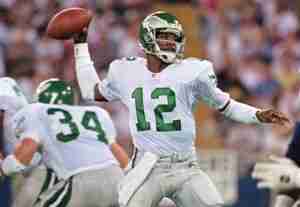
If the Football Hall of Fame were based solely on excitement, there should be no doubt that Randall Cunningham would have been inducted on the first ballot. His nickname, the “Human Highlight Reel,” was well deserved, and he was hands down the most entertaining Quarterback of his era.
Randall Cunningham could beat you with his throwing arm or with his legs. He excelled at scrambling and is the current all-time leader for rushing yards (4,928) for a Quarterback. This made him exciting to watch but also overshadowed his passing. Cunningham was an efficient thrower, and as his speed began to wane, he was able to prove to a lot of people in the league that he could throw with the best of them.
Cunningham's scrambling was not always effective, as he was sacked a lot. He did, however, bring so many weapons (he was also a great punter) to the field that he inspired a new generation of mobile, multi-faceted quarterbacks. Cunningham never won the AP MVP, but he was a three-time Bert Bell Award winner, and also won a PFWA MVP and NEA MVP. Doesn't that show how incredible he was? This should be enough to warrant a look from the Hall, though it hasn’t happened yet, and may never
Regardless of whether Cunningham makes the PFHOF, he is one of the most influential Quarterbacks in Football, and that can never be taken away from him.
Should Randall Cunningham be in the Hall of Fame?
101. Herschel Walker
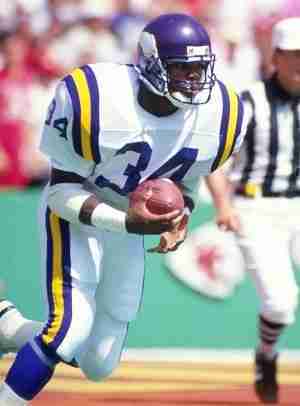
It may be called the Pro Football Hall of Fame, but for all intents and purposes, it only focuses on accomplishments from the NFL and, to a lesser extent, the AFL. This is too bad for Herschel Walker, who chalked up monster totals in his first three years of Pro Football but did so as a member of the New Jersey Generals of the upstart United States Football League.
Walker went to the Dallas Cowboys and tried to live up to the PlayStation-like numbers he put up in College and in the USFL. Walker was still very good and put up good numbers for Dallas in both receiving and running the ball. He was, however, the focal point of one of the more lopsided trades in NFL history, where the Vikings sent five players and a multitude of draft picks (three of which were Emmitt Smith, Alvin Harper, and Darren Woodson). Dallas used this to build a dynasty in the ’90s, and Minnesota coaches took their frustration out on Walker, who wasn’t used to his best ability as a Viking. Herschel was still good, but his stock dropped dramatically.
That lopsided trade hurt his legacy, but Herschel Walker should be remembered as a great Running Back who contributed in pass and kick return situations. If he were a rookie today coming out of Georgia, where there is no USFL, would he have had a shot to shatter NFL rushing records?
Sadly, we will never know.
Should Herschel Walker be in the Hall of Fame?
81. Chuck Foreman
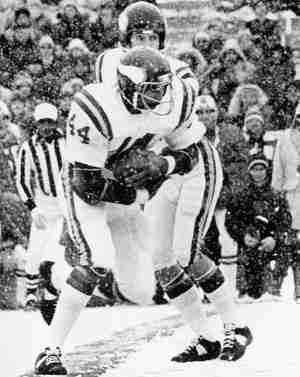
Chuck Foreman was called the “Spin Doctor”, but it was not due to his ability to spin his words. It was because he could effortlessly spin his body around would-be tacklers, making it look like ballet.
When people think of the Minnesota Vikings of the 1970s, they recall the Purple People Eaters and Fran Tarkenton's scrambling. They should also remember the offensive exploits of Chuck Foreman, who twice led the National Football League in Touchdowns. He may have been a Running Back, but he was often used for his receiving skills and was the league leader in that category in 1975. Watching Foreman run with the ball was like watching a rhinoceros. While he could spin away from defenders, he often tried to overpower them, though that style also led to multiple fumbles (52 in 109 Games)
The career numbers of Chuck Foreman may not seem like a lot now (9,106 YFS/76 TD), but they were quite good for the era he played in. He did make the Minnesota Vikings Ring of Honor, but reaching the NFL version of that accolade may continue to prove difficult.
