

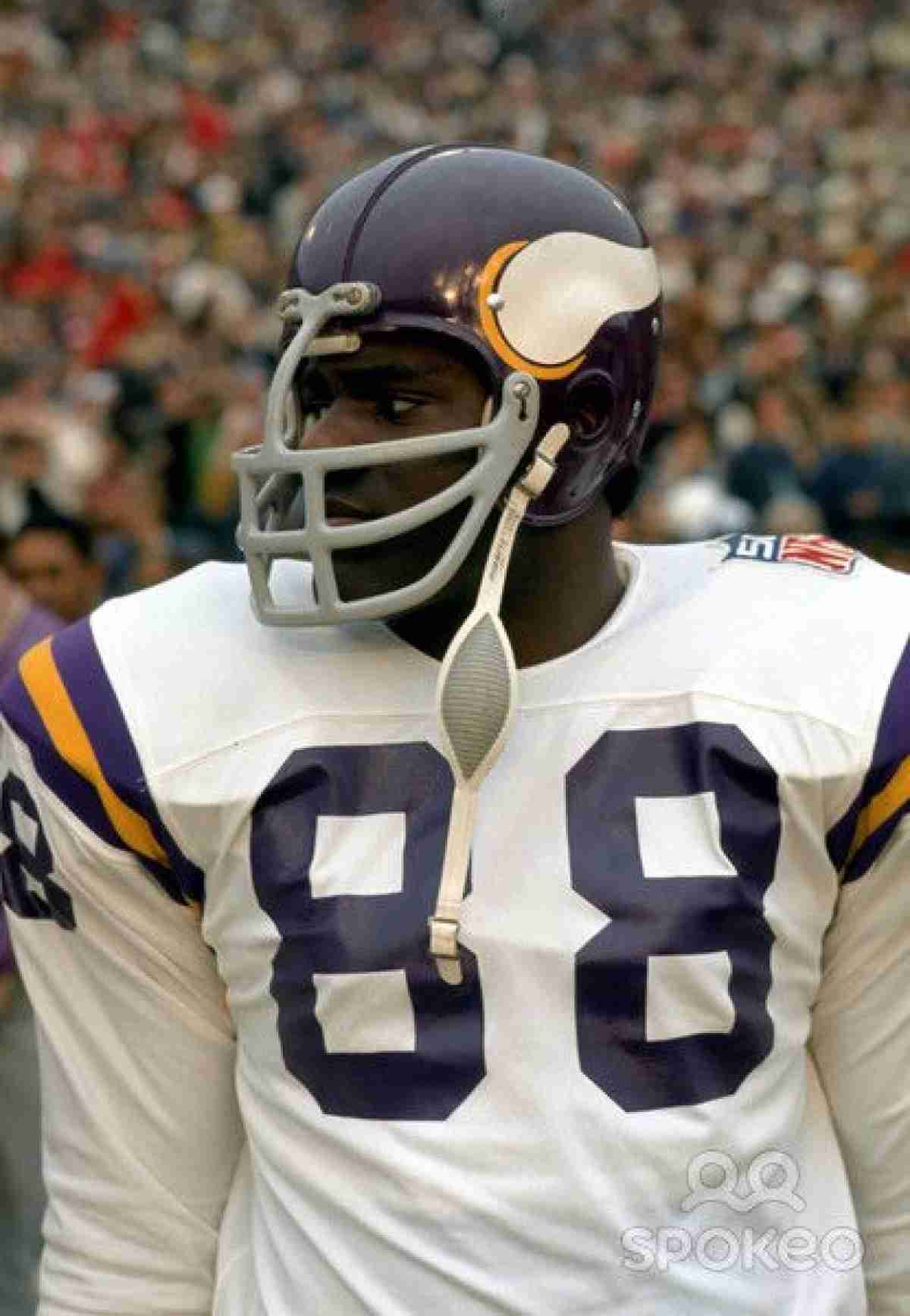
There are so many cases for who should be at the top of this all-time Minnesota Vikings list. Carl Eller for the star power he brought to the Purple People Eaters. Jim Marshall for his unequaled longevity. Fran Tarkenton, who, when he retired, held every major quarterback record. Adrian Peterson, the superstar running back.
In the end, we went with Alan Page. While his teammate Carl Eller won the NEA Defensive Player of the Year Award in 1971, Page won the inaugural AP Defensive Player of the Year Award that same year. He became the first defensive player to win the AP Most Valuable Player of the Year, a recognition that remains rare.
Page arrived as a first-round pick in 1967 out of Notre Dame and quickly moved into the starting lineup on the defensive line. He joined Marshall, Eller, and Gary Larsen as one of the Purple People Eaters, a group that defined the Vikings defense for years. His quickness off the ball set him apart even among that talented front.
Over his time in Minnesota, he earned nine straight Pro Bowl selections from 1968 through 1976 and was a six-time first-team All-Pro. He was the heart of a defense that helped the Vikings reach four Super Bowls. Page’s ability to disrupt the passer and control the line of scrimmage made him one of the finest defensive linemen of his day. He recorded roughly 108.5 sacks with the Vikings and recovered 19 fumbles during his years in purple. The numbers reflected consistent production across more than a decade as a starter. He played in 160 games for Minnesota and started nearly all of them once he locked down the position.
Page’s peak came in 1971 when he was named both the AP Most Valuable Player and the inaugural AP Defensive Player of the Year. That season he started all 14 games and helped the Vikings defense allow the fewest points in the NFL for the third straight year. He finished with 109 tackles, nine sacks, three fumble recoveries, and two safeties, including one on a blocked punt against Detroit. The performance made him the first defensive player ever to win MVP, a distinction only Lawrence Taylor has matched since. It was the clearest statement of how dominant he had become in the middle of the Purple People Eaters.
He remained a core piece through the mid-1970s even as the team’s Super Bowl appearances continued. Page played in all four of Minnesota’s Super Bowls (IV, VIII, IX, and XI) and was one of only 11 Vikings to appear in every one of them. His presence forced offenses to account for him on every snap, and the combination with Eller and Marshall created matchup problems few teams could solve. He stayed a first-team All-Pro in 1973, 1974, and 1975 while continuing to pile up Pro Bowl selections. Page’s motor and technique kept him effective year after year, even as the Super Bowl losses never diminished that front four's dominance.
The Vikings released him midway through the 1978 season after a disagreement with coach Bud Grant over his reduced weight and training methods. The Chicago Bears claimed him off waivers, and he finished his career there. The departure ended an 11-plus-year run that had shaped the franchise’s defensive identity.
Page entered the Pro Football Hall of Fame in 1988, the same year Minnesota retired his number 88. In 1998, he was among the first players inducted into the Vikings Ring of Honor. With the team, he was a nine-time Pro Bowler, six-time All-Pro, and the rare defensive player to win MVP.
As good as he was on the field, Page was regarded as an even finer human being. He later became a lawyer and served on the Minnesota Supreme Court. His impact extended well beyond the sack totals and the Super Bowl appearances that defined his years in Minnesota.


Comments powered by CComment