
Committee Chairman
The College Football Hall of Fame names the Class of 2023
Last night, TCU was destroyed by Georgia in the National Championship Game, but for us at Notinhalloffame.com, the true story was the announcement of 18 new members chosen for the College Football Hall of Fame.
The inducted players are:
Eric Berry, Tennessee, 2007-09, Defensive Back: Berry was a two-time All-American with the Volunteers, winning two Jack Tatum Awards as the nation’s top DB. He also won the 2008 SEC Defensive Player of the Year and the 2009 Jim Thorpe Award. Berry accumulated 241 Tackles and 14 Interceptions in his three college seasons, and he would professionally go to five Pro Bowls and collect three First Team All-Pros as a Kansas City Chief.
Michael Bishop, Blinn Junior College 1995-96 & Kansas State, 1997-98, Quarterback: Bishop led Blinn to two consecutive NJCAA National Championships and he was given a chance at QB with the Wildcats. With Kansas State, Bishop threw for 4,401 Yards and 36 Touchdowns and rushed for 1,314 and 23 TDs, and was the 1998 Heisman runner-up. He won the Davey O’Brien Award as a Senior, and as a pro led the Toronto Argonauts to a Grey Cup win.
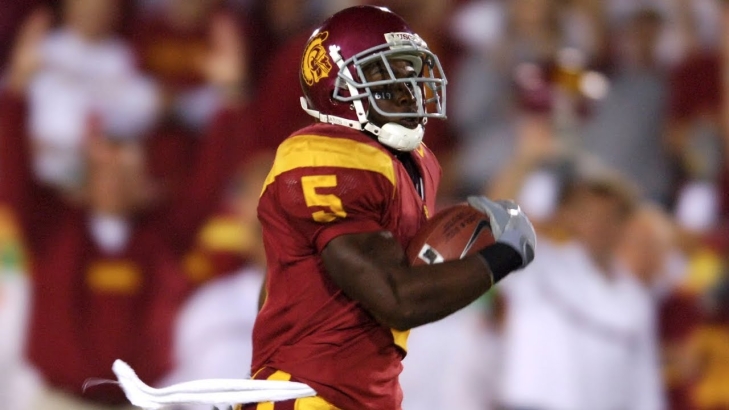
Reggie Bush, USC, 2003-05, Running Back: Bush may have had his 2005 Heisman taken away due to his family receiving gifts during his time as a Trojan, but he is now a College Football Hall of Famer. Bush had 6,890 All-Purpose Yards. Leading USC to a now-vacated BCS National Championship in 2004, Bush not only won the Heisman, but also captured that year’s Doak Walker Award and Walter Camp Award, and was named the AP College Football Player of the Year. Bush would all go on to win a Super Bowl with the New Orleans Saints and had 58 Touchdowns with nearly 9,000 Yards From Scrimmage.
Dwight Freeney, Syracuse, 1998-01, Linebacker: Freeney recorded 36 Sacks and 104 Tackles with the Orange and was a two-time All-Big East Selection. He played most of his pro career with the Indianapolis Colts, where he went to seven Pro Bowls and was the leader in Sacks in 2004.
Robert Gallery, Iowa, 1999-01, Offensive Lineman: Gallery won the Outland Trophy and the Big Ten Offensive Lineman of the Year in 2003, and he was later taken second overall by Oakland and had an eight-year NFL career.
LaMichael James, Oregon, 2009-11, Running Back: James won the Doak Walker Award in 2010 as the nation’s top Running Back and was third in Heisman voting. In his three years as a Duck, James rushed for 5,082 Yards and 53 Touchdowns. He would only rush for 193 Yards as a pro.
Derrick Johnson, Texas, 2001-04, Linebacker. As a senior, Johnson won the Big 12 Defensive Player of the Year, Dick Butkus Award, Bronko Nagurski Trophy and Jack Lambert Trophy, and had 10.5 Sacks, 9 Interceptions and 458 Tackles over his four-year career. Later, with the Kansas City Chiefs, he went to four Pro Bowls.
Luke Kuechly, Boston College, 2009-11, Linebacker. Kuechly was the ACC Defensive Rookie of the Year in 2009, and the two-time All-American won the ACC Defensive Player of the Year in 2011. It was a monster season for Kuechly, who also won the Bronko Nagurski Trophy, Lombardi Award, Lott Trophy, Butkus Award and Jack Lambert Award. He went to be a five-time First Team All-Pro, a seven-time Pro Bowl and was the NFL Defensive Player of the Year in 2013.
Terance Mathis, New Mexico, 1986-89, Wide Receiver. Mathis accumulated 4,524 Receiving Yards and 36 Touchdowns for the Lobos.
Bryant McKinnie, Miami, 1998-2001, Offensive Lineman. McKinnie was a member of Miami’s 2001 BCS National Championship Team, and would win the Outland Trophy and Jim Parker Award that year. He later won a Super Bowl with the Ravens.
Corey Moore, Virginia Tech, 1996-99, Defensive Lineman. In Moore’s senior year, he won the Big East Defensive Player of the Year (he also won it as a junior), Bronko Nagurski Award and Vince Lombardi Award.
Michael Stonebreaker, Notre Dame, 1986-90, Linebacker. Stonebreaker was a two-time All-American and a key member of the 1988 undefeated NCAA Championship Team.
Tim Tebow, Florida, 2006-09, Quarterback: Tebow was a phenom with the Gators, leading Florida to two BCS Championships (2006 & 2008), while also winning the 2007 Heisman. The two-time All-American also added two Maxwell Awards (2007 & 2008), the Davey O’Brien Award (2007), Manning Award (2008), and the AP and Sporting News also named Tebow their 2007 Player of the Year. He passed for 9,286 Yards and 88 Touchdowns while rushing for 2,947 Yards and 57 Touchdowns. Tebow’s NFL career was not good, but there are few in his league collegiately.
Troy Vincent, Wisconsin, 1988-91, Defensive Back: Vincent was the co-winner of the Big 10 Defensive Player of the Year in 1991, and would enjoy a long NFL career, that included the 2002 Walter Payton Man of the Year.
DeAngelo Williams, Memphis, Running Back, 2002-05. Williams was a three-time Conference USA Offensive Player of the Year, and won the MVP in the 2005 Music City Bowl. Rushing for 6,026 Yards and 55 Touchdowns as a Tiger, Williams was a two-time NFL leader in Rushing TDs.
The Inducted Coaches are:
Monte Cater, Lakeland 1981-86 & Shepherd 1987-2017. Cater won 19 Conference Championships (3 IBFC, 12 WVIAC, 4 MEC) and was also a 12-time Conference Coach of the Year. He had an overall record of 275-117-2.
Paul Johnson, Georgia Tech 1997-2001, Navy 2002-07 & Georgia Tech 2008-18. Johnson had an overall record of 189-100, and he led Georgia Southern to back-to-back NCAA D-I-AA Titles in 1999 and 2000. He was a seven-time Conference Coach of the Year.
Roy Kramer, Vanderbilt 1978-90, SEC Commissioner 1990-2002. Kramer had a record of 83-32-2 with the Commodores but was more instrumental in his work as the SEC Commissioner where he elevated the conference.
Mark Richt, Georgia 2001-15 & Miami (FL) 2016-18. Richt won three conference Coach of the Year Awards (SEC 2002 & 2005, ACC 2017), and was also named the 2017 Walter Camp Coach of the Year. He had a 10-7 record in Bowls, including two Sugar Bowl wins, and Richt’s overall record was 171-64.
We here at Notinhalloffame.com would like congratulate the newest members of the College Football Hall of Fame.
The Most Shocking NFL Upsets in History
The Most Shocking NFL Upsets in History
Whether you're a football fan or not, we can all agree that the National Football League (NFL) is a huge part of our culture. The Super Bowl has become like a National Holiday. Every year, we look forward to watching the game and seeing who will emerge victorious, even if we have yet to learn much about either team.
Every year, NFL happens, and as always, it had some twists and turns along the way. Of course, the most remarkable games in NFL history resulted in shocking upsets, and we've listed the greatest ones here.
The Dallas Cowboys vs. the San Francisco 49ers (2022)
The playoff rivalry between the San Francisco 49ers and the Dallas Cowboys goes back a long way. Currently, NFL odds have America's Cowboys as the favorites every season, and their 8.51 million fans agree. However, on January 16, 2022, despite a fierce comeback attempt by the Cowboys (11-7), the San Francisco 49ers (11-7) prevailed 23-17 at AT&T Stadium in Arlington, Texas. With their victory, the 49ers became the first road team to advance in the playoffs.
Prescott completes a 20-yard gain on a quarterback sneak in 0:14 seconds, moving the ball to the 49ers' 25-yard line. They need more time as they try to form a lineup. The umpire must touch the ball. He takes out for the middle of the field and promptly loses possession of the ball. The 49ers win by a 23-17 after the center gets the ball to Prescott just as time expires.
The Pittsburgh Steelers vs. the Indianapolis Colts (2005)
In the 2005 AFC Divisional Playoff, the Steelers led the Indianapolis Colts 21-3 in the last quarter. However, the Colts came out strong in the final 15 minutes of the game.
Over 10 minutes, they earned 15 points, cutting the deficit to three points at 21-18 with 4:24 on the clock. The next drive resulted in no points for the Steelers and increased pressure on the defense to hold back Peyton Manning and the Colts' high-scoring attack.
The Steelers appeared to be cruising to an easy AFC Championship Game berth with 1:20 remaining and possession at the two-yard line. However, it was not the case. After receiving the handoff from the two, Jerome Bettis was sacked by Gary Brackett, and the offense recovered the ball. Nick Harper snatched it up and sprinted while the Steelers' sideline gazed in stunned awe. What was a fairly easy finale to the game quickly became a nightmare. All hope seemed lost until Ben Roethlisberger performed what would be forever named "The Tackle." At the Colts' 42-yard line, Roethlisberger made the crucial shoestring tackle on Harper, preventing what seemed like it would have been an easy touchdown.
With 1:01 remaining and the ball on their 42-yard line, the Colts appeared to be in command. Starting at the Steelers' 28-yard line, Manning completed passes of 22 and 8 yards to Reggie Wayne and Marvin Harrison, respectively. Next, kicker Mike Vanderjagt stepped up to make the 46-yard field goal.
The Steelers used a timeout to try to calm him down, but the kick sailed wide. What happened after it is legend or legend itself. The Pittsburgh Steelers prevailed and advanced to the AFC Championship Game, ultimately defeating the Seattle Seahawks in Super Bowl XL.
The New England Patriots vs. the New York Jets (2011)
Any game between the New York Jets and the New England Patriots will garner wide attention. There is more at stake here than a simple border battle between two regions that cannot stand the sight of each other. You can't find a better football rivalry than this.
In 2011, however, the Patriots finished the regular season with a 14-2 record, good enough to secure the AFC's top playoff spot. When the Patriots and Jets last met during the regular season, the Patriots won by a score of 45 to 3. New York won the divisional round game 28-14 thanks to a 20-yard touchdown run from Shonn Greene and five sacks of Tom Brady.
After a drought of more than 40 years, the Jets nearly made it to the Super Bowl before losing to the Pittsburgh Steelers in the AFC Championship Game.
The Miami Dolphins vs. the New England Patriots (2008)
The 2008 Super Bowl champions are the New York Giants. They won the Super Bowl and defeated one of the best teams in history. The final result was 17–14 in favor of the Giants over the Patriots. They were able to pull out the victory thanks to Eli Manning's incredible play in the fourth quarter. He had two touchdown passes in the fourth (both of which gave his team the lead), no interceptions, and completed 9 of 14 passes.
Ultimately, the Patriots' loss came down to them being outperformed. This was demonstrated when Eli escaped a collapsed pocket, and David Tyree intercepted a pass intended for New England safety Rodney Harrison. New England's offensive momentum sometimes picked up, but the Giants' defense eventually stifled the Patriots.
Final Thoughts
Sports fans adore the NFL playoffs for several reasons, including seeing underdogs upset favored teams like the ones we've highlighted here. The history of NFL upsets only proves that each season brings its unique set of unpredictable games, which makes the NFL so exciting to watch.
23. Don Newcombe
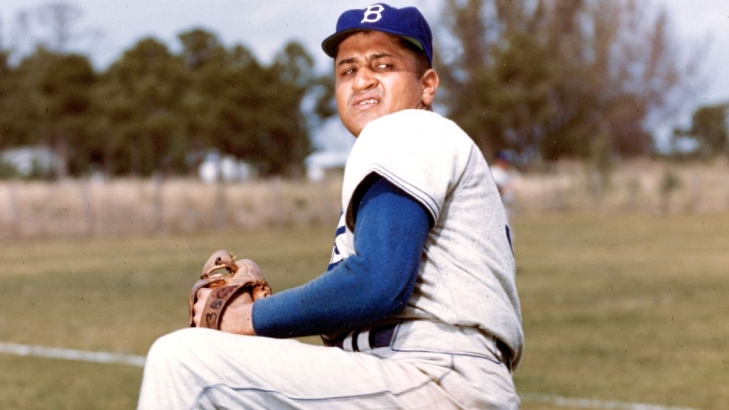
After a brief time with Newark in the Negro Leagues, Don Newcombe was signed by the Brooklyn Dodgers. After a few seasons in their minor league system, Newcombe was called up for the 1949 season, making him the third black pitcher in the Majors, but he was arguably the first dominant one.
With a towering 6-foot-4 frame, Newcombe captured the Rookie of the Year award after a 17-8 debut season that included 32 consecutive scoreless innings and a league-leading five shutouts, which he followed up with 19 wins in 1950 and his first 20-win season in 1951, while leading the league in strikeouts. Newcombe looked ready to dominate, but he was drafted into the U.S. Military and served in Korea for 2 years.
Following an underwhelming 1954 season, Newcombe demonstrated a remarkable resurgence. In 1955, he owned the mound, posting a 20-5 record that helped the Dodgers secure their inaugural and only World Series championship in Brooklyn. He subsequently delivered a stellar performance in 1956, posting a 27-7 record and leading the league with a WHIP of 0.989. This outstanding achievement granted him the distinction of being the first recipient of the Cy Young Award and concurrently named the National League Most Valuable Player, marking the first occasion on which a player received both honors within a single season.
Newcombe never came close to having another season like that again, and in the middle of the 1958 season, which he started 0-6 with a seven-plus ERA, he was traded to the Cincinnati Reds.
As a Dodger, Newcombe compiled a 123-66 record, a 3.51 ERA, and 916 strikeouts. The Dodgers would honor Newcombe in 2019, along with three others, with plaques as "Legends of Dodger Baseball."
17. Mike Piazza
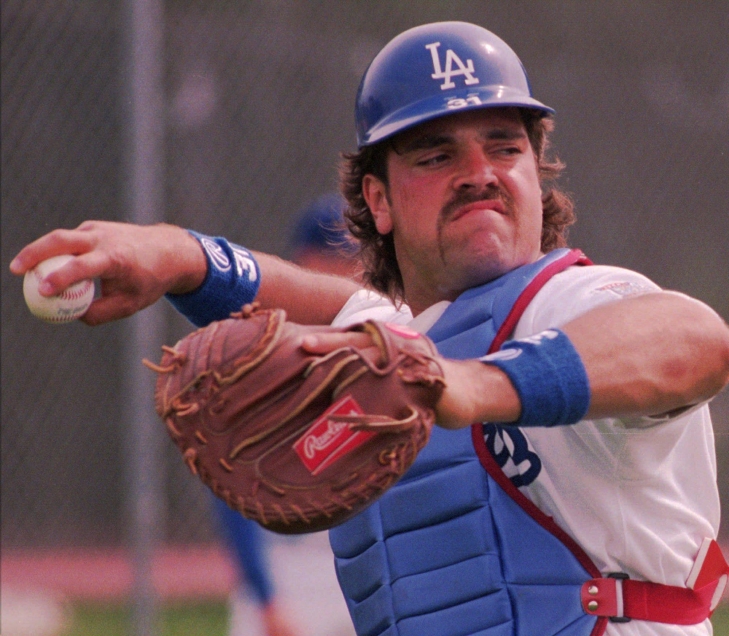
Mike Piazza’s story is a baseball impossibility, a 62nd-round draft pick whose entry into the professional ranks was a personal favor from Tommy Lasorda to his father. Initially a first baseman with a specialized bat but no defensive home, he made a tactical switch to catcher in the minors, a move that ultimately made him the greatest offensive force to ever play the position.
After a brief stint in 1992, Piazza took over the starting role in 1993 and delivered one of the most impressive debut seasons ever. He showed a rare ability to consistently hit to all fields, finishing with a .318 average, 35 home runs, and 112 RBIs, earning the National League Rookie of the Year Award unanimously. This breakout season set a new standard for a Dodger catcher, indicating that the organization had unintentionally discovered a once-in-a-generation talent with immense potential.
Between 1996 and 1997, Piazza achieved a historic surge in offensive efficiency, earning back-to-back second-place MVP finishes. His 1997 season stands out as a unique anomaly in franchise history; he hit an astonishing .362 with 40 home runs and 124 RBIs—a statistical feat that seems almost mythical for a full-time catcher. During this period, he was a regular All-Star and Silver Slugger, demonstrating his ability to anchor the middle of the lineup while managing a pitching staff featuring legends like Hideo Nomo and Pedro Martinez. Although some criticized his defensive skills, his offensive contributions largely made those concerns irrelevant.
As a Dodger, he posted a remarkable .966 OPS, a high-volume achievement that still stands as a franchise record for catchers. He demonstrated exceptional durability for the organization, regularly catching over 130 games annually while delivering a powerful bat that compelled opposing managers to adjust their entire game plan.
The departure from Los Angeles in May 1998 is one of the most divisive moments in the franchise's recent history. After a tense contract dispute and a change in team ownership to Fox, the Dodgers traded their star player to the Florida Marlins. This move was a bold sign of a rebuilding phase, although Piazza only spent a week in Florida before being traded again to the Mets.
Piazza compiled 177 home runs, a .331 average, and a .966 OPS in Dodger blue.
