

Our All Time Top 50 Cleveland Browns have been revised to reflect the 2025 Season
Yes, we know that this is taking a while!
As many of you know, we at Notinhalloffame.com are slowly generating the top 50 of each major North American sports team. That being said, we maintain and update our existing Top 50 lists annually. We are pleased to present our pre-2026 revision of our top 50 Cleveland Browns.
As for all of our top 50 players in football, we look at the following:
1. Duration and Impact.
2. Traditional statistics and how they finished in the National Football League.
3. Advanced Statistics.
4. Playoff performance.
5. Their respective legacy on the team.
6. How successful the team was when he was there.
7. Respecting the era in which they played.
Criteria 1-4 will make up the lion’s share of the algorithm. Please note that we have implemented this for the first time. This has changed the rankings all throughout the board.
Last year, the Browns won only five games, yet three players rose into the top 50.
As always, we present our top five, which saw a change at the top tier of the list.
1. Jim Brown
2. Otto Graham
3. Myles Garrett
4. Joe Thomas
5. Lou Groza
You can find the complete list here:
Defensive End Myles Garrett, who was shockingly traded to the Los Angeles Rams in the offseason after winning his second Defensive Player of the Year Award, moved up to #3 from #5.
Offensive Lineman Joel Bitonio edged up two more spots to #14.
The only other change was Cornerback Denzel Ward, who vaulted ten spots to #36.
We thank you for your continued support of our lists on Notinhalloffame.com.
Our All Time Top 50 Cleveland Browns have been revised to reflect the 2025 Season

Yes, we know that this is taking a while!
As many of you know, we at Notinhalloffame.com are slowly generating the top 50 of each major North American sports team. That being said, we maintain and update our existing Top 50 lists annually. As such, we are delighted to present our post-2024 revision of our top 50 Cleveland Browns.
As for all of our top 50 players in football, we look at the following:
1. Advanced Statistics.
2. Traditional statistics and how they finished in the National Football League.
3. Playoff accomplishments.
4. Their overall impact on the team and other intangibles that are not reflected in a stat sheet.
Last year, the Browns were awful, winning only three games. Despite this dismal performance, there was one new entry and three elevations on the all-time list.
As always, we present our top five, which saw a new entrant to the elite group.
1. Jim Brown
2. Otto Graham
3. Joe Thomas
4. Lou Groza
5. Myles Garrett
You can find the entire list here.
The change in the top five saw 2023 Defensive Player of the Year Myles Garrett move up five spots and knock Hall of Fame Tight End Ozzie Newsome from that spot.
Offensive Guard Joel Bitonio moved up three spots to #16 after adding his seventh Pro Bowl in 2024.
Running Back Nick Chubb, who is now a Houston Texan, did enough to move up one spot to #43.
The lone new entry is Cornerback Denzel Ward. He comes in at #46.
We thank you for your continued support of our lists on Notinhalloffame.com.
Our All-Time Top 50 Cleveland Browns have been revised to reflect the 2023 Season.
Yes, we know that this is taking a while!
As many of you know, we at Notinhalloffame.com are slowly generating the top 50 of each major North American sports team. That being said, we have existing Top 50 lists and consistently look to update them when necessary and based on necessity. As such, we are delighted to present our post-2023 revision of our top 50 Cleveland Browns.
As for all of our top 50 players in football, we look at the following:
1. Advanced Statistics.
2. Traditional statistics and how they finished in the National Football League.
3. Playoff accomplishments.
4. Their overall impact on the team and other intangibles that are not reflected in a stat sheet.
Last year, the Browns returned to the playoffs but could not get past their first game. There were no new entries and two elevations in our Top 50.
As always, we present our top five, which saw no changes:
1. Jim Brown
2. Otto Graham
3. Joe Thomas
4. Lou Groza
5. Ozzie Newsome
You can find the entire list here.
Reigning Defensive Player of the Year, Myles Garrett rocketed to #12 from #32.
Left Tackle Joel Bitonio, on a six-year Pro Bowl streak, climbed to #18 from #24.
Notably, Running Back Nick Chubb remains at #44.
We thank you for your continued support of our lists on Notinhalloffame.com.
Pro Football Hall of Fame Revisited Project: 1961 FINAL VOTE
1961 Pro Football Hall of Fame Revisited Project Class.
Here we are! Again!!
If you have been following our Pro Football Hall of Fame Revisited Project, you know that we have asked the rhetorical question: What if the PFHOF began in January 1946?
After soliciting and obtaining a passionate group of football fans and historians, we sent out a ballot for a Preliminary Vote, in which we asked each voter to give us 25 names as their semi-finalists and 5 in the Senior Pool. Following that, we asked the group to vote for their 15 Finalists in the Modern Era and 3 in the Senior Category. The final stage was to vote for their five Modern Era inductee and one Senior inductee.
This is the result of the sixteenth official class;
Below are the final results of this project based on 31 votes,
Remember that the group took a vote in “1961”, and we have reverted back to the top five candidates entering the Hall PROVIDING THEY MAKE 50% of the vote. This will be put to a vote again in “1963”.
This is for the “Modern Era”
*Bold indicates they have been elected to the Pro Football Hall of Fame Revisited Class of 1961:
|
Player |
Year of Eligibility |
Vote Total |
|
Otto Graham QB |
1 |
31 |
|
Marion Motley FB |
1 |
28 |
|
Pete Pihos E-DE |
1 |
19 |
|
Charley Trippi HB-QB-DB |
1 |
17 |
|
Doak Walker HB-DB |
1 |
15 |
|
George Connor T-LB-DT-G |
1 |
10 |
|
Ward Cuff WB-QB-HB |
9 |
6 |
|
Marshall Goldberg FB |
8 |
6 |
|
Joe Kopcha G |
20 |
5 |
|
Dick Barwegan G |
2 |
5 |
|
Buckets Goldenberg G-BB |
11 |
4 |
|
Bill Osmanski FB |
9 |
2 |
|
Lou Rymkus T |
5 |
2 |
|
Ed Sprinkle DE-E-G-LB |
1 |
2 |
|
Pat Harder FB |
3 |
1 |
This is for the “Senior Era”, *Bold indicates they have been elected to the Pro Football Hall of Fame Revisited Class of 1961, though no one made the mandatory 50% threshold to advance.
|
Tony Latone |
6 |
12 |
|
Hunk Anderson |
11 |
10 |
|
None of the Above |
N/A |
5 |
|
Al Nesser |
5 |
4 |
About the 1961 Inductees:
Otto Graham QB-DB, CLE 1946-55: Inducted in the Pro Football Hall of Fame Revisited Project in 1961 on his 1st Ballot. Inducted into the actual Pro Football Hall of Fame in 1965.
Otto Graham was the first player that Cleveland Browns owner; Paul Brown, sought when he assembled his team in 1946 to begin play in the All-American Football Conference. Brown was right to convert the Northwestern Tailback to a pro Quarterback in the T-Formation. Graham and the Browns dominated the AAFC, and without question, Graham was the best player in the upstart league. The Browns won every single title in the four-year existence of the AAFC, and Graham was at the forefront of that success. The AAFC would merge with the NFL, and it was expected that those teams would not be successful in the first few years of the unification. They were wrong. The Browns won the 1950 NFL Championship, thus proving the merit of the AAFC; Graham won two more NFL Championships and was, overall, a five-time league leader in Passing Yards. In the ten years he played, there was never a year where he didn’t at least take the Browns to a Division Title.
Marion Motley FB-LB, CLE 1946-55: Inducted in the Pro Football Hall of Fame Revisited Project in 1961 on his 1st Ballot. Inducted into the actual Pro Football Hall of Fame in 1968.
While there were African Americans in pro football before Marion Motley, they had been phased out, but after World War II, this was about to change. Motley tried out for the Cleveland Browns of the new All-American Football Conference, and he made the team and would become oone f the best players in team history. Motley was an excellent rusher who won the AAFC Rushing Title in 1948, and the NFL Rushing Title in 1950, and he was a large part of the Cleveland juggernaut that won all four AAFC Championships and the 1950 NFL Championship. He was also incredibly valuable as a blocker and helped open up Otto Graham’s passing game. Motley had 5,827 Yards From Scrimmage, an excellent total for his era.
Pete Pihos E-DE, PHI 1947-55: Inducted in the Pro Football Hall of Fame Revisited Project in 1961 on his 1st Ballot. Inducted into the actual Pro Football Hall of Fame in 1970.
A three-time All-American at Indiana, Pete Pihos played his entire nine-year career with the Philadelphia Eagles, beginning as a two-way end, but eventually specializing in the offence. Pihos was one of the top receivers in the late 1940s and early 1950s, aiding the Eagles in back-to-back NFL Championships (1948 & 1949), and securing five First Team All-Pro Selections. In 1953, Pihos began a three-year streak leading the NFL in Receptions, with him also finishing first in Receiving Yards in the bookend seasons. He would accumulate 5,619 Yards with 61 Touchdowns.
Charley Trippi HB-QB-DB, CRD 1947-55: Inducted in the Pro Football Hall of Fame Revisited Project in 1961 on his 1st Ballot. Inducted into the actual Pro Football Hall of Fame in 1968.
Charley Trippi was a coveted player coming out of the University of Georgia, and the New York Yankees of the upstart All-American Football Conference thought they had him locked up. The Chicago Cardinals, who drafted him first overall, earned his services when Cardinals owner, Charles Bidwell signed him to what was a huge contract at the time, $100,000 over four years. Trippi was the heart of what would become Chicago’s “Million Dollar Backfield” and as a rookie in 1947, he would lead the Cardinals to an NFL Championship. Incredibly versatile, Trippi could play any offensive skill position and excelled at rushing, passing and punting. He played until 1955, finishing his career with the Cardinals and amassing 4,827 Yards From Scrimmage.
Pro Football Hall of Fame Revisited Project: 1961 SEMI-FINAL VOTE

1961 SEMI-FINAL RESULTS:
Thank you for all of you who have participated in the Pro Football Hall of Fame Revisited Project. If you are unaware of what that is, we acted as if the PFHOF had its first class in January 1946.
We have completed the years up to 1960.
For “1961,” a Preliminary Vote with over 100 players whose playing career ended by 1954. We are also following the structure in that players have 20 years of eligibility, and if they do not make it into the Hall, they are relegated to the Senior Pool.
Each voter was asked to select 25 names from the preliminary list, and the top 25 vote-getters were named Semi-Finalists.
A week later, the voters were asked to pick 15 names from the 25 Semi-Finalists, and next week, they will pick five from the remaining 15. We will continue this process weekly until we catch up to the current year.
30 Votes took place, with the top five advancing.
This is for the “Modern Era”
Bold indicates they advanced to the Finals:
|
Player |
Year of Eligibility |
Vote Total |
|
Otto Graham QB |
1 |
29 |
|
Marion Motley FB |
1 |
29 |
|
Charley Trippi HB-QB-DB |
1 |
26 |
|
Doak Walker HB-DB |
1 |
23 |
|
Pete Pihos E-DE |
1 |
23 |
|
Dick Barwagen G |
2 |
21 |
|
Marshall Goldberg T |
8 |
20 |
|
George Connor T-LB-DT-G |
1 |
18 |
|
Ward Cuff WB-QB-HB |
9 |
17 |
|
Joe Kopcha G |
20 |
17 |
|
Bill Osmanski FB |
9 |
15 |
|
Lou Rymkus T |
5 |
16 |
|
Buckets Goldenberg G-BB |
11 |
14 |
|
Pat Harder FB |
3 |
14 |
|
Ed Sprinkle DE-E-G-LB |
1 |
14 |
|
George Christensen G-T |
18 |
13 |
|
Ace Gutkowski FB-TB |
17 |
13 |
|
Bruno Banducci G |
2 |
13 |
|
Whizzer White TB-HB |
15 |
12 |
|
Vic Sears T-DT |
3 |
12 |
|
Woody Strode E |
7 |
6 |
|
Glenn Presnell T-B |
20 |
6 |
|
George Svendsen C |
15 |
6 |
|
Spec Sanders TB |
6 |
5 |
|
Frankie Albert QB |
4 |
3 |
This is for the “Senior Era”
*Bold indicates they advanced to the Finals:
|
Tony Latone |
6 |
19 |
|
Al Nesser |
4 |
18 |
|
Hunk Anderson |
11 |
15 |
|
Cub Buck |
11 |
9 |
|
Wildcat Wilson |
7 |
8 |
We will post the Finalists of the Class of the 1961 Pro Football Hall of Fame Revisited Project next Saturday.
Thank you to all who contributed. If you want to be part of this project, please let us know!
Our All-Time Top 50 Cleveland Browns have been revised to reflect the 2022 Season
Yes, we know that this is taking a while!
As many of you know, we here at Notinhalloffame.com are slowly generating the 50 of each major North American sports team. That being said, we have existing Top 50 lists out and we always consistently look to update them when we can and based on necessity. As such, we are very happy to present our post 2022 revision of our top 50 Cleveland Browns.
As for all of our top 50 players in football we look at the following:
1. Advanced Statistics.
2. Traditional statistics and how they finished in the National Football League.
3. Playoff accomplishments.
4. Their overall impact on the team and other intangibles not reflected in a stat sheet.
Last year, the Browns were a trendy pick to make it to the Super Bowl, but not only did that not happen, they failed to make the playoffs. This did not impact a new entrant occurring as well as two significant elevations from occurring.
As always, we present our top five, which had no changes.
1. Jim Brown
2. Otto Graham
3. Joe Thomas
4. Lou Groza
You can find the entire list here.
Joel Bitonio, who has starred on the Browns O-Line for the past half-decade, rocketed to #24 from #38.
Defensive End, Myles Garrett advances to #32 from 44.
Running Back, Nick Chubb, makes his first appearance at #44.
We welcome your input and comments and as always, we thank you for your support.
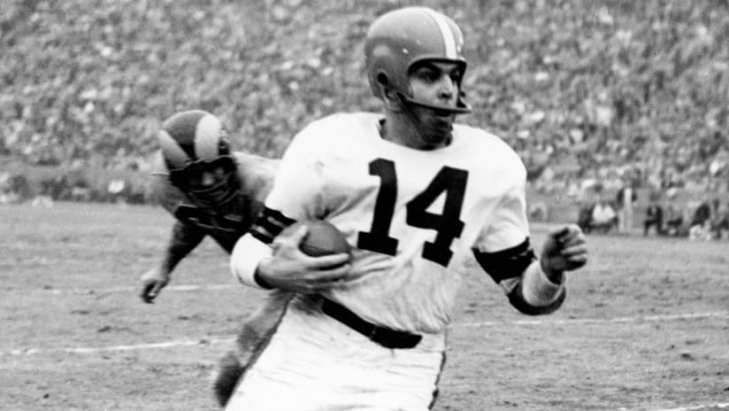
2. Otto Graham
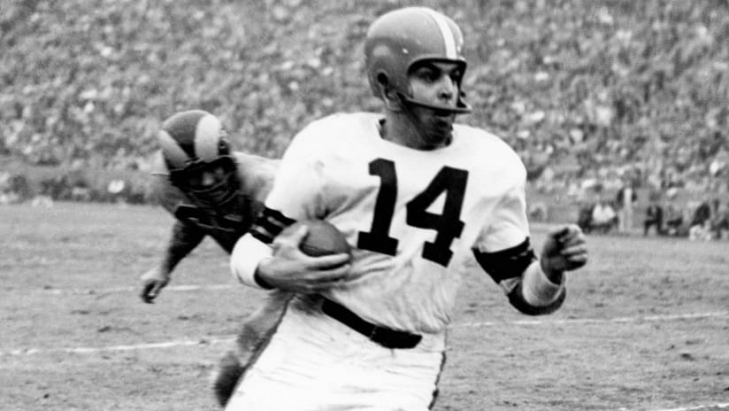
Long before Jim Brown arrived on Lake Erie, Otto Graham established the baseline of excellence for the Cleveland Browns. A multi-sport standout at Northwestern, Graham was named Big Ten Player of the Year in 1943 and finished third in Heisman Trophy voting. While enrolled in Navy flight school at Colgate, he continued to showcase his athletic versatility by playing professional basketball for the Rochester Royals—winning an NBL title in 1946—before legendary coach Paul Brown selected him to be the field general for his new pro football franchise in the All-America Football Conference (AAFC).
Graham possessed pinpoint passing accuracy, supreme poise under pressure, and a deep understanding of Paul Brown’s revolutionary, structured passing offense. Operating under center, "Automatic Otto" possessed a quick release, deadly deep-ball placement, and the mobility to run for clutch third-downs or short-yardage touchdowns. He set a standard for efficiency that fundamentally shifted professional football from a run-heavy league to a passing-dominated sport.
What truly defined Graham’s playing style was his ahead-of-his-time mastery of pocket mechanics and intermediate field vision. In an era when quarterbacks rarely had structured pass protection, Graham navigated collapsing pockets with light, rhythmic footwork, never taking his eyes off downfield coverage. He threw with exquisite touch, effortlessly dropping deep corner routes over tight coverage or driving fastballs into tight windows on comeback routes. His quick decision-making allowed Paul Brown’s scripted timing offense to operate with surgical precision, rarely giving pass rushers a chance to strike.
Graham's skills extended beyond his arm, as he brought a tough, gritty physicality to the quarterback role. With a background as a collegiate single-wing tailback, he served as a powerful goal-line runner, executing handoffs on bootlegs or sneaks into the end zone. A fearless leader, he embraced the rough physicality of 1950s football, often playing through severe injuries, and his steady, composed presence in fourth-quarter drives earned the complete trust of his teammates in the Cleveland huddle.
Since the franchise's inception in 1946, Graham transformed the AAFC into his personal domain. He led the Browns to win all four AAFC Championship Games (1946–1949) and topped the league in passing yards in the last three seasons before the league dissolved.
Throughout that four-year period, Graham was awarded three AAFC Most Valuable Player honors. Following the dissolution of the AAFC after the 1949 season and the subsequent merger of the Browns into the National Football League, critics anticipated that Cleveland’s expansive passing offense would falter against the seasoned defenses of the NFL.
Graham quickly silenced all skeptics in his 1950 NFL debut season. In the season opener against the reigning NFL champion Philadelphia Eagles—a game dubbed the "World Series of Football"—he shredded the Eagles for 346 passing yards and three touchdowns in a 35–10 rout. He capped the year by leading the Browns to the 1950 NFL Championship Game, throwing four touchdown passes and engineering a game-winning fourth-quarter drive in a 30–28 victory over the Los Angeles Rams, securing five consecutive league titles for Cleveland.
Over the subsequent three seasons, Graham remained the unequivocal benchmark at the quarterback position. He was awarded the UPI NFL Most Valuable Player accolade in 1951, guiding Cleveland to the championship game. In 1952, he led the NFL in completions with 181 and passing yards totaling 2,816. In 1953, he achieved a personal statistical zenith, earning his second NFL MVP award while leading the league in completion percentage (64.7%), passing yards (2,722), and attaining an impressive 10.55 yards per pass attempt.
Graham's career concluded with back-to-back championship masterclasses. In the 1954 NFL Championship Game, he delivered an all-time performance against the Detroit Lions, throwing for three touchdowns and rushing for three more in a 56–10 blowout win. Though he initially planned to retire, Paul Brown coaxed him back for one final season in 1955. Graham responded by earning his third NFL MVP award and leading the Browns back to the title game against the Rams, where he ran for two touchdowns and threw for two more in a 38–14 victory before walking off into retirement to a standing ovation.
Graham played in 126 regular-season games, compiling a staggering 105–17–4 record as a starter and leading the Browns to the league championship game in every season of his career. He threw for 23,584 yards and 174 touchdowns, adding 44 rushing touchdowns. His career average of 8.63 yards per pass attempt remains the highest mark in NFL history.
In 1965, Graham took his rightful place in Canton with his induction into the Pro Football Hall of Fame. The Browns retired his iconic No. 14 jersey, enshrined him in the inaugural class of the Cleveland Browns Ring of Honor in 2010, and commemorated his impact with a bronze statue outside Huntington Bank Field. He was also selected to the NFL 1950s All-Decade Team as well as the NFL's 75th and 100th Anniversary All-Time Teams.
