

Committee Chairman
Our All Time Top 50 Los Angeles Angels have been updated to reflect the 2022 Season
Yes, we know that this is taking a while!
As many of you know, we here at Notinhalloffame.com are slowly generating the 50 of each major North American sports team. That being said, we have existing Top 50 lists out and we always consistently look to update them when we can and based on necessity. As such, we are very happy to present our post 2022 revision of our top 50 Los Angeles Angels.
As for all of our top 50 players in baseball we look at the following:
1. Advanced Statistics.
2. Traditional statistics and how they finished in the American League.
3. Playoff accomplishments.
4. Their overall impact on the team and other intangibles not reflected in a stat sheet.
Last year, Los Angeles again failed to make the playoffs, despite having the two best players of this generation, one who is ranked number one on this list, and another who jumped 20 spots.
As always, we present our top five, which was not affected by the last season:
1. Mike Trout
2. Nolan Ryan
3. Chuck Finley
4. Frank Tanana
5. Jered Weaver
You can find the entire list here.
2021 MVP and dual-threat superstar, Shohei Ohtani, rocketed from #31 to #12.
We welcome your input and comments and as always, we thank you for your support.
Our All-Time Top 50 Cleveland Guardians have been updated to reflect the 2022 Season
Yes, we know that this is taking a while!
As many of you know, we here at Notinhalloffame.com are slowly generating the 50 of each major North American sports team. That being said, we have existing Top 50 lists out and we always consistently look to update them when we can and based on necessity. As such, we are very happy to present our post 2022 revision of our top 50 Cleveland Guardians.
As for all of our top 50 players in baseball we look at the following:
1. Advanced Statistics.
2. Traditional statistics and how they finished in the American League.
3. Playoff accomplishments.
4. Their overall impact on the team and other intangibles not reflected in a stat sheet.
Last year, Cleveland had a great year, making the playoffs, and showing that they have a roster that could go deep this year. This resulted in two changes, one new entrant, and one elevation.
As always, we present our top five, which was not affected by the last season:
1. Bob Feller
2. Nap Lajoie
3. Tris Speaker
4. Lou Boudreau
5. Bob Lemon
You can find the entire list here.
Slugger, Jose Ramirez, climbed to #16 from #21.
The lone new entry is 2020 Cy Young winner, Shane Bieber, who debuts at #49.
We welcome your input and comments and as always, we thank you for your support.
41. Shane Bieber
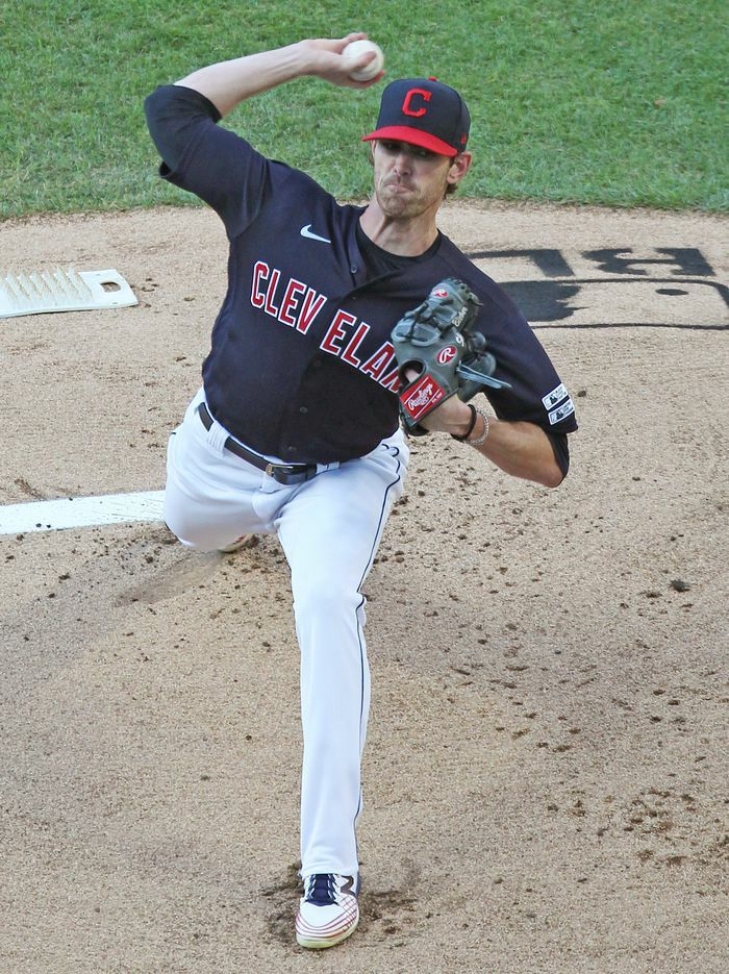
When Shane Bieber arrived in Cleveland in 2018, he brought a level of specialized control that seemed to belong to a different era. A fourth-round find who prioritized precision over raw velocity, the right-hander quickly evolved into the premier tactical force of the American League. For most of the early 2020s, he served as the high-leverage anchor of a Guardians rotation that has long been the gold standard for pitching development, providing a blueprint for how to dismantle elite lineups with a devastating knuckle-curve and an almost surgical command of the strike zone.
Bieber’s tenure in Cleveland was defined by a rapid, high-velocity ascent from a sleeper prospect to a dominant strikeout king. After a foundational rookie campaign, he earned his first All-Star nod in 2019, fanning 259 batters. However, his career reached a historic outlier status during the shortened 2020 season. That summer, Bieber orchestrated one of the most efficient runs in the history of the sport, capturing the Triple Crown of pitching by leading the American League in wins (8), ERA (1.63), and strikeouts (122). He was a model of specialized dominance, posting a staggering 273 ERA+ and a league-leading 14.2 strikeouts per nine innings to secure a unanimous Cy Young Award.
The hallmark of his stay was a professional resilience that saw him transition from a high-strikeout power arm to a more nuanced, efficiency-driven starter as he navigated the physical toll of the modern game. Even as his velocity fluctuated, his individual value remained elite; he collected a second All-Star selection in 2021 and a Gold Glove in 2022, proving he was the most efficient run-preventer on the roster regardless of how the ball left his hand. He served as the primary engine of the 2022 division-winning squad, using veteran poise to lead a young staff back to the postseason. He proved that a player could remain a franchise pillar by mastering the specialized, high-stakes art of sequencing and location.
His presence in Cleveland was defined by a focused intensity that solidified his status as a local icon, famously highlighted by his 2019 All-Star Game MVP performance before the home crowd. However, the narrative reached a pivotal crossroads in early 2024 when he underwent Tommy John surgery. As he navigated his recovery into the 2025 season, the Guardians faced a difficult organizational decision regarding his expiring contract. Bieber was traded to the Blue Jays for their playoff run, thus ending his run on the shore of Lake Erie.
With Cleveland, Bieber compiled 62 wins and 958 strikeouts while securing a Cy Young Award and a Pitcher's Triple Crown.
Our All-Time Top 50 Baltimore Orioles have been revised to reflect the 2022 Season
Yes, we know that this is taking a while!
As many of you know, we here at Notinhalloffame.com are slowly generating the 50 of each major North American sports team. That being said, we have existing Top 50 lists out and we always consistently look to update them when we can and based on necessity. As such, we are very happy to present our post 2022 revision of our top Baltimore Orioles.
As for all of our top 50 players in baseball we look at the following:
1. Advanced Statistics.
2. Traditional statistics and how they finished in the American League.
3. Playoff accomplishments.
4. Their overall impact on the team and other intangibles not reflected in a stat sheet.
Last year, Baltimore went over .500, and could be a sleeper team in 2023, however none of their players cracked the Top 50, nor were there any changes. We still want to acknowledge that we have counted 2022 into our rankings.
As always, we present our top five, which was not affected by the last season:
2. Jim Palmer
5. Eddie Murray
You can find the entire list here.
We welcome your input and comments and as always, we thank you for your support.
