


Committee Chairman
The 5 Most Impactful Events In Canadian Sports History
Every nation has its formative sporting moments; those events that gather friends and family around a TV to watch the action unfold; which pick up viewers as time passes, as people call their friends and say, “have you seen what’s happening?”. These are the events that sports professionals talk about decades later when an interviewer asks them, “So, what made you want to pick up a stick/reach for a bat/grab your running shoes?”.
They are events that dominate the national conversation, at least for a week or so, and which have even been guiding smart wagers since sports betting in Canada became legal in 2021. When people say, “there’s no chance a Canadian player/team could [x]”, these are the moments people have cited to prove them wrong. So which moments have launched these revelations for a Canadian sporting audience?
Wayne Gretzky is traded to LA
Gretzky is nicknamed “The Great One”, and when you have a nickname that doesn’t reference your own name, you know you have joined the elite. No-one better has ever picked up a stick, and Edmonton Oilers fans were proud to call him their own for a decade starting in 1979. When Oilers owner Peter Pocklington traded Gretzky away to the Kings in 1988, the anger was so great that effigies of Pocklington were burned in public, and questions were asked in Parliament over whether the move could be blocked. Wounds heal, of course, and Gretzky is remembered these days simply as the best there ever was; he also - arguably single-handedly - made hockey a big deal even in warm-weather locations.
Donovan Bailey wins the Olympic 100m in 1996
Few events have been more scarring on the Canadian national sporting psyche than Ben Johnson’s 1988 Olympic win and the rapid overturning of that win due to a failed drug test. That story has been told and re-told, but redemption came for Canadian sprinting eight years later as Bailey, running in lane six, legitimately broke the world record and picked up gold. The race had been preceded by three false starts and the disqualification of defending champion Linford Christie; in the circumstances, Bailey’s focus and calm were astonishing.
The Blue Jays win the World Series in 1992. And then also in 1993.
Canadian teams were a late addition to Major League Baseball, beginning with Montreal in 1969. Toronto followed in the mid-70s, and it was the Jays who would first bring the World Series back over the border with them, knocking off perennial runners-up Atlanta in 1992. The triumph was more impressive when they repeated it the following year, defeating Philadelphia 4-2 in the series to become the first club since the Yankees in 1978 to retain the title.
Team Schmirler wins gold at the 1998 Winter Games
Curling was a medal sport for the first time at the 1998 games in Nagano, Japan. Selected after a competitive round-robin tournament, Sandra Schmirler’s rink represented the Maple Leaf in Japan. After setting the pace in the pool stages, Schmirler saw off Great Britain in the semi-final and then won in nine ends against Denmark to take gold. As a result, Schmirler became the first curler to appear on the front of the New York Times.
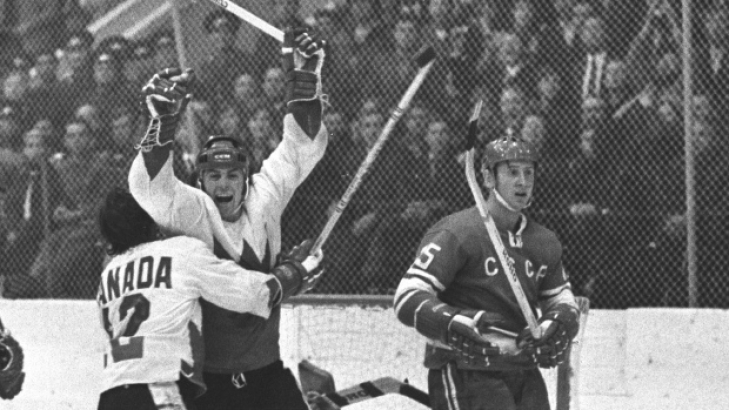
Paul Henderson. Moscow. 1972.
There have, as we have seen, been other moments in Canadian sports which has grabbed the hearts and minds of the nation. However, the final game of the Summit Series in Moscow had it all. With the series tied at three wins each and a single tie - and having come back from a 3-1 series deficit - Canada faced the Soviet Union one last time for the honor of being the world’s best ice hockey team. Trailing 5-3 at the entry to the final period, Canada needed something special. They got it.
Inspired by Phil Esposito, the visiting team mounted a comeback, culminating in Henderson’s rebound winner with 34 seconds left to play. Fifty years on, it is a moment that reverberates with hockey fans, including those who weren’t yet born when it happened.
RIP: Burt Bacharach
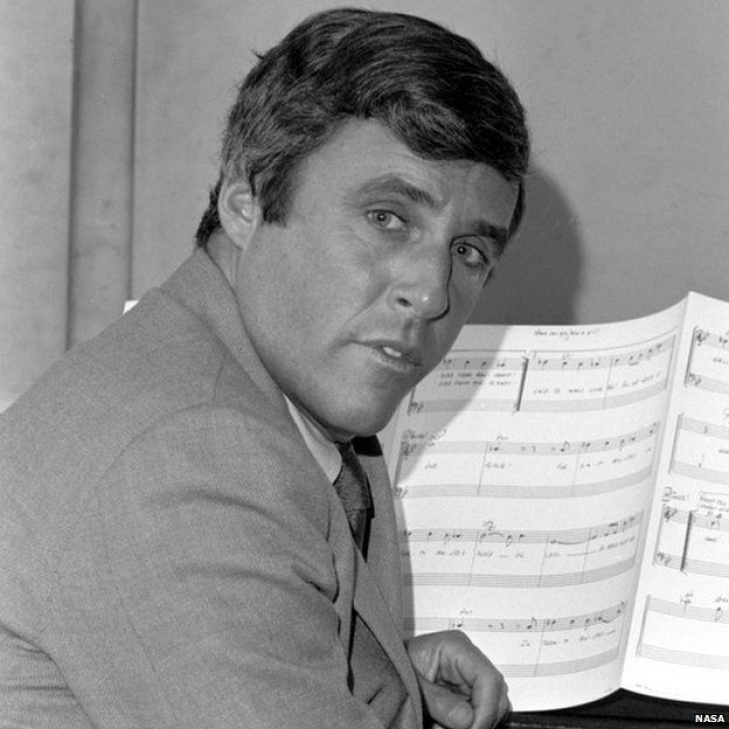
Music lost one of the legendary composers/songwriters with the passing of Burt Bacharach, who passed away at the age of 94.
Bacharach is considered one of the greatest songwriters of all-time, having written or cowritten staples in the Easy Listening genre. His fingerprints were all over 73 U.S. top 40 hits which included these songs:
“The Man Who Shot Liberty Valance” (Gene Pitney)
“Only Love Can Break a Heart” (Gene Pitney)
“Don’t Make Me Over” (Dionne Warwick)
“Blue on Blue” (Bobby Vinton)
“Close to You” (The Carpenters)
“Walk On By” (Dionne Warwick)
“What the World Needs Now Is Love” (Jackie DeShannon)
“What’s New Pussycat” (Tom Jones)
“The Look of Love” (Dusty Springfield)
“I Say a Little Prayer” (Dionne Warwick)
“Do You Know the Way to San Jose” (Dionne Warwick)
“This Guy’s in Love with You” (Herb Alpert)
“Raindrops Keep Fallin’ on My Head” (B.J. Thomas)
“Arthur’s Theme” (Christopher Cross)
“That’s What Friends are For” (Stevie Wonder, Elton John, Gladys Knight and Dionne Warwick)
“On My Own” (Patti LaBelle and Michael McDonald)
Bacharach also won six Grammy Awards and three Oscars for his work.
We here at Notinhalloffame.com would like to extend our condolences to the fans, friends and family of Burt Bacharach.
Our All-Time Top 50 Houston Astros have been revised to reflect the 2022 Season
Yes, we know that this is taking a while!
As many of you know, we here at Notinhalloffame.com are slowly generating the 50 of each major North American sports team. That being said, we have existing Top 50 lists out and we always consistently look to update them when we can and based on necessity. As such, we are very happy to present our post 2022 revision of our top Houston Astros.
As for all of our top 50 players in basketball we look at the following:
1. Advanced Statistics.
2. Traditional statistics and how they finished in the American League.
3. Playoff accomplishments.
4. Their overall impact on the team and other intangibles not reflected in a stat sheet.
Last year, Houston won their second World Series, and they are blessed with young talent, two of which make their first appearance on this list.
As always, we present our top five, which was not impacted by last season:
1. Jeff Bagwell
2. Craig Biggio
3. Jose Altuve
5. Cesar Cedeno
You can find the entire list here.
Despite his good year, Altuve was unable to pass Biggio for #2.
Justin Verlander, who won the Cy Young, and is now with the New York Mets, jumped from #19 to #11; an impressive feat considering the relative brevity of his Astros career.
Infielder, Alex Bregman, moved up two spots to #14.
Yuli Gurriel also moved up by two, with a new rank of #35.
Designated Hitter, Yordan Alvarez, makes his debut at #37 and Outfielder, Kyle Tucker, comes in at #45.
We welcome your input and comments and as always, we thank you for your support.
23. Kyle Tucker
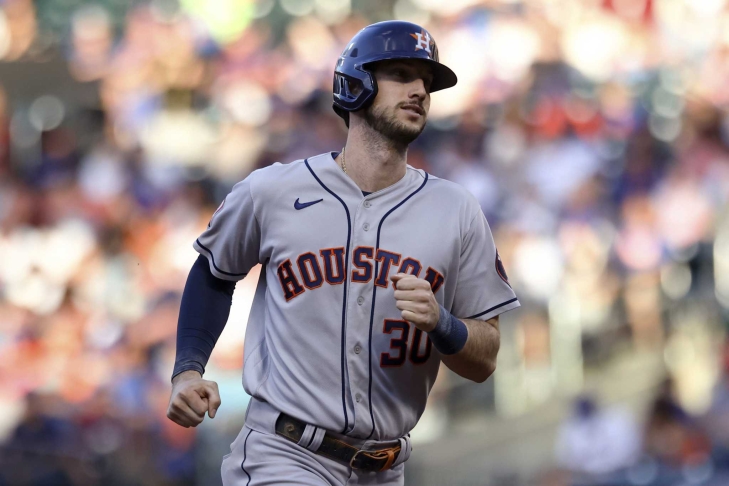
Kyle Tucker first made his mark in Houston as a highly touted fifth-overall pick, though his initial taste of the big leagues in 2018 was a difficult stretch where he struggled to find his rhythm. After a more promising 2019 cameo, he secured his place in the lineup for good during the shortened 2020 campaign. For seven seasons, he patrolled right field with a specialized, smooth left-handed swing and a deceptive speed that made him one of the most efficient all-around threats in the American League.
Tucker’s emergence in Houston reached a historic breakout during the 2021 and 2022 seasons. After leading the league in triples in 2020, he transitioned into a premier middle-of-the-order force, launching 30 home runs in back-to-back years. He demonstrated a focused intensity on both sides of the ball, pairing his offensive efficiency with an elite glove that earned him a Gold Glove in 2022. He showed the organization that he was a foundational piece of a world-title squad, recording 107 RBIs and earning a Silver Slugger as the Astros captured the 2022 World Series championship.
In 2023, Tucker reached a career peak for individual dominance, leading the American League with 112 RBIs and finishing fifth in the MVP voting. He possessed a specialized ability to combine power and discipline, narrowly missing a 30-30 season while earning his second straight All-Star nod and a third consecutive All-MLB selection. Despite a 2024 campaign that was interrupted by a frustrating injury, he remained a statistical force when healthy, securing his third straight All-Star selection before a shifting organizational strategy led to a change in direction.
Following the 2024 season, the Astros traded their star outfielder to the Chicago Cubs. He left behind a statistical footprint that reflected his status as one of the most balanced players in franchise history, amassing 125 home runs and 615 hits during his tenure.
