


Committee Chairman
19. Juan Guzman
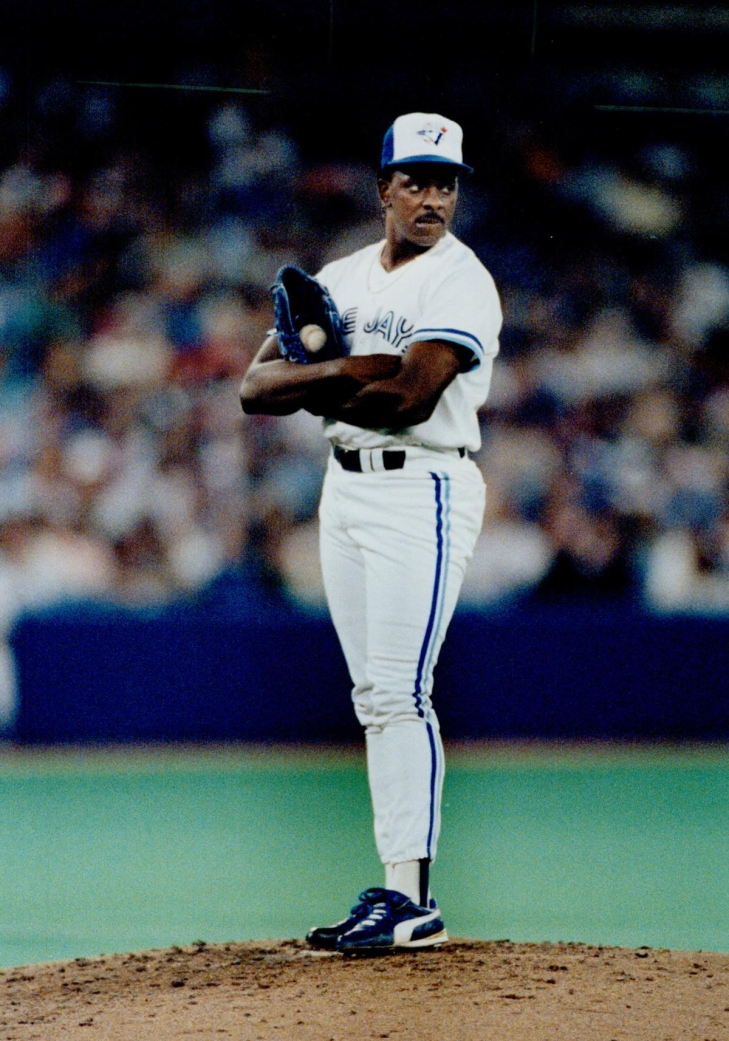
The Los Angeles Dodgers first signed a young Juan Guzmán from the Dominican Republic in 1985, seeing a raw, unrefined arm still years from maturity. Recognizing his potential, the Toronto Blue Jays acquired him in a minor league trade two years later. After developing through the farm system, the dynamic right-hander made a major breakthrough in June 1991. With a blazing fastball in the high-90s and an effective slider, Guzmán delivered a remarkable 10–3 rookie season, finishing as a close runner-up for the AL Rookie of the Year Award and quickly becoming a key member of a championship-caliber rotation.
His remarkable debut marked the start of an impressive two-year peak that aligned perfectly with the franchise's golden era. During the 1992 and 1993 seasons, Guzmán emerged as the key player in high-stakes games for a dominant team, destroying opposing lineups and achieving an outstanding 30–8 record in the regular season. He combined this with an exceptional postseason record, losing no games in the playoffs during the team’s consecutive championship runs, going 5–0 in both October series to help secure back-to-back World Series titles. After finishing seventh in the 1992 Cy Young Award voting, he seemed ready to establish himself as the junior circuit's next top ace.
Surprisingly, that elite velocity soon collided with severe mechanical and physical inconsistencies. Guzmán experienced a catastrophic drop-off over the next two summers, looking completely lost during the strike-shortened 1994 and 1995 campaigns. He battled rampant walks and persistent injuries, watching his ERA balloon to a disastrous 5.68 and 6.32 while his WHIP spiked past 1.60.
Just when it seemed Guzmán’s career was over, he staged an extraordinary comeback in 1996. Confusing American League hitters with a completely revamped approach, he led the league with a 2.93 ERA. His resurgence was also evident as he topped the junior circuit in ERA+ (171), WHIP (1.124), and hits allowed per nine innings (7.6). However, in a surprising turn of events typical in high-scoring eras, he received no votes for the Cy Young Award.
Unfortunately, that spectacular rebound proved to be a final, isolated flash of his peak form. The mechanical issues returned to derail him in 1997, and with his contract winding down on a struggling Toronto team, the front office elected to maximize his remaining market value. In July 1998, the Blue Jays traded their former postseason hero to the Baltimore Orioles, bringing a highly volatile, thrilling chapter to a sudden close.
With the Jays, Guzmán made 218 appearances (214 starts). He compiled a 76–62 record with a 4.07 ERA and a 1.36 WHIP, logging 1,321.2 innings and 1,030 strikeouts.
14. Roger Clemens
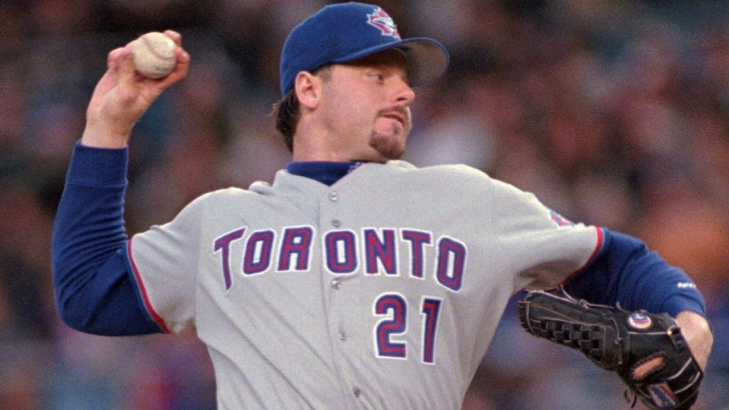
When Roger Clemens signed a lucrative free-agent deal with the Toronto Blue Jays in December 1996, many in baseball doubted the move. Boston general manager Dan Duquette had notably said the ace was nearing the end of his career, allowing the 13-year Red Sox legend to leave after two seasons that hinted his top skills were fading. Determined to disprove his former team, the fiercely competitive pitcher moved north of the border and delivered an extraordinary period of dominance, recording one of the most statistically impressive consecutive pitching performances in Major League Baseball history.
Although modern sports history tends to overlook his short two-season stint with the Blue Jays—and while concerns about performance-enhancing drugs would later cast a shadow on his career—his performance in that uniform marked a remarkable return to his absolute peak.
During the 1997 and 1998 seasons at SkyDome, "The Rocket" transformed his pitching approach, combining a revitalized mid-90s fastball with a deadly, untouchable split-finger fastball. He dominated American League hitters, winning the pitching Triple Crown in both years by leading in wins, strikeouts, and ERA each summer. He earned the AL Cy Young Award twice, leading the league in ERA+ and FIP throughout his tenure and also leading in WHIP during his groundbreaking 1997 debut. No pitcher in Toronto's history, before or since, has achieved such consistent individual dominance.
Every fifth day, Clemens turned a struggling Toronto team into a top-tier competitor, posting a remarkable 41–13 record and recording 563 strikeouts. However, despite his exceptional talent on the mound, the Blue Jays lacked sufficient roster depth to back him up. The team hovered around an equal number of wins and losses, rendering them non-competitive in the fiercely contested AL East pennant race, which was led by his former team and the rising powerhouse in New York.
Realizing his chance to win another World Series ring was slipping away, Clemens asked for a trade to a strong contender after his second consecutive Cy Young Award in 1998. The front office responded in February 1999 by making a major trade, sending Clemens to the New York Yankees in exchange for David Wells, Graeme Lloyd, and Homer Bush.
Because his time in Ontario was compressed into just two summers, his name doesn't sit near the top of the organization's multi-decade career volume leaderboards. Yet, generating an astronomical 20.1 total bWAR in just 67 starts, his blistering, award-winning peak gave Toronto baseball a concentrated injection of historic pitching excellence that remains permanently unmatched. With Toronto, he posted an impressive 41–13 record, a tiny 2.33 ERA, and a 1.06 WHIP. He pitched 508.2 innings, including 20 complete games, five shutouts, and 563 strikeouts.
13. Joe Carter
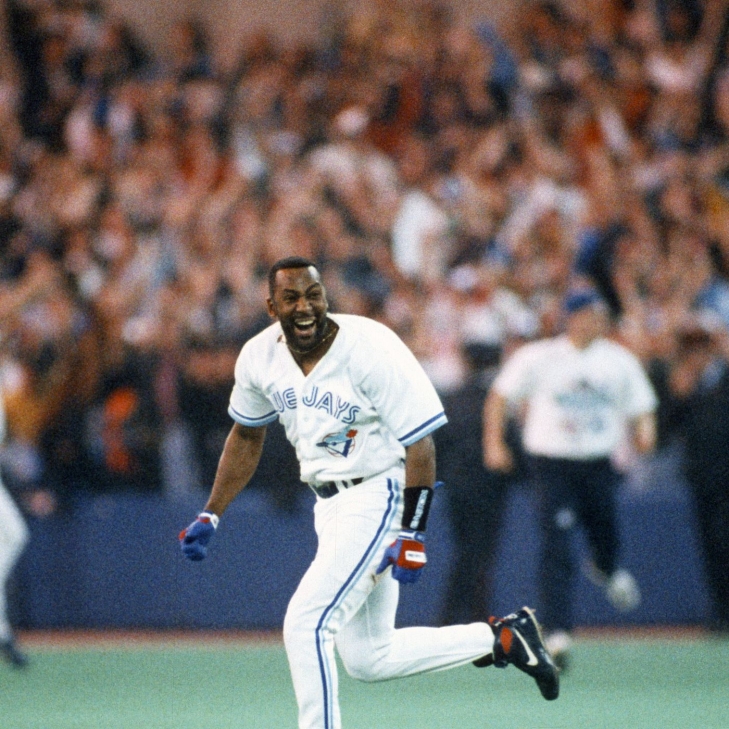
Assessing Joe Carter’s legacy in Canada involves balancing striking cinematic imagery with the concrete realities of contemporary baseball statistics. To many fans, he represents the quintessential symbol of the franchise's zenith. However, upon closer examination of his overall contribution through advanced metrics, a nuanced picture appears of a largely imperfect run-producer whose legendary stature significantly exceeds his analytical impact.
Arriving alongside Roberto Alomar in the historic December 1990 trade that sent Fred McGriff and Tony Fernández to San Diego, Carter immediately provided the Toronto Blue Jays with a formidable, high-profile middle-of-the-order hitter. He delivered precisely what the front office requested: sustained, formidable power. During a seven-season tenure in Ontario, the resilient outfielder averaged nearly 30 home runs annually, culminating in 203 home runs and 736 RBIs. Traditional award voters appreciated his impressive counting statistics; Carter’s consistent performance near the top of the American League in home runs and RBIs earned him two Silver Slugger Awards and consecutive top-five finishes in the AL MVP voting (fifth in 1991 and third in 1992).
His place in baseball immortality, however, was forged entirely in October. After helping propel Toronto to its first world championship in 1992, Carter led the lineup in the 1993 repeat charge. In the bottom of the ninth inning of Game 6 of the 1993 World Series, he connected on a low-and-inside slider from Philadelphia’s Mitch Williams, launching a majestic walk-off three-run home run into the left-field seats to clinch the title. Accompanied by broadcaster Tom Cheek's immortal call—"Touch 'em all, Joe! You'll never hit a bigger home run in your life!"—it remains the defining, most celebrated moment in Canadian sports history.
Yet, looking past the ticker-tape parades reveals the statistical paradox that keeps Carter from reaching the absolute top tier of franchise greats. While he hit cleanup for a powerhouse, his overall offensive efficiency was surprisingly limited. He had an incredibly aggressive, free-swinging approach; in no single season as a Blue Jay did he draw 50 walks or push his on-base percentage above .330. Because he routinely failed to get on base at an elite clip, his overall OPS in Toronto hovered around a sub-.800 mark—an incredibly low baseline for a premier 1990s slugger.
Furthermore, advanced metrics are unkind to his defensive work. Whether stationed in the outfield corners or filling in at first base, Carter was a severe defensive liability, routinely allowing runs. That combination of a low on-base ceiling and negative defensive value severely limited his overall contributions, leaving his lifetime bWAR in Toronto well under 10.
Carter remained an indispensable emotional leader for the club through the mid-1990s transition before finally hitting the open market and signing with the Baltimore Orioles following the 1997 campaign.
While analytical models will always view his overall efficiency with a critical eye, baseball is ultimately a game of moments—and Carter authored the grandest one of all. To ensure his permanent standing as a towering pillar of the organization's identity, the Blue Jays inducted him into the Level of Excellence at Rogers Centre, and he was proudly enshrined in the Canadian Baseball Hall of Fame. Carter had accumulated 1,051 hits, 203 home runs, and 736 RBIs while generating a .257/.310/.473 slash line (104 OPS+) for the club.
15. Edwin Encarnacion

Before arriving in Canada in mid-2009, Edwin Encarnación was mostly seen as a mysterious, unpolished third baseman—a player with remarkable raw power but who often struggled with consistency at the plate and in the field. When the Toronto Blue Jays brought him over from Cincinnati at the trading deadline as part of the deal for Scott Rolen, it seemed like a small risk for a fresh start. With time, patience, and a few twists within the organization, that initial gamble paid off, transforming him into one of the most powerful and intimidating middle-of-the-order hitters in franchise history.
His initial years in Ontario were challenging. Following an inconsistent 2010 campaign, the front office subjected him to waivers, resulting in his claim by Oakland. However, when the Athletics non-tendered him a few weeks later, the Toronto Blue Jays seized the opportunity to re-sign him on a low-risk contract. This decision proved to be a strategic display of patience. While Encarnación continued to contend with defensive limitations in the corner positions, the Toronto staff implemented a permanent structural adjustment by predominantly deploying him as a designated hitter by mid-2011. Freed from defensive concerns, his right-handed batting performance experienced a complete transformation.
That positional shift paved the way for an exceptional breakthrough masterpiece in 2012. Dominating American League pitching throughout the summer, Encarnación established himself as an elite performer by hitting 42 home runs and driving in 110 runs. He combined this formidable power with a sophisticated approach, achieving career-highs across his entire .280/.384/557 slash line and ultimately finishing 11th in the AL MVP voting.
Encarnación, far from being merely a one-season wonder, established himself as the preeminent designated hitter of the mid-2010s. He was renowned for celebrating his home runs with his distinctive "Edwing" arm gesture as he rounded the bases. Throughout an impressive five-year peak, he consistently secured a position in the cleanup spot, surpassing the 30-home run mark each summer and recording a minimum of 98 runs batted in during all those seasons. His continued excellence was exemplified by a remarkable 2016 campaign, during which he led the major leagues with a career-high 127 RBIs. Although he narrowly missed receiving the Edgar Martinez Award amid an era populated with elite designated hitters, traditional voters regularly acknowledged his influence by awarding him MVP votes in four of those five peak seasons.
Most importantly, his heavy-handed run production served as the emotional and statistical engine that lifted the franchise out of its long postseason drought. He anchored back-to-back playoff teams in 2015 and 2016, famously cementing his place in Toronto lore by launching a legendary walk-off three-run home run in the 11th inning of the 2016 AL Wild Card Game against Baltimore, a swing that shook the foundations of Rogers Center.
Following that thrilling postseason run, Encarnación entered the open market as a free agent and eventually signed a lucrative multi-year contract with Cleveland ahead of the 2017 season.
With the Blue Jays, Encarnacion compiled 977 hits, 239 home runs, and 679 RBIs while generating an outstanding .268/.355/.522 slash line (134 OPS+).
