


Site Admin
12. Tony Brackens
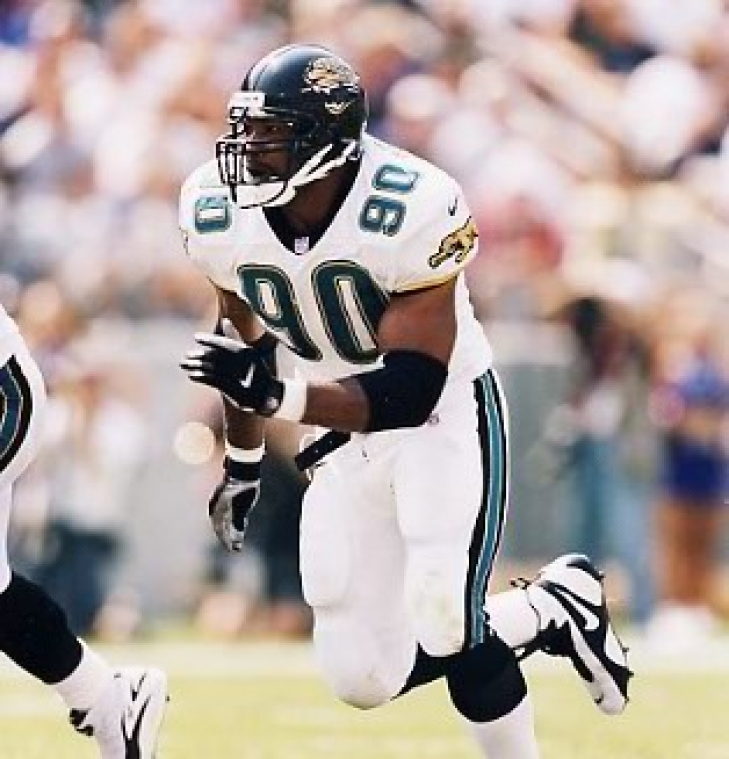
Drafted 33rd overall in the second round out of Texas in the 1996 NFL Draft, Tony Brackens wasted no time establishing himself as an absolute menace on the edge for Jacksonville. Despite starting just one game as a rookie, he generated instant backfield chaos, putting up 7.0 sacks and co-leading the NFL with five forced fumbles to earn a spot on the PFWA All-Rookie Team. He followed that up in 1997 by again co-leading the league in forced fumbles (6), quickly developing a reputation as one of the game's most lethal strip-sacking defenders.
Brackens put together his finest professional campaign during Jacksonville's historic 1999 run. As the premier edge threat on a squad that stormed to a league-best 14–2 record, he registered a career-high 12.0 sacks, two interceptions, and an NFL-leading eight forced fumbles. That dominant performance earned him Pro Bowl honors and a Second-Team AP All-Pro selection, solidifying his role as the franchise’s defensive heartbeat. He elevated his play even further in the postseason, racking up 3.0 sacks, a forced fumble, and a fumble recovery returned for a touchdown across two playoff starts.
Though persistent injuries hampered his availability after another double-digit sack year in 2001 (11.0 sacks), Brackens spent all eight of his NFL seasons terrorizing quarterbacks in North Florida before retiring after the 2003 season.
In Duval County, Brackens recorded 55.0 sacks, 362 tackles (304 solo, 58 assists), 27 forced fumbles, 13 recoveries, and five interceptions.
11. John Henderson
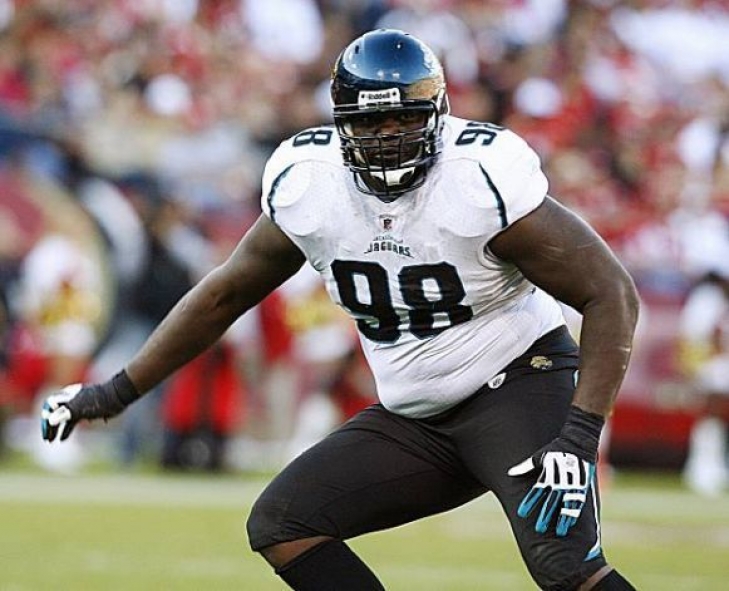
Long before a sideline video went viral of a Jacksonville athletic trainer slapping him across the face to stoke his pregame fury, John Henderson had already made a career out of punishing opposing offensive lines. Selected ninth overall out of Tennessee in the 2002 NFL Draft, Henderson entered the league with immense expectations and immediately established himself as a dominant, long-term anchor in the heart of the Jaguars' defense.
Paired alongside Marcus Stroud to create "Hurricane & Stroud," Henderson gave North Florida the most physically daunting interior tackle duo in football. Using explosive power off the snap and heavy hands at the point of attack, he routinely blew up interior run schemes and collapsed pockets from the middle. After earning PFWA All-Rookie Team recognition in 2002, Henderson developed into a two-time Pro Bowler (2004, 2006). His peak performance arrived in 2006, when he posted 3.5 sacks, 51 combined tackles, and a Second-Team AP All-Pro selection while leading Jacksonville's defense to elite league standings.
An indispensable pillar in the trenches, Henderson logged 120 starts over eight seasons in teal and black, driving playoff runs in 2005 and 2007. He concluded his 10-year NFL career with a two-season stretch in Oakland, but his prime years in Jacksonville defined an entire defensive era for the organization.
With the Jags, Henderson would have 29 sacks, 58 tackles for loss, and 426 combined tackles.
10. Calais Campbell
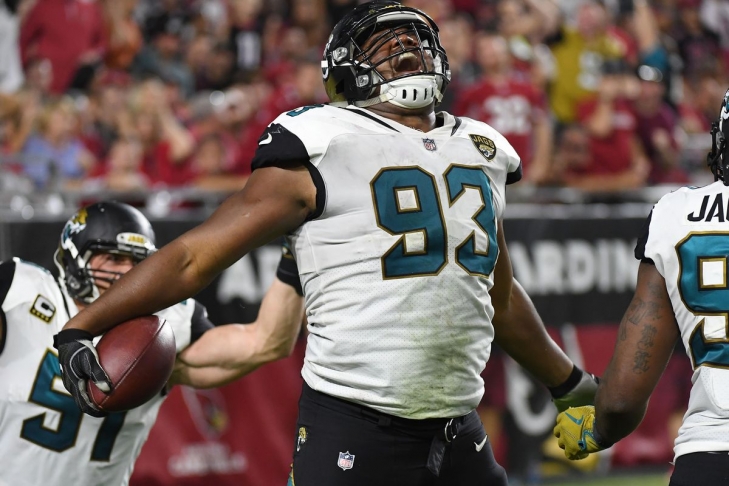
After spending the first nine seasons of his career establishing himself as a defensive force with the Arizona Cardinals, Calais Campbell signed with Jacksonville in the spring of 2017 as a 31-year-old free agent. Expectations were modest for a veteran entering his 10th season, but Campbell blew past every projection, unlocking the absolute peak of his career in teal and black and quickly earning the moniker "Mayor of Sacksonville".
Campbell’s impact was immediate, transformative, and ferocious. Operating as the vocal leader and physical focal point of a terrifying pass rush, he erupted in his very first game with the Jaguars by setting a franchise record with 4.0 sacks against Houston. He finished his inaugural 2017 campaign with a career-high 14.5 sacks, earning First-Team AP All-Pro honors and finishing as the runner-up for AP NFL Defensive Player of the Year. His dominant presence up front powered Jacksonville all the way to the AFC Championship Game, turning a former cellar-dweller into an elite defensive powerhouse.
His three-year run in North Florida was a masterclass in sustained excellence, as he earned Pro Bowl nods in all three seasons with the franchise (2017–2019) along with a First-Team AP All-Pro selection in 2017 and a Second-Team AP All-Pro choice in 2019. Beyond his elite backfield production, Campbell was a revered ambassador for the city and the league off the field, earning the prestigious Walter Payton NFL Man of the Year Award in 2019. His decade of dominance across the league culminated in a selection to the NFL 2010s All-Decade Team.
After three stellar campaigns, Campbell was traded to the Baltimore Ravens in 2020, eventually adding stops with Atlanta and Miami late in his career.
In his relatively brief stay in Jacksonville, Campbell recorded 31.5 sacks, 195 combined tackles (132 solo, 63 assists), 44 tackles for loss, 77 quarterback hits, and six forced fumbles.
9. Marcus Stroud
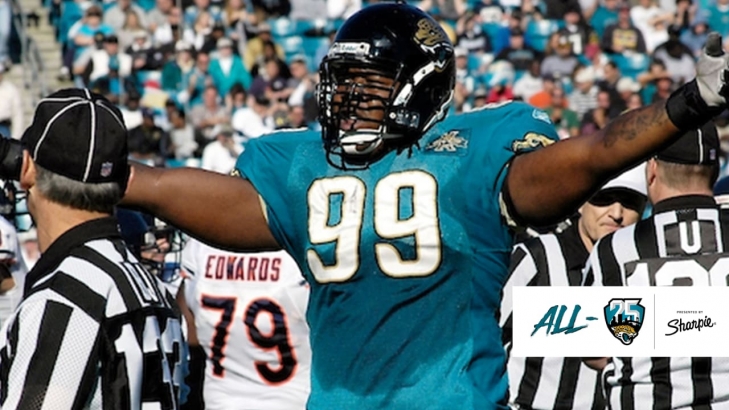
Selected 13th overall out of Georgia in the 2001 NFL Draft, Marcus Stroud arrived in North Florida as a cornerstone piece for a rebuilding defense. After spending his rookie campaign learning the speed of the professional game in a rotational role, Stroud became the full-time starting defensive tackle in 2002. From that point onward, he became a fixture in the middle, starting every single game he appeared in for Jacksonville over the next six seasons.
When the Jaguars drafted John Henderson in 2002, Stroud became part of "Hurricane & Stroud," arguably the most physically dominant interior defensive line duo of the 2000s. Playing mainly at left defensive tackle, Stroud used excellent leverage, raw strength, and quickness off the line to collapse pockets and close running lanes. His prime run lasted three seasons from 2003 to 2005, during which he earned three consecutive Pro Bowl selections and three straight Second-Team AP All-Pro honors (2003, 2004, 2005). With Stroud anchoring the interior line, Jacksonville built a top-tier defense that helped the franchise reach the playoffs in 2005 and 2007.
Injuries began catching up to Stroud during his final two campaigns in teal, limiting his availability before Jacksonville traded him to the Buffalo Bills in early 2008. Stroud spent three seasons in Buffalo before ending his career, but his prime years in Jacksonville made him one of the defining defensive players in Jaguars franchise history.
With the Jags, Stroud had 22 sacks, 43 tackles for loss, and 279 combined tackles.
