Site Admin
23. Todd Heap

Drafted 31st overall in the first round of the 2001 NFL Draft out of Arizona State, Todd Heap arrived in Baltimore as the handpicked successor to Hall of Famer Shannon Sharpe. Over the next decade, "Heap" became a household name in Maryland, serving as the primary passing target and fan-favorite focal point during an era defined by stellar defense and offensive retooling.
Heap was a matchup nightmare, excelling at exploiting seams and intermediate zones. With a wide catch radius and dependable hands, he often absorbed tough hits over the middle and secured contested catches in traffic. His soft hands and leaping ability made him a top red-zone threat, while his aggressive inline blocking supported Baltimore’s run-first approach with Jamal Lewis.
Following his rookie season in 2001, during which he learned behind Sharpe, Heap became a full-time starter in 2002. He quickly made an impact by catching 68 passes for 836 yards and six touchdowns, earning his first Pro Bowl selection.
In 2003, he improved significantly, making his second Pro Bowl and earning Second-Team All-Pro honors. Even though he played in a run-focused offense with Jamal Lewis rushing for 2,066 yards, Heap caught 57 passes for 693 yards and scored three touchdowns. He also set an NFL record by executing four two-point conversions in one season.
Although injuries affected him in 2004, Heap recovered strongly in 2005, achieving his career-best stats with 75 receptions, 855 yards, and seven touchdowns. He continued his strong performance in 2006, with a 13–3 season, catching 73 passes for 765 yards and six touchdowns, which earned him the NFL Alumni Tight End of the Year award.
Heap was a reliable presence when Joe Flacco joined in 2008, providing a dependable safety net during playoff runs to the AFC Championship and further. In his last Baltimore season in 2010, Heap recorded 40 catches for 599 yards and five touchdowns, with a career-best 15.0 yards per catch.
Heap was signed before the 2011 season as a cost-saving measure. During his time in Baltimore, he played 133 regular-season games, amassing 467 receptions, 5,492 receiving yards, and 41 touchdowns. At his departure, he was the franchise's all-time leader in touchdown catches. In 2014, the Ravens honored him by inducting Heap into their Ring of Honor, recognizing his strong bond with fans and significant impact on the team.
26. Matt Stover
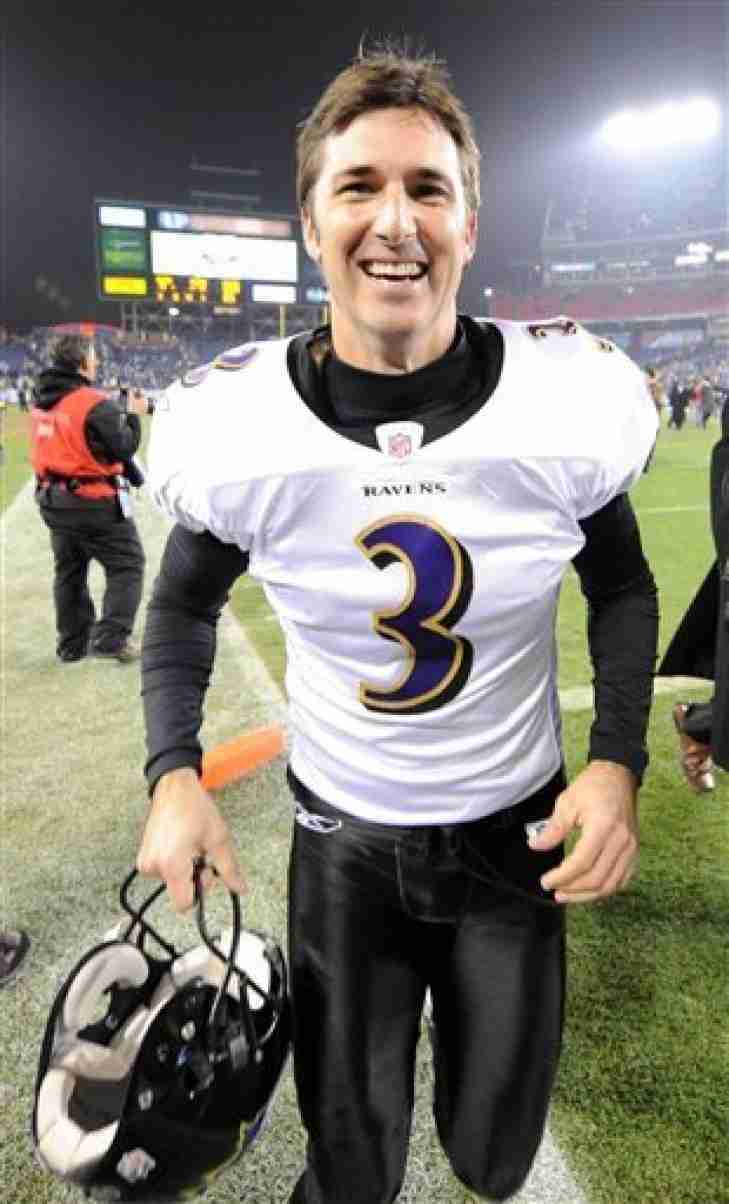
Drafted in the 12th round (329th overall) of the 1990 NFL Draft by the New York Giants out of Louisiana Tech, Matt Stover spent his entire rookie year on injured reserve before signing with the Cleveland Browns in 1991. When the franchise relocated to Maryland in 1996, Stover followed, establishing himself over the next 13 seasons as the original clutch specialist in Baltimore history and a model of consistency in NFL annals.
Stover depended on consistent technique and mental strength rather than pure leg strength. He mastered the challenging wind conditions in M&T Bank Stadium, managing his ball flight with precise contact and a smooth follow-through. His real importance became clear late in close games: when Baltimore's power-running offense struggled inside the opponent's 35-yard line, Stover almost always ensured three points.
Stover smoothly transitioned from Cleveland, scoring 19 field goals in Baltimore's first season in 1996. As the Ravens developed an elite defense later in the decade, Stover became the main contributor to the team's scoring.
His most notable campaign was during the historic 2000 season. In a significant five-game stretch in October, when Baltimore's offense failed to score a single touchdown, Stover carried the team's scoring efforts, accounting for all 49 points scored during those weeks. He ended the regular season as the NFL's leading scorer with 35 field goals on 39 attempts (an 89.7% success rate) and 135 total points, earning his first Pro Bowl selection and First-Team All-Pro honors. His perfect postseason continued, with six field goals and 11 extra points, aiding Baltimore in winning Super Bowl XXXV.
Throughout the 2000s, Stover was known for his consistency. From 2003 to 2005, he achieved over 86% success on field goals each season and was perfect on extra points. In 2006, he had another notable year, tying for the NFL lead in field goal accuracy with 28 of 30 successful attempts (93.3%), which earned him Second-Team All-Pro honors. Moreover, between 2002 and 2004, he set an NFL record by successfully making a field goal in 38 consecutive games.
After the 2008 season, Baltimore chose not to re-sign the 41-year-old veteran, transitioning the kicking role to Stephen Hauschka until Justin Tucker ultimately became the franchise's legendary kicker. Stover's last NFL season was in 2009 with Indianapolis, where he replaced the injured Adam Vinatieri and set the record as the oldest player to kick a field goal in Super Bowl history during Super Bowl XLIV.
Across 13 seasons in Baltimore (1996–2008), Stover appeared in 207 regular-season games, converting 354 of 422 field goals (83.9%) and 402 of 403 extra points to set the franchise's then all-time scoring mark with 1,464 points. His overall NFL career total of 2,004 points ranks sixth in league history.
30. Sage Erickson

29. Natalie Gulbis