


Site Admin
36. Sam Koch
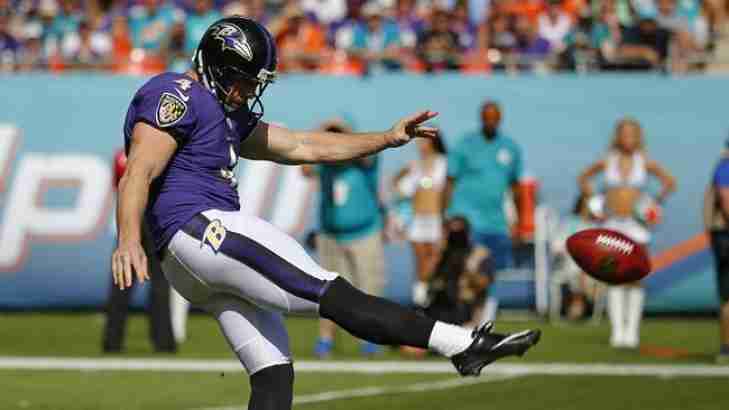
Selected in the sixth round (203rd overall) of the 2006 NFL Draft out of Nebraska, Sam Koch arrived in Baltimore as one of the rare punters taken in the draft. Over a remarkable 16-season tenure spent entirely in Charm City, Koch revolutionized special teams across the league by pioneering new directional punting techniques, solidifying his status as a foundational pillar of Baltimore's special teams.
Koch changed the punting game from just focusing on distance to using clever placement as a powerful tool. Knowing that returners found traditional spiral punts easier to track, he created a wide variety of creative kicks, like his well-known rotational "whirlybird" or "knuckleball" punts, as well as end-over-end drop-pouts and tricky corner-pins. By tweaking the spin and flight of the ball, he often caused muffed catches, closed off return options, and kept opposing teams pinned inside their own 10-yard line, making his punts both exciting and strategically effective.
Koch's technical mastery was instrumental during the Ravens' journey to Super Bowl XLVII in 2012. Throughout that championship campaign, his control of field position consistently provided Baltimore's defense with advantageous, long fields to defend. In the Super Bowl XLVII victory over the San Francisco 49ers, Koch executed a renowned late-game maneuver: with 12 seconds remaining, he deliberately scrambled through the end zone to calculate a strategic safety, thereby running down the clock and expending crucial seconds to ensure a 34–31 victory.
His standout moment came in 2015 when Koch led the NFL in net punting average at 42.9 yards and gross punting at 46.7 yards. That impressive season earned him his first Pro Bowl selection and Second-Team All-Pro honors. Throughout his career, Koch was often among the top in yards per punt, ranking in the top 10 four times, and he regularly placed high in punts downed inside the 20-yard line.
After retiring following the 2021 season, Koch ranked seventh all-time in NFL history with 52,868 punting yards on 1,168 punts, and he placed 453 of those kicks inside the 20-yard line. He immediately transitioned to coaching, staying with Baltimore as the team's special teams consultant. In 2023, the franchise honored his legendary career by inducting him into the Ravens Ring of Honor.
49. Sam Adams
No, this isn’t the beer guy.
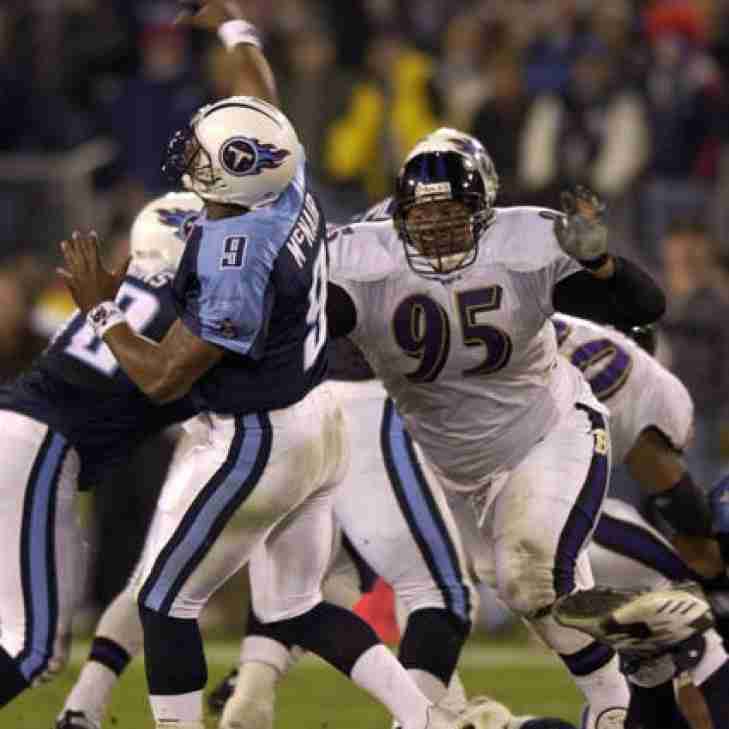
Signed as a marquee free agent prior to the 2000 season after six years in Seattle, Sam Adams arrived in Baltimore to give the Ravens an imposing interior defensive presence. Partnering with Tony Siragusa, Adams formed a massive interior wall that redefined defensive line play and transformed Baltimore's front seven into one of the most dominant units in NFL history.
At 6 feet 3 inches and 350 pounds, Adams possessed a rare combination of raw size and explosive initial quickness. As a defensive tackle, his primary role was to draw double-teams and occupy multiple interior blockers, keeping middle linebacker Ray Lewis clean and able to flow to the football. When left single-blocked, Adams consistently collapsed the pocket from the inside, disrupting running lanes before they could develop.
In his first year in Baltimore (2000), Adams started all 16 regular-season games for a defense that set the NFL 16-game record for fewest points allowed (165) and fewest rushing yards allowed (970). He tallied 27 tackles and 2.0 sacks in the regular season, then started all four postseason games. In Super Bowl XXXV, Adams helped neutralize the New York Giants' ground attack—holding them to just 66 rushing yards—en route to a 34–7 victory and his first career Pro Bowl selection.
Adams was even more dominant in 2001, earning his second consecutive Pro Bowl selection and receiving First-Team All-Pro honors. He recorded 23 tackles and 2.0 sacks across 14 starts, anchoring a defensive unit that allowed just 16.5 points per game and propelled Baltimore back to the postseason.
Due to salary cap constraints, Adams left after 2001, signing with the Raiders and earning a third Pro Bowl with the Bills. In two years with the Ravens (2000–2001), he started 30 games, recording 50 tackles, 4.0 sacks, 1 forced fumble, and 1 recovery.
30. Lardarius Webb
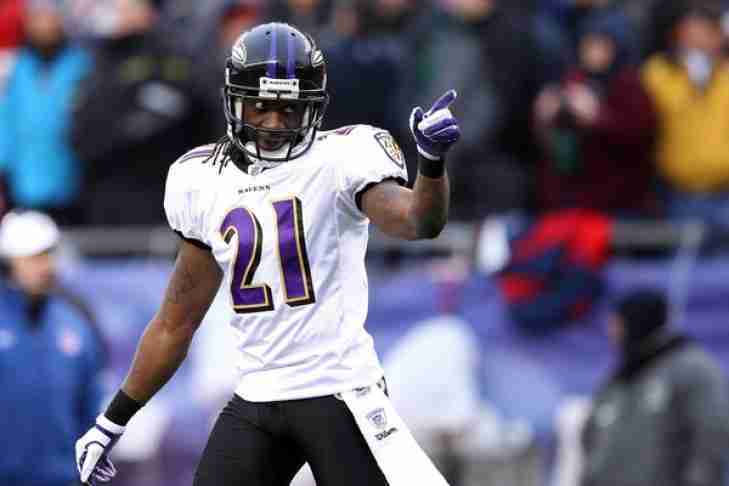
Taken in the third round (88th overall) of the 2009 NFL Draft out of Nicholls State, Lardarius Webb overcame lower-division obscurity with elite top-end speed and natural ball skills. Over nine seasons in Maryland, Webb evolved into one of the most reliable and versatile defensive backs in franchise history, transitioning from a dynamic return man and lockdown boundary corner to a dependable deep safety.
Webb was a versatile athlete known for his quick footwork and rapid recovery. Early in his career, he thrived as a press-man cornerback who could mirror the league's fastest receivers and provided a game-changing burst on kick returns. As injuries changed his physical abilities later in his career, Webb used his sharp football IQ to adapt by moving into the slot and later returning to free safety, helping him stay impactful for Baltimore's defense.
Webb first gained attention in his 2009 rookie season as a kickoff returner, notably with a 95-yard touchdown return against Denver, before a torn ACL ended his year prematurely. He recovered well in 2010, becoming an important part of Baltimore's secondary.
His standout campaign came in 2011, where he served as a key shutdown corner. Webb started all 16 games, tallying 67 tackles, five interceptions, 20 pass defenses, and scoring a punt return touchdown. In Baltimore's playoff run that winter, he added three more interceptions, ending the year with eight total takeaways and solidifying his status as one of the league's premier cover corners.
Webb started the 2012 championship season strongly, but tragedy struck in Week 6 when he tore his ACL against Dallas, ending his season. Although he couldn’t play in the postseason or the Super Bowl, Webb remained a vital part of the secondary and earned his Super Bowl XLVII ring with his teammates.
Demonstrating remarkable resolve, Webb returned in 2013 to play all 16 games, tallying 74 tackles and 22 pass deflections. Facing age and injury wear, he willingly converted to safety late in his career, giving Baltimore critical flexibility through the 2017 season.
Webb played his entire nine-year NFL career (2009–2017) exclusively as a Raven, appearing in 127 regular-season games (84 starts) while accumulating 467 total tackles, 15 interceptions, 91 pass deflections, 5.0 sacks, and two special teams touchdowns.
40. Jermaine Lewis
Jermaine Lewis, a local product of the University of Maryland, was chosen in the fifth round (153rd overall) and became an explosive dual-threat player for Baltimore. With exceptional speed and fearless instincts as both a wide receiver and return specialist, Lewis proved to be one of the franchise’s most versatile playmakers, offering Baltimore’s offense and special teams a burst of instant energy.
Lewis turned lack of stature (5’ 7”) into an open-field advantage. Possessing elite 4.3 speed, twitchy acceleration, and razor-sharp cutback ability, he erased angles for coverage teams the moment he caught the ball. Lined up at receiver, he blew past cornerbacks on deep post routes; on punt and kickoff returns, his patient setup behind wall blocks and decisive burst made him a constant threat to score from anywhere on the field.
Lewis became the top return specialist in professional football during the late 1990s and early 2000s. In 1997, he led the NFL in punt return average with an impressive 15.6 yards per return, also catching 42 passes for 648 yards and six touchdowns. His performance improved in 1998, earning his first Pro Bowl and First-Team All-Pro selections after posting 784 receiving yards, six receiving touchdowns, and two punt return touchdowns.
His dominance in returns persisted as he led the NFL with two punt return touchdowns in 1998 and 2000. In 2001, Lewis had an outstanding season, leading the league with 519 punt return yards and accumulating 1,039 kickoff return yards, earning his second Pro Bowl and Second-Team All-Pro distinctions.
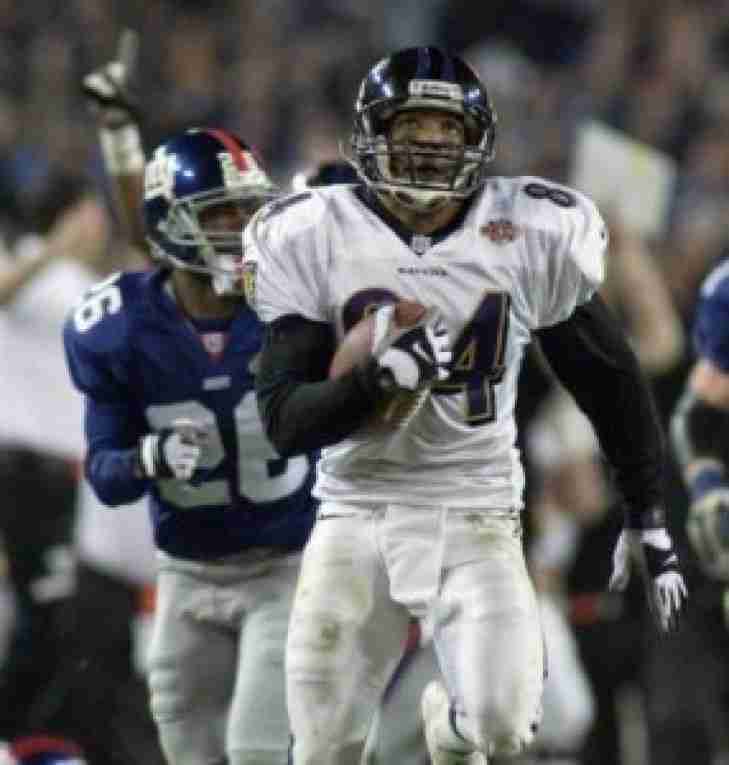
Lewis’ iconic moment for Baltimore came during Super Bowl XXXV, the game's biggest stage. In the third quarter, after the Giants reduced Baltimore's lead to 17–7 with a kickoff return TD, Lewis responded immediately. He caught the next kickoff, dashed through a gap, and returned it 84 yards for a touchdown, instantly halting New York's comeback and sealing the game. He finished with 152 all-purpose yards and a TD, capping the franchise's first Super Bowl victory.
After a salary-cap squeeze following the 2001 season, Baltimore left Lewis unprotected in the 2002 NFL Expansion Draft, where he was picked sixth overall by the Houston Texans.
Lewis generated 8,001 all-purpose yards—a franchise record that stood for years—and scored 23 total touchdowns (17 receiving, six punt returns). His six career punt return touchdowns remain the benchmark for Baltimore special teams play.
2-7–96-7-31–396-60-10-300
