


Site Admin
24. Kelly Gregg
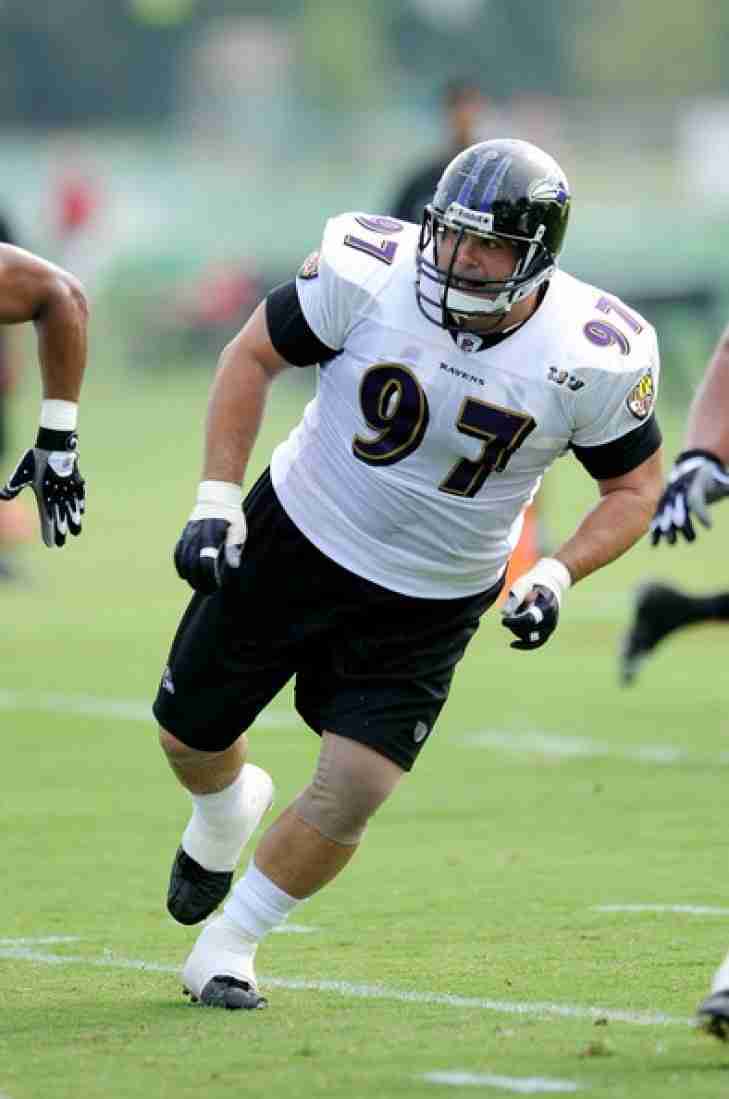
Kelly Gregg was selected in the sixth round of the 1999 NFL Draft by Cincinnati but was released before playing any regular-season games in Ohio. After brief stints with Philadelphia and on Baltimore's practice squad, he proved his resilience by competing in NFL Europe with the Rhein Fire, eventually becoming a regular in Maryland. At 6 feet tall and 320 pounds, Gregg didn’t have long limbs, but he compensated with wrestling leverage, toughness, and relentless energy as a nose tackle.
Gregg was the quintessential gritty interior lineman. Positioned directly over the center, his low center of gravity made him nearly immovable by single blocks. In Baltimore's 3-4 system, his primary role was to handle double-teams from guards and centers, taking the hits so linebackers like Ray Lewis and Terrell Suggs could attack the ball. Despite facing double-teams on almost every snap, Gregg had the lateral quickness to disengage and make tackles in the run gap.
Gregg joined the Ravens' practice squad during their landmark 2000 season and earned a Super Bowl XXXV ring behind the scenes. He made his first rotational appearance in 2001 and became the full-time starting nose tackle in 2002. That breakout year, he recorded 56 total tackles and two sacks, demonstrating he could lead a defense on his own terms.
His best statistical season came in 2003, when he recorded 80 total tackles and 3.0 sacks—unusually high production for a 0-technique nose tackle. Year in and year out, Gregg served as the silent engine of run defenses that routinely ranked near the top of the NFL. In 2007, he posted a career-high 83 total tackles while starting all 16 games.
Though he never earned Pro Bowl recognition—a common fate for non-flashy interior nose tackles—Gregg earned immense respect across the locker room and throughout the league for his durability and toughness. After missing 2008 due to microfracture knee surgery, he returned to start every game in 2009 and 2010, anchoring Baltimore's front five through his age-34 season.
Salary-cap constraints resulted in his release in July 2011, along with veteran teammates Todd Heap and Derrick Mason. He concluded his career with a single season in Kansas City. During his decade with Baltimore (2001–2010), Gregg appeared in 134 regular-season games, starting 124, and recorded 512 tackles, 19.5 sacks, and two forced fumbles.
17. Ray Rice
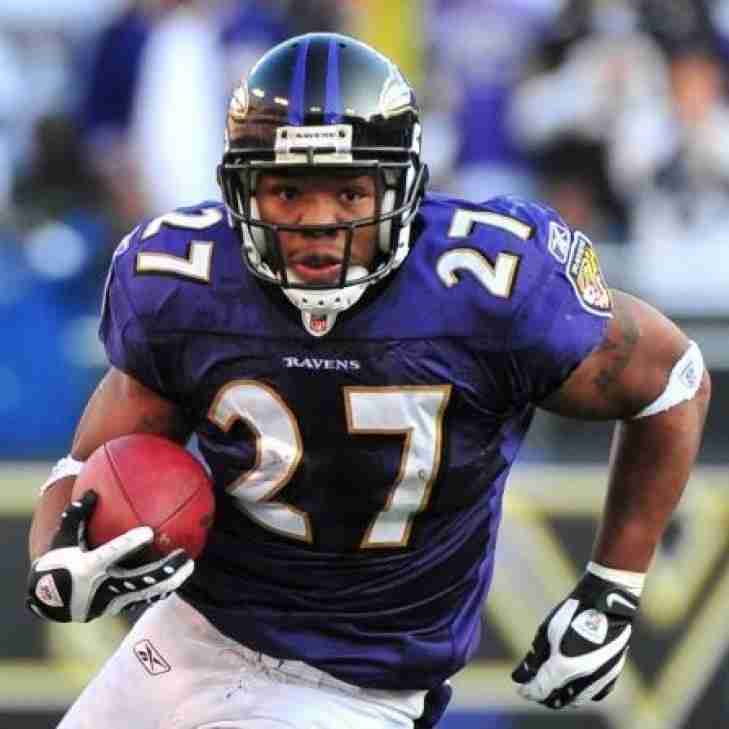
Selected in the second round (55th overall) of the 2008 NFL Draft out of Rutgers, Ray Rice stepped into Baltimore's backfield as a compact, versatile running back. At 5 feet 8 inches and 206 pounds, he possessed a low center of gravity, leverage, and elite lateral agility that made him an ideal fit for Cam Cameron’s zone-stretching offense.
Rice exhibited a low, elusive running style that was beneath the height of most defenders. He utilized the offensive line of Baltimore as cover before rapidly advancing into interior gaps or redirecting plays to the perimeter. His indispensability was rooted in his dual-threat ability out of the backfield: he was a skilled route runner with dependable hands on swing passes and screens, and he also possessed the strength to block blitzing linebackers during pass protection.
Following his role as a rotational backup behind Willis McGahee during his rookie year in 2008, Rice secured the principal starting position in 2009. He achieved a remarkable breakthrough, accumulating 1,339 rushing yards and contributing an additional 78 receptions for 702 yards, resulting in a total of 2,041 scrimmage yards. He earned his first Pro Bowl selection and received Second-Team All-Pro honors.
Rice backed that up in 2010 with another 1,776 scrimmage yards and six total touchdowns, but his peak individual campaign came in 2011. As the centerpiece of Baltimore’s offense, Rice led the NFL with 2,068 yards from scrimmage (1,364 rushing, 704 receiving) and scored 15 touchdowns. His performance earned him his second Pro Bowl trip and another Second-Team All-Pro nod.
During the 2012 championship season, Rice earned his third consecutive Pro Bowl selection, compiling 1,621 yards from scrimmage and 10 touchdowns. He authored one of the most famous plays in franchise history in Week 12 against San Diego: converting a legendary "4th & 29" by taking a short checkdown pass, weaving through the Chargers’ defense, and diving past the line to keep the game-winning drive alive. He remained vital throughout the postseason, rushing for 306 yards to help power Baltimore to victory in Super Bowl XLVII.
Following a down 2013 season, Rice’s career came to a sudden end during the 2014 offseason following a high-profile domestic violence incident, leading to his release from the team and an indefinite suspension from the league. He never played another down in the NFL. Over his six seasons in Baltimore (2008–2013), Rice played in 92 regular-season games, compiling 6,180 rushing yards, 3,034 receiving yards, and 43 total touchdowns. He compiled 9,214 scrimmage yards and 9,377 all-purpose yards, leaving him second in franchise history in total rushing yards behind Jamal Lewis.
6. Marshal Yanda
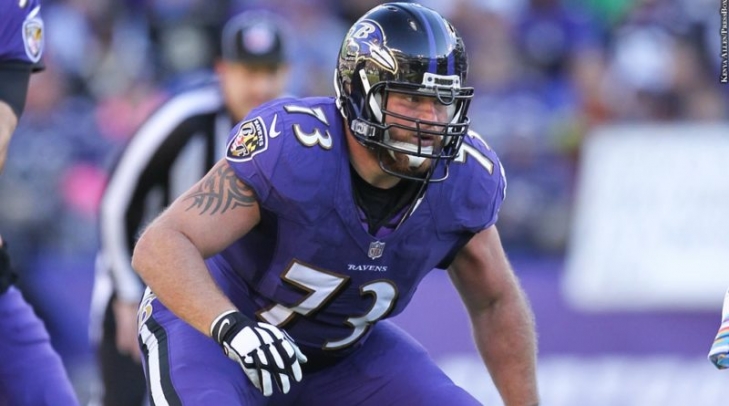
Taken in the third round (86th overall) of the 2007 NFL Draft from Iowa, Marshal Yanda entered the league with a blue-collar work ethic and a rugged, physical playing style. While left tackle Jonathan Ogden set the gold standard for Baltimore line play in the 1990s and 2000s, Yanda stepped in to become the unquestioned engine of the Ravens' front five throughout the 2010s, cementing his legacy as one of the most dominant interior guards in modern football history.
Standing 6 feet 3 inches tall and weighing 305 pounds, Yanda utilized precise hand placement, explosive core power, and a fierce competitive edge to dominate the line of scrimmage. Mainly playing at right guard—briefly filling in at right tackle during injuries—he excelled at stopping interior pass rushers with a solid anchor and used persistent leg drive to open B-gap lanes in Baltimore's power run plays.
After securing a starting role in his 2007 rookie season, Yanda faced a severe multi-ligament knee injury in 2008 but managed to improve his performance to an elite level. His standout period started in 2011, when he was first chosen for the Pro Bowl as the offensive line created running lanes for Ray Rice and led Baltimore to the AFC Championship Game. During the 2012 postseason, Yanda anchored the interior of an offensive line that allowed minimal pressure, powering the franchise to a Super Bowl XLVII victory.
His personal peak occurred around the middle of the decade, when Yanda earned First-Team All-Pro honors in consecutive years (2014 and 2015), establishing himself as the top guard in the league. Even after switching from right guard to left guard in 2016 because of team injuries—and playing much of that season with a torn shoulder labrum—he maintained an impeccable record, not allowing a single sack or quarterback hit throughout the year.
Yanda upheld his exceptional standard into the later years of his career. Acting as the experienced leader for a young Lamar Jackson, he achieved his seventh and eighth Pro Bowl nominations in 2018 and 2019. He finished his career by paving the way for the 2019 team, which set the NFL record for single-season rushing yards with 3,296 yards.
After retiring following the 2019 season, Yanda, who spent all 13 of his professional years with Baltimore, tied Jonathan Ogden for the most regular-season games played by an offensive lineman in franchise history at 177. Including playoffs, his total of 191 games set a franchise record for linemen. Inducted into the Ravens Ring of Honor in December 2022, Yanda's path to Canton is seen as inevitable, as he has been a multiple-time finalist for the Pro Football Hall of Fame.
14. Jamal Lewis
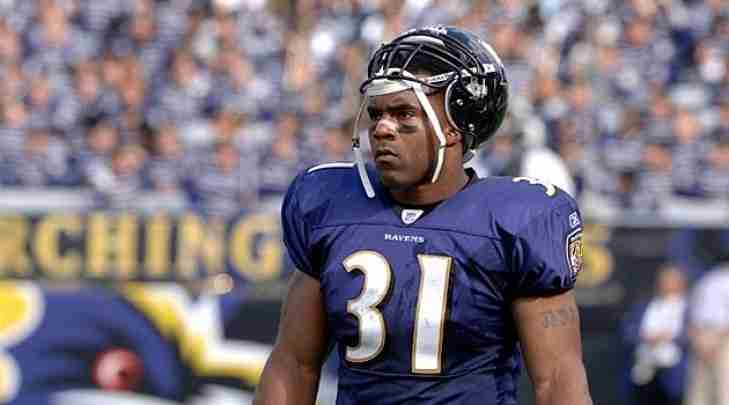
Drafted fifth overall in 2000 from Tennessee, Jamal Lewis was brought to Baltimore as the primary running back. With a unique blend of 240-pound power and track speed, Lewis established a strong rushing identity for the franchise, leading the offense during a championship period focused on a dominant defense.
Lewis was a formidable power runner who wore down defenses through relentless physicality. Instead of dodging behind the line of scrimmage, he charged downhill, planting his cleats and powerfully driving through arm tackles. Once past the second level, he had explosive speed, making him capable of turning short-yardage dives into long touchdown runs.
Lewis made an immediate impact as a rookie in 2000, taking over the lead running back position and rushing for 1,364 yards and six touchdowns. He became an essential player in the postseason, rushing for 103 yards and a touchdown in Super Bowl XXXV, becoming the youngest player to score a touchdown in the Super Bowl. After injuring his ACL and missing the entire 2001 season, Lewis returned in 2002, resuming his strong performance with 1,327 rushing yards and six touchdowns.
His masterpiece came in 2003, marking one of the most outstanding rushing seasons in football history. Notably, he set an NFL single-game record with 295 yards against Cleveland in Week 2. Throughout that season, Lewis carried the ball 387 times, amassing 2,066 rushing yards and 14 touchdowns. He was only the fifth player in league history to surpass 2,000 yards, earning his first Pro Bowl selection, First-Team All-Pro honors, and the AP NFL Offensive Player of the Year award.
Despite facing injuries and off-field legal problems in 2004, Lewis managed to surpass 1,000 yards (1,006 yards) in only 12 games. He achieved another 1,000-yard season in 2006 with 1,132 yards and 9 touchdowns, contributing significantly to Baltimore's 13-3 record and division win in the AFC North.
After the 2006 season, Lewis joined the division rival Cleveland Browns, achieving his fifth and final 1,000-yard rushing season in 2007 before retiring after the 2009 season. During his time in Baltimore, he played 91 regular-season games, rushing for 7,801 yards, adding 1,265 receiving yards, and scoring 47 total touchdowns. His 7,801 rushing yards still stand as the franchise record. In 2021, the Baltimore Ravens honored Lewis by inducting him into their Ring of Honor.
