


Site Admin
16. Derrick Johnson
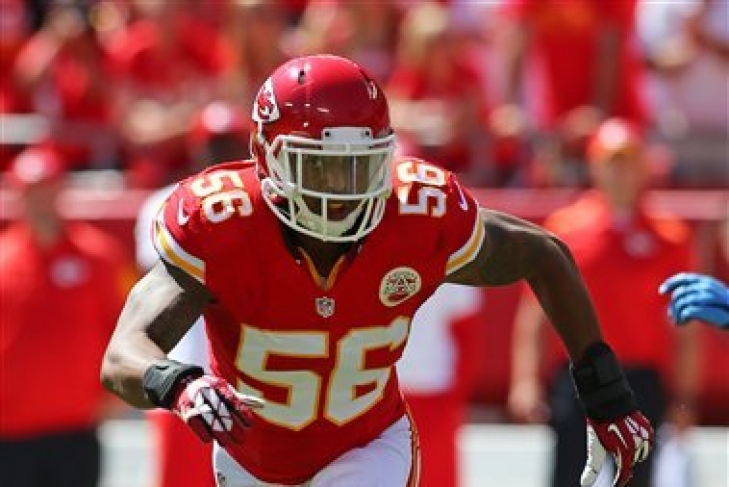
Taken 15th overall in the 2005 NFL Draft out of Texas, Derrick Johnson arrived in Arrowhead Stadium carrying massive expectations as a Dick Butkus Award and Bronko Nagurski Trophy winner. Initially lining up at outside linebacker under Dick Vermeil and Herm Edwards, Johnson proved to be a reliable, highly active force, racking up 95-plus tackles in three of his first four seasons. However, his career arc changed completely when he made the permanent shift inside to middle linebacker in 2010.
That position swap unlocked a decade-defining stretch of elite playmaking. Operating as the heart and soul of Kansas City's defense, Johnson strung together four consecutive 100-tackle campaigns from 2010 through 2013. His breakout high-water mark arrived in 2011, when he set a single-season franchise record with 179 combined tackles (131 solo), earning his first career Pro Bowl selection and First-Team AP All-Pro honors.
Combining baseline sideline-to-sideline range with lightning-fast Diagnostics, Johnson made a living shooting gaps before interior linemen could climb to the second level. He earned back-to-back Pro Bowl nods again in 2012 and 2013, solidifying his standing as one of the premier inside linebackers in the NFL. Even after suffering a torn Achilles in the 2014 season opener, Johnson staged a triumphant return in 2015, posting 116 combined tackles, 4.0 sacks, and earning his fourth career Pro Bowl invitation alongside Comeback Player of the Year consideration.
During the 2016 campaign, Johnson permanently eclipsed Gary Spani to become the all-time leading tackler in Kansas City Chiefs history. Over his 13 seasons in Arrowhead, he anchored multiple playoff rosters across different coaching eras—transitioning seamlessly from the rebuilding late 2000s to the championship-caliber culture built under Andy Reid.
After a brief six-game tenure with Oakland in 2018, Johnson signed a one-day contract in May 2019 to officially retire as a Chief. He later was immortalized locally when he was named the 55th member of the Chiefs Hall of Fame.
With Kansas City, Johnson had 27.5 sacks, 14 interceptions, and 1,154 combined tackles.
15. Ed Budde
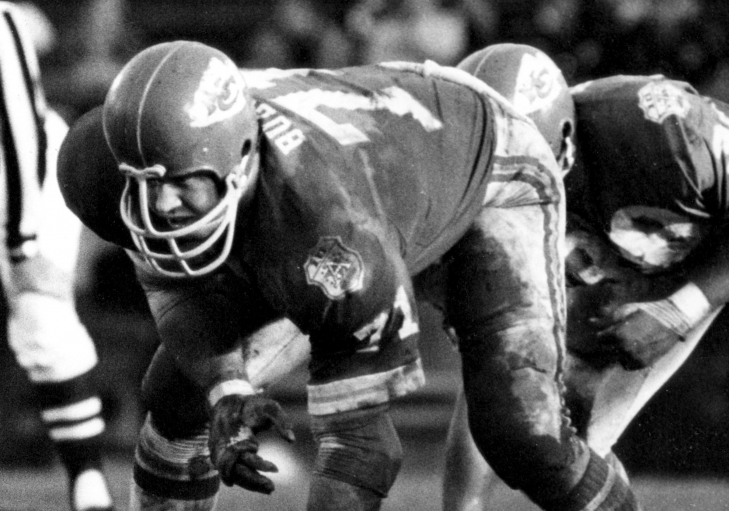
A first-round draft choice (4th overall) out of Michigan State in the 1963 AFL Draft, Ed Budde arrived in Kansas City as a ready-made, imposing physical presence at 6-foot-5 and 260 pounds. Head coach Hank Stram immediately plugged the physical rookie into the starting left guard spot, where his rare blend of explosive lower-body power and tight leverage made him an indispensable anchor for the franchise’s interior offensive line for over a decade.
Budde established an extraordinary standard of durability, starting all 126 regular-season games for the franchise between 1963 and 1971. Operating alongside tackle Jim Tyrer on the left side of the formation, Budde formed one half of the era’s most formidable, physical blocking tandems. His explosive pulling ability in space and relentless drive-blocking inside paved the way for tailbacks Mike Garrett and Otis Taylor, powering Kansas City to two AFL Championships (1966, 1969) and appearances in Super Bowls I and IV.
His finest individual hour arrived on the game's grandest stage in Super Bowl IV against the Minnesota Vikings. Tasked with neutralizing Minnesota's terrifying, Hall of Fame defensive tackle Alan Page, Budde put on an absolute clinic in technical leverage and physical dominance. He completely erased Page from the stat sheet, giving quarterback Len Dawson pristine pockets to operate within and opening wide lanes for a 151-yard rushing performance in Kansas City's decisive 23–7 upset victory.
Individual accolades followed his stellar output throughout his 14-year career. Budde was named an AFL All-Star five times (1966–1969) and earned two post-merger NFL Pro Bowl nods (1970, 1971). He garnered First-Team All-AFL recognition twice (1966, 1969) and became the first offensive lineman ever named the AFL Player of the Week for his suffocating performance against the Oakland Raiders in 1968. Recognized as one of the premier interior blockers of his generation, he was named to the official AFL All-Time Team and inducted into the Kansas City Chiefs Hall of Fame in 1984.
13. Jerry Mays

Before ever putting on a helmet for the Dallas Texans, Southern Methodist University standout Jerry Mays turned down a draft offer from the Minnesota Vikings to join Hank Stram's fledgling American Football League franchise in 1961. It turned out to be a franchise-altering decision. A cerebral scholar-athlete with an engineering background, Mays brought unmatched athletic agility and leadership to the front line, stepping into a starting role during his second season and instantly becoming the emotional anchor of the defense.
Mays had remarkable positional versatility, shifting seamlessly between defensive tackle and defensive end depending on the team's scheme. His quickness off the snap made him equally effective as an interior disruptor or an edge rusher. In just his second season, he helped lead the Texans to the 1962 AFL Championship, anchoring a defense that outlasted the Houston Oilers in a grueling double-overtime thriller. When the franchise relocated to Missouri in 1963 to become the Kansas City Chiefs, Mays remained the bedrock of the defensive line, earning two First-Team All-AFL selections (1965, 1966) and securing an AFL All-Star berth in six different seasons.
Respected across the entire organization for his steady leadership, Mays was chosen by his teammates as defensive captain for both Super Bowl I and Super Bowl IV. His leadership proved instrumental in keeping the team composed during the franchise's crowning moment in January 1970, when Kansas City suffocated the Minnesota Vikings 23–7 to capture its first Super Bowl title. After the AFL-NFL merger in 1970, Mays proved his elite standing wasn’t limited to one league, earning a Pro Bowl selection in his final professional season before retiring.
Mays spent his entire 10-year professional career with the franchise, playing in 140 consecutive regular-season games without ever missing a single contest. Named to the official AFL All-Time Team, he was recognized almost immediately following his retirement when he became the third player ever inducted into the Kansas City Chiefs Hall of Fame in 1972. He compiled 65.5 sacks over his career.
14. Emmitt Thomas
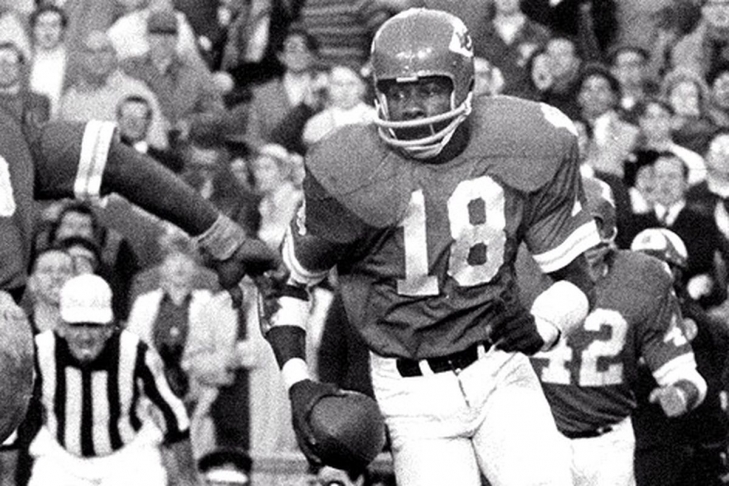
Emmitt Thomas is the franchise leader in Interceptions (58, one more than Johnny Robinson) and was a two-time league leader in that statistic (1969 & 1974). Making a case as the greatest Cornerback in Chiefs history, Thomas played thirteen of his NFL seasons with Kansas City and he was named to the AFL All-Star Team once (’68) and was a four-time Pro Bowl Selection (1971, 1972, 1974 & 1975), the last of which was First Team All-Pro worthy. In that season his league-leading 12 Interceptions was matched by an also league-high 214 Interception Return Yards. Like so many on the upper echelon of this list, Thomas was a member of the Super Bowl IV winning team and was also an AFL Champion in 1966.
