

Committee Chairman
16. Gene Tenace
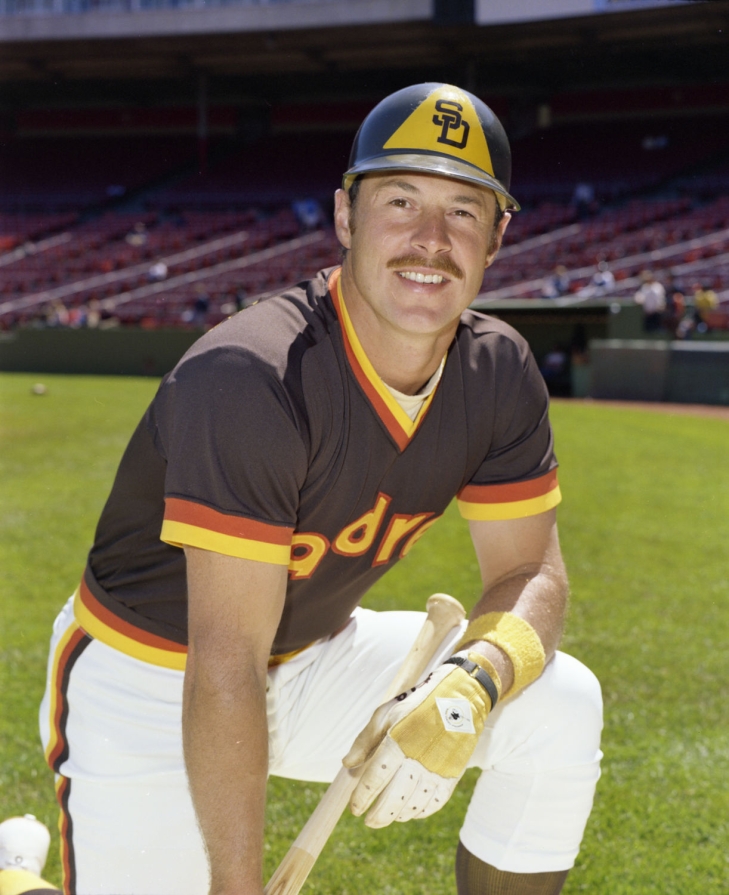
Looking back at the early innovators of modern baseball metrics, a tough, right-handed catcher from Pennsylvania emerges as a key pioneer in on-base efficiency. Gene Tenace had already established a postseason legacy as a crucial contributor to the Oakland Athletics' three consecutive championships from 1972 to 1974. However, as free agency disrupted that historic Oakland team, Tenace decided to remain in California, signing a lucrative deal to join the San Diego Padres before the 1977 season.
To be fair, Tenace was never a feared, high-average contact hitter in the traditional sense. He maintained a modest .240 batting average over his career with the Padres and didn't compile huge hit totals. Instead, he excelled at turning the basic act of drawing a walk into a showcase of spatial awareness and strike-zone discipline.
In his 1977 debut season, Tenace showcased exceptional patience, bewildering National League pitchers and drawing a league-high 125 walks. This impressive number of free passes contributed to a remarkable .415 on-base percentage, which is especially striking given that he hit only .233 that summer.
This hardware-certified authority deeply committed to discipline was no temporary success; it became his daily habit. Tenace consistently exceeded 100 walks each summer during his first three seasons in San Diego, with 101 in 1978 and 105 in 1979. Over his four seasons with the Friars, he maintained an on-base percentage never below .392, even though he only surpassed a .250 batting average once. Defensively, his value to the pitching staff was absolutely incalculable; splitting time between catcher and first base, his preparation and high-intensity game-calling settled a young rotation and provided a steady hand for the entire defense.
Dealt to the Cardinals after the 1980 Season, Tenace had a .403 OBP with San Diego, a number higher than what he did in Oakland (.374). Amazingly, he had more Walks (423) than Hits (384) as a Padre, but as Moneyball tells you, “he gets on base."
8. Andy Ashby
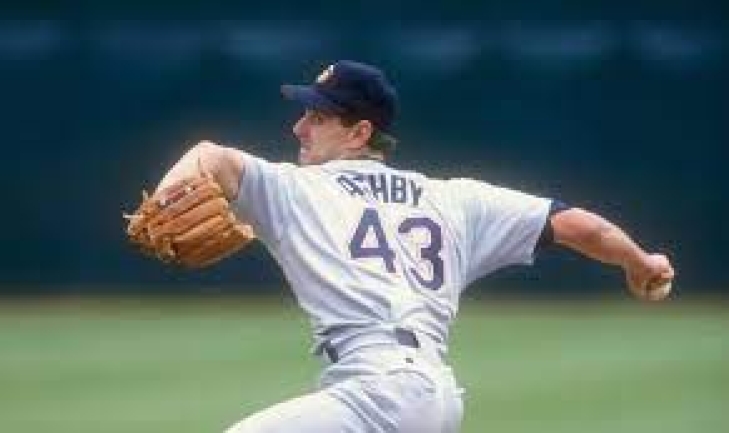
Andy Ashby was traded during his third Major League Season from the expansion Colorado Rockies in 1993 to San Diego, and it was as a Padre where Ashby shone brightest.
The Righthanded Pitcher, who arrived as the "player to be named later," finished off '93 better than in Colorado, though considering he had an 8.50 ERA with the Rockies, that did not say much. Ashby was much better in 1994 (6-11, 3.40 ERA), but in 1995, he cemented himself as a valuable part of the Padres staff, with a 12-10 Record and a 2.94 ERA.
Ashby had respectable years in 1996 and 1997 but broke out with All-Star seasons in 1998 and 1999 and was undoubtedly the staff ace. These two years landed Ashby so high on this list, but it also led to his trade, as the small market Padres traded him to the Phillies before the 2000 Season.
Ashby had a 70-62 Record and 829 Strikeouts with the Padres.
7. Randy Jones
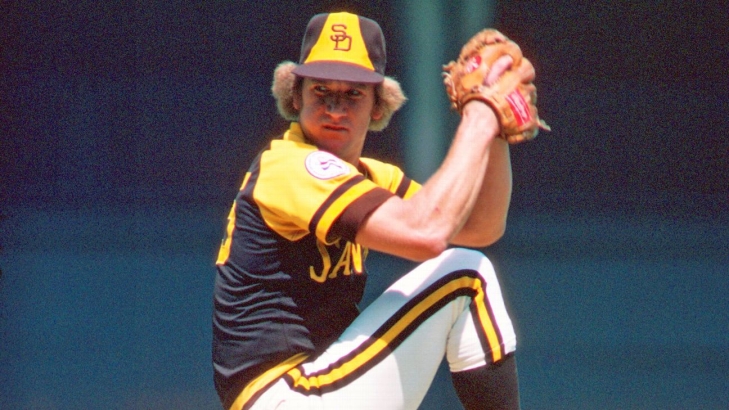
The early years of the San Diego Padres were marked by a lack of success during the expansion era, but they were occasionally broken up by a curly-haired left-hander who brought recognition to the team. Randy Jones stood out as the opposite of today's high-velocity pitchers. Known as "The Junkman," he relied on a heavy sinker, consistent pace, and precise control of the lower strike zone. During an era when radar guns were becoming a measure of a pitcher's worth, Jones was notable for his quick and efficient outings, often finishing games in less than two hours.
Making his major league debut in 1973 with a respectable 7–6 record, he quickly found himself at the mercy of a structurally weak team roster the following summer. Demonstrating how high volume can backfire on a poor team, Jones suffered through a terrible 1974 season, leading the National League with 22 losses despite pitching with more talent than his record showed. Instead of letting this setback derail his progress, the resilient southpaw returned in 1975 to deliver a season of exceptional performance. He confounded hitters in the Senior Circuit by changing his mechanics, lowering his ERA to a league-best 2.24, and posting an outstanding 156 ERA+. He earned 20 wins for a Padres team that finished below .500 and narrowly missed winning the Cy Young Award, finishing second to Tom Seaver in a competitive race. This would be a springboard for what was to come.
The 1976 campaign was a highlight of durability and precise, low-variance pitching. Jones’ dominance was evident as he tore through the first half of the season, tying a historic National League record by pitching 68 straight innings without giving up a walk. He headed into the All-Star break with an impressive 16–3 record. He also started and won the Midsummer Classic and finished the year leading the major leagues in wins (22), starts (40), complete games (25), and total innings (315.1). His outstanding performance earned him the National League Cy Young Award, making him the first in franchise history to win a major individual honor.
Sadly, the heavy workload of that famous 300-inning season took a significant physical toll. In his last start of 1976, Jones suffered a serious nerve injury in his throwing arm, which needed major surgery. He made a comeback with his characteristic determination but was unable to fully regain his top form, instead settling into a reliable, dependable starting role.
After gutting out three more high-volume campaigns, including a resilient 13-win bounce-back in 1978, the front office officially signaled a transition following the 1980 schedule, trading the veteran icon to the New York Mets. As a Padre, Jones had a 92-105 record with a 3.30 ERA and 677 strikeouts.
In 1999, the Padres enshrined Jones into their inaugural Hall of Fame Class two years after they retired his number 37.
4. Dave Winfield
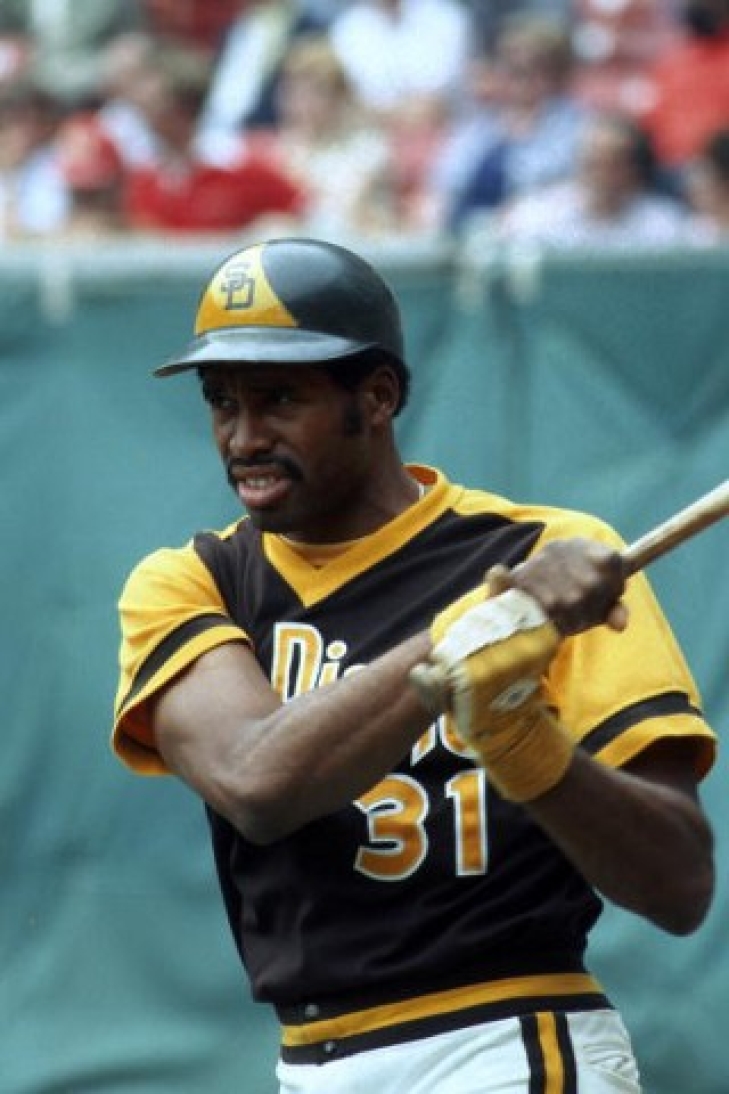
Before sports specialization limited athletes’ paths, some rare prodigies had an explosive physical toolkit that broke traditional boundaries. Dave Winfield exemplified this exceptional, multi-sport athleticism. Standing tall at the University of Minnesota, Winfield achieved the remarkable feat of being drafted by three different professional sports leagues: the NBA's Atlanta Hawks, the ABA's Utah Stars, and the NFL's Minnesota Vikings, despite never playing college football. Ultimately, he chose baseball, and the San Diego Padres eagerly used the fourth overall pick in the 1973 amateur draft to secure a pioneering power hitter for a new era.
His exceptional innate talent was evident to such a degree that management opted to bypass the minor leagues entirely, promoting the 21-year-old phenom directly to the major league roster. Although Winfield had distinguished himself as a dominant College World Series MVP pitcher for the Golden Gophers, the Padres front office was unwilling to risk his dynamic physical frame on the mound. Instead, they promptly assigned him to right field, a position in which he demonstrated remarkable proficiency with rapid mastery.
By the 1974 schedule, his long, high-velocity swing yielded 20 home runs, signaling the arrival of a premier middle-of-the-order threat. He methodically sharpened his approach over the subsequent summers, turning baseline run-production into an absolute regular-season routine.
His national breakthrough occurred in 1977, when he hit 25 home runs to secure his inaugural All-Star invitation, marking the beginning of a distinguished streak of twelve consecutive appearances in the Midsummer Classic. Following this achievement with a strong 24-homer season in 1978, Winfield reached the zenith of his tenure in Southern California during an exceptional 1979 season. He delivered a remarkable display of run production and batting.308, hitting 34 home runs, and leading the league with 118 runs batted in, anchoring the San Diego offense. His highly efficient performance further validated his dominant peak, as he led all National League position players with an outstanding 8.3 bWAR and finished third in the National League MVP voting.
The clock was ticking on his beach residency. After a productive 1980 campaign with 20 home runs and a second Gold Glove, his relationship with the financially constrained team ended. Frustrated by their small-market limits and inability to build a winning team, Winfield tested free agency and signed a record-breaking contract with the Yankees, becoming the highest-paid player at the time.
He departed Southern California, leaving behind 1,134 hits, 154 home runs, 185 doubles, and 626 RBIs alongside a highly respectable .284/.357/.464 slash line across 1,117 games.
In 2001, the Baseball Hall of Fame inducted Winfield into their Hall of Fame in his first year of eligibility, and the Padres retired his number 31 the same year. San Diego also inducted Winfield into their Hall of Fame the year before.
