

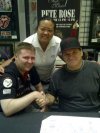
Committee Chairman
18. Kris Dielman

Kris Dielman showed up in San Diego in 2003 as an undrafted free agent out of Indiana and somehow stuck around. The Chargers signed him, cut him at the end of camp, then brought him back to the practice squad. With six games left, they called him up as a reserve, and he spent the next year mostly on the bench before the team finally handed him the starting left-guard job in 2005.
Once he got the job, he played like he had something to prove. Teammates called him the enforcer and the battering ram—the guy who loved to finish blocks and kept the scuff marks on his helmet so everyone could see how hard he hit. In 2007, he went an entire season without allowing a sack and earned the first of four straight Pro Bowls. The next two years he was even better: Second-Team All-Pro in both 2008 and 2009, with an Approximate Value of at least 15 each time, while the Chargers kept stacking division titles and LaDainian Tomlinson ran behind a line that felt like it could move anybody.
Everything changed in 2011. Dielman took a nasty shot against the Jets in Week 6, staggered around, stayed in the game anyway, then suffered a seizure on the flight home. The Chargers put him on injured reserve, and the concussion issues lingered. He retired the following spring, deciding the risk wasn’t worth it.
By the time he walked away, he had started 97 games in a Chargers uniform, earned four Pro Bowls, and left a reputation as one of the nastiest, most reliable guards the franchise had seen in years—the kind of player who made the whole line feel tougher just by lining up next to him.
16. Gary Johnson
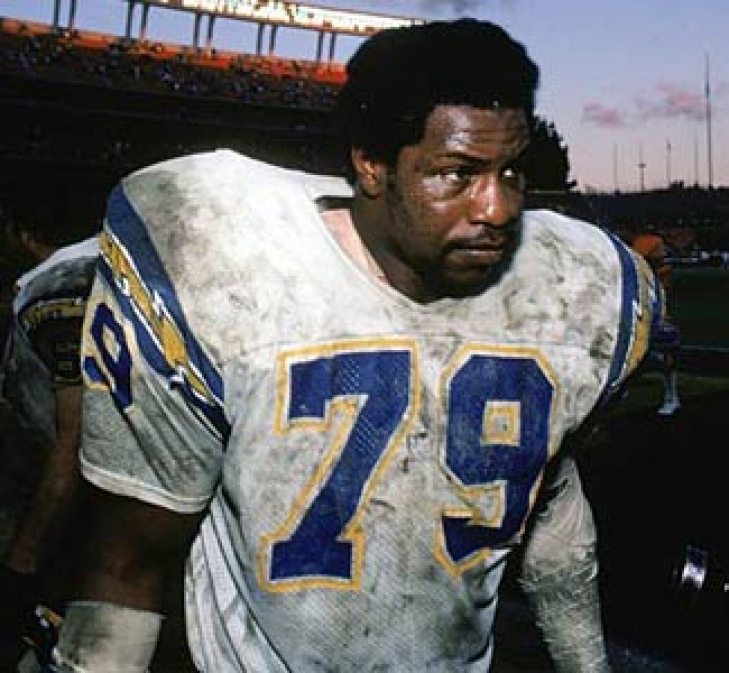
Gary “Big Hands” Johnson arrived in San Diego as the eighth overall pick in the 1975 draft out of Grambling, and the nickname stuck for a reason—a junior-high coach once told him to keep his big hands off a basketball. At 6-foot-2 and around 250 pounds, he wasn’t the biggest defensive tackle, but he was strong enough to bench-press 460 pounds and quick enough to chase down plays. He made the All-Rookie team right away, then really found his footing once defensive line coach Jerry Smith arrived; by 1977 he was up to 13.5 unofficial sacks and starting to look like a problem for opposing quarterbacks.
Everything clicked in 1980. Johnson led the whole league with 17.5 sacks—still the Chargers’ single-season record—and the defense piled up a league-high 60. He teamed with Fred Dean, Louie Kelcher, and Leroy Jones on a front four that got nicknamed the Bruise Brothers, and he walked away with First-Team All-Pro honors plus the AFC Defensive Lineman of the Year award from the players. One of those sacks, which knocked Eagles quarterback Ron Jaworski out of a game, was so loud that someone called Chargers owner Gene Klein and threatened Johnson’s life. He followed it up with another First-Team All-Pro season in 1981 (10 more unofficial sacks) while the Chargers stacked consecutive division titles and Johnson stacked four straight Pro Bowls from 1979 through 1982.
The Chargers shipped him to the 49ers early in the 1984 season. By the time he left, he had racked up roughly 67.5 unofficial sacks in San Diego—a franchise mark at the time—plus a couple of interceptions and a handful of fumble recoveries, all before sacks even became an official stat in 1982.
The team finally put him in the Chargers Hall of Fame in 1999, a nice nod to the guy who spent nearly a decade making life miserable for quarterbacks in the middle of the Air Coryell era.
17. Gary Garrison
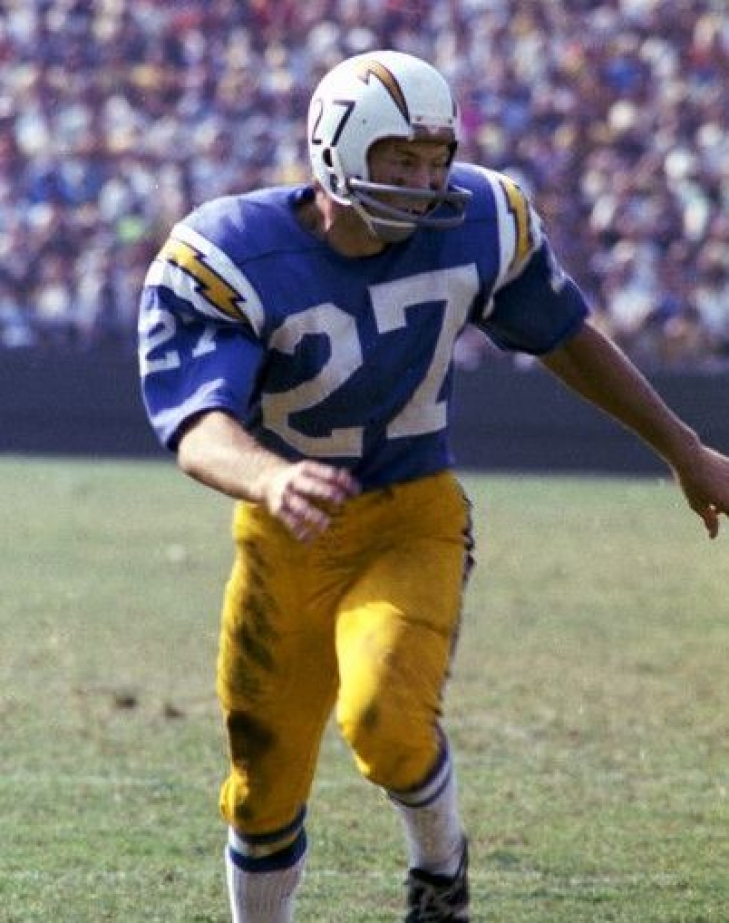
Gary Garrison stayed close to home after starring at San Diego State, choosing the local Chargers over the Philadelphia Eagles after being selected in both the AFL and NFL drafts. He joined the team for the 1966 season and immediately carved out a role as a serious threat in Sid Gillman’s innovative passing attack, catching 46 passes for 642 yards as a rookie.
Over the next decade, he became one of the Chargers’ steadiest receivers, finishing among the league’s top ten in receiving yards in seven different seasons and posting two 1,000-yard campaigns. His best years came in 1968 (1,103 yards and 10 touchdowns) and 1970 (1,006 yards and 12 scores). Nicknamed “The Ghost” for the way he slipped into open spaces and ran precise routes, Garrison averaged nearly 19 yards per catch across his Chargers career. Gillman praised his work ethic, acceleration, and ability to create separation, calling him one of the finest receivers he had coached.
Garrison’s time in San Diego ended after the 1976 season, and he tallied 404 receptions for 7,533 yards and 58 touchdowns. He earned an AFL All-Star selection and four Pro Bowl nods (1968, 1970–1972), serving as a reliable complement to stars like Lance Alworth before becoming a primary target himself. Even as the offense evolved in the early 1970s, he continued producing big plays until injuries and age slowed him in his final years with the club.
The franchise later inducted him into its Hall of Fame in 1985, recognizing his long stretch of consistent production as a local product who helped define the Chargers’ passing game for more than a decade.
15. Doug Wilkerson
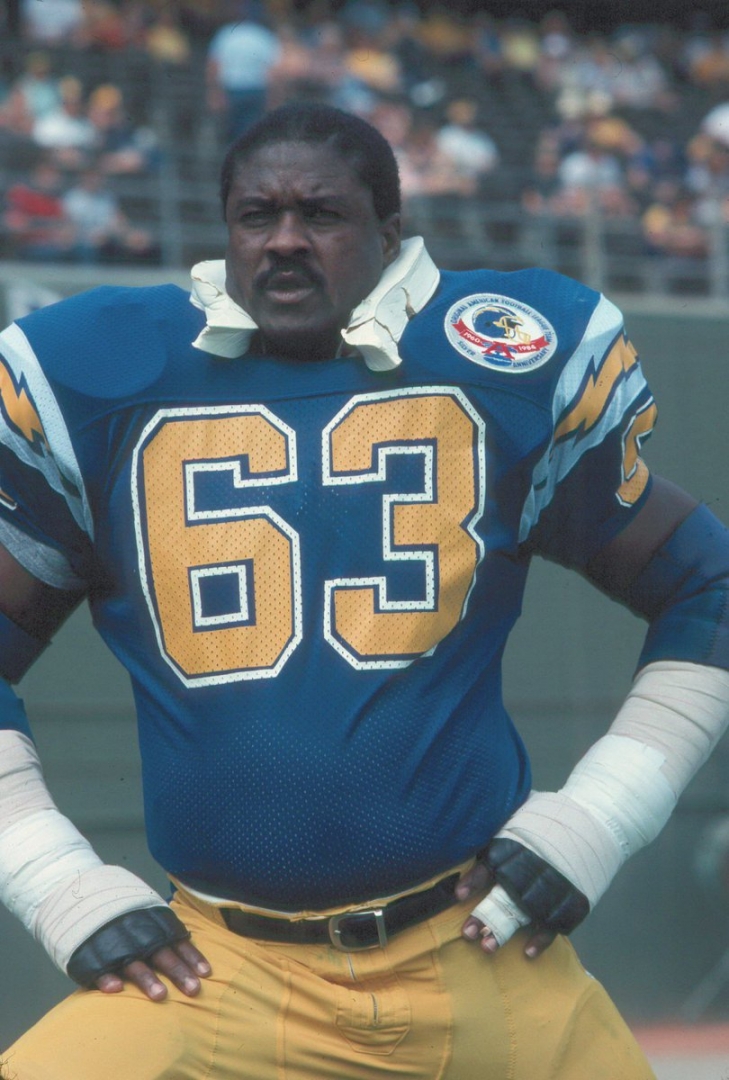
Doug Wilkerson arrived in San Diego before the 1971 season via a trade from the Houston Oilers, sent in exchange for tight end Willie Frazier. Frazier had been a two-time AFL All-Star for the Chargers, but his best years were behind him. Wilkerson, who had spent his rookie year mostly as a defensive end and backup, settled in as the starting left guard and quickly became a fixture.
For the next fourteen seasons, he anchored the interior of the line and rarely missed a game. He started all 195 of his appearances with the Chargers, missing only a handful of contests across the entire stretch. Athletic and mobile for a 6-foot-3, 250-pound guard—he had been timed at 9.8 in the 100 as a college player—Wilkerson excelled at pulling on sweeps, sustaining blocks at the second level, and providing the pocket stability that let Dan Fouts operate. Once Don Coryell’s high-powered passing attack took hold in the late 1970s, Wilkerson’s combination of quickness, leverage, and intensity helped protect one of the league’s most prolific offenses while still contributing to a strong running game.
His peak recognition came from 1980 through 1982, when he earned three straight Pro Bowl selections and a First-Team All-Pro honor in 1982. He served as a team captain for five years and was frequently named the Chargers’ Lineman of the Year. During that stretch, the offense ranked among the league’s best in scoring, and Wilkerson’s reliability was a constant as San Diego made multiple playoff runs and reached back-to-back AFC Championship Games.
Wilkerson retired after the 1984 season. The franchise later inducted him into its Hall of Fame in 2000 and placed him on both the 40th and 50th Anniversary Teams, recognizing the long, steady tenure of a guard who had helped define the Air Coryell era from the inside.
