

Committee Chairman
22. Jamal Williams

Jamal Williams arrived in San Diego as a second-round pick in the 1998 supplemental draft out of Oklahoma State, and it took him a little while to lock down a full-time role. He started only a couple of games in his first two seasons, then finally became the regular left defensive tackle in 2000. An injury knocked him out after just three weeks in 2001, but he worked his way back the next year and was starting again. When the Chargers switched to a 3-4 defense, they slid him to nose tackle, and that move turned out to be perfect.
At nose tackle, Williams became one of the best in the league. From 2005 through 2007, he earned three straight Pro Bowls, with First-Team All-Pro honors in 2005 and 2006. He was the big, sturdy anchor who occupied blockers, clogged running lanes, and let the linebackers and edge rushers fly around. The Chargers named him their Defensive Player of the Year three times during that stretch, and he was a big reason the defense ranked near the top of the league against the run in several of those seasons.
A triceps injury sidelined him early in 2009, and the Chargers released him shortly afterward. Across his dozen years in San Diego, he appeared in 148 games with 122 starts, finishing with 396 tackles, 13 sacks, four forced fumbles, three fumble recoveries, and one interception returned for a touchdown.
The franchise later inducted him into its Hall of Fame and added him to the 50th Anniversary Team, recognizing the guy who spent more than a decade making the Chargers’ defense harder to run on.
21. Nick Hardwick

Nick Hardwick showed up in San Diego as a third-round pick out of Purdue in 2004 and stepped right into the starting lineup at center. He didn’t ease into the job—he just started every game he played for the Chargers, all 136 of them, and stayed there for more than a decade. From day one, he snapped the ball to Philip Rivers, called protections, and kept the middle of the line intact while LaDainian Tomlinson ran behind it.
His best year came in 2006. Hardwick started all 16 games, earned a Pro Bowl nod, and helped an offensive line open holes for Tomlinson’s monster season (1,815 rushing yards and a record 31 total touchdowns) as the Chargers rolled to a 14-2 record. He kept grinding through the years after that, dealing with foot and ankle issues that cost him time in 2007–2009, then coming back to start every game from 2010 through 2013. Teammates and coaches talked about his toughness and dependability—the kind of center who rarely missed assignments and made the whole line feel more stable.
A neck injury ended his 2014 season after just one game, and he retired the following spring. Across those eleven seasons in San Diego, he had started every single one of the 136 games he played, protected Rivers for most of that stretch, and left a reputation as one of the most reliable centers the franchise had ever had.
The Chargers later put him on their 50th Anniversary Team, a nod to the long, steady run of a guy who simply showed up and started every week.
20. Earl Faison
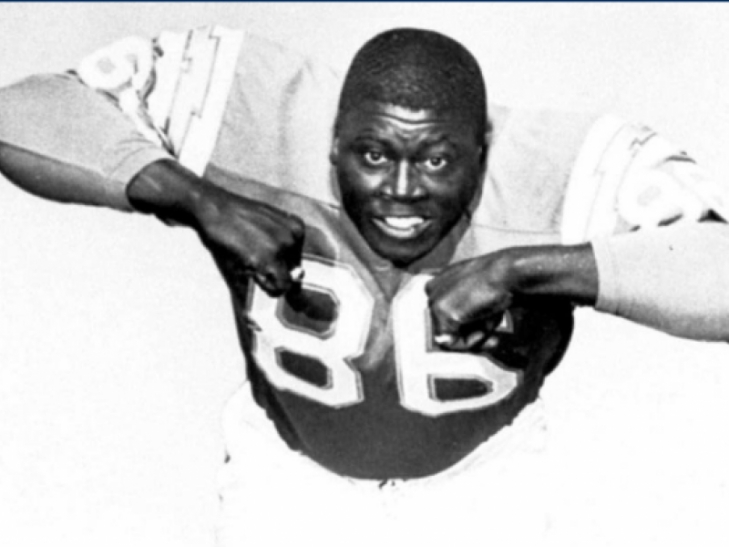
Earl Faison showed up in San Diego as a first-round pick in 1961 after an All-American career at Indiana, and he wasted no time making noise. At 6-foot-5 and around 260 pounds, he was big, strong, and surprisingly quick for the era. He won AFL Rookie of the Year and First-Team All-Pro honors right away, batting down passes, stuffing runs, and giving quarterbacks fits. Sid Gillman and the coaches loved him—Gillman later said there hadn’t been many better.
He spent the next several years as a key piece of the original Fearsome Foursome defensive line alongside guys like Ernie Ladd. The group was massive and disruptive, and Faison was the explosive end who could fight through double-teams and still get to the quarterback. He was an AFL All-Star in each of his five full seasons with the Chargers and earned First-Team All-Pro honors in four. In 1963, the defense helped the Chargers win the AFL Championship, and Faison was even named the defensive MVP of the All-Star Game that year. He also snagged five interceptions in San Diego and returned two for touchdowns—pretty rare for a defensive end.
Back trouble and contract issues piled up, and early in 1966 the Chargers traded him to the Houston Oilers. Across those five-plus seasons in San Diego he racked up roughly 30 unofficial sacks and those five interceptions, numbers that reflected a consistently disruptive presence on one of the AFL’s better defensive fronts.
The franchise later inducted him into its Hall of Fame in 1986, a fitting nod to the big, disruptive defensive end who had helped set the tone for those early Chargers teams.
19. Eric Weddle

Eric Weddle landed in San Diego as a second-round pick out of Utah in 2007, and it took him a minute to settle in. He didn’t start as a rookie, playing mostly in nickel packages and on special teams, but by 2008 he was the full-time free safety and immediately looked like he belonged. That year he piled up a career-high 127 combined tackles and returned a fumble 86 yards for a touchdown, the kind of play that made it clear the Chargers had found a guy who could cover ground, hit, and occasionally change a game with one big moment.
Things really clicked in 2011 after the Chargers locked him up with a five-year, $40 million deal. Weddle led the NFL with seven interceptions, earned his first Pro Bowl nod, and made First-Team All-Pro while also getting named the Chargers’ Defensive Player of the Year. He had a couple of late-game picks that sealed early wins—one of them a fourth-quarter interception against the Chiefs that ended a potential game-winning drive after he diagnosed a screen and jumped the route—and he even grabbed two more in the Pro Bowl itself. From there he kept stacking solid seasons: two more Pro Bowls in 2013 and 2014, both of them 100-tackle years (115 in 2013, 114 in 2014), plus another First-Team All-Pro in 2014. He wasn’t flashy like some of the big-name safeties, but he was smart, rangy, and reliable—the guy who rarely got beat deep, always seemed to be around the ball, and made the whole secondary look more organized by calling things out and covering a ton of ground.
Weddle left the Chargers after the 2015 season and signed with the Baltimore Ravens. Across nine years in San Diego he had turned into one of the steadiest defensive backs the franchise had seen, finishing his Chargers run with 19 interceptions and more than 850 tackles while starting 122 games.
Later he was named to the 2010s All-Decade Team, a nice cap on a Chargers stretch that had produced three Pro Bowls and two First-Team All-Pro seasons.
