

Committee Chairman
26. Wes Chandler

Wes Chandler joined the Chargers early in the 1981 season via a trade from the New Orleans Saints and quickly fit into the high-powered offense. In his final 12 games that year he caught 52 passes for 857 yards and five touchdowns, showing the speed and route-running that would make him a dangerous deep threat alongside Dan Fouts. He also made an immediate splash in the playoffs, including a 56-yard punt return for a touchdown in the famous “Epic in Miami” win over the Dolphins.
The following year, even though a strike cut the season to nine games, Chandler went off. In eight contests he led the NFL with 1,032 receiving yards and nine touchdowns, averaging a still-standing record 129 yards per game, and he earned First-Team All-Pro and Pro Bowl honors. One of the signature performances came against Cincinnati, when he hauled in 10 catches for 260 yards and two scores in a 50-34 shootout. He returned to the Pro Bowl in 1983, then had another big year in 1985 with career highs of 1,199 receiving yards and 10 touchdowns while earning a third Pro Bowl nod with the Chargers. He was the kind of receiver who could stretch the field vertically and still make tough catches over the middle when the defense tightened up.
After the 1987 season the Chargers dealt him to the San Francisco 49ers, where he played just four games before retiring. Across his seven years in San Diego he finished with 373 receptions for 6,132 yards and 41 touchdowns, production that placed him among the franchise’s all-time leaders in receiving.
The Chargers later inducted him into their Hall of Fame in 2001, recognizing the explosive wideout who had helped power the Air Coryell attack during some of its most productive seasons.
25. Paul Lowe

Paul Lowe was undrafted out of Oregon State in 1959 and didn’t stick with the 49ers in training camp, but the brand-new American Football League gave him a fresh shot in 1960. He landed with the Los Angeles Chargers and immediately made noise as the starting halfback. As a rookie, he ran for 855 yards on just 136 carries—an eye-popping 6.3 yards per attempt that led the league—while also hauling in 23 passes for 377 yards. He earned First-Team All-AFL honors and showed the kind of speed and elusiveness that would make him a problem for defenses for years.
Once the team moved to San Diego, Lowe kept producing. In 1961, he led the AFL with nine rushing touchdowns and ripped off an 87-yard score that still stands as a Chargers record. He missed all of 1962 with a broken arm, then bounced back in 1963 with 1,010 rushing yards and another eight touchdowns as the Chargers won the AFL Championship; in that title game he ran for 94 yards, including a 58-yard touchdown, in the 51-10 blowout of Boston. Two years later he had his biggest season, leading the league with 1,121 rushing yards and six scores while earning AFL Player of the Year honors from The Sporting News and another First-Team All-AFL selection. Sid Gillman once compared his speed and change of pace to Gale Sayers, and Lowe’s ability to hit the outside on toss plays made him a constant threat.
He played another year-plus in San Diego before the Chargers released him in 1968. Across his time with the franchise, he finished with 4,972 rushing yards, 1,045 receiving yards, and 45 total touchdowns, numbers that made him one of the most productive backs the early Chargers ever had.
The team later inducted him into its Hall of Fame in 1979, recognizing the elusive halfback who had helped define the franchise’s first championship run and spent the better part of a decade wearing out opposing defenses.
24. Fred Dean
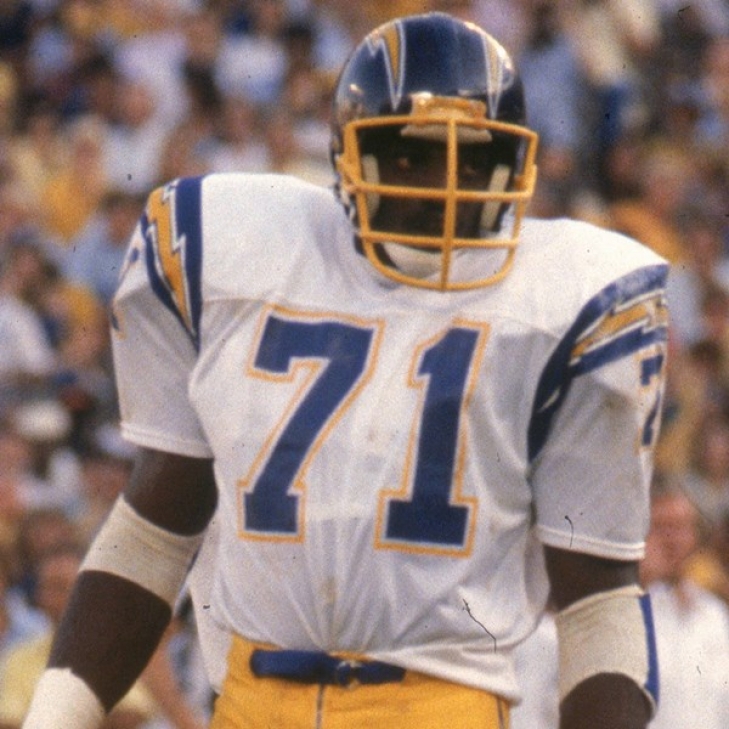
Fred Dean arrived in San Diego as a second-round pick out of Louisiana Tech in 1975 and stepped right into the starting lineup at defensive end. At roughly 6-foot-3 and 230 pounds, he was light for the position by NFL standards, yet that never slowed him down. His explosive first step, long arms, and ability to dip under bigger tackles or club them out of the way made him a nightmare on the edge. As a rookie, he already looked the part, recording seven sacks and a career-high 93 tackles while showing the kind of pass-rush juice that would define his career.
His best years came in the late 1970s and into 1980. In 1978, he put up 15.5 unofficial sacks as the team found its footing under Don Coryell. The next season he added nine more and earned his first Pro Bowl nod while the Chargers won the AFC West and allowed the fewest points in the conference. Then in 1980, even after missing the first two games because of a holdout, he still finished with 10.5 sacks, made First-Team All-Pro, and returned to the Pro Bowl. Lined up alongside Gary “Big Hands” Johnson, Louie Kelcher, and Leroy Jones, the front four earned the nickname the Bruise Brothers and helped the defense lead the entire NFL with 60 sacks. Quarterbacks felt him coming; his combination of speed and leverage let him win even when teams tried to double him.
The 1981 season began with continued contract tension. Dean played only a handful of games for the Chargers before becoming disgruntled with his pay relative to his production and other defensive linemen. Early in the season (October 2), San Diego traded him to the San Francisco 49ers. While some contemporary accounts had highlighted his earlier pass-rushing excellence as AFC Defensive Player of the Year-level production, his full 1981 campaign and major individual honors came after the trade.
In 2008, Dean was inducted into both the Pro Football Hall of Fame and the Chargers Hall of Fame, a dual recognition for the undersized edge rusher who had spent the Air Coryell years making life miserable for opposing quarterbacks before the trade sent him north.
23. Gill Byrd

Gill Byrd arrived in San Diego as a first-round pick out of San Jose State in 1983 and spent his entire ten-year career with the Chargers. He started 146 of the 149 games he played, and the team moved him around the secondary like few other defensive backs of his era—he began as the starting left cornerback, shifted to strong safety in 1985, free safety in 1986, and right cornerback in 1987 before settling back on the left side in 1989. That kind of positional flexibility made him one of the most versatile defensive backs the franchise has ever had.
That final stretch turned out to be his best. From 1989 through 1992, he was a steady ballhawk, earning Pro Bowl nods in 1991 and 1992 and a Second-Team All-Pro selection in his last season. In 1989, he led all NFL cornerbacks with seven interceptions, and he posted seven picks again in 1990 before following it with six in 1991 and four more in 1992. Those four seasons alone accounted for 24 of his career interceptions, and he finished with double-digit Approximate Value in each of his final two years.
Byrd retired after the 1992 season. Across those ten years in San Diego, he finished with 42 interceptions and 546 return yards (including two touchdowns), both still franchise records, along with four fumble recoveries.
The Chargers later inducted him into their Hall of Fame in 1998, recognizing the defensive back who spent a decade covering every spot in the secondary and left as the franchise’s all-time interception leader.
