
Our All Time Top 50 Charlotte Hornets have been revised to reflect the 2023-24 Season

Yes, we know that this is taking a while!
As many of you know, we at Notinhalloffame.com are slowly generating the top 50 of each major North American sports team. That being said, we have existing Top 50 lists and consistently look to update them when necessary and based on necessity. As such, we are delighted to present our post-2023-24 revision of our top 50 Charlotte Hornets.
As for all of our top 50 players in basketball, we look at the following:
1. Advanced Statistics.
2. Traditional statistics and how they finished in the National Basketball Association.
3. Playoff accomplishments.
4. Their overall impact on the team and other intangibles that are not reflected in a stat sheet.
Last year, Charlotte had another awful year and was nowhere close to playoff consideration. As this is a very young organization, there were multiple elevations and one new entrant.
As always, we present our top five, which saw no changes:
1. Kenba Walker
2. Gerald Wallace
3. Larry Johnson
4. Muggsy Bogues
5. Dell Curry
You can find the entire list here.
Terry Rozier, who was traded to the Miami Heat during the season, played 30 Games for Charlotte. There was a chasm between his #17 rank and #16, and he did not do enough to advance from that rank.
LaMelo Ball, who played less than 30 Games last year, still managed to climb up five spots to #18. This is a testament to Ball’s skills and the lack of overall talent this Hornets incarnation has had.
The returning Miles Bridges moved up four spots to #21.
P.J. Washington, who was traded to the Dallas Mavericks during the season, went up one spot to #40.
Gordon Hayward, who retired after the season (and was also traded during the year to the Oklahoma City Thunder) advanced one rank to #45.
The new entrant is Center Nick Richards, who debuts at #48.
We thank you for your continued support of our lists on Notinhalloffame.com.
Notinhalloffame List Update: 21-30 on Basketball Revised

The problem with running a Hall of Fame-related website is that many of the big ones we cover all have announcements within months of each other. The backbone of what we do is list-related, so this results in a long push to revise what we already have; specifically, now with our Football and Basketball Lists.
At present, we have a minor update as we have completed the third ten of the 2024 Basketball List, which you can comment on and vote on:
The new 21 to 30:
21. Glen Rice
22. Paul Silas
23. Johnny Kerr
24. Larry Kenon
25. Rasheed Wallace
26. Rudy LaRusso
27. Peja Stojakovic
28. Tyson Chandler
29. Willie Naulls
30. Larry Johnson
Rankings are impacted annually based on your comments and votes.
Thank you all for your patience. We will soon unveil more changes to the football and basketball lists.
41. Larry Johnson
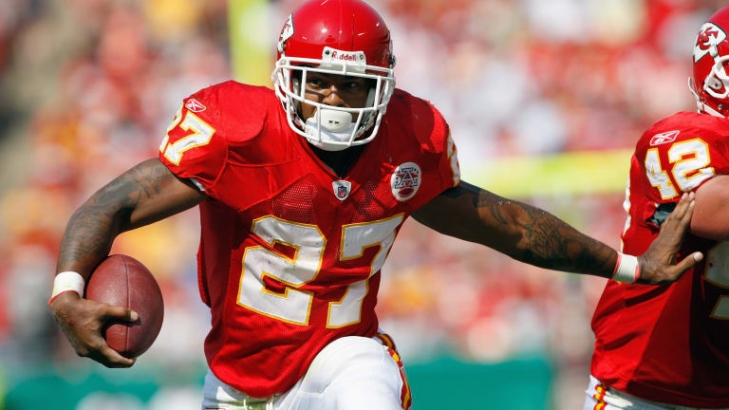
With the 27th overall pick in 2003, the Chiefs took Larry Johnson from Penn State under turbulent circumstances. Head coach Dick Vermeil made no secret that he hadn’t prioritized drafting the Doak Walker Award winner, which led to a cold start to Johnson’s pro career. Trailing Priest Holmes on the depth chart, Johnson logged sparse touches as a rookie, but his patience broke through late in 2004 when Holmes went down with an injury, offering a tantalizing glimpse of Johnson's raw, punishing power over nine games.
When Holmes suffered a season-ending neck injury midway through the 2005 campaign, Johnson stepped into the feature back role and unleashed one of the most physical rushing stretches in league history. Despite starting only nine games that year, he steamrolled defenses for 1,750 rushing yards and 20 touchdowns—adding 343 receiving yards to finish third in rushing and second in touchdowns in the NFL —earning his first Pro Bowl selection and an AP Second-Team All-Pro nod.
Johnson pushed his production even further in 2006 under Herm Edwards, putting together a legendary workhorse campaign. Carrying the entire offensive workload, he broke the NFL single-season record with 416 rushing attempts, racking up 1,789 rushing yards and 17 touchdowns while snagging 41 passes for 410 receiving yards. His dominant 2,199 scrimmage yards earned him consensus AP First-Team All-Pro honors and a second consecutive Pro Bowl berth as Kansas City clinched a postseason spot.
However, that historic volume exacted a steep physical toll. A foot injury halted his 2007 campaign after nine games, limiting him to 559 rushing yards, and he again stayed under 1,000 yards in 2008. Tensions over his workload and off-field controversies mounting in the local media eventually led to a mid-season release in 2009, ending his tenure in Missouri before brief, quiet stops in Cincinnati, Washington, and Miami.
Though his trajectory in Kansas City was volatile and polarizing, Johnson’s absolute peak stands as one of the most overwhelming two-year runs ever executed by a running back in franchise history.
With Kansas City, Johnson had 6,015 rushing yards, 55 rushing touchdowns, 151 receptions for 1,369 receiving yards, 7,384 total scrimmage yards, and 61 total touchdowns.
The College Basketball Hall of Fame Announced their 2019 Class

The Final Four is this weekend and what better way to celebrate that then by having the College Basketball Hall of Fame announce their Class of 2019. This group consists of six former players and three former coaches.
They are:
Shane Battier: Battier played at Duke where he would take the Blue Devils to the Final Four in 1999 and 2001. In the latter appearance Duke would win the NCAA Championship and he was the consensus MVP as well as being the Final Four Most Outstanding Player. Battier would later win two NBA Championships with the Miami Heat in 2012 and 2013.
Calbert Cheaney: Cheaney played for the University of Indiana from 1989 to 1993 where he would take on the role as the team leader for the Hoosiers. As a Senior, Cheaney would be named a First Team All-American, Big Ten Player of the Year and the National College Player of the Year. He is the all time leader in school and Big Ten history.
Ernie DiGregorio: DiGregorio played college ball at Providence where he would lead the Friars to a Final Four in 1970. He would after be named the NBA Rookie of the Year.
Terry Dischinger: Dischinger played three years at Purdue and as a Junior and Senior was a First Team All-American. He averaged 28 Points per Game as a Boilermaker and he would go on to be a the NBA Rookie of the Year and a three time NBA All Star.
Homer Drew: Drew had an overall coaching record of 640-428 that spanned from 1976 to 2011, and he achieved most of his fame helming Valparaiso from 1988 to 2011 (with the exception of the 2002/03 season). He took the Crusaders to eight Mid-Con tournament wins and was named the Mid-Con Coach of the Year four times.
Larry Johnson: Johnson was the NJCAA Player of the Year at Odessa and he would transfer to UNLV where he would help the Runnin’ Rebels win the 1990 NCAA Championship. They would go undefeated the next season only to be upset by Duke in the Final Four but Johnson was the Naismith College Player of the Year in 1991. He was the Big West Player of the Year in both of his years at UNLV.
Todd Lichti: Lichti played at Stanford for four years where he was a Consensus Second Team All-American as a Senior (1989). Lichti was also a four time First Team All Pac 10 player and after he left the school he was their all-time leading scorer.
Rick Majerus: Majerus was the five time WAC Coach of the Year and he took Utah to the Final Four in 1998. His coaching record was 517-215 while helming Marquette, Ball State, Utah and Saint Louis.
Lute Olson: Olson coached from 1973 to 2008 compiling a 781-280 record with Long Beach State, Iowa and Arizona. He took the Hawkeyes to the Final Four in 1980 but it was with the Wildcats where he had his greatest success taking them to four Final Fours and the NCAA Championship in 1997. Olson was already inducted in 2006 with 179 other people but the College Basketball Hall of Fame is now taking a more traditional approach with those from that class, hence his second induction.
The Naismith Basketball Hall of Fame will be announcing their class this weekend.
We here at Notinhalloffame.com would like to congratulate the members of the Class of 2019.
The Charlotte Hornets Top 50 has been revised

Regular visitors know that we are slowly working away on our Top 50 players for each major franchise. Those same visitors know that they are being added VERY slowly and that we have a long way to go still.
Having said that, we have updated the first NBA Top 50 list, which is that of the Charlotte Hornets.
In the future, changes to top 50 NBA teams will be more subtle, as we now have an algorithm that is fixed, and adds more elements of advanced statistics. All changes after this will be only reflect what has changed over a completed season. Basically, what we are saying is that the Hornets overhaul reflects our new system and now the 2015-16 season accomplishments.
We have switched around the entire list, but for the sake of brevity, let’s look at the new top five:
Larry Johnson takes over the #1 from Gerald Wallace who traded places to come in at #2. Muggsy Bogues and Dell Curry remain at #3 and #4 respectively. Glen Rice moves into #5, up one spot, taking over for Emeka Okafor who dropped significantly to #9. Notably, Kemba Walker moved up from #12 to #6.
The entire list can be found here.
Look for more Top 50 lists and revisions from us soon!
The Top 50 Charlotte Hornets of All-Time

Regular visitors to Notinhalloffame.com might know that we have told you in past updates that we will be looking at the top fifty players in each major North American Franchise.
For those unsure who exactly what the major North American Franchises are, it refers to the National Hockey League, National Football League, National Basketball Association and Major League Baseball.
Selected first are the Charlotte Hornets. Why? Honestly, there is no reason. One of the 100 plus franchises has to go first, and the Hornets were chosen randomly. Although the NBA season is in full flux now, this list will reflect only up to the end of the 2014-15 season.
Keep in mind that the Hornets absorbed the past history of the original franchise that relocated to the New Orleans and are known as the Pelicans. This means that there are many players on this list who never had “Hornets” on their chest, but “Bobcats”. For all intents and purposes, they are all Hornets now.
The list is based on traditional metrics, advanced metrics, length of service, popularity, and post season performance.
The complete list can be found here, but for those who are curious immediately as to who the top five are, we’ll grant that immediately:
1. Gerald Wallace.
2. Larry Johnson.
3. Muggsy Bogues.
4. Dell Curry.
5. Emaka Okafor.
We look forward to your comments on this list and it will be updated annually.
Up next will be the Baltimore Ravens. Look for that in the upcoming weeks.
3. Larry Johnson

The 2017 Football Futures have been updated

We already had the Football Futures from 2016, 2017 and 2018 up, and we have first decided to add additional candidates to the 2017 Football Futures Section.
First, here are the 2017 Football Future candidates who had already been uploaded:
Albert Haynesworth, a controversial Defensive Tackle who was two time First Team All Pro.
Brian Dawkins, a Safety who was named to nine Pro Bowls, four First Team All Pros and is a member of the 20/20 club.
Chad Johnson, the charismatic Wide Receiver who was a six time Pro Bowler and once led the NFL in Receiving Yards.
Derrick Mason, a two time Pro Bowl Selection who once led the National Football League in All-Purpose Yards.
Hines Ward, a Wide Receiver who was a Pro Bowl Selection twice, and a two time Super Bowl Champion (and one time Super Bowl MVP) with the Pittsburgh Steelers.
Jason Taylor, a Defensive Tackle who was a six time Pro Bowl Selection and was a former Defensive Player of the Year.
Jeremy Shockey, a brash Tight End who was a four time Pro Bowler and two time winner of the Super Bowl (one with the New York Giants and one with the New Orleans Saints).
Joey Porter, a Linebacker who went to four Pro Bowls and helped the Pittsburgh Steelers win the Super Bowl.
Kris Dielman, an Offensive Guard who played his entire career with the San Diego Chargers and went to four Pro Bowls.
LaDanian Tomlinson, a Running Back who was a two time Rushing Champion and five time Pro Bowler while playing with the San Diego Chargers.
Olin Kreutz, a Center who was a six time Pro Bowler and one time First Team All Pro while playing for the Chicago Bears.
Ricky Williams, an enigmatic Running Back who was the NFL’s leading rusher in 2002.
The new additions are as follows:
Aaron Kampman, a Defensive End with two Pro Bowl Selections and over 50 Quarterback Sacks.
Aaron Smith, a Defensive End with two Super Bowl Rings and two Pro Bowl nods in a career that was only spent with the Pittsburgh Steelers.
Al Harris, a Cornerback who helped the Green Bay Packers win a Super Bowl and also a two time Pro Bowl Selection.
Bob Sanders, a Safety who was a former AP Defensive Player of the Year and a member of the Colts’ lone Super Bowl win in Indianapolis.
Casey Wiegmann, an undrafted Center who was a one time Pro Bowl Selection.
Chad Clifton, an Offensive Lineman who made two Pro Bowls and helped the Green Bay Packers win a Super Bowl.
Donovan McNabb, a Quarterback known for his time with the Philadelphia Eagles where he took them to multiple NFC Championship Games.
E.J. Henderson, a linebacker who played all nine of his seasons with Minnesota Vikings.
Jake Delhomme, a Quarterback who took the Carolina Panthers to their first Super Bowl appearance.
John Henderson, a Defensive Tackle who made two Pro Bowls while playing for the Jacksonville Jaguars.
Joseph Addai, a Running Back who went to one Pro Bowl and was a big reason that Indianapolis Colts won the Super Bowl.
Larry Johnson, a Running Back who went to two Pro Bowls and earned a first Team All Pro spot.
Lito Sheppard, a Cornerback who went to a pair of Pro Bowls and was also a First Team All Pro Selection once.
Marion Barber, a Running Back who was a one time Pro Bowl Selection.
Matt Light, an Offensive Tackle who won three Super Bowls and went to three Pro Bowls with the New England Patriots.
Mike Sellers, a Fullback who made one Pro Bowl.
Neil Rackers, a Place Kicker who once led the NFL in Field Goals.
Nick Collins, a Safety who led the NFL once in Interception Return Yards, made three Pro Bowls and was a Super Bowl Champion with the Green Bay Packers.
Ovie Mughelli, a Fullback who was a one time Pro Bowl Selection.
Ryan Pontbriand, a Long Snapper who went to two Pro Bowls.
Shaun Ellis, a Defensive End who went to two Pro Bowls.
T.J. Houshmandzadeh, a Wide Receiver who was a one time Pro Bowl Selection.
Thomas Jones, a Running Back who is a member of the 10,000 Yard Rushing Club.
Tommie Harris, a Defensive Tackle who was a three time Pro Bowler.
Vince Young, a Quarterback who went to two Pro Bowls.
We will be continuing our work on the football futures and you will be seeing that shortly. In the meantime we are hopeful that we will receive your inputs and votes on this batch of future eligible football players.
42. Larry Johnson

Saying that, what was the deal with "Grandmama"?
