

8. Andy Ashby
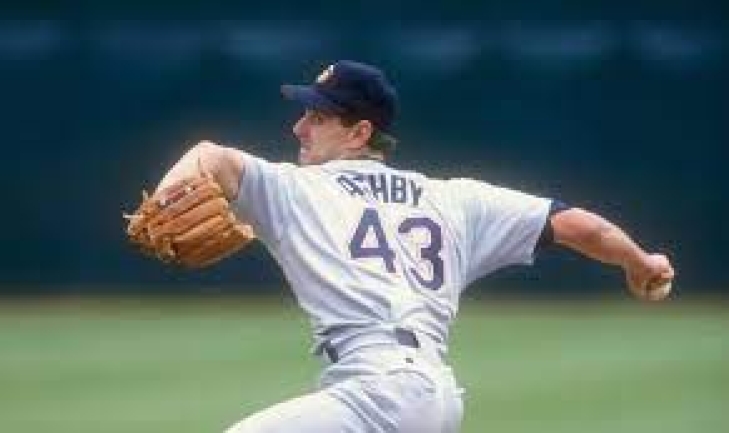
Andy Ashby was traded during his third Major League Season from the expansion Colorado Rockies in 1993 to San Diego, and it was as a Padre where Ashby shone brightest.
The Righthanded Pitcher, who arrived as the "player to be named later," finished off '93 better than in Colorado, though considering he had an 8.50 ERA with the Rockies, that did not say much. Ashby was much better in 1994 (6-11, 3.40 ERA), but in 1995, he cemented himself as a valuable part of the Padres staff, with a 12-10 Record and a 2.94 ERA.
Ashby had respectable years in 1996 and 1997 but broke out with All-Star seasons in 1998 and 1999 and was undoubtedly the staff ace. These two years landed Ashby so high on this list, but it also led to his trade, as the small market Padres traded him to the Phillies before the 2000 Season.
Ashby had a 70-62 Record and 829 Strikeouts with the Padres.
7. Randy Jones
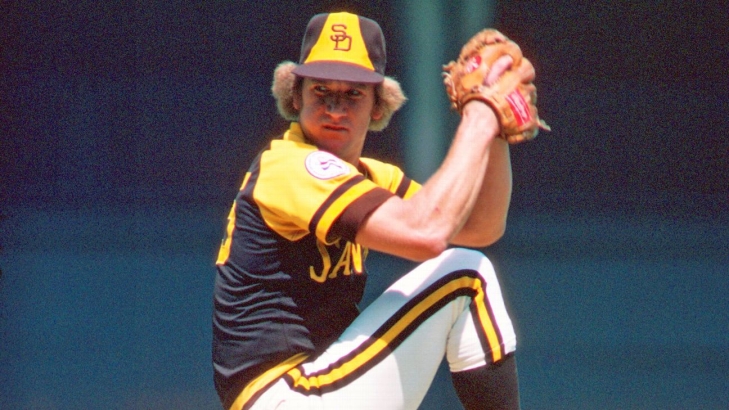
The early years of the San Diego Padres were marked by a lack of success during the expansion era, but they were occasionally broken up by a curly-haired left-hander who brought recognition to the team. Randy Jones stood out as the opposite of today's high-velocity pitchers. Known as "The Junkman," he relied on a heavy sinker, consistent pace, and precise control of the lower strike zone. During an era when radar guns were becoming a measure of a pitcher's worth, Jones was notable for his quick and efficient outings, often finishing games in less than two hours.
Making his major league debut in 1973 with a respectable 7–6 record, he quickly found himself at the mercy of a structurally weak team roster the following summer. Demonstrating how high volume can backfire on a poor team, Jones suffered through a terrible 1974 season, leading the National League with 22 losses despite pitching with more talent than his record showed. Instead of letting this setback derail his progress, the resilient southpaw returned in 1975 to deliver a season of exceptional performance. He confounded hitters in the Senior Circuit by changing his mechanics, lowering his ERA to a league-best 2.24, and posting an outstanding 156 ERA+. He earned 20 wins for a Padres team that finished below .500 and narrowly missed winning the Cy Young Award, finishing second to Tom Seaver in a competitive race. This would be a springboard for what was to come.
The 1976 campaign was a highlight of durability and precise, low-variance pitching. Jones’ dominance was evident as he tore through the first half of the season, tying a historic National League record by pitching 68 straight innings without giving up a walk. He headed into the All-Star break with an impressive 16–3 record. He also started and won the Midsummer Classic and finished the year leading the major leagues in wins (22), starts (40), complete games (25), and total innings (315.1). His outstanding performance earned him the National League Cy Young Award, making him the first in franchise history to win a major individual honor.
Sadly, the heavy workload of that famous 300-inning season took a significant physical toll. In his last start of 1976, Jones suffered a serious nerve injury in his throwing arm, which needed major surgery. He made a comeback with his characteristic determination but was unable to fully regain his top form, instead settling into a reliable, dependable starting role.
After gutting out three more high-volume campaigns, including a resilient 13-win bounce-back in 1978, the front office officially signaled a transition following the 1980 schedule, trading the veteran icon to the New York Mets. As a Padre, Jones had a 92-105 record with a 3.30 ERA and 677 strikeouts.
In 1999, the Padres enshrined Jones into their inaugural Hall of Fame Class two years after they retired his number 37.
3. Jake Peavy
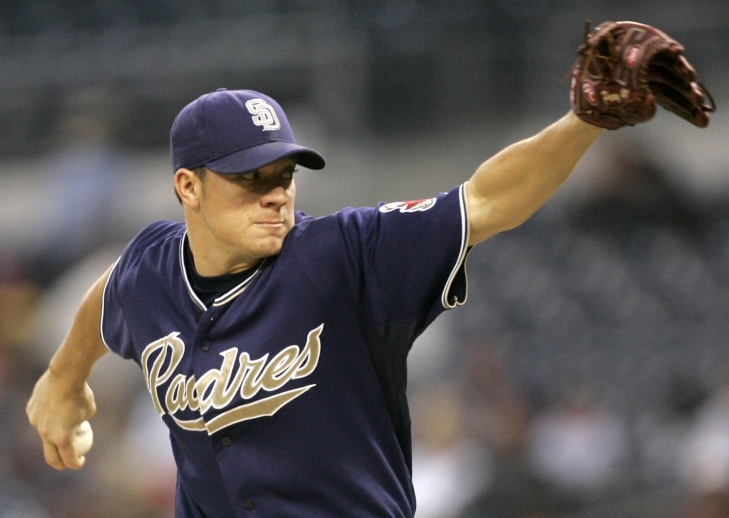
The profile of a top-tier, elite major league starter usually goes to celebrated first-round talents, but Jake Peavy distinguished himself in the baseball world through pure Southern grit. Drafted out of an Alabama high school in the 15th round of the 1999 amateur draft, many teams saw Peavy as mainly organizational depth. However, he defied these modest expectations, swiftly advancing through the minors to debut in the majors by summer 2002. With a fierce, highly competitive glare on the mound and a fast, crossfire delivery that posed a daunting sight for right-handed hitters, he spent the next seven seasons leading the starting rotation with relentless intensity and bravado.
By the 2004 season, the young right-hander had established himself as the team's leading pitcher. He consistently dominated in preventing runs, posting a remarkable 2.27 ERA over 166.1 innings, which earned him his first efficiency award. His success was not a fleeting peak; in 2005, Peavy earned his first All-Star spot, confirming his rising prominence. He continued to rack up impressive strikeout numbers using a powerful slider-fastball combo, finishing the year with a 2.88 ERA and leading the Senior Circuit with 216 strikeouts, thereby cementing his reputation on the national stage.
After a somewhat disappointing and uneven 2006 season marked by command problems, Peavy came back with a strong competitive drive for the 2007 pennant race. What followed was a showcase of pitching excellence. Peavy delivered an impressive performance, earning the National League Pitcher's Triple Crown by leading the league in wins (19), ERA (2.54), and strikeouts (240). His advanced efficiency metrics completely outperformed opponents, as he led the Senior Circuit in FIP (2.84), WHIP (1.061), and struck out an average of 9.7 batters per nine innings. Naturally, he was a unanimous selection for the 2007 National League Cy Young Award.
Sadly, the physical demands of his high-effort mechanics and ongoing tendon and shoulder injuries kept him from reaching those historic heights again in Southern California. By 2009, as the franchise shifted toward a complete rebuild in a small-market setting, the main goal was to unload Peavy's substantial contract. This led to a highly publicized saga: initially, the Padres agreed to send their ace to Chicago in May, but Peavy exercised his veto right, using his full no-trade clause to stay in the National League. The deadlock was eventually broken at the July 31 trade deadline. After injuring his ankle and aware that the cash-strapped Padres were determined to trade him, Peavy relented and waived his no-trade rights to join the Chicago White Sox.
With the Padres, Peavy posted a 92-68 record with 1,348 Strikeouts, which, as of this writing, is the franchise record.
2. Trevor Hoffman
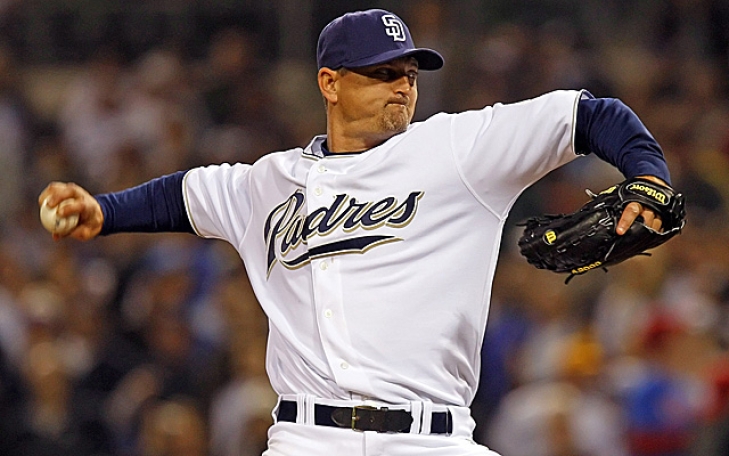
The loud groan that swept through San Diego in summer 1993 was entirely understandable. The Padres' management, amid a major salary dump, had just traded Gary Sheffield, the reigning batting champion and a franchise icon, to the Florida Marlins. Fans felt betrayed, but hidden within the traded players was a failed minor-league shortstop who became a rookie reliever and later transformed late-inning pitching. Trevor Hoffman didn't arrive as a top prospect, but over the next decade and a half, he became the gold standard for run prevention in the National League, anchoring the bullpen with a calm, relentless efficiency that redefined the closer role.
By 1994, Hoffman had fully established the role of the everyday closer, and the organization quickly recognized that they had found something extraordinary. Over time, his approach to games evolved into a true theatrical spectacle for stadium audiences.
As the stadium lights dimmed, AC/DC's "Hells Bells" echoed ominously through the ballpark, energizing the home fans and unsettling opposing teams. His true nightmare for hitters wasn't his fastball's velocity—often over 100 mph—but a powerful, high-concept changeup thrown with the same arm speed. The ball would vanish at the plate, leaving top sluggers lunging and off-balance.
Hoffman's emergence on the national stage was during the 1998 pennant race. He delivered an exceptional display of high-pressure performance, consistently shutting down National League batters to record a career-high 53 saves and a tiny 1.48 ERA. His steady hand in the ninth inning was the key driving force behind the Padres’ tough postseason run, leading them to their second National League pennant. Although they ultimately lost to the formidable Yankees in the World Series, Hoffman's reliable closing was vital in making October's journey possible.
Hoffman's impressive performance was not just a brief peak; he maintained his elite, low-variance output for more than ten years in Southern California. He made the ninth inning a daily, routine part of the regular season, leading the National League in saves again during a standout 2006 season. He also achieved nine seasons with at least 40 saves. His efficiency gains led to two second-place finishes in the National League Cy Young Award voting, including a very close result in 1998, and he was selected for seven All-Star Games, becoming a key representative of the franchise.
As he chased historic milestones, his unyielding longevity shattered the existing boundaries of baseball history. He became the very first pitcher to cross the mythical 500-save threshold, and though he would later collect his 600th career save while wearing a Milwaukee Brewers uniform at the twilight of his journey, the overwhelming volume of his historic footprint was compiled right by the beach.
Hoffman accumulated a staggering 552 of his 601 career saves representing San Diego, establishing a franchise record that may never be approached. San Diego retired his number 51 in 2011 and inducted Hoffman to their franchise Hall of Fame three years later. In 2018, Cooperstown came calling, inducting Hoffman in the third year of his eligibility. Appropriately, the player considered the best reliever in the NL now wins the Trevor Hoffman Award.
16. Gene Tenace
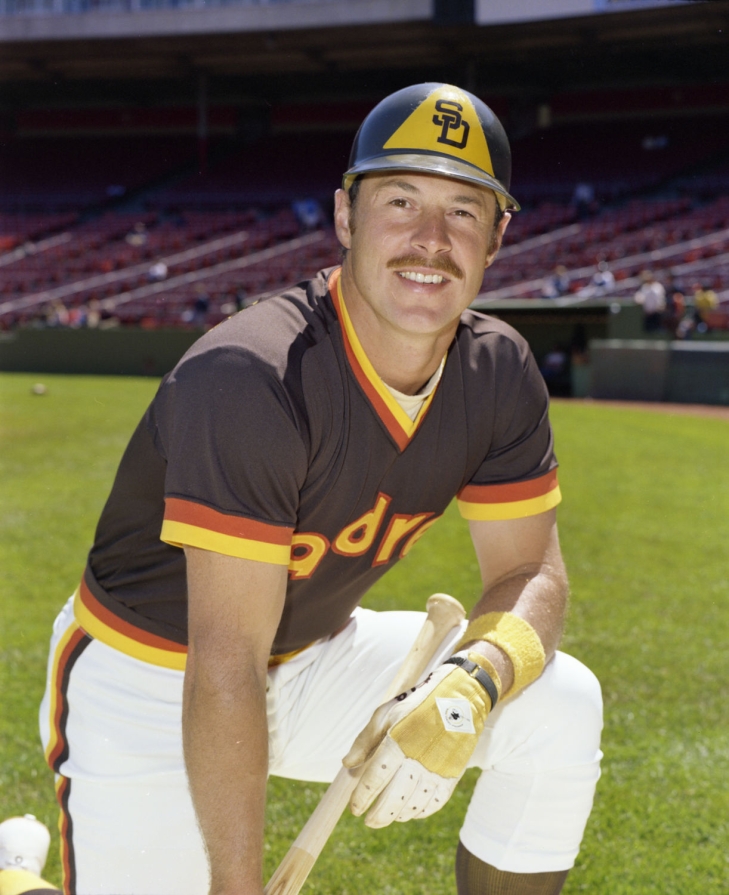
Looking back at the early innovators of modern baseball metrics, a tough, right-handed catcher from Pennsylvania emerges as a key pioneer in on-base efficiency. Gene Tenace had already established a postseason legacy as a crucial contributor to the Oakland Athletics' three consecutive championships from 1972 to 1974. However, as free agency disrupted that historic Oakland team, Tenace decided to remain in California, signing a lucrative deal to join the San Diego Padres before the 1977 season.
To be fair, Tenace was never a feared, high-average contact hitter in the traditional sense. He maintained a modest .240 batting average over his career with the Padres and didn't compile huge hit totals. Instead, he excelled at turning the basic act of drawing a walk into a showcase of spatial awareness and strike-zone discipline.
In his 1977 debut season, Tenace showcased exceptional patience, bewildering National League pitchers and drawing a league-high 125 walks. This impressive number of free passes contributed to a remarkable .415 on-base percentage, which is especially striking given that he hit only .233 that summer.
This hardware-certified authority deeply committed to discipline was no temporary success; it became his daily habit. Tenace consistently exceeded 100 walks each summer during his first three seasons in San Diego, with 101 in 1978 and 105 in 1979. Over his four seasons with the Friars, he maintained an on-base percentage never below .392, even though he only surpassed a .250 batting average once. Defensively, his value to the pitching staff was absolutely incalculable; splitting time between catcher and first base, his preparation and high-intensity game-calling settled a young rotation and provided a steady hand for the entire defense.
Dealt to the Cardinals after the 1980 Season, Tenace had a .403 OBP with San Diego, a number higher than what he did in Oakland (.374). Amazingly, he had more Walks (423) than Hits (384) as a Padre, but as Moneyball tells you, “he gets on base."
12. Gene Richards
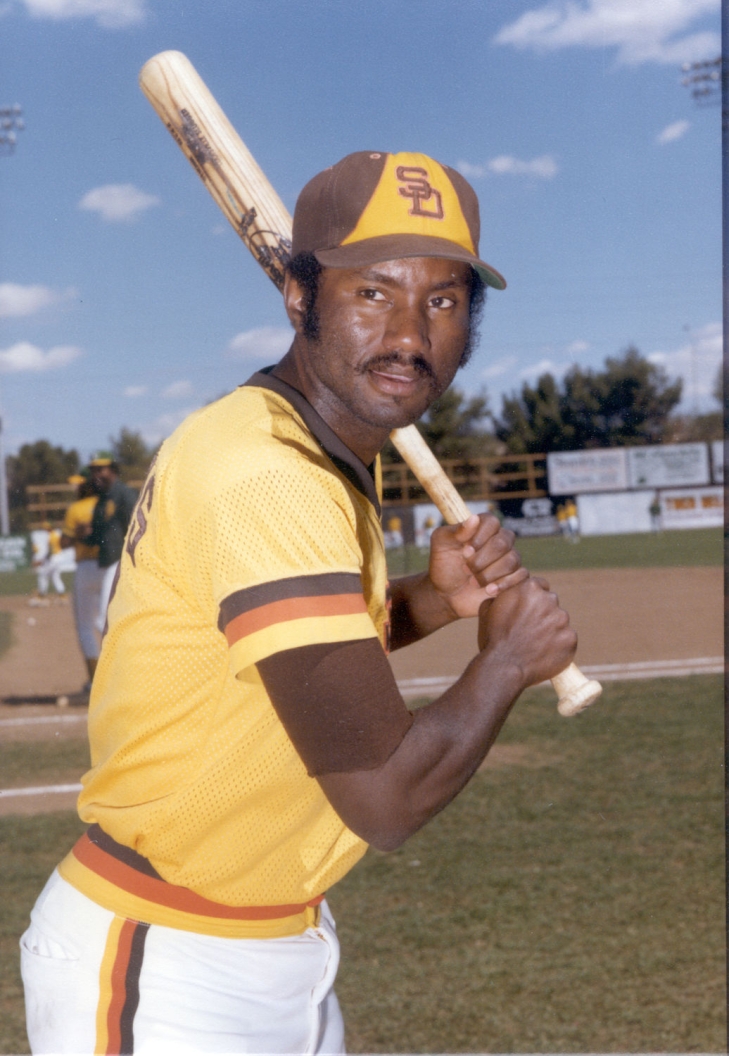
When establishing an organizational identity from inception, a young franchise necessitates a dynamic catalyst capable of dictating the pace of the game solely through speed. The San Diego Padres identified their ideal facilitator when they selected Gene Richards as the top pick in the secondary phase of the 1975 amateur draft. Demonstrating relentless progress through the minor leagues with unrestricted authorization, the left-handed outfielder made his debut in Major League Baseball by the spring of 1977. Richards promptly transformed his first summer into a notable demonstration of high-velocity playmaking, achieving an impressive .290 batting average and setting a then-Major League rookie record with 56 stolen bases. This served as an exceptional initial introduction to a player who would dedicate the subsequent seasons to exemplifying the definitive pace-setter for the San Diego offense.
Throughout the late 1970s and early 1980s, Richards established himself as a reliable leadoff hitter under the Southern California sun. He combined excellent bat control with sharp spatial awareness, often forcing opposing National League defenses into a frantic routine.
He surpassed the coveted .300 batting average twice, achieving a smooth .308 in 1978 and a strong .301 during a standout 1980 season. This 1980 regular-season performance showcased his ability to produce volume, as he frequently connected against National League pitchers, leading the Senior Circuit with 155 singles and stealing 40 bases.
His unique, high-velocity running style remained a nightmare for catchers, and he backed up his offensive prowess by leading the National League with 12 triples during the strike-shortened 1981 season.
Yet, focusing entirely on his offensive speed tells only half the story of his multi-dimensional footprint. Defensively, Richards adapted smoothly to Jack Murphy Stadium's large outfield, using his quick closing speed to chase down line drives. His throwing arm was effective and surprisingly fierce; he led all National League left fielders in assists in 1980 with 21 outfield putouts. He continued this performance in 1981, recording 14 assists and consistently providing a reliable and aggressive defensive presence.
After a subpar 1983 season, Richards left for San Francisco as a free agent, but he would be out of the Majors after a year. With San Diego, Richards batted .291 with 242 stolen bases.
14. Nate Colbert
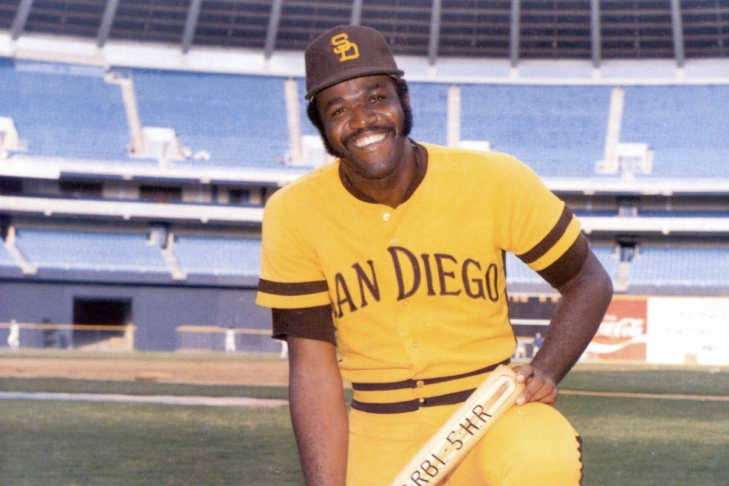
When a franchise enters league history for the first time, it relies on key pillars to build its identity from scratch. For the 1969 expansion San Diego Padres, that was Nate Colbert, a powerful hitter from the Houston Astros drafted in expansion. He not only led the struggling team's offense but became its first superstar. As starting first baseman, he brought immediate, impressive power to the field, giving fans a reason to visit San Diego Stadium.
Calling it as it is means recognizing that Colbert was never a refined contact hitter. Throughout his career, he struggled with frequent swing-and-miss issues, recording over 100 strikeouts in five seasons and maintaining a modest .243 batting average with the Padres. However, his lack of pure efficiency was compensated for by his high offensive volume and power in high-pressure situations.
During his first five summers in San Diego, Colbert aimed to hit 20 home runs daily, achieving this every year from 1969 to 1973. His most outstanding season was 1970 with 38 home runs, a feat he repeated in the exceptional 1972 season. That year is remembered as one of the most remarkable displays of individual run production in baseball history. Colbert was a starter in three consecutive All-Star games from 1971 to 1973, but his 1972 performance peaked on August 1st during a historic doubleheader against the Atlanta Braves.
Using a powerful and aggressive approach, Colbert delivered an outstanding performance by hitting five home runs and driving in 13 runs over two games—a record in major league history that still stands. His impressive skill and dominance that summer earned him eighth place in the National League MVP voting, even though he played for a team at the bottom of the standings.
Chronic back issues significantly damaged his physical abilities before the 1974 season, leading to a sudden decline in performance and the loss of his trademark bat speed. With reduced efficiency and the team planning a roster overhaul, the front office orchestrated a clear career exit by trading their original star to the Detroit Tigers in November 1974.
Colbert accumulated 163 taters with the Padres.
4. Dave Winfield
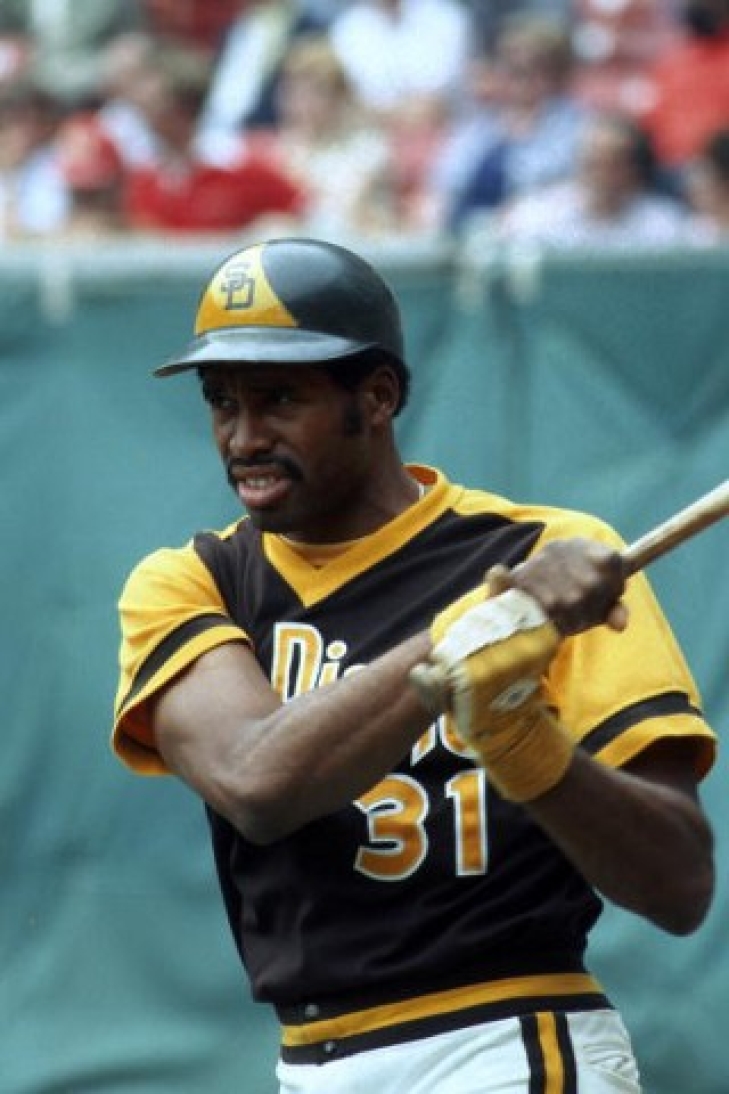
Before sports specialization limited athletes’ paths, some rare prodigies had an explosive physical toolkit that broke traditional boundaries. Dave Winfield exemplified this exceptional, multi-sport athleticism. Standing tall at the University of Minnesota, Winfield achieved the remarkable feat of being drafted by three different professional sports leagues: the NBA's Atlanta Hawks, the ABA's Utah Stars, and the NFL's Minnesota Vikings, despite never playing college football. Ultimately, he chose baseball, and the San Diego Padres eagerly used the fourth overall pick in the 1973 amateur draft to secure a pioneering power hitter for a new era.
His exceptional innate talent was evident to such a degree that management opted to bypass the minor leagues entirely, promoting the 21-year-old phenom directly to the major league roster. Although Winfield had distinguished himself as a dominant College World Series MVP pitcher for the Golden Gophers, the Padres front office was unwilling to risk his dynamic physical frame on the mound. Instead, they promptly assigned him to right field, a position in which he demonstrated remarkable proficiency with rapid mastery.
By the 1974 schedule, his long, high-velocity swing yielded 20 home runs, signaling the arrival of a premier middle-of-the-order threat. He methodically sharpened his approach over the subsequent summers, turning baseline run-production into an absolute regular-season routine.
His national breakthrough occurred in 1977, when he hit 25 home runs to secure his inaugural All-Star invitation, marking the beginning of a distinguished streak of twelve consecutive appearances in the Midsummer Classic. Following this achievement with a strong 24-homer season in 1978, Winfield reached the zenith of his tenure in Southern California during an exceptional 1979 season. He delivered a remarkable display of run production and batting.308, hitting 34 home runs, and leading the league with 118 runs batted in, anchoring the San Diego offense. His highly efficient performance further validated his dominant peak, as he led all National League position players with an outstanding 8.3 bWAR and finished third in the National League MVP voting.
The clock was ticking on his beach residency. After a productive 1980 campaign with 20 home runs and a second Gold Glove, his relationship with the financially constrained team ended. Frustrated by their small-market limits and inability to build a winning team, Winfield tested free agency and signed a record-breaking contract with the Yankees, becoming the highest-paid player at the time.
He departed Southern California, leaving behind 1,134 hits, 154 home runs, 185 doubles, and 626 RBIs alongside a highly respectable .284/.357/.464 slash line across 1,117 games.
In 2001, the Baseball Hall of Fame inducted Winfield into their Hall of Fame in his first year of eligibility, and the Padres retired his number 31 the same year. San Diego also inducted Winfield into their Hall of Fame the year before.
1. Tony Gwynn
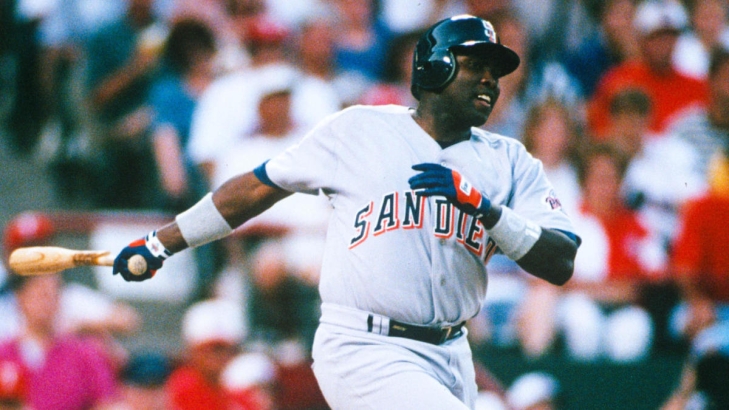
When constructing a historical hierarchy for a Major League franchise, debating the top spot usually requires parsing through eras, contrasting raw power against pitching longevity, and splitting hairs over decimal points. This is not one of those times.
Tony Gwynn is not just the undisputed legend of the San Diego Padres; he is one of the most exceptional and mesmerizing pure hitters in baseball history. Long before advanced analytics changed player evaluation, Gwynn revolutionized the game by approaching the batter's box as a science, pioneering detailed video analysis to study opposing pitchers. With a compact, instinctive left-handed swing that skillfully navigates the "5.5 hole" between third base and shortstop, he elevated contact hitting to an art form and a consistent part of his daily game.
His initial appearance during the 1982 season offered a brief preview of what was ahead, but Gwynn truly rose to star status in 1984. That year, he delivered an exceptional regular season, putting the franchise on the national stage. His consistent performance overwhelmed National League pitching by hitting a league-leading .351 and amassing 213 hits, the most in the league. His outstanding hitting fueled San Diego’s first-ever National League pennant run, earning him his first All-Star honor, a Silver Slugger award, and a third-place finish in MVP voting. In the NLCS against Chicago, his critical double in the bottom of the seventh inning of Game 5 drove in the tying and go-ahead runs, an iconic moment that sparked celebration at Jack Murphy Stadium and secured the Padres' first appearance in the Fall Classic.
The stunning breakout of 1984 quickly became routine over the next fifteen years. Aside from his brief 54-game debut, Gwynn consistently avoided slumps, batting over .300 in 19 consecutive summers. He achieved an impressive eight National League batting titles, tying Honus Wagner for the league record, and led in hits seven times. The peak of his individual dominance was during the strike-shortened 1994 season, when he batted an extraordinary .394, creating a lingering "what-if" regarding the .400 batting average milestone. Although he never won the MVP award, his advanced batting efficiency earned him seven top-ten MVP finishes and 15 All-Star selections.
Fourteen years after his first taste of October magic, Gwynn served as a revered elder statesman and offensive catalyst for the legendary 1998 team. Showing unwavering consistency at age 38, he hit .321 with a career-high 148 adjusted OPS+, guiding the team through a tough postseason, including victories over a strong Houston squad and the pitching-heavy Atlanta Braves. This outstanding run earned San Diego its second National League championship pennant, bringing the franchise back to baseball's biggest stage. In Game 1 of the 1998 World Series at Yankee Stadium, Gwynn capped his postseason performance with a majestic, decisive home run off El Duque Orlando Hernández, a memorable moment that remains etched in Padres fans’ memories.
Labeling Gwynn solely as a singles hitter overlooks the multi-dimensional skill set that defined his physical peak. While he wasn't primarily focused on hitting over fences, he had sneaky gap power, hitting 543 doubles and 135 home runs, which helped him achieve a strong .459 lifetime slugging percentage. Additionally, before aging and physical decline affected him, his exceptional spatial awareness and quick acceleration made him a dangerous base runner, with 319 stolen bases in his career. His defensive instincts were equally sharp, enabling him to move gracefully across the outfield and earn five National League Gold Glove awards.
Gwynn’s careful daily preparation set the stage for a historically unique profile, now even more complex with modern analytics. During a time when strikeouts increased rapidly league-wide, he demonstrated exceptional strike-zone judgment. He faced Hall of Fame legends like Greg Maddux, Tom Glavine, John Smoltz, and Pedro Martínez a total of 323 times, and was remarkably never struck out by any of them. His skill in making contact against top-tier, high-velocity pitches allowed him to lead the batting order with an extremely low walk-to-strikeout ratio, showing that his legendary vision was not just a physical talent but also a disciplined, mental mastery of situational hitting.
When he finally left the diamond at the end of the 2001 season, he did so as a true, unwavering “Lifer”, spending his entire 20-year career in a single uniform. Gwynn established an extraordinary, record-breaking career that sounds like science fiction today: 3,141 hits, 1,138 RBIs, and an impressive .338 batting average, with only 434 strikeouts in nearly 10,240 plate appearances. The organization quickly recognized his significance by retiring his iconic number 19 and inducting him into the Padres Hall of Fame in 2004. Three years later, national voters cemented his legacy by inducting him into the Baseball Hall of Fame on his first ballot in 2007, ensuring that "Mr. Padre" remains legendary forever.
10. Ken Caminiti
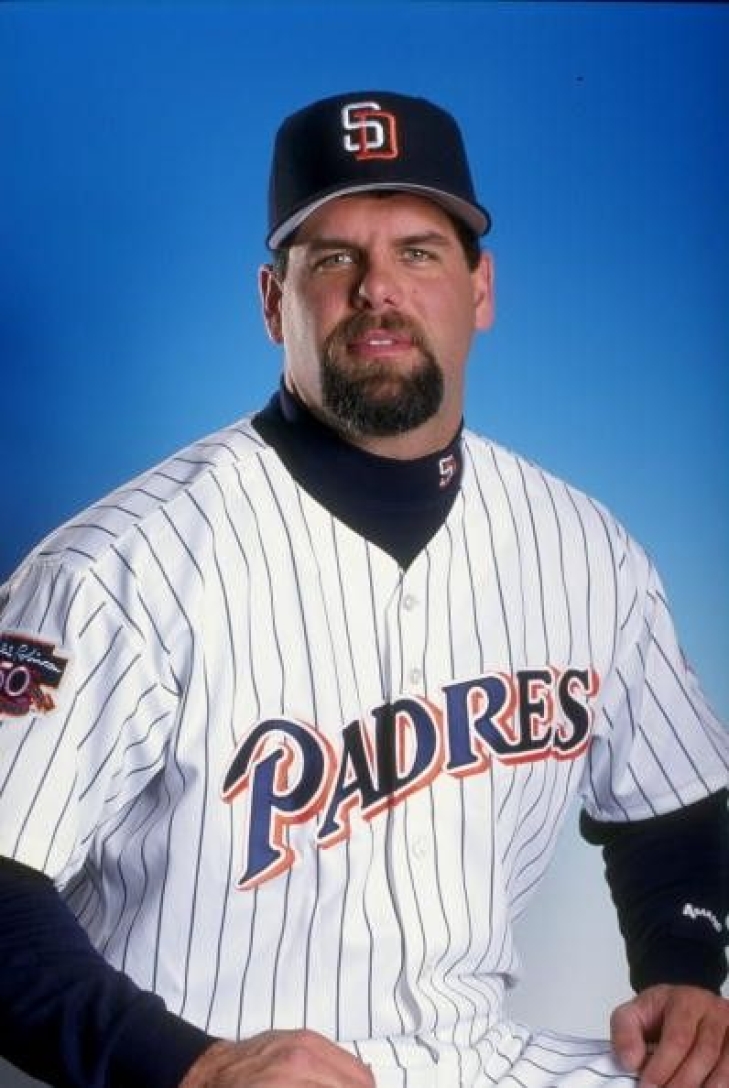
In evaluating the history of the San Diego Padres, certain periods are characterized by a remarkable surge in individual prowess that significantly influences the franchise's trajectory. The resurgence in Southern California during the mid-1990s was notably driven by the intense and aggressive playmaking of Ken Caminiti. Having spent his initial eight seasons in Major League Baseball with the Houston Astros—where he received a single All-Star selection during the strike-shortened 1994 season—the third baseman was subsequently traded westward as the pivotal figure in a transformative, twelve-player trade in December 1994. Upon his arrival in San Diego, armed with a fierce competitive spirit and a reputation for playing through severe physical pain, the switch-hitter experienced a distinguished peak marked by hardware accolades, transforming Jack Murphy Stadium into a veritable laboratory of offensive output.
His first year in a Padres uniform offered an immediate look at his evolving power profile. Caminiti systematically dismantled National League pitching staffs, lashing out a career-high 26 home runs and driving home 94 runs while eclipsing the coveted .300 batting average threshold for the first time in his career.
In 1996, Caminiti showcased exceptional offensive power, hitting a career-high 40 home runs and recording a franchise-record 130 RBIs. His impressive performance improved league efficiency metrics with a notable .326/.408/621 slash line, leading the Padres to win the National League West division. His outstanding play earned him unanimous recognition as the National League Most Valuable Player and a Silver Slugger Award.
Caminiti kept his power numbers strong over the next two years, with seasons of 26 and 29 Home Runs, respectively, while his arm earned him three straight Gold Gloves (1995-97).
He rejoined the Astros as a Free Agent in 1999, leaving the Padres after 121 home runs and a .295 batting average. While Caminiti would later admit to PED use, he had other demons, as he died of a drug overdose at the age of 41. The Padres would, however, immortalize Caminiti in their Hall of Fame in 2016.
11. Andy Benes
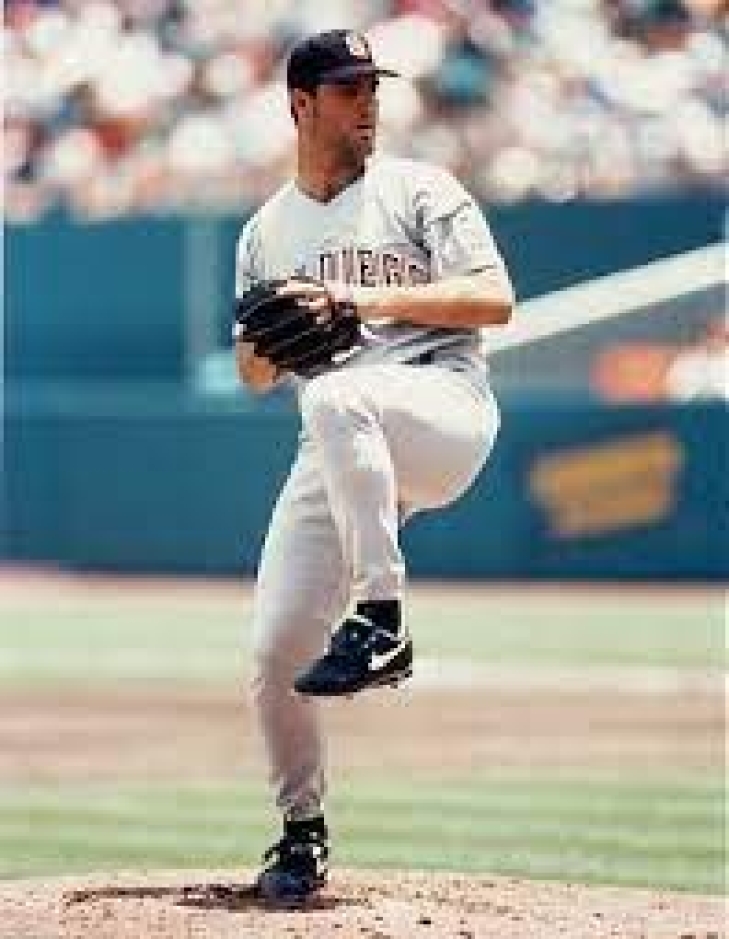
The San Diego Padres believed they found their foundational player when they picked Andy Benes at the top of the 1988 amateur draft. The talented right-hander quickly proved the front office correct, advancing rapidly through the minor leagues to make his major league debut by summer 1989. Jumping straight into the regular season, Benes delivered an impressive debut, posting a 6–3 record with a 3.51 ERA in 10 strong starts, finishing fifth in the National League Rookie of the Year voting. This promising start indicated a pitcher who would be a reliable, durable cornerstone of the San Diego pitching staff during the first half of the 1990s.
Over five summers, Benes was the clear staff ace during a challenging transitional period for the team. He combined a powerful, high-velocity fastball with excellent spatial awareness, making late-game durability a consistent expectation. In 1991, he delivered an outstanding season, leading the rotation with 15 wins and a solid 3.03 ERA, also surpassing 200 strikeouts for the first time in his career.
After achieving another consistent and productive season of frames in 1992, he regained his frontline dominance during the 1993 season's standout. Benes achieved 15 wins again and pitched a career-high 230.2 demanding innings, earning his first All-Star selection and boosting his national reputation.
His 1994 campaign vividly exemplified the challenging reality of being a key player on a struggling team. During that strike-shortened season, Benes showcased impressive high-volume performance and statistical setbacks; he dominated hitters to lead the National League with 189 strikeouts, yet a lack of run support caused him to top the league with 14 losses.
Tragically, that heavy burden caused a sharp performance drop, leading to a difficult first half of the 1995 season. As the small-market team prepared for a roster rebuild and looked to the future, the front office signaled his career end by trading him to the Seattle Mariners mid-season.
As a Padre, he had a 69-75 record with 1,036 strikeouts.
9. Adrian Gonzalez
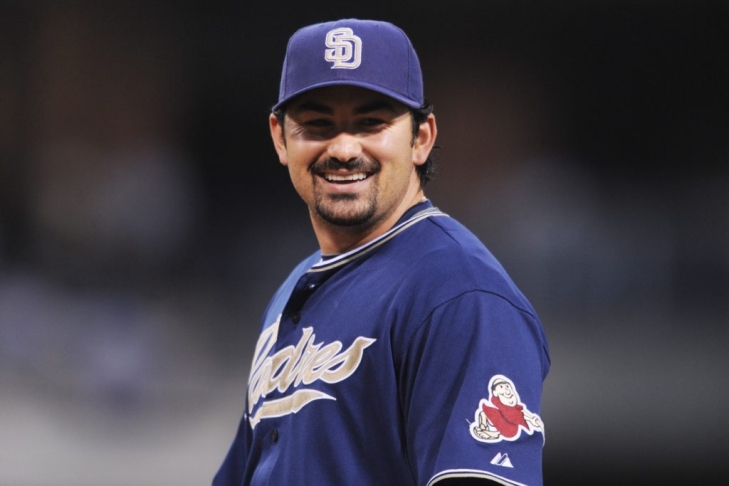
Evaluating a first overall draft pick involves significant organizational pressure, and the Florida Marlins made a critical error in their developmental patience with Adrián González. Picked at the top of the 2000 amateur draft, the left-handed first baseman injured his wrist in the minors, leading Florida scouts to prematurely doubt that his raw power would ever fully develop at the major league level. After being traded to Texas, he briefly made the team before the Rangers deemed him surplus and sent him to San Diego prior to the 2006 season. For González, this trade was like a homecoming, as he had moved to that area as a child and grown up watching the local field. Filling in for injured Ryan Klesko in the starting lineup, he quickly disproved previous evaluations of him, becoming a key contributor to run production under Southern California’s sun.
His summer debut in 2006 quickly showcased elite contact skills and smooth mechanics. González methodically dismantled National League pitching staffs, collecting 173 hits with a .304 batting average and 24 home runs, solidifying his strong presence at first base. His true power was confirmed in 2007, when he hit 30 home runs and brought in 100 RBIs.
This hardware-certified consistency flourished into an exceptional series of individual dominance over the following three summers. González achieved three consecutive All-Star selections from 2008 to 2010, combining his superior batting skills with impressive home run totals of 36, 40, and 31.
Far from a one-dimensional slugger, he was developing a telepathic batting eye to counter defensive positioning. This peaked during the 2009 season, where he systematically forced pitchers deep into counts, leading to a career-high 119 walks. This efficiency created high-leverage opportunities, earning him MVP consideration across all three All-Star campaigns, culminating in a fourth-place finish in 2010. He was also a two-time Gold Glove winner in San Diego (2008 & 2009)
At the conclusion of the 2010 Season, Gonzalez would be traded to the Red Sox for four players. Gonzalez blasted 856 hits, 161 home runs with a .514 slugging percentage as a Padre.
15. Terry Kennedy
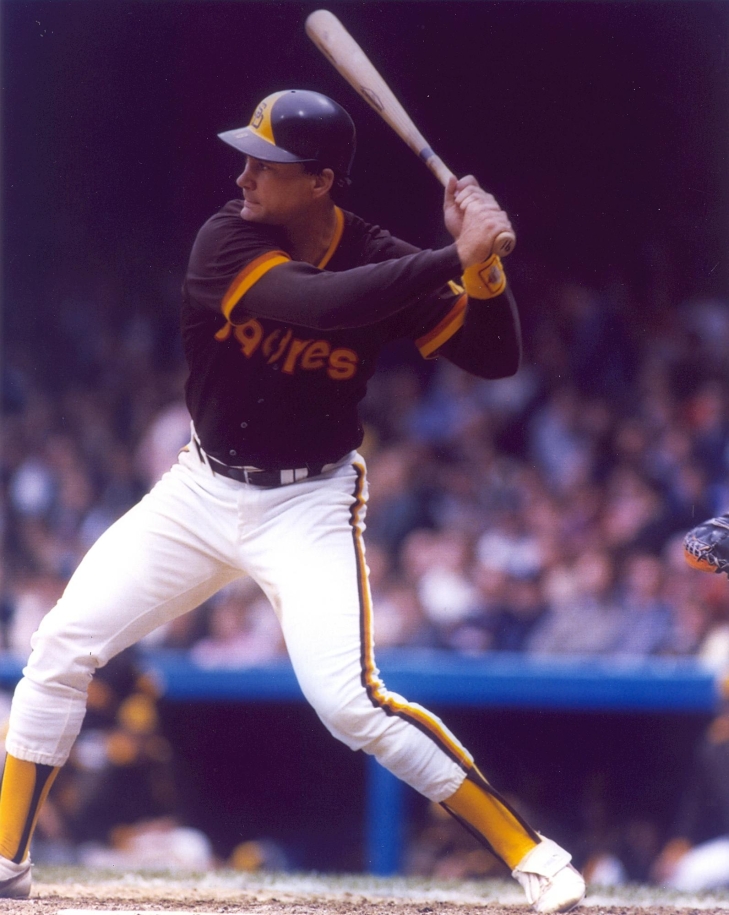
When constructing a championship roster, an organization often requires a robust, vocal anchor behind the plate to oversee the pitching staff and set an assertive tone in the lower half of the batting order. The San Diego Padres identified precisely this foundational element when they orchestrated a significant trade with the St. Louis Cardinals in December 1980, acquiring TerryKennedy. Restricted from regular duties in St. Louis by Ted Simmons, the physically imposing, left-handed hitting catcher regarded the move to Southern California as the ultimate opportunity to demonstrate his daily durability. He wasted no time in affirming this conviction, assuming the role of the starting catcher and promptly establishing himself as a valuable asset under the Pacific sun.
His initial 1981 campaign was a brilliant showcase of immediate contact and spatial awareness. Kennedy logged a spectacular .301 batting average to capture his first career All-Star selection. While he narrowly missed out on a return trip to the Midsummer Classic the following summer, his 1982 campaign proved to be the absolute evolutionary zenith of his raw power.
Kennedy turned run production into a strict daily routine, posting personal bests with 42 doubles, 21 home runs, and driving in 97 runners. He combined offensive volume with durability behind the plate, catching 153 games to lead the San Diego defense. His peak came during the 1983 season when he batted .271 with 17 home runs and 98 RBIs, winning the National League Silver Slugger Award and finishing tenth in MVP voting.
He remained a respectable threat over summers, hitting at least 10 home runs from 1983 to 1986 and earning All-Star selections in 1985 and 1986. His true legacy in Southern California was forged during the 1984 pennant race, where Kennedy was the emotional heartbeat of a team that won its first National League pennant. In that October, he stepped onto the game's grandest stage and carved out a unique piece of baseball lore during Game 1 of the 1984 World Series against Detroit. By driving home two runs against the Tigers, Terry joined his father, Bob Kennedy, as the first father-son combination in Major League history to both record an RBI in World Series play.
Kennedy was traded to Baltimore in 1986, with the Catcher leaving behind a .274 Batting Average, 817 Hits, and 76 Home Runs.
204. Brian Giles
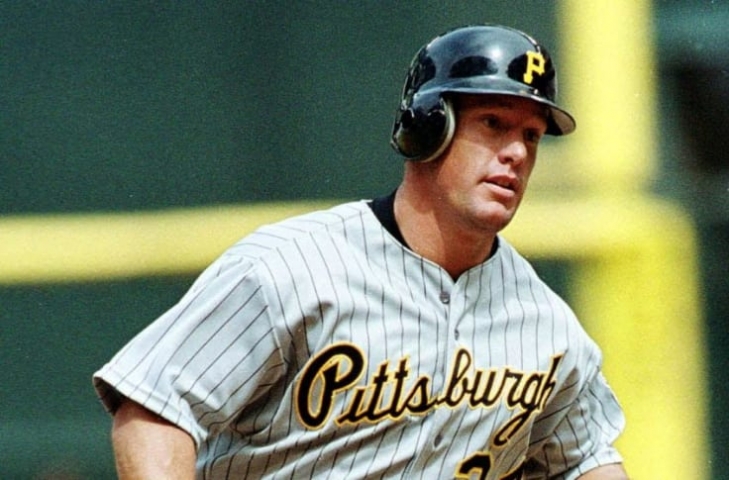
One of the most underrated players was Brian Giles, who played for three mediocre teams (Cleveland, Pittsburgh, and San Diego) and did not see as much love as he should have.
The Outfielder played his first four seasons (1995-98) as an Indian before he moved to the National League with Pittsburgh, and in his four full seasons as a Pirate, he never had less than 35 Home Runs, 95 RBIs, or a .298 Batting Average. His On Base Percentage was over .400 in all of those seasons and received at least one MVP vote.
The Pirates traded him to San Diego during the 2003 season, and while his power declined, his plate discipline remained strong, as he led the NL in Walks in 2005. Giles played until 2009, and he retired with 1,897 Hits, 287 Home Runs, and a career Slash Line of .291/.400/.501.
271. Adrian Gonzalez
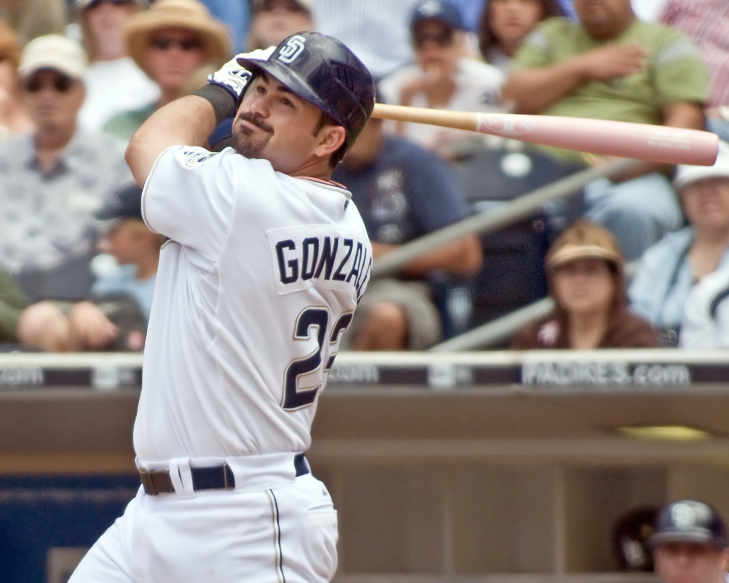
Born in the United States, but raised in Mexico, Adrian Gonzalez would have a very good career playing First Base in the Major Leagues.
Gonzalez first debuted for the Texas Rangers, but it was in San Diego where he first came into prominence. With the Padres, he was a three-time All-Star and would secure four consecutive 30 plus HR seasons, including a career-high 40 in 2009. That year, he led the National League in Walks (119).
34. Graig Nettles
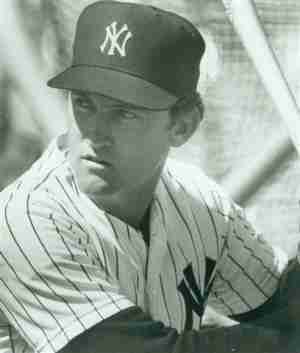
Many baseball players are known for their clutch performances at the plate. Graig Nettles certainly had many clutch hits in his long career, but he may have been known for having more clutch performances with his glove.
Many players start off fast and tail off, but Graig Nettles really hit his stride eight years into his pro career. He was a power-hitting third baseman and was a big part of the Yankees' three consecutive American League Pennants in the ’70s. As his bat came alive, more people paid attention to his aggressive fielding and noticed his wide range at the hot corner. Although he did it well in the 1978 World Series, his defensive expertise was never better, and he robbed Reggie Smith of extra-base hits twice in Game 3.
Despite his ability to hit the long ball, Graig Nettles had a fairly low Batting Average and only hit higher than .270 once. He did walk a lot, though, and for a power hitter, did not strike out that much. Still, justifying Nettles for the Hall with a .248 career Batting Average does prove difficult, and without an MVP season proves harder. Of course, how many teams in the ’70s wanted Nettles as their third baseman? Likely, the answer is almost all of them.
Should Graig Nettles be in the Hall of Fame?
