

 Not in Hall of Fame News
Yes, we know that this is taking a while! As many of…
 Not in Hall of Fame News
Yes, we know that this is taking a while! As many of…
 Not in Hall of Fame News
2002 SEMI-FINAL RESULTS: Thank you for your participation in the Pro Football…
 Not in Hall of Fame News
Yes, we know that this is taking a while! As many of…
 Not in Hall of Fame News
We are diligently working away at Notinhalloffame on revising our Football lists…
 Not in Hall of Fame News
We are diligently working away at Notinhalloffame on revising our Football lists…
 From the Desk of the Chairman
October baseball often turns individual pitching performances into lasting postseason memories. Strikeout…
 From the Desk of the Chairman
For decades, the sports debate ran on gut feeling. Barstool arguments, call-in…
 From the Desk of the Chairman
Introduction to Private Adult Tennis Camps in Prague Adult club players increasingly…
 From the Desk of the Chairman
Unlike in the case of pre-match betting, where you have to pick…
 From the Desk of the Chairman
Kupu178 builds trust with people by using top-end end-to-end encryption. It checks…
 From the Desk of the Chairman
Sports fans thrive on calculating strategy, reading momentum, and maximizing every tactical…






100 Active Potential Football Hall of Famers
-
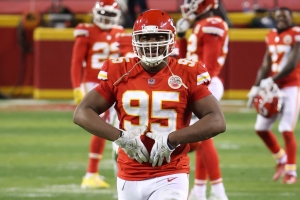 #19 Overall, Chris Jones, Kansas City Chiefs, Defensive Tackle, #8 Defensive Lineman/Linebacker: Pass Rusher2025 Pre-Season Rank #15, 2024 Pre-Season Rank #15, 2023 Pre-Season Rank #58, 2022 Pre-Season Rank #100. Peak Period 2020-24. When you think of…
 -
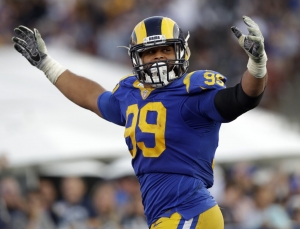 #1 Overall, Aaron Donald: Los Angeles Rams, Defensive End, #1 Defensive Lineman/Linebackers/Pass Rushers2020 Pre-Season Rank #15, 2021 Pre-Season Rank #5, 2022 Pre-Season Rank #3, 2023 Pre-Season Rank #2. PEAK 2017-21 Well, look who’s back! When…
 -
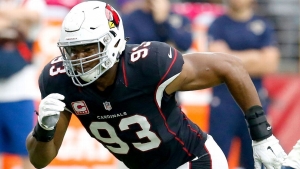 #14 Overall, Calais Campbell, Baltimore Ravens, Defensive End, #6 Defensive Lineman/Linebacker: Pass Rusher2025 Pre-Seasn Rank #14, 2024 Pre-Season Rank #19, 2023 Pre-Season Rank #19, 2022 Pre-Season Rank #26 2021 Pre-Season Rank #28, 2020 Pre-Season Rank…
 -
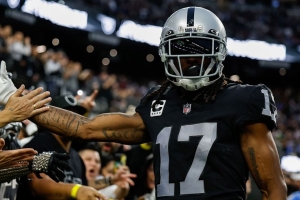 #21 Overall, Davante Adams, Los Angeles Rams, #2 Wide Receiver2025 Pre-Season Rank #23, 2024 Pre-Season Rank #27, 2023 Pre-Season Rank #24, 2022 Pre-Season Rank #43, 2021 Pre-Season Rank #67, 2020 Pre-Season Rank…
Visit the Fictitious Halls of Fame!


You May Also Like...
EDITOR’S CHOICE

 DDT's Pop Flies
When the veterans committee (VC), officially convening as the Contemporary Baseball Era…

 Live Music Head
Project/Objectan interview with André Cholmondeleyby Live Music HeadOriginally published at timessquare.com on…

LATEST RANKINGS





MOST POPULAR RANKINGS
















Committee Chairman
10. Dan Uggla
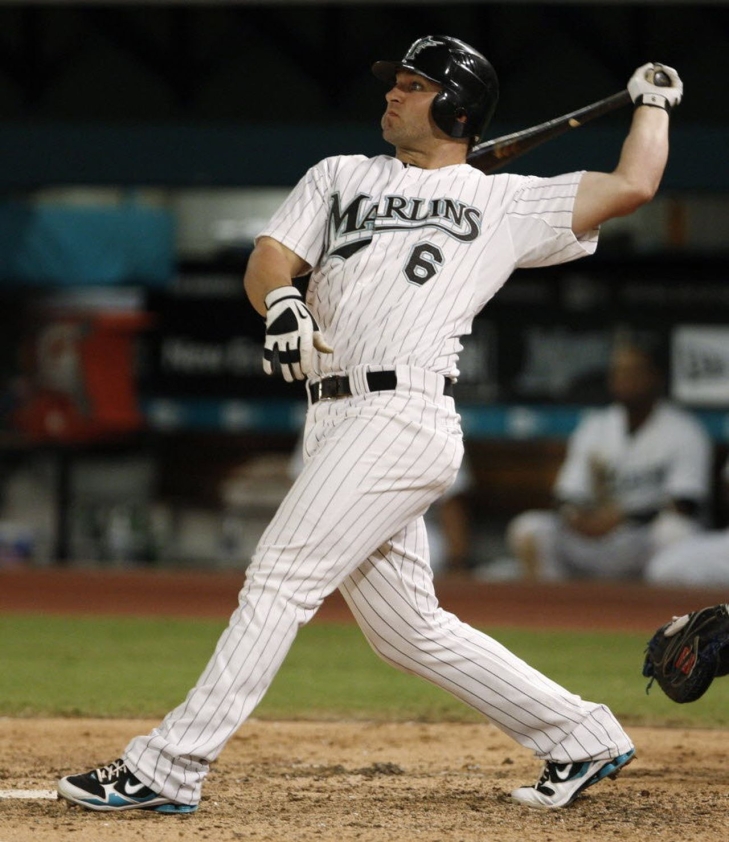
Dan Uggla’s arrival in South Florida in 2006 was as a Rule 5 Draft gamble from the Arizona Diamondbacks, a player whose previous organization didn't believe he was worth a spot on the 40-man roster.
In 2006, Uggla had an immediate impact, putting forth a debut season that remains one of the best in franchise history. He batted .282 with 27 home runs and 172 hits, earning an All-Star selection and finishing third in the Rookie of the Year voting. This breakout set a high-quality baseline, indicating that the Marlins had unexpectedly identified a valuable cornerstone.
From 2007 to 2010, the organization showcased an almost unmatched level of middle-infield power. He achieved four straight seasons with at least 30 home runs, a unique streak that consistently made him a Silver Slugger contender. While he was never a technical master with the glove, he provided respectable defense and a high-caliber work ethic that anchored a shifting Marlins roster. In 2010, his final year with the club, he reached a career high with 33 home runs and 105 RBIs, winning his first Silver Slugger Award.
Following the 2010 season, with Uggla entering his final year of arbitration and a high-stakes contract extension looming, the front office chose to trade the veteran for younger assets. On November 16, 2010, he was sent to the Atlanta Braves in exchange for Omar Infante and Mike Dunn, and the Marlins’ pattern continued. Uggla had 154 home runs, 465 RBIs, and a .259 batting average in Miami.
8. Kevin Brown
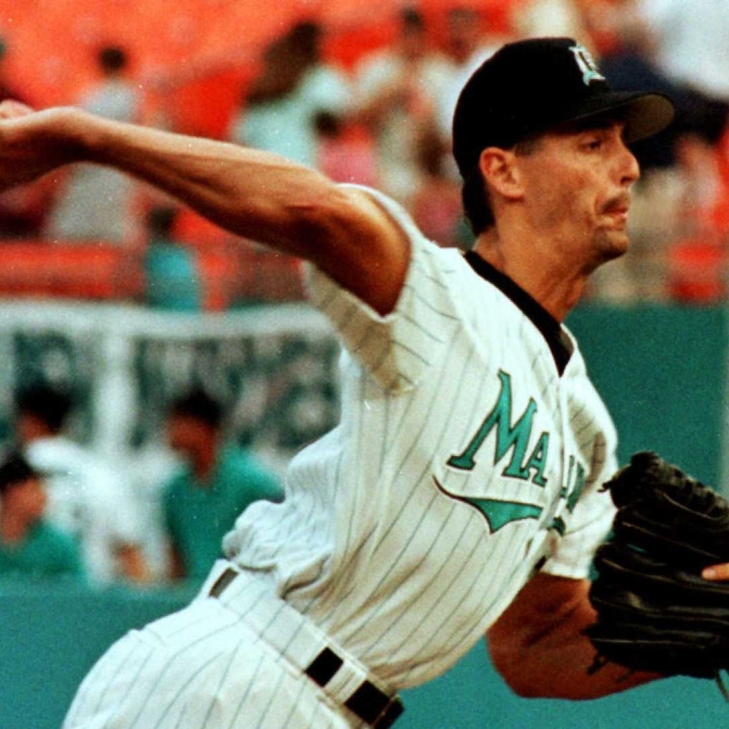
Kevin Brown arrived in South Florida in 1996 as a high-caliber free agent, a right-hander with a sinking fastball that induced broken bats and ground-ball outs with surgical precision. While his tenure in a Marlins uniform was a brief two-season residency, he provided a brand of top-tier pitching that stands as the most dominant individual peak in the organization's history, and you can easily argue that the franchise’s first World Series win does not happen without him.
In his first season with the Fish, Brown was electric, recording a staggering 1.89 ERA and a 0.944 WHIP. He showcased technical efficiency that produced an ERA+ of 215, meaning he was more than twice as effective as the average pitcher in an era defined by explosive offense. While he finished as the runner-up for the Cy Young Award to John Smoltz, his performance established a high-quality baseline that transformed the Marlins into a legitimate postseason threat.
The season after Brown tossed the second no-hitter in team history against the Giants and earned his second consecutive All-Star selection. He proved to be a high-caliber winner by recording 16 victories and eclipsing 200 strikeouts, anchoring a staff that secured a Wild Card berth. His impact was never more apparent than in the NLCS against the Braves, where he famously pitched a complete-game masterpiece while battling the flu to clinch the Marlins' first pennant. While his efficiency dipped in the 1997 World Series, where he struggled in two starts against the Indians, his value to the championship run remained unquestioned; without his earlier dominance during the regular season and the early playoff rounds, the team never reached the Fall Classic.
In the winter of 1997, when, as part of the franchise's total roster dismantling, he was traded to the San Diego Padres for Derrek Lee and prospects. He walked away with a championship ring and the status of having authored the greatest two-year pitching run the team has ever seen. Stat-wise, Brown had a 33-19 record and a 2.83 ERA.
6. Dontrelle Willis
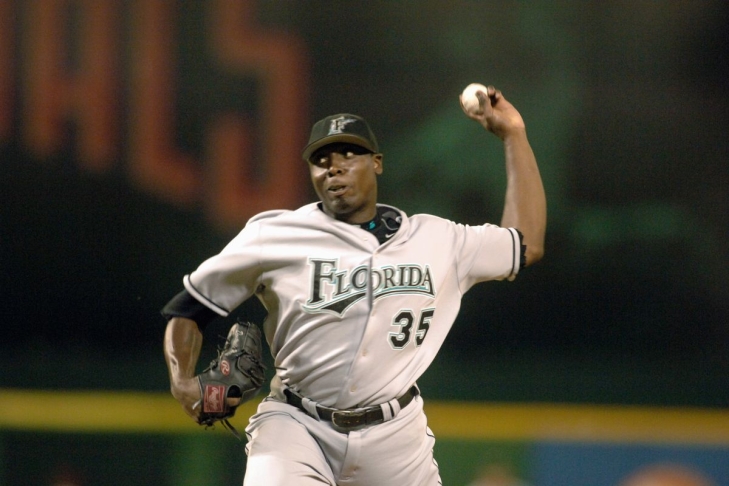
While he was still a minor league prospect, Dontrelle Willis was traded by the Chicago Cubs to the Florida Marlins, bringing with him a high-leg kick and an infectious energy that immediately captivated the South Florida fanbase. Debuting in 2003, the southpaw became a phenomenon, his "D-Train" persona powering a clubhouse that was surging toward a historic October.
In 2003, Willis made it to the Majors and recorded a 14-6 record with a 3.30 ERA to secure the National League Rookie of the Year Award. While he was a professional mainstay during the regular season, he truly solidified his legend during the 2003 World Series run, famously batting .313 in the postseason while helping the club capture its second championship.
Two seasons later, Willis was one of the top hurlers in the National League, leading the circuit in wins (22), complete games (7), and shutouts (5). He finished as the runner-up for the Cy Young Award, recording a career-best 2.63 ERA and 170 strikeouts while becoming the first African-American pitcher to win 20 games in a season since 1990. His impact was further highlighted by his hitting; he recorded 21 hits that season, including a home run, proving he was a foundational athlete who could impact the game from both the mound and the batter's box.
Between 2005 and 2007, Willis threw for well over 200 innings. While an average 2006 campaign saw him finish with 12 wins, the trajectory of his career hit a localized snag in 2007. That season, his efficiency eroded as his ERA ballooned to 5.17, and he struggled with command, finishing the season leading the league in earned runs allowed. Nevertheless, he was considered a valuable player, and after the 2007 season, he was dealt to the Detroit Tigers in the same deal that sent Miguel Cabrera.
As a Marlin, Willis had a 68-54 record with 757 strikeouts, while batting .234 with 8 taters.
4. Miguel Cabrera
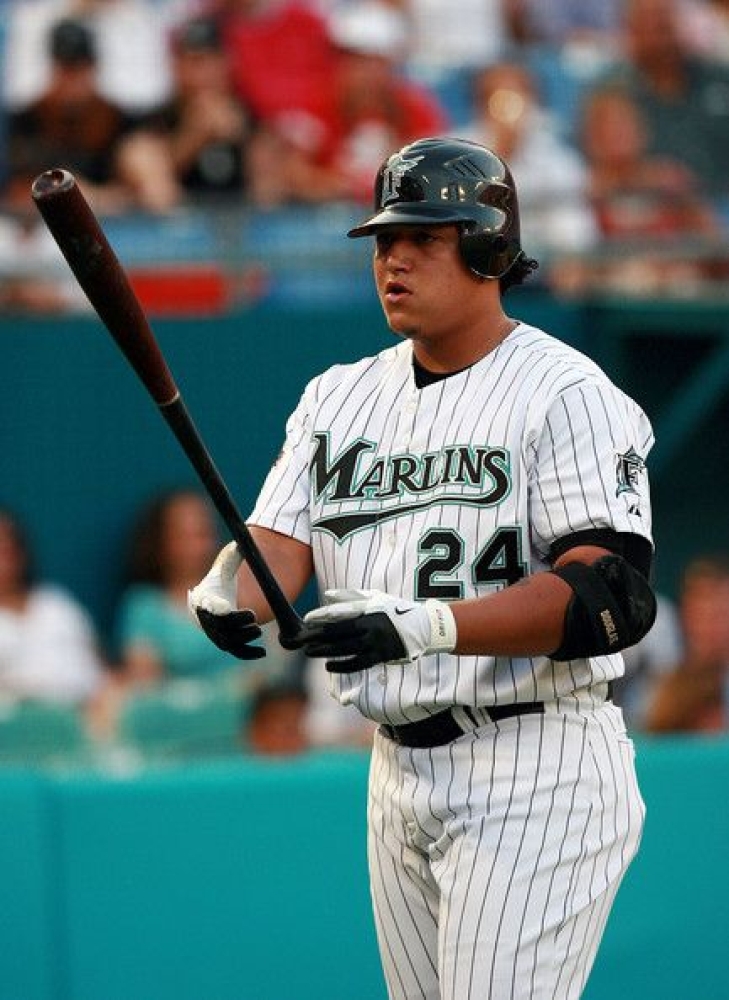
Miguel Cabrera arrived in South Florida as a teenager from Venezuela, a highly touted prospect whose bat speed and preternatural sense for the strike zone made him a legend before he even reached the big leagues. Debuting at just 20 years old in June 2003, he immediately sparked a veteran-heavy lineup with a walk-off home run in his first game.
After finishing fifth in the 2003 Rookie of the Year voting, Cabrera demonstrated a remarkable composure on the game's biggest stage. During the World Series against the New York Yankees, he famously faced future Hall of Famer Roger Clemens; after being brushed back by a high-and-inside fastball, he responded by driving a home run to the opposite field in a display of strength that defied his age. This composure under pressure was the spark that helped the Marlins secure their second World Series title, announcing his arrival as a premier superstar.
Between 2004 and 2007, Cabrera enjoyed a four-year stretch that established him as one of the most dynamic young hitters in baseball history. During this peak, he was an annual fixture at the All-Star Game, consistently batting over .300 while maintaining a slugging percentage well above .500. He remained a professional mainstay in the heart of the order, recording at least 33 home runs and 112 RBIs in three of those four seasons. His ability to hit for both power and average was a specialized asset that saw him finish in the top five of the MVP voting in 2005 and 2006, highlighting a steady excellence that bridged the gap between the club's championship years and its rebuilding phases.
As a Marlin, Cabrera owned a filthy franchise slash line of .313/.388/.542. While he frequently moved between third base and the outfield to accommodate the team’s shifting rosters, his offensive volume never wavered. He showed the organization he was a high-caliber anchor by accumulating 138 home runs and 523 RBIs before his 25th birthday, marks that placed him among the elite run-producers in the sport’s history.
In 2007, in a move that mirrored the franchise’s established business patterns, Cabrera was traded to the Detroit Tigers in a blockbuster deal. He carried the Marlins through the middle of the decade with a smile and a lethal swing, a journey that eventually saw him become the first player in 45 years to win the Triple Crown after his departure to the American League.
