


Site Admin
7. Rod Smith
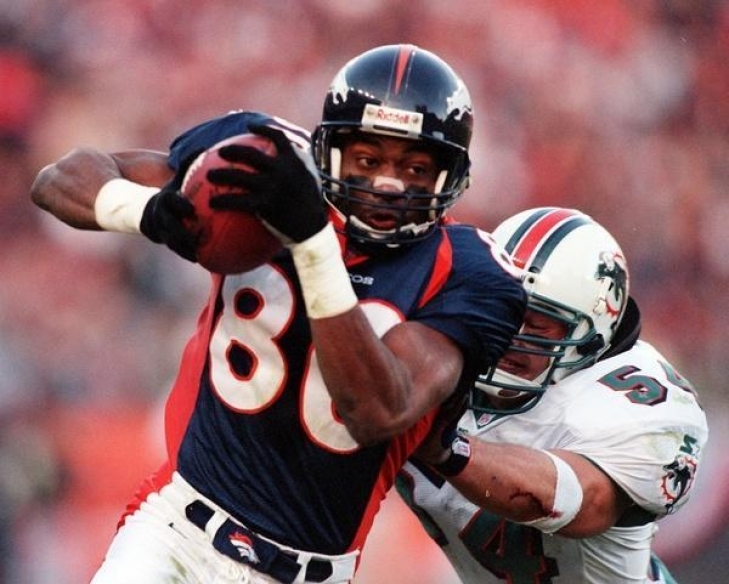
Going unselected in the 1994 NFL Draft despite shattering records at Division II Missouri Southern State, Rod Smith entered the league as a complete longshot. He spent his entire rookie year on the practice squad and operated strictly as a depth option for his first two active seasons in Denver, but he quietly refined his route running while waiting for his moment.
His breakthrough arrived in 1997, when he earned a starting role and became a favorite target for John Elway. Smith delivered a huge campaign with 70 receptions for 1,180 yards and 12 touchdowns, helping drive Denver to its first world championship in Super Bowl XXXII. He backed it up in 1998 with another 1,222 receiving yards, saving his defining moment for Super Bowl XXXIII, where he hauled in an iconic 80-yard touchdown strike from Elway en route to a 152-yard performance that sealed back-to-back titles.
After Elway retired, Smith seamlessly became the veteran anchor of the offense, serving as the go-to target through quarterback transitions to Brian Griese and Jake Plummer. From 1997 through 2002, he logged six consecutive 1,000-yard receiving seasons. His individual dominance peaked with consecutive Second-Team All-Pro selections in 2000 and 2001; he set a franchise record with 1,602 receiving yards in 2000 alongside Ed McCaffrey, then led the entire NFL with 113 catches in 2001.
Smith hit the 1,000-yard mark twice more in 2004 and 2005, earning his third career Pro Bowl selection in 2005 while becoming the first undrafted wide receiver in NFL history to break the 10,000-yard barrier. His precise footwork, relentless run-blocking, and incredible consistency helped him record 70 or more catches in nine consecutive seasons.
A severe hip injury sustained in 2006 eventually ended his playing days after the 2007 offseason. As a Bronco, Smith played in 183 games, leaving as the organization's all-time leader in receptions (849), receiving yards (11,389), and touchdown catches (68), while adding 860 receiving yards and six touchdowns in the postseason. The Broncos inducted their self-made star into the Ring of Fame in 2012.
3. Shannon Sharpe
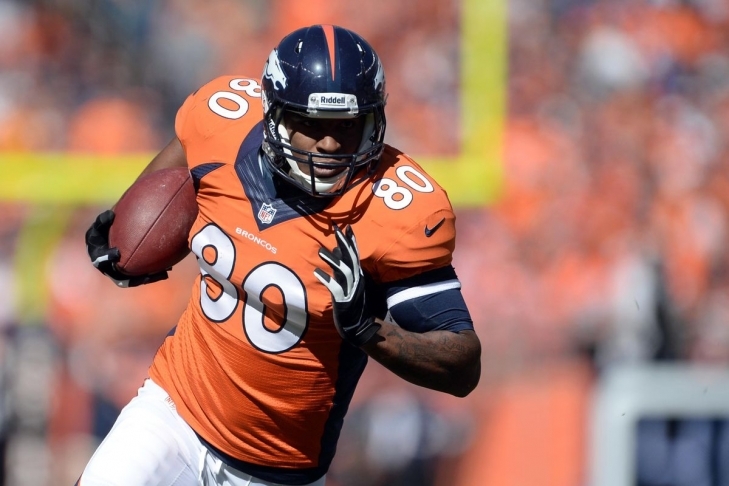
Selected in the seventh round (192nd overall) of the 1990 NFL Draft out of Division II Savannah State, Shannon Sharpe arrived in Denver as a converted wide receiver with long odds of making an impact. Instead, he completely redefined the tight end position, blending wide receiver athleticism with unmatched verbal swagger to become the premier pass-catching tight end of the 1990s and a centerpiece of Denver's back-to-back championship teams.
Prior to Sharpe's emergence, the National Football League regarded tight ends chiefly as supplementary offensive linemen with occasional infiltration into the flat. Sharpe disrupted this traditional perception. By flexing into the slot or enlarging his role as a receiver, he compelled defensive coordinators to confront complex schematic challenges. Should a defense maintain base personnel, Sharpe evaded coverage by isolating a slow-footed linebacker; conversely, if they employed nickel or dime defensive backs, Denver responded with audible shifts to facilitate a handoff to Terrell Davis into a less crowded box. His capacity to divert coverage away from the perimeter facilitated the entire offensive operation, acting as both a primary vertical target and an auxiliary catalyst for Denver's renowned zone-blocking running scheme.
Sharpe demonstrated exceptional speed that outpaced linebackers when covering downfield, and physicality that proved challenging for safeties attempting tackles in open space. Head coach Mike Shanahan strategically utilized Sharpe’s unique movement abilities by positioning him in the slot, in the flex, or isolated on the boundary. Possessing elite run-after-catch acceleration, Sharpe effectively employed strong hands to secure passes amid traffic and subsequently accelerate past defensive backs, resulting in explosive gains.
Sharpe’s illustrious career commenced during his breakout year of 1992, when he led the Denver Broncos in receiving with 53 receptions for 640 yards, thereby earning his inaugural Pro Bowl selection. In 1993, he cemented his status as a premier offensive asset by receiving his first First-Team All-Pro accolade after securing 81 receptions for 995 yards and nine touchdowns, including a historic 13-reception playoff game against the Los Angeles Raiders. He further demonstrated his continued excellence in 1994 with a career-high 87 receptions for 1,010 yards, evidencing that defensive game-planning could not effectively limit his downfield volume.
When Mike Shanahan assumed coaching responsibilities in 1995, Sharpe adapted seamlessly, recording 63 receptions across 13 games despite contending with injuries. From 1996 to 1998, Sharpe attained the pinnacle of his career, securing three consecutive First-Team All-Pro honors. He achieved 80 receptions for 1,062 yards and 10 touchdowns in 1996, followed by a personal-best 1,107 receiving yards in 1997. During the 1997 postseason, his critical third-and-5 reception against Pittsburgh in the AFC Championship Game secured Denver’s qualification for the Super Bowl, ultimately leading to victory in Super Bowl XXXII. He concluded his seven-year Pro Bowl streak in 1998 with 768 yards and 10 touchdowns, aiding Denver in achieving a 14-2 record and clinching consecutive championships in Super Bowl XXXIII.
Following a two-year stint with the Baltimore Ravens, during which he secured his third Super Bowl ring (XXXV) and an eighth Pro Bowl selection, Sharpe returned to Denver in 2002 to complete his career. At the time of his retirement following the 2003 season, Sharpe held the all-time NFL records for tight ends in receptions (815), receiving yards (10,060), and receiving touchdowns (62), becoming the first tight end in league history to cross the 10,000-yard threshold.
In 2009, he was inducted into the Denver Broncos Ring of Fame. In 2011, he entered the Pro Football Hall of Fame. Playing for the Broncos (1990–1999, 2002–2003), Sharpe appeared in 172 games (139 starts), with 675 receptions, 8,439 yards, and 55 touchdowns.
5. Randy Gradishar
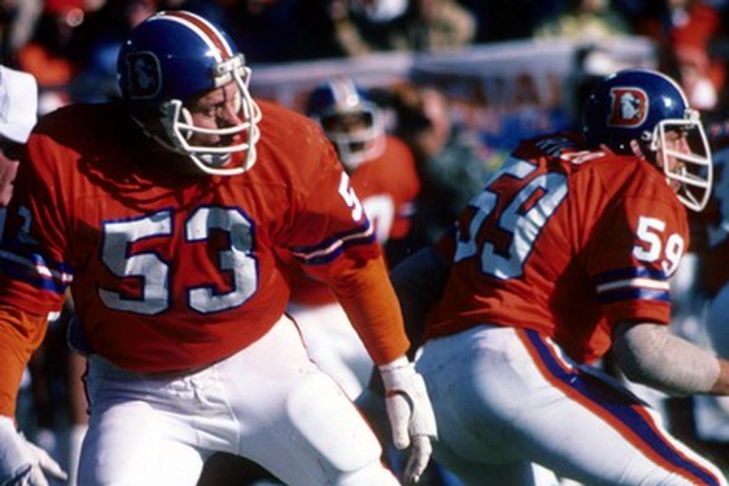
Drafted 14th overall in the first round of the 1974 NFL Draft from Ohio State, Randy Gradishar came to Denver with glowing praise from legendary Buckeyes coach Woody Hayes, who famously called him the best linebacker he ever coached. Throughout a career spanning over a decade, all in Denver's colors of brown, gold, and orange, Gradishar became the cornerstone of Denver's defense, growing to be the heart, mind, and spirit of the celebrated "Orange Crush" era.
Gradishar combined sideline-to-sideline range, textbook tackling form, and unmatched pre-snap recognition. Operating at middle linebacker in Joe Collier's 3-4 scheme, he was legendary for his short-yardage and goal-line stops, consistently meeting running backs head-on at the line of scrimmage to deny forward momentum. His instincts allowed him to drop cleanly into pass coverage as well, snaring 20 career interceptions.
Gradishar stepped into the starting lineup during his 1974 rookie season and earned his first Pro Bowl selection in 1975. By 1977, he was the undisputed centerpiece of a dominant defense that allowed just 10.6 points per game during the regular season. His ability to neutralize power-running games helped propel Denver to a 12-2 record, its first AFC West division title, and an iconic playoff run to Super Bowl XII, earning Gradishar his first First-Team All-Pro selection.
He reached the absolute peak of his national recognition in 1978, capturing consensus AP NFL Defensive Player of the Year honors. That season, Gradishar recorded a staggering, franchise-record 286 tackles (according to the team), three sacks, and three interceptions while leading Denver to another 10-win campaign and a playoff berth. He capped his dominant late-70s run in 1979 with a fourth consecutive Pro Bowl nod, recording over 200 tackles and three interceptions as the Orange Crush defense yielded under 18 points per game for a third straight year.
What made Gradishar's decade of service in Denver particularly noteworthy was his unwavering availability. Throughout his ten-year career spanning from 1974 to 1983, he did not miss a single game, establishing a streak of 145 consecutive regular-season appearances. He was the leading tackler for the Broncos for nine successive seasons (1975–1983), amassed a total of 33 takeaways (comprising 20 interceptions and 13 fumble recoveries), and received seven Pro Bowl selections along with five All-Pro honors (including 2 First-Team and 3 Second-Team).
In 1989, the franchise permanently recognized his unmatched contributions by inducting him as the sole member into the Denver Broncos Ring of Fame. For decades, his absence from the Hall of Fame was cited as one of the game's most egregious omissions. That long-overdue justice finally arrived when Gradishar was elected to the Pro Football Hall of Fame as a member of the Class of 2024, taking his rightful place among the immortals in Canton.
1. John Elway
The 1983 Draft had a lot of drama.
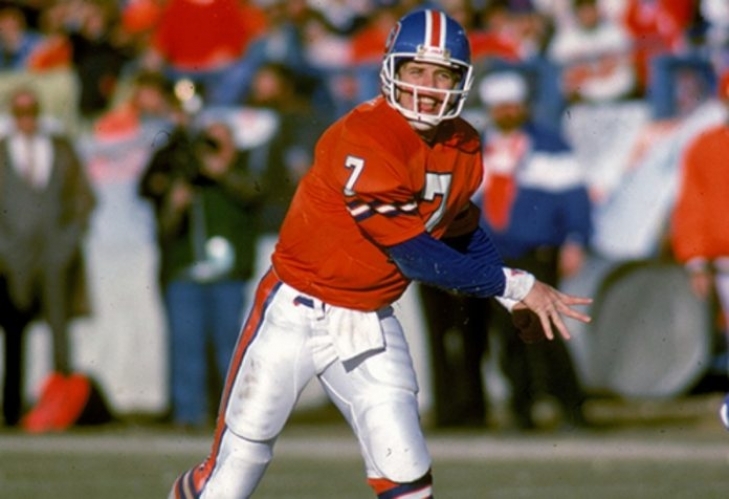
John Elway, who was selected first overall in the 1983 NFL Draft by the Baltimore Colts from Stanford University, was renowned for possessing the most celebrated combination of arm strength, athletic mobility, and field vision among his peers. Having explicitly expressed his intention not to play on the East Coast for Baltimore—leveraging his status as a top draft prospect of the New York Yankees to compel a transfer—he persuaded the Colts to trade his rights to the Denver Broncos. Under the leadership of head coach Dan Reeves, Elway faced immediate challenges as a rookie. Nevertheless, he quickly developed into one of the most dynamic playmakers in the history of football, utilizing his mobility to evade collapsing pockets and delivering off-platform throws that redefined the role of the quarterback.
Elway demonstrated exceptional arm strength, capable of delivering precise deep passes on a line, complemented by uncommon speed and physical resilience as a runner. Excelling in heavy bootleg and scramble-drill scenarios, he thrived when structured plays collapsed. His notable mobility enabled him to manipulate pursuit angles, employing his legs to secure vital third downs or to buy time outside the pocket before accurately delivering long throws downfield.
Elway’s reputation as a distinguished performer on significant stages was exemplified during the 1986 AFC Championship Game against the Cleveland Browns. With a deficit of one touchdown and 5:32 remaining, and situated at his own 2-yard line, Elway meticulously directed a 15-play, 98-yard touchdown drive—commonly known as "The Drive"—to compel overtime, ultimately leading Denver to secure a position in Super Bowl XXI. Despite Denver’s defeat by the New York Giants' formidable defense, Elway had already cemented his status as the preeminent late-game strategist in the National Football League.
The following year, Elway captured the 1987 AP NFL Most Valuable Player award after throwing for 3,198 yards and 19 touchdowns, while adding 304 yards and four scores on the ground. He led Denver back to Super Bowl XXII, though the campaign ended in a blowout loss to Washington. Two seasons later, Elway led another Denver roster to the championship stage in Super Bowl XXIV, only to suffer a third defeat at the hands of the San Francisco 49ers.
Despite the uneven postseason outcomes during his initial championship pursuits, Elway consistently maintained his status as an elite regular-season performer. Over the course of his 16-year career, he was selected to nine Pro Bowls and received three Second-Team All-Pro honors (1987, 1993, 1996). He led the entire NFL in passing yards in 1993 with a career-high 4,028 yards, continuously improving his pre-snap decision-making and pocket mechanics as he gained experience.
Throughout the late 1980s and early 1990s, Elway consistently enhanced the talent surrounding him, establishing late-game fourth-quarter comebacks as his distinctive hallmark. By the time Head Coach Mike Shanahan joined in 1995, Elway had acquired the veteran expertise necessary to proficiently operate a sophisticated, movement-oriented West Coast offensive scheme that capitalized on his deep-ball accuracy off play-action fakes.
The incorporation of Terrell Davis and Shanahan's zone-blocking strategy furnished Elway with the well-balanced offensive support he lacked earlier in his career. During Super Bowl XXXII, Elway executed his most renowned physical play—the celebrated "Helicopter" run on third down, which facilitated a touchdown—as Denver triumphed over the Green Bay Packers with a score of 31-24, securing the franchise's inaugural Lombardi Trophy.
Elway returned for one final campaign in 1998, leading Denver to a 14-2 regular-season record. He capped his legendary career in Super Bowl XXXIII, throwing for 336 yards and a touchdown while scoring another on the ground in a 34-19 victory over the Atlanta Falcons. Named Super Bowl MVP in his final professional contest, Elway walked off the field as a back-to-back world champion.
Elway played all 234 of his regular-season games with the Denver Broncos. During his career, he threw for 51,475 yards and 300 touchdowns, and also rushed for 3,407 yards and 33 touchdowns. He ended his playing days holding the NFL record for fourth-quarter comebacks by a quarterback with 47.
In 1999, the franchise expedited Elway's induction into the Denver Broncos Ring of Fame and officially retired his No. 7 jersey. Subsequently, in 2004, he was inducted into the Pro Football Hall of Fame during his first year of eligibility. Elway rejoined the franchise as General Manager and Executive Vice President of Football Operations in 2011, where he was responsible for constructing the roster—including signing free-agent quarterback Peyton Manning—that secured Super Bowl 50, thereby earning Elway his third championship ring with the franchise.
With the Broncos (1983–1998), Elway played in 234 regular-season games (230 starts), throwing for 51,475 yards and 300 touchdowns, rushing for 3,407 yards and 33 scores.
