
The Pro Football Hall of Fame Revisited Project: 2001 Final VOTE
2001 Pro Football Hall of Fame Revisited Project Class.
Here we are! Again!!
If you have been following our Pro Football Hall of Fame Revisited Project, you know we have asked the question: What if the PFHOF had begun in January 1946?
After soliciting and obtaining a passionate group of football fans and historians, we sent out a ballot for a Preliminary Vote, in which each voter selected 25 names as their semi-finalists and five names for the Senior Pool.
We then asked the group to vote for their 15 Finalists in the Modern Era and 3 in the Senior Category. The final stage was to vote for their five Modern Era inductee and one Senior inductee.
These are the results of the 56th official class.
Below are the final results of this project based on 38 votes.
Remember that we have reverted back to the top five candidates entering the Hall in the Modern Era
This is for the “Modern Era”
*Bold indicates they have been elected to the Pro Football Hall of Fame Revisited Class of 2001:
|
Player |
Year of Eligibility |
Vote Total |
|
Jackie Slater T-G |
1 |
25 |
|
Sterling Sharpe WR |
2 |
22 |
|
Bob Griese QB |
16 |
16 |
|
Art Monk WR |
1 |
15 |
|
Lemar Parrish DB |
14 |
13 |
|
Lester Hayes DB |
10 |
13 |
|
Roger Craig RB |
3 |
13 |
|
Cliff Harris DB |
17 |
12 |
|
Billy “White Shoes” Johnson |
8 |
12 |
|
Andy Russell LB |
20 |
9 |
|
Ken Stabler QB |
12 |
6 |
|
Ken Anderson QB |
10 |
6 |
|
Todd Christensen TE |
8 |
6 |
|
Rickey Jackson LB-DE |
1 |
6 |
|
Drew Pearson WR |
13 |
5 |
|
Ken Riley DB |
13 |
5 |
|
Deron Cherry DB |
5 |
3 |
This is for the “Senior Era.”,
*Bold indicates they have been elected to the Pro Football Hall of Fame Revisited Class of 2001.
|
Otis Taylor WR-FL |
1 |
12 |
|
Floyd Little RB |
1 |
11 |
|
Arch Ward CONTRIBUTOR |
12 |
8 |
|
None of the Above |
N/A |
8 |
This is for the “Coaches/Contributors.”,
*Bold indicates they have been elected to the Pro Football Hall of Fame Revisited Class of 2001.
|
Eddie Kotal (Scout) |
6 |
24 |
|
Tom Flores (Coach) |
5 |
8 |
|
Ron Wolf (Executive) |
3 |
3 |
|
None of the Above |
N/A |
4 |
About the 2001 Inductees:
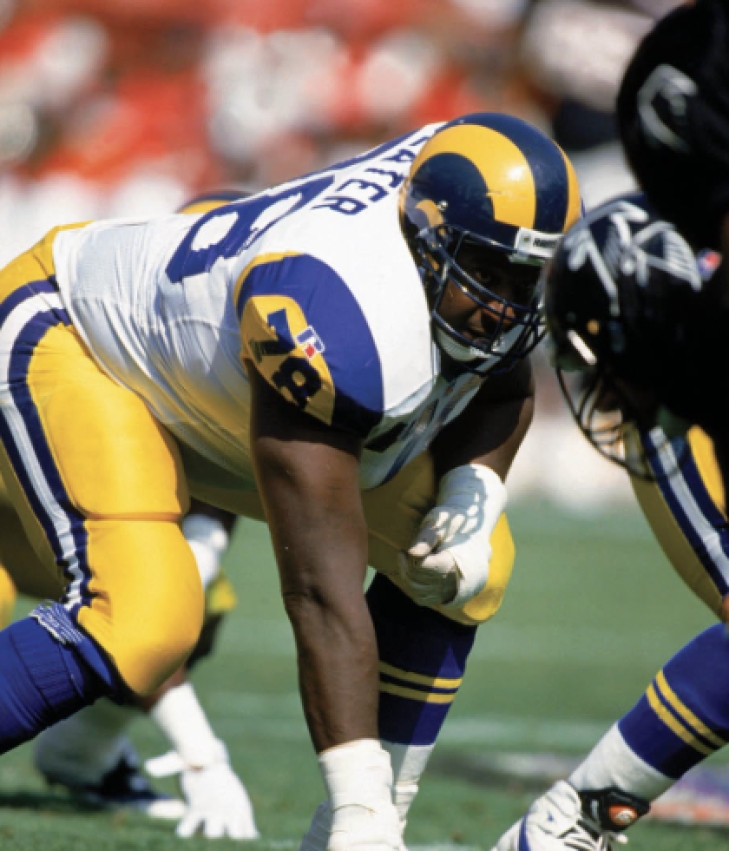
Jackie Slater, T-G, RAM/STL 1976-95: Inducted in the Pro Football Hall of Fame Revisited Project in 2001 on his 1st Ballot. Inducted into the actual Pro Football Hall of Fame in 2001.
Jackie Slater enjoyed one of the most durable and decorated careers in NFL history, anchoring the Los Angeles Rams offensive line for 20 seasons. Drafted out of Jackson State University in the third round of the 1976 NFL Draft, Slater did not become a permanent fixture in the starting lineup immediately, serving primarily as a backup and special teams contributor during his first three seasons. His breakthrough came in 1979, when he earned the starting right tackle position and helped propel the Rams to an appearance in Super Bowl XIV against the Pittsburgh Steelers.
Once established, Slater became a model of consistent dominance and the franchise’s emotional rock. Over the course of his two decades in the trenches, he played in 259 regular-season games, which stood as an NFL record for offensive linemen at the time of his retirement. His legendary work ethic and rigorous film study allowed him to maintain an elite level of play even as he faced younger, faster pass rushers. One of the defining highlights of his career came in the 1989 NFC Wild Card Game, when 35-year-old Slater famously neutralized Philadelphia Eagles legend Reggie White, holding the historic sack-master to zero sacks in a dominant Rams victory.
Slater's longevity meant he blocked for generations of talent, protecting 24 different quarterbacks and paving the way for 37 different running backs. He was an indispensable force out in front of seven different 1,000-yard rushers, most notably Hall of Famer Eric Dickerson. In 1983, Slater spearheaded an offensive front that gave up a league-low 23 sacks while driving Dickerson to a rookie rushing record of 1,808 yards. His unique career also achieved a rare geographical feat: because he played from 1976 through 1995, he became the only player in NFL history to play for the same franchise in three different home locations—Los Angeles, Anaheim, and St. Louis.
Slater earned seven Pro Bowl selections and was named NFC Offensive Lineman of the Year four times (1983, 1986, 1987, and 1989). Following his final season in 1995, the Rams retired his No. 78 jersey. His son, Matthew, had a stellar NFL career, spending 16 years with the New England Patriots as a special teams icon.
Sterling Sharpe, WR, GNB 1988-94: Inducted in the Pro Football Hall of Fame Revisited Project in 2001 on his 2nd Ballot. Inducted into the actual Pro Football Hall of Fame in 2025.
Sterling Sharpe was a force of absolute nature for the Green Bay Packers, establishing a terrifyingly dominant peak that completely redefined the wide receiver position in the late 1980s and early 1990s. Selected seventh overall in the star-studded 1988 NFL Draft, Sharpe instantly became the focal point of the Packers' offense, combining the route-running precision of an elite wideout with the bruising, tackle-breaking physicality of a 207-pound running back. Over his brief seven-season tenure, he proved entirely unguardable, leading the NFL in receptions three separate times (1989, 1992, 1993) and building an almost telepathic chemistry with a young Brett Favre.
Sharpe’s explosive peak arrived during the legendary 1992 season, when he achieved the elusive NFL Wide Receiver Triple Crown. In a mesmerizing campaign, Sharpe paced the entire league by racking up 108 receptions, 1,461 receiving yards, and 13 touchdowns, becoming a consensus First-Team All-Pro. Not content with merely holding the single-season reception record, he shattered his own historic mark the very next year by reeling in 112 catches. Even as opposing defenses explicitly game-planned to take him away, Sharpe remained entirely unstoppable, capping off his final healthy season in 1994 with a jaw-dropping, league-leading 18 receiving touchdowns.
Tragically, this blinding trajectory came to a sudden and heartbreaking halt in December 1994. During a Week 16 matchup against the Atlanta Falcons, Sharpe’s head violently snapped back while delivering a block, leaving him momentarily paralyzed on the turf. Miraculously, he walked off under his own power and—in a testament to his staggering toughness—returned the next week to torch the Tampa Bay Buccaneers for three touchdowns while secretly battling severe cervical spine trauma. Post-season medical evaluations soon uncovered a catastrophic instability between his C1 and C2 vertebrae, requiring an extensive neck fusion surgery that instantly ended his football career at the mere age of 29.
For three decades, Sharpe’s career stood as one of the greatest "what-if" stories in professional sports history, his breathtaking 112-game statistical output frozen in time. Despite this, Sharpe was inducted into both the Pro Football Hall of Fame and, of course, our Revisited Project.
Bob Griese, QB, MIA 1967-80. Inducted in the Pro Football Hall of Fame Revisited Project in 2001 on his 16th Ballot. Inducted into the actual Pro Football Hall of Fame in 1990.
Bob Griese was the principal architect of the Miami Dolphins dynasty of the 1970s, leaving a legacy defined by exceptional situational intelligence and unwavering composure. Drafted fourth overall in the 1967 AFL Draft out of Purdue University, Griese immediately assumed leadership of an expansion franchise in only its second year of existence. He adapted quickly, passing for more than 2,000 yards as a rookie and earning AFL All-Star honors. Known as the "Thinking Man's Quarterback," Griese famously called his own plays at the line of scrimmage, applying astute analysis and precise decision-making to translate head coach Don Shula’s vision into effective on-field execution.
Griese’s career peaked during Miami's legendary 1972 season, which culminated in the NFL's only undefeated and untied 17-0 record. Although a fractured leg and dislocated ankle suffered in Week 5 sidelined him for much of the regular season, Griese's championship mettle was evident in how he completed the journey. Entering the AFC Championship Game in relief during the second half, he sparked a comeback victory over the Pittsburgh Steelers before starting and winning Super Bowl VII against Washington. Griese returned the following year to lead a dominant title defense, guiding the Dolphins to a decisive victory over the Minnesota Vikings in Super Bowl VIII and securing consecutive world championships.
While contemporary critics sometimes mislabeled Griese as a mere "game manager" due to Miami’s historically dominant ground game, his efficiency when called upon was devastatingly lethal. In Super Bowl VIII, he threw the ball just seven times, yet completed six passes to effortlessly dismantle the Vikings' defense. When defenses clogged the running lanes, Griese unleashed his precise aerial attack, culminating in a spectacular 1977 campaign in which he earned First-Team All-Pro honors, won the Bert Bell Award, and led the NFL in both passing touchdowns (22) and passer rating (87.8). Over his 14-year career entirely spent in South Florida, he amassed 25,092 passing yards and 192 touchdowns while piloting the Dolphins to nine winning seasons.
A severe shoulder injury during the 1980 season ultimately forced Griese to retire at the age of 35, leaving him as the undisputed cornerstone of the franchise. His sustained excellence earned him six Pro Bowl selections and consecutive AFL All-Star nods, and the Dolphins permanently honored his leadership by retiring his No. 12 jersey.
Art Monk, WR, WAS 1980-93, NYJ 1994 & PHI 1995. Inducted in the Pro Football Hall of Fame Revisited Project in 2001 on his 1st Ballot. Inducted into the actual Pro Football Hall of Fame in 2008.
Art Monk was the understated force behind the Washington Redskins dynasty of the 1980s and early 1990s. His career stood out for remarkable consistency, physical toughness, and precise route running. Selected by the team in the first round as the 18th overall pick in the 1980 NFL Draft after playing at Syracuse University, the 6-foot-3, 210-pound receiver embodied the physical prototype of the modern big wide receiver. He made an immediate impact, setting a franchise rookie record with 58 receptions and earning unanimous selection to the NFL All-Rookie Team. Under head coach Joe Gibbs, Monk’s fearlessness over the middle and exceptional blocking established him as an outstanding possession receiver, consistently moving the chains; nearly two-thirds of his receptions in Washington resulted in first downs.
Monk's statistical peak came in the historic 1984 season, when he set a then-NFL record with 106 receptions, totaling a career-high 1,372 yards and seven touchdowns. His achievement was particularly notable for its efficiency, preceding the pass-heavy rule changes of the 1990s and making him the only player of his era to record more than 100 receptions in a single season. He followed this performance with consecutive 1,000-yard seasons, becoming the first player in franchise history to achieve three consecutive seasons with at least 1,000 receiving yards. By 1989, Monk had joined Gary Clark and Ricky Sanders to form "The Posse," a formidable wide-receiver trio that challenged opposing defensive backfields and became the first trio in NFL history in which each member surpassed 1,000 receiving yards in the same season.
Monk’s exceptional reliability was a cornerstone of Washington’s success during its golden era, making him an indispensable contributor to three Super Bowl championship teams (XVII, XXII, and XXVI). His career was distinguished by sustained excellence; he became the first player in NFL history to record a touchdown reception and at least 35 receptions in 15 consecutive seasons. His dependable hands helped him maintain a streak of 183 consecutive regular-season games with a reception. In 1992, Monk further solidified his legacy before the home crowd by catching his 820th career pass, officially surpassing Steve Largent's record to become the NFL’s all-time receptions leader. After 14 memorable seasons in Washington, Monk concluded his career with one-year stints with the New York Jets and Philadelphia Eagles, retiring with 940 receptions for 12,721 yards and 68 touchdowns. The Redskins also retired his number, 81.
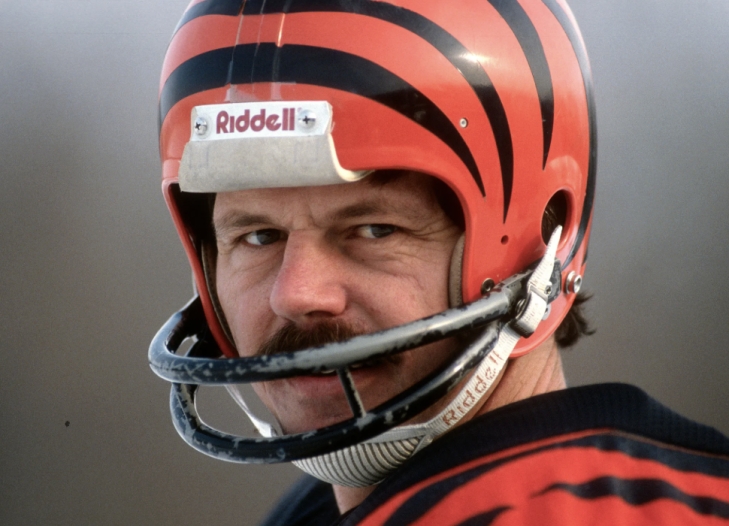
Lemar Parrish, CB, CIN 1970-77, WAS 1978-81 & BUF 1982. Inducted in the Pro Football Hall of Fame Revisited Project in 2001 on his 14th Ballot. Was never inducted into the actual Pro Football Hall of Fame.
Lemar Parrish, affectionately known as "Leapin' Lemar," was one of the NFL’s most dynamic and versatile playmakers of the 1970s. Selected by the Lincoln Bengals in the seventh round of the 1970 NFL Draft as the 163rd overall pick, the 5-foot-11 cornerback quickly made a significant impact on the league. Combining exceptional coverage skills with remarkable speed, Parrish fit the modern shutdown cornerback profile while also excelling as a game-changing return specialist. During his rookie season with the Bengals, he made an immediate impression, recording five interceptions, averaging an impressive 30.1 yards per kickoff return, and scoring touchdowns on both a kickoff return and a blocked field goal return. His performance earned him the first of many Pro Bowl selections.
During his eight seasons in Cincinnati, Parrish became a cornerstone of Paul Brown's secondary. He became a major scoring threat whenever the ball was in his hands, setting numerous franchise records. In 1974, he established an NFL post-merger record with a league-leading punt return average of 18.8 yards, a historic single-season mark that remains unbroken. Parrish ultimately left Cincinnati as the franchise's highest-scoring defensive player, having recorded 25 interceptions and 13 return or recovery touchdowns: four on punt returns, four on interceptions, three on fumbles, one on a kickoff, and one on a blocked field goal. His distinctive clothing, confident on-field presence, and exceptional athletic quickness earned him six Pro Bowl selections with the Bengals.
Following a contract dispute, Parrish was traded to the Washington Redskins before the 1978 season, where his career reached another defensive peak. Although Washington’s coaching staff removed him from return duties to prioritize his lockdown coverage, the adjustment produced exceptional results. After exchanging his renowned Cincinnati No. 20 for Washington’s No. 24, Parrish became a prolific ball-hawk in the nation's capital. He recorded a career-high nine interceptions in 1979, followed by seven more in 1980. His dominant play in the secondary earned him consecutive First-Team All-Pro honors and brought his career total to eight Pro Bowl selections, demonstrating his exceptional longevity across two distinct franchises.
Parrish concluded his distinguished 13-year professional career in 1982, with his final season split between the Buffalo Bills and another team, leaving behind a record worthy of significant historical recognition. Across 166 career games, he recorded 47 interceptions and 13 fumble recoveries. Today, he is one of only six cornerbacks in NFL history to earn eight Pro Bowl selections. However, he remains the only member of that distinguished group who has not been inducted into the Pro Football Hall of Fame. He is, however, inducted here!
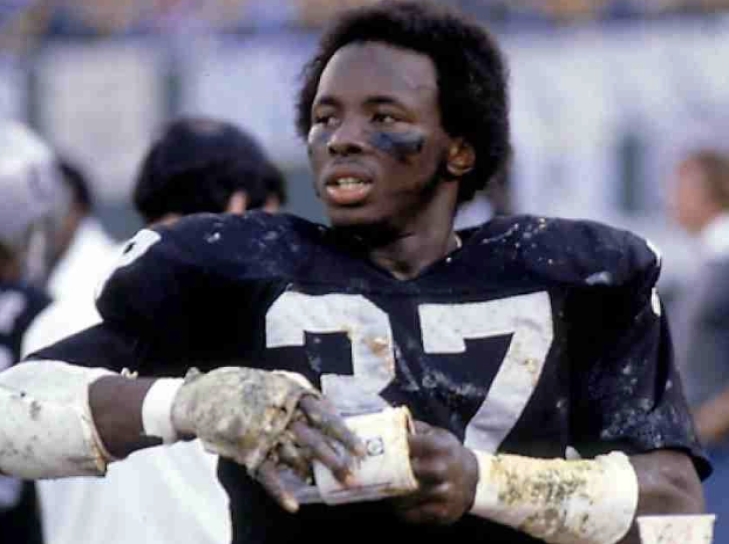
Lester Hayes, CB, OAK/RAI 1977-86. Inducted in the Pro Football Hall of Fame Revisited Project in 2001 on his 10th Ballot. Was never inducted into the actual Pro Football Hall of Fame.
Lester Hayes was one of the NFL’s most feared, theatrical, and fiercely physical cornerbacks, bringing the Raiders’ renegade spirit to life on the field.
Selected in the fifth round as the 126th overall pick of the 1977 NFL Draft out of Texas A&M, Hayes played safety and linebacker in college before legendary head coach John Madden famously transitioned him to cornerback. This change created a formidable challenge for opposing quarterbacks. Standing 6 feet tall and adopting an exceptionally low pre-snap stance, Hayes mastered the aggressive bump-and-run coverage favored by Raiders owner Al Davis, using his strength and elite recovery speed to physically disrupt wide receivers at the line of scrimmage.
Hayes’s 1980 campaign remains one of the greatest individual defensive performances in NFL history. He effectively shut down his side of the field, recording an impressive 13 interceptions during the regular season—just one short of Dick "Night Train" Lane's single-season record. His dominant performance earned him the NFL Defensive Player of the Year award and consensus First-Team All-Pro honors. Hayes continued his exceptional play in the postseason, recording five additional interceptions in four playoff games and helping anchor the Raiders' historic run to a Super Bowl XV victory over the Philadelphia Eagles.
Beyond his coverage skills, Hayes became closely associated with Stickum, a highly adhesive substance that he applied generously to his hands, wrists, and forearms to help secure anything resembling a football. His conspicuous use of the substance attracted intense league-wide scrutiny and directly prompted the NFL to adopt the infamous "Lester Hayes Rule" in 1981, permanently banning it. Although critics speculated that his performance would decline without this chemical advantage, Hayes demonstrated his elite ability by maintaining his dominant form without it. He earned five consecutive Pro Bowl selections from 1980 to 1984. After the franchise added fellow shutdown cornerback Mike Haynes in 1983, the pair formed what was arguably the greatest cornerback tandem in NFL history, leading the team to a decisive victory over Washington in Super Bowl XVIII.
Hayes retired following the 1986 season after spending his entire 10-year career in Silver and Black. He stepped away with 39 career regular-season interceptions, which leaves him tied with Hall of Famer Willie Brown for the Raiders' all-time franchise record.
Roger Craig, RB, SFO 1983-90, RAI 1991 & MIN 1992-93. Inducted in the Pro Football Hall of Fame Revisited Project in 2001 on his 3rd Ballot. Inducted into the actual Pro Football Hall of Fame in 2026.
Roger Craig was a transformative force behind the San Francisco 49ers’ dynasty of the 1980s, redefining the running back position through his exceptional versatility and distinctive high-knee running style. Selected in the second round of the 1983 NFL Draft after playing at the University of Nebraska, Craig combined downhill power with receiver-like route-running ability, making him an ideal centerpiece for Bill Walsh’s innovative West Coast offense. He made an immediate impact as a rookie, but his profile rose to national prominence during Super Bowl XIX. In the decisive victory over the Miami Dolphins, Craig made NFL history as the first player to score three touchdowns in a single Super Bowl, showcasing his ability to challenge defenses both on the ground and through the air.
Craig’s dual-threat dominance reached its height during the historic 1985 season, when he achieved a milestone many had considered impossible. In a remarkable display of athletic endurance, Craig became the first player in NFL history to record more than 1,000 rushing yards (1,050) and 1,016 receiving yards in the same season, while also leading the league with a career-high 92 receptions. This "1,000/1,000" club remained exclusive to Craig for more than a decade and has been matched only twice since. He demonstrated that his peak performance was no anomaly in 1988, transitioning smoothly from fullback to primary halfback and earning NFL Offensive Player of the Year honors. He recorded a league-leading 2,036 yards from scrimmage and set a franchise record with 1,502 rushing yards, helping lead San Francisco to another world championship in Super Bowl XXIII.
Craig’s exceptional courage and willingness to withstand punishing hits across the middle of the field ultimately shortened his peak, as the sustained physical demands of his aggressive playing style began to take their toll. After winning a third Super Bowl ring in Super Bowl XXIV, persistent injuries diminished his renowned explosiveness. His tenure in San Francisco ended on a heartbreaking note when a late-game fumble in the 1990 NFC Championship Game helped derail the 49ers' bid for a historic third consecutive Super Bowl title. He concluded his distinguished 11-year career with brief veteran stints with the Los Angeles Raiders and Minnesota Vikings, retiring after the 1993 season with 13,100 yards from scrimmage and 73 total touchdowns.
Otis Taylor, WR-FL, KAN 1965-75. Inducted in the Pro Football Hall of Fame Revisited Project in 2001 on his 1st Senior Ballot. Was never inducted into the actual Pro Football Hall of Fame.
Otis Taylor was a transformative presence for the Kansas City Chiefs and is widely regarded as a prototype for the modern NFL wide receiver. Legendary head coach Hank Stram famously remarked that he had been seeking a new dimension for his passing game and, upon seeing Taylor, knew he had found it. In an era dominated by powerful rushing attacks, Taylor fundamentally altered defensive coverage strategies, combining reliable hands with an exceptional ability to gain yards after the catch.
The most memorable moment of Taylor's career occurred on January 11, 1970, on the sport's grandest stage: Super Bowl IV. Facing the heavily favored Minnesota Vikings and their legendary "Purple People Eater" defense, Taylor caught a short hitch pass from quarterback Len Dawson, broke a tackle near the sideline, and completed a spectacular, high-stepping 46-yard sprint for a touchdown. The score secured a decisive 23-7 upset, firmly establishing Taylor’s place in championship history and bolstering the AFL's legitimacy shortly before the official league merger. This achievement capped a brilliant period during which he also helped lead the Chiefs to an appearance in the inaugural Super Bowl.
Taylor’s individual dominance reached its statistical peak during the 1971 season, when he proved exceptionally difficult to defend. He led the NFL with 1,110 receiving yards and averaged an impressive 19.5 yards per reception, earning consensus First-Team All-Pro honors and the UPI AFC Player of the Year award. Over his distinguished 11-season career, spent entirely in Kansas City, he recorded 410 receptions for 7,306 yards and 57 touchdowns. Although these statistics may appear modest by today's pass-oriented standards, they were exceptional for their era. Upon his retirement, he held the franchise record for career receptions.
Eddie Kotal, SCOUT, LAR 1946-41. Inducted in the Pro Football Hall of Fame Revisited Project in 2001 on his 6th Coach/Contributor Ballot. Was never inducted into the actual Pro Football Hall of Fame.
Talk about ahead of the times!
Before revolutionizing player personnel, Kotal built a diverse athletic career as a versatile 170-pound quarterback and halfback for the Green Bay Packers from 1925 to 1929, helping Curly Lambeau's team secure its first NFL championship in 1929. He later embarked on a highly successful multisport coaching career at the University of Wisconsin–Stevens Point, leading teams to conference titles in football, basketball, track, and boxing. In 1942, Kotal returned to the professional ranks as a backfield coach and part-time scout for the Packers, laying the foundation for his groundbreaking career transition.
His lasting legacy began in October 1946, when Los Angeles Rams owner Dan Reeves appointed Kotal as the league's first full-time head scout. When other NFL franchises prepared for the draft by casually browsing commercial football magazines such as Street & Smith, Kotal took a far more rigorous approach. He spent nine months each year on the road, driving more than 40,000 miles annually to visit college campuses, consult with coaches, and evaluate players in person. Kotal pioneered the organization of comprehensive player dossiers into library-like systems and introduced the revolutionary draft principle of selecting the "best player available.” This systematic approach laid the foundation for today's computerized personnel departments and established the Rams as a scouting powerhouse ahead of its time.
Beyond establishing standardized scouting protocols, Kotal played a pivotal role in social change and demonstrated foresight in identifying underrecognized talent. He was among the first NFL scouts to cultivate extensive relationships with Historically Black Colleges and Universities (HBCUs). Through these networks, Kotal signed Grambling's Paul "Tank" Younger in 1949, who became the first African-American player from an HBCU to play in the NFL. Kotal’s ability to identify promising prospects at small or unconventional schools also brought future Pro Football Hall of Famers such as Andy Robustelli of tiny Arnold College and Deacon Jones of South Carolina State to the Rams’ attention. He also anticipated cross-sport scouting by recommending that the Rams draft track stars such as Rafer Johnson and basketball standouts such as K.C. Jones, further establishing his reputation as one of the most astute evaluators of athletic talent in football history.
The Pro Football Hall of Fame Revisited Project: 2001 Semi-Final VOTE
2001 SEMI-FINAL RESULTS:
Thank you for your participation in the Pro Football Hall of Fame Revisited Project. If you are unaware of what that is, we acted like the PFHOF had its first class in January 1946.
We have completed the years up to 2000.
For “2001,” a Preliminary Vote with nearly 100 players whose playing career ended by 1995. We also follow the structure in which players have 20 years of eligibility, and if they do not make it into the Hall, they are relegated to the Senior Pool.
Each voter was asked to select 25 names from the preliminary list, and the top 25 vote-getters were named Semi-Finalists.
A week later, the voters were asked to pick 15 names from the 25 Semi-Finalists, and next week, they will choose five from the remaining 15. We will continue this process every week until we catch up to the current year.
31 votes were cast, with the top 15 advancing.
This is for the “Modern Era”
Bold indicates they advanced to the Finals:
|
Player |
Year of Eligibility |
Vote Total |
|
Art Monk WR |
1 |
25 |
|
Bob Griese QB |
16 |
23 |
|
Lester Hayes DB |
10 |
23 |
|
Roger Craig RB |
3 |
23 |
|
Jackie Slater T |
1 |
23 |
|
Ken Anderson QB |
10 |
21 |
|
Sterling Sharpe WR |
2 |
21 |
|
Cliff Harris S |
17 |
19 |
|
Ken Stabler QB |
12 |
19 |
|
Billy “White Shoes” Johnson WR/R |
8 |
18 |
|
Drew Pearson WR |
13 |
17 |
|
Rickey Jackson LB-DE |
1 |
17 |
|
Deron Cherry DB |
5 |
15 |
|
Andy Russell |
20 |
14 |
|
Lemar Parrish DB |
14 |
14 |
|
Ken Riley DB |
13 |
14 |
|
Todd Christensen TE |
8 |
14 |
|
George Kunz T |
16 |
13 |
|
Joe Jacoby T |
1 |
3 |
|
Winston Hill T |
19 |
12 |
|
Joe Klecko DE-NT |
8 |
12 |
|
Fred Dean DE |
11 |
11 |
|
Mark Gastineau DE |
8 |
8 |
|
Jimbo Covert T |
1 |
6 |
|
Steve McMichael DT |
2 |
5 |
This is for the “Senior Era”
*Bold indicates they advanced to the Finals:
|
Player |
Year of Eligibility |
Vote Total |
|
Floyd Little RB |
1 |
22 |
|
Arch Ward CONTRIBUTOR |
12 |
18 |
|
Otis Taylor WR-FL |
1 |
14 |
|
Walt Sweeney G |
1 |
13 |
|
Alan Ameche FB |
15 |
16 |
|
None of the Above |
3 |
This is for the “Coaches/Contributors Era”
*Bold indicates they advanced to the Finals:
|
Player |
Year of Eligibility |
Vote Total |
|
SCOUT: Eddie Kotal |
6 |
19 |
|
EXEC: Ron Wolf |
3 |
18 |
|
COACH: Tom Flores |
5 |
17 |
|
EXECUTIVE: George Young |
4 |
11 |
|
OWNER: Eddie DeBartolo Jr. |
2 |
8 |
|
None of the Above |
2 |
We will post the Class of 2001 Pro Football Hall of Fame Revisited Project next Saturday.
Thank you to all who contributed. If you want to be part of this project, please let us know!
The Pro Football Hall of Fame Revisited Project: 2001 Preliminary VOTE
2001 PRELIMINARY RESULTS:
Thank you to all who participated in the Pro Football Hall of Fame Revisited Project. If you are still figuring that out, we treated the PFHOF as having its first class in January 1946.
For “2001,” a Preliminary Vote with over 100 players whose playing career ended by 1995. We also follow the structure in which players have 20 years of eligibility, and if they do not make it into the Hall, they are relegated to the Senior Pool.
Each voter was asked to select 25 names from the preliminary list, and the top 25 vote-getters were named Semi-Finalists.
A week later, voters will be asked to select 15 names from the 25 Semi-Finalists, then choose five from the remaining 15. We will continue this process every week until we catch up to the current year.
Please note that a significant change occurred “years ago,” allowing voters to submit fewer than the allotted number of spots.
31 Votes took place.
This is for the “Modern Era”
Bold indicates they advanced to the Semi-Finals:
*Indicates they have been removed from future ballots
|
Player |
Year of Eligibility |
Vote Total |
|
Sterling Sharpe WR |
2 |
23 |
|
Jackie Slater T-G |
1 |
22 |
|
Ken Anderson QB |
10 |
20 |
|
Joe Klecko DE |
8 |
20 |
|
Art Monk WR |
1 |
20 |
|
Lester Hayes DB |
10 |
19 |
|
Billy “White Shoes” Johnson |
8 |
19 |
|
Roger Craig RB |
3 |
19 |
|
Rickey Jackson LB-DE |
1 |
18 |
|
Bob Griese QB |
16 |
17 |
|
Ken Stabler QB |
12 |
17 |
|
Lemar Parrish DB |
14 |
16 |
|
Steve McMichael DT |
2 |
16 |
|
Cliff Harris S |
17 |
15 |
|
Todd Christensen TE |
8 |
15 |
|
Drew Pearson WR |
13 |
14 |
|
George Kunz T |
16 |
13 |
|
Winston Hill T |
19 |
12 |
|
Ken Riley DB |
13 |
12 |
|
Fred Dean DE |
11 |
12 |
|
Mark Gastineau DE |
8 |
12 |
|
Jimbo Covert T |
6 |
12 |
|
Deron Cherry DB |
5 |
12 |
|
Joe Jacoby T |
3 |
12 |
|
Andy Russell LB |
20 |
11 |
|
Harry Carson LB |
8 |
10 |
|
Russ Francis TE |
8 |
10 |
|
Stanley Morgan WR |
6 |
10 |
|
Jim Marshall DE |
17 |
9 |
|
Karl Mecklenburg LB |
2 |
9 |
|
Harold Carmichael WR |
12 |
8 |
|
Ottis Anderson RB |
4 |
8 |
|
Mike Kenn T |
1 |
7 |
|
*Larry Brown RB |
20 |
6 |
|
Bill Bergey LB |
16 |
6 |
|
Curley Culp DT-NT |
15 |
6 |
|
Matt Blair LB |
11 |
6 |
|
Bubba Baker DE |
6 |
6 |
|
Joey Browner DB |
4 |
6 |
|
Carl Banks LB |
1 |
6 |
|
Chris Hinton T-G |
1 |
6 |
|
Wilber Marshall LB |
1 |
6 |
|
Jack Tatum DB |
16 |
5 |
|
Isiah Robertson LB |
14 |
5 |
|
Lyle Alzado DE |
11 |
5 |
|
Ed White G |
11 |
5 |
|
Nolan Cromwell DB |
9 |
5 |
|
Frank Minnifield DB |
4 |
5 |
|
Fred Smerlas NT |
4 |
5 |
|
Jay Hilgenberg C |
3 |
5 |
|
*Lee Roy Jordan LB |
20 |
4 |
|
Pat Fischer CB |
19 |
4 |
|
Jerry Smith TE |
19 |
4 |
|
Jim Bakken PK |
18 |
4 |
|
Jake Scott DB |
18 |
4 |
|
Rick Upchurch WR/R |
13 |
4 |
|
Billy Sims RB |
12 |
4 |
|
Doug Wilkerson G |
12 |
4 |
|
Wes Chandler WR |
8 |
4 |
|
Ed “Too Tall” Jones DE |
7 |
4 |
|
Doug Williams QB |
7 |
4 |
|
Christian Okoye RB |
4 |
4 |
|
Everson Walls DB |
3 |
4 |
|
Dennis Smith DB |
2 |
4 |
|
*Gale Gillingham G-DT |
20 |
3 |
|
*Ed Budde G |
20 |
3 |
|
*Ernie McMillan T |
20 |
3 |
|
Dick Anderson DB |
19 |
3 |
|
Roman Gabriel QB |
19 |
3 |
|
Harold Jackson WR |
13 |
3 |
|
Harvey Martin DE |
13 |
3 |
|
Joe Theismann QB |
11 |
3 |
|
Dwight Clark WR |
9 |
3 |
|
Mark Clayton WR |
3 |
3 |
|
Mark Bavaro TE |
2 |
3 |
|
Gary Clark WR |
1 |
3 |
|
Jim Ritcher G |
1 |
3 |
|
Mike Curtis LB-FB |
18 |
2 |
|
Ron McDole DE-DT |
18 |
2 |
|
George Atkinson DB |
17 |
2 |
|
Chuck Foreman RB |
16 |
2 |
|
Coy Bacon DE |
15 |
2 |
|
Lawrence McCutchen RB |
15 |
2 |
|
Mel Gray WR |
14 |
2 |
|
Bert Jones QB |
14 |
2 |
|
Tom Jackson LB |
10 |
2 |
|
Jeff Van Note C |
10 |
2 |
|
Randy Cross G-C |
8 |
2 |
|
Hanford Dixon DB |
7 |
2 |
|
James Brooks RB |
4 |
2 |
|
Keith Millard DT-NT |
3 |
2 |
|
Phil Simms QB |
3 |
2 |
|
Leonard Marshall DE |
2 |
2 |
|
John Taylor WR |
1 |
2 |
|
Lydell Mitchell RB |
16 |
1 |
|
Mike Wagner DB |
16 |
1 |
|
Dennis Harrah G |
9 |
1 |
|
Steve Nelson LB |
9 |
1 |
|
Rulon Jones DE |
8 |
1 |
|
Neil Lomax QB |
8 |
1 |
|
Keena Turner LB |
6 |
1 |
|
Curt Warner RB |
6 |
1 |
|
Raymond Clayborn DB |
5 |
1 |
|
Dexter Manley DE |
5 |
1 |
|
Michael Carter NT |
4 |
1 |
|
Roy Green WR |
4 |
1 |
|
Freeman McNeil RB |
4 |
1 |
|
Bill Fralic G |
3 |
1 |
|
Mark Bortz G |
2 |
1 |
|
Steve Jordan TE |
2 |
1 |
|
Tim Krumrie NT |
2 |
1 |
|
Carl Lee DB |
2 |
1 |
|
Charles Mann DE |
2 |
1 |
|
Luis Sharpe T |
2 |
1 |
|
Anthony Carter WR |
1 |
1 |
|
Shane Conlan LB |
1 |
1 |
|
Jack Del Rio LB |
1 |
1 |
|
Jim Lachey T |
1 |
1 |
|
Jay Novacek TE |
1 |
1 |
|
Ralph Neely T |
19 |
0 |
|
Riley Odoms TE |
13 |
0 |
|
Gary Johnson DT |
11 |
0 |
|
Marvin Powell T |
9 |
0 |
|
Dave Brown DB |
7 |
0 |
|
*Mike Quick WR |
6 |
0 |
|
Matt Millen LB |
5 |
0 |
|
*Vaughan Johnson LB |
2 |
0 |
|
*Max Montoya G |
2 |
0 |
|
*Don Mosebar C-T-G |
2 |
0 |
|
*Bill Pickel DT-NT |
2 |
0 |
|
Marion Butts RB |
1 |
0 |
|
Scott Case DB |
1 |
0 |
|
Ernest Givins WR |
1 |
0 |
|
Tim Harris LB-DE |
1 |
0 |
|
Rodney Holman TE |
1 |
0 |
|
Mike Johnson LB |
1 |
0 |
|
Tom Newberry G-C |
1 |
0 |
|
Bart Oates C |
1 |
0 |
Bold indicates they advanced to the Semi-Finals:
*Indicates that they will be removed from the ballot permanently.
|
Player |
Year |
Votes |
|
Alan Ameche FB |
16 |
11 |
|
Floyd Little RB |
1 |
11 |
|
Otis Taylor WR-FL |
1 |
11 |
|
Arch Ward CONTRIBUTOR |
12 |
10 |
|
Walt Sweeney G |
1 |
7 |
|
Greasy Neale COACH |
12 |
6 |
|
Tank Younger FB-LB-HB |
18 |
5 |
|
Charlie Conerly QB |
15 |
5 |
|
Charles Bidwill OWNER |
12 |
5 |
|
Dan Reeves OWNER |
12 |
5 |
|
Art Powell E |
8 |
5 |
|
Larry Grantham LB |
4 |
5 |
|
Max McGee E |
9 |
4 |
|
Houston Antwine DT |
4 |
4 |
|
Billy Wilson FL-E |
16 |
3 |
|
George Preston Marshall OWNER |
12 |
3 |
|
Jim Ray Smith G-T |
12 |
3 |
|
Rosey Grier DT-DE |
10 |
3 |
|
Don Meredith QB |
8 |
3 |
|
Dave Grayson DB |
6 |
3 |
|
Boyd Dowler FL-SE-LB |
5 |
3 |
|
Rich Jackson DE |
4 |
3 |
|
Cornell Green DB |
2 |
3 |
|
Daryle Lamonica QB |
2 |
3 |
|
Harlon Hill E-DB |
14 |
2 |
|
Cookie Gilchrist FB |
9 |
2 |
|
Erich Barnes DB |
5 |
2 |
|
John Brodie QB |
3 |
2 |
|
Mike Stratton LB |
3 |
2 |
|
John Niland G |
1 |
2 |
|
Goose Gonsoulin DB |
9 |
1 |
|
Abner Haynes HB |
9 |
1 |
|
Jim Katcavage DE |
8 |
1 |
|
Jack Kemp QB |
7 |
1 |
|
George Saimes DB |
4 |
1 |
|
Carroll Dale WR-E |
3 |
1 |
|
Jim Nance RB-FB |
3 |
1 |
|
Fuzzy Thurston G |
9 |
0 |
|
Babe Parilli QB |
7 |
0 |
|
Butch Byrd DB |
5 |
0 |
|
Bob Jeter DB-WR |
3 |
0 |
|
*George Halas Jr EXEC |
2 |
0 |
This is for the “Coaches/Contributors”
Bold indicates they advanced to the Semi-Finals:
*Indicates that they will be removed from the ballot permanently.
|
Name |
Year |
Votes |
|
COACH: Tom Flores |
5 |
13 |
|
EXEC: Ron Wolf |
3 |
13 |
|
SCOUT: Eddie Kotal |
6 |
10 |
|
OWNER: Eddie DeBartolo Jr. |
2 |
10 |
|
EXEC: George Young |
4 |
9 |
|
EXEC: Jim Finks |
13 |
8 |
|
*OWNER: Bud Adams |
20 |
7 |
|
COACH: Buddy Ryan |
4 |
6 |
|
TV EXEC: Roone Arledge |
15 |
5 |
|
TV COMMENTATOR: Howard Cosell |
15 |
5 |
|
SCOUT: Lloyd Wells |
6 |
5 |
|
*OWNER: Clint Murchison |
20 |
4 |
|
OWNER: William Clay Ford |
6 |
4 |
|
SCOUT: John Wooten |
6 |
4 |
|
COACH: Chuck Knox |
5 |
4 |
|
COACH: Bum Phillips |
14 |
3 |
|
NARRATOR: John Facenda |
6 |
3 |
|
SCOUT : Jack Vainsi |
6 |
3 |
|
EXEC: John McVay |
2 |
3 |
|
OWNER: Art Modell |
16 |
2 |
|
OWNER: Jack Kent Cooke |
6 |
2 |
|
COACH: Bill Arnsbarger |
16 |
1 |
|
COACH: John Robinson |
7 |
1 |
|
COACH: Jerry Glanville |
6 |
1 |
|
COACH: Bud Carson |
2 |
1 |
|
COACH: Barry Switzer |
2 |
1 |
|
COACH: Ted Marchibroda |
1 |
1 |
|
COACH: Lindy Infante |
13 |
0 |
|
*COACH: Richie Petitbon |
6 |
0 |
|
*COACH: Ron Erhardt |
2 |
0 |
|
*EXEC: Harry Gamble |
2 |
0 |
|
EXEC: John Beake |
1 |
0 |
|
EXEC: Vince Cerrato |
1 |
0 |
|
COACH: Dick Coury |
1 |
0 |
|
COACH: Mike McCormack |
1 |
0 |
|
COACH: Frtz Shurmur |
1 |
0 |
|
EXEC: Jerry Vainisi |
1 |
0 |
Next week, we will announce the Semi-Finalists for the 2001 Pro Football Hall of Fame Revisited Project.
The Pro Football Hall of Fame Revisited Project: 2000 Final VOTE
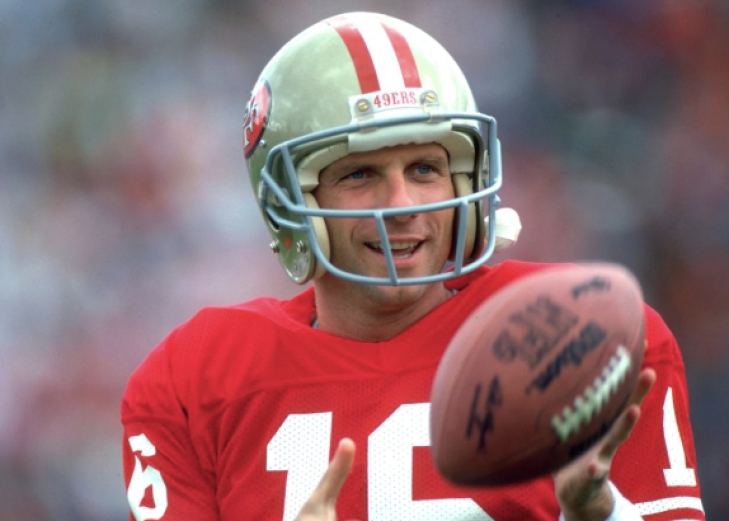
2000 Pro Football Hall of Fame Revisited Project Class.
Here we are! Again!!
If you have been following our Pro Football Hall of Fame Revisited Project, you know we have asked the question: What if the PFHOF had begun in January 1946?
After soliciting and obtaining a passionate group of football fans and historians, we sent out a ballot for a Preliminary Vote, in which each voter selected 25 names as their semi-finalists and five names for the Senior Pool.
We then asked the group to vote for their 15 Finalists in the Modern Era and 3 in the Senior Category. The final stage was to vote for their five Modern Era inductee and one Senior inductee.
These are the results of the 55th official class.
Below are the final results of this project based on 32 votes.
Remember that we have reverted back to the top five candidates entering the Hall in the Modern Era
This is for the “Modern Era”
*Bold indicates they have been elected to the Pro Football Hall of Fame Revisited Class of 2000:
|
Player |
Year of Eligibility |
Vote Total |
|
Joe Montana QB |
1 |
32 |
|
Ronnie Lott DB |
1 |
26 |
|
L.C. Greenwood DE |
14 |
11 |
|
James Lofton WR |
2 |
11 |
|
Andre Tippett LB |
2 |
10 |
|
Floyd Little RB |
20 |
9 |
|
Cliff Harris DB |
16 |
8 |
|
Roger Craig RB |
2 |
8 |
|
Otis Taylor WR-FL |
20 |
7 |
|
Bob Griese QB |
15 |
7 |
|
Lester Hayes DB |
9 |
7 |
|
Sterling Sharpe WR |
1 |
6 |
|
Joe Klecko DE-NT |
7 |
5 |
|
Ken Stabler QB |
11 |
3 |
|
Ken Anderson QB |
9 |
3 |
|
Drew Pearson WR |
12 |
2 |
This is for the “Senior Era”,
*Bold indicates they have been elected to the Pro Football Hall of Fame Revisited Class of 2000.
|
Bobby Boyd DB |
7 |
16 |
|
Alan Ameche FB |
15 |
9 |
|
Art Powell E |
7 |
6 |
|
None of the Above |
N/A |
1 |
This is for the “Coaches/Contributors”,
*Bold indicates they have been elected to the Pro Football Hall of Fame Revisited Class of 2000.
|
Marv Levy (Coach) |
1 |
22 |
|
Eddie Kotal (Scout) |
5 |
6 |
|
Tom Flores (Coach) |
4 |
4 |
|
None of the Above |
N/A |
6 |
About the 2000 Inductees:
Joe Montana, QB, SFO 1981-92 & KAN 1993-94: Inducted in the Pro Football Hall of Fame Revisited Project in 2000 on his 1st Ballot. Inducted into the actual Pro Football Hall of Fame in 2000.
A National Champion at Notre Dame in 1977, Joe Montana was a third-round pick two years later by the San Francisco 49ers, where he began his pro career as Steve DeBerg’s backup.
After riding the pine as a rookie, Montana became the 49ers’ starting Quarterback midway through the 1980 season. It was a good start: he finished first in Pass Completion Percentage (64.5), and it showcased the man who became the most successful QB of the 1980s.
Montana earned his first Pro Bowl in 1981 and led the league in Pass Completion Percentage (63.7), but San Francisco was a far more complete team. The Niners won 13 games that year, defeated the heavily favored Dallas Cowboys in "The Catch Game,” and went on to win the Super Bowl, with Montana winning the game's MVP. "Joe Cool" had arrived, and he was there to stay.
Montana returned to the Pro Bowl in 1983, and also to the Super Bowl, but this time they lost to the Washington Redskins. A Pro Bowler again in 1984, Montana and the Niners were not going to be denied in that year’s Super Bowl, as Montana won his second Super Bowl and Super Bowl MVP in their sound defeat of the Miami Dolphins.
San Francisco remained strong over the years, and as good as Montana was in the first half of the 1980s, his second was arguably even better. The Quarterback again was a First Team All-Pro with a league-leading and career-high 31 Touchdown Passes. The following season, Montana also took the 49ers to a Super Bowl Title, his third of the decade.
You would think that it would be impossible to top that, but Montana did just that in the next two years.
In 1989 and 1990, Montana achieved rarefied NFL air by winning back-to-back MVPs, with the first of those years earning him his fourth Super Bowl and third Super Bowl MVP. No other QB from 1980 to 1990 did more than Montana in the 1980s, and arguably nobody came close. As great as this was, this was the end for Joe Montana in San Francisco.
Montana missed the entire 1991 season and most of 1992 due to an elbow injury. When he was ready to return, Steve Young emerged as the chosen QB, and the Chiefs traded Montana to Kansas City, where he played two more seasons. Over his career, Montana threw for 40,551 Yards and 273 Touchdowns.
Montana entered the Pro Football Hall of Fame and was named to the NFL 1980s All-Decade, 75th and 100th Anniversary Team. The former Quarterback had his number retired in 1997, and he was an inaugural member of the 49ers Hall of Fame in 2009.
Ronnie Lott, CB, SFO 1981-90, RAI 1991-92 & NYJ 1993-94: Inducted in the Pro Football Hall of Fame Revisited Project in 2000 on his 1st Ballot. Inducted into the actual Pro Football Hall of Fame in 1999.
Ronnie Lott stands as one of the most ferocious and impactful defensive backs in NFL history, a player whose legendary intensity redefined the safety position. Drafted eighth overall by the San Francisco 49ers in 1981, Lott made an immediate impact by helping anchor a defense that captured a victory in Super Bowl XVI during his rookie season. His playing style was defined by an uncompromising, punishing physical nature combined with elite closing speed. Lott didn't just tackle opponents; he delivered bone-jarring collisions that forced turnovers, rattled receivers, and altered the game plan of opposing offenses that feared entering his zone.
During the first half of his career, Lott showcased his elite coverage skills as a dominant cornerback. His exceptional instincts and ability to read quarterbacks allowed him to shut down opposing wide receivers while maintaining his signature physical presence against the run. However, his transition to safety in 1985 truly unlocked his legendary status. From the safety position, Lott became the ultimate field general, patrolling the secondary with unmatched range and a predatory instinct for the football. This versatility allowed him to lead the league in interceptions twice, once as a cornerback and later as a safety.
Lott’s psychological and physical toughness became NFL lore, epitomized by a famous incident during the 1985 season. After crushing his left pinky finger while making a tackle against the Dallas Cowboys, Lott chose to have the tip of his finger amputated during the off-season rather than undergo a complex surgery that would delay his availability for the upcoming season. This extreme commitment to the game and his teammates solidified his reputation as a warrior who prioritized winning above all else, inspiring fear in opponents and deep loyalty from his teammates.
As a primary catalyst for the 1980s San Francisco 49ers dynasty, Lott won four Super Bowl rings and served as the emotional heartbeat of a team often celebrated for its elegant West Coast offense. He brought a necessary, gritty edge to those championship rosters, earning ten Pro Bowl selections and eight First-Team All-Pro honors throughout his career. After a dominant decade in San Francisco, Lott continued to show his leadership and hard-hitting style during impactful later-career stints with the Los Angeles Raiders and the New York Jets, proving his defensive excellence could transcend any system.
By the time he retired, Lott had amassed 63 career interceptions, 16 regular-season forced fumbles, and an extensive highlight reel of legendary hits.
L.C. Greenwood, DE, PIT 1969-81. Inducted in the Pro Football Hall of Fame Revisited Project in 2000 on his 14th Ballot. Was never inducted into the actual Pro Football Hall of Fame in 2000.
L.C. Greenwood stands as one of the most imposing and architecturally significant defensive ends in NFL history, a player whose relentless pursuit redefined edge-rushing during the 1970s. Drafted by the Pittsburgh Steelers in the tenth round of the 1969 draft out of Arkansas AM&N, Greenwood defied his late-round draft status to become an indispensable cornerstone of the legendary "Steel Curtain" defense. His playing style blended exceptional length with deceptive, linebacker-like speed. Standing 6-foot-6 but playing at a relatively lean 245 pounds, Greenwood did not rely on overwhelming bulk; instead, he weaponized a blistering 4.6-second forty-yard dash and exceptionally long arms to bypass offensive tackles before they could set their blocks.
Operating on the left side of the defensive line alongside Hall of Fame tackle Joe Greene, Greenwood used his unique frame to torture opposing quarterbacks. His technique was a calculated chess match; coaches widely regarded him as a "thinking man's player" who meticulously set up offensive linemen over the course of a game before flashing past them in critical moments. When he wasn't bypassing tackles to collect 78.0 career sacks, Greenwood used his massive wingspan and height to alter passing lanes, famously batting down three passes in Super Bowl IX and routinely suffocating the outside run.
Greenwood’s persona on the field was as unforgettable as his physical dominance, highlighted by his iconic choice of footwear. To help fans and officials distinguish him on the muddy, monochromatic fields of the 1970s, Greenwood began wearing bright gold, high-top cleats. This flash of color, paired with his stylish off-field demeanor, earned him the moniker "Hollywood Bags" and added psychological theater to his game. The gold shoes became a visual warning flag for opposing offenses, signaling that one of the league’s premier big-game hunters was closing in from the perimeter.
As a vital engine of the 1970s Steelers’ dynasty, Greenwood accumulated four Super Bowl rings and routinely saved his most devastating performances for the grandest stages. His clutch gene was immortalized in Super Bowl X, where he terrorized Dallas Cowboys quarterback Roger Staubach by sacking him a record-tying four times. Throughout his decorated 13-year career, Greenwood earned six Pro Bowl selections, two First-Team All-Pro honors, and a well-deserved spot on the NFL 1970s All-Decade Team. Greenwood may not have made the Pro Football Hall of Fame, but he did make it to ours.
James Lofton, WR, GNB 1982-93, RAI 1987-88, BUF 1989-92, RAM 1993 & PHI 1993. Inducted in the Pro Football Hall of Fame Revisited Project in 2000 on his 2nd Ballot. Inducted into the actual Pro Football Hall of Fame in 2003.
James Lofton stands as one of the most graceful and revolutionary vertical threats in NFL history, a player whose breathtaking speed completely altered how offenses attacked the deep secondary. Drafted sixth overall by the Green Bay Packers in 1978, the Stanford alumnus and NCAA track champion brought Olympic-level sprinting capabilities straight to the gridiron. His playing style was a masterclass in fluid, long-striding acceleration that made cornerbacks look like they were running in place. Lofton didn’t just beat coverages; he vaporized them, routinely gliding past deep safeties with deceptive ease that forced opposing defenses to permanently alter their alignments to account for his game-breaking speed.
During his prime in Green Bay, Lofton established himself as the ultimate prototype for the modern "X" wide receiver. His game was built on exceptional route-running precision and an incredible catching radius, allowing him to pluck balls out of the air at their highest point. He weaponized this combination to become the first player in NFL history to score a touchdown in three different decades. Lofton was a walking big play, leading the league in yards per reception twice and stringing together five consecutive 1,000-yard seasons for a Packers franchise that leaned heavily on his ability to stretch the field.
Lofton’s rare longevity and adaptability became defining features of his Hall of Fame career, as shown by his late-career resurgence. After a productive stint with the Los Angeles Raiders, Lofton joined the Buffalo Bills in 1989 as a veteran piece for their explosive "K-Gun" offense. Even in his mid-30s, his deep-threat ability remained so potent that he helped propel the Bills to three straight Super Bowl appearances, highlighted by a 1991 season in which he earned a Pro Bowl nod at 35. His presence demanded respect from younger secondaries, proving that his masterclass in vertical tracking and body control was completely timeless.
By the time he retired, Lofton had amassed 764 receptions, 75 touchdowns, and a staggering 14,004 receiving yards—a number that stood as the NFL's all-time record at the moment of his departure from the game.
Andre Tippett, LB, NWE 1982-93. Inducted in the Pro Football Hall of Fame Revisited Project in 2000 on his 2nd Ballot. Inducted into the actual Pro Football Hall of Fame in 2008.
Andre Tippett stands as one of the most explosive and technically unique outside linebackers in NFL history, a player whose combination of raw speed and martial arts mastery revolutionized edge-rushing in the 1980s. Drafted in the second round of the 1982 NFL Draft by the New England Patriots out of Iowa, Tippett quickly became the foundational piece of a defense that previously lacked a marquee star in the front seven. His playing style was defined by a terrifying burst off the line of scrimmage, utilizing a low-slung, powerful frame to bend around the edge of offensive tackles. Rather than relying strictly on standard football mechanics, Tippett infused his rush with advanced hand-combat techniques. As a high-level black belt in karate, his lightning-fast hands and forearm shivers allowed him to systematically swat away and disarm would-be blockers before they could ever establish leverage.
Operating out of the Patriots' traditional 3-4 defensive scheme as a left outside linebacker, Tippett used his unique attributes to orchestrate the most destructive two-year stretch by any linebacker in league history. Between the 1984 and 1985 seasons, he terrorized opposing quarterbacks to the tune of 35.0 combined sacks—setting a historic standard for his position. He wasn't a one-dimensional specialist, however; Tippett was equally adept at diagnosing plays from the edge, shedding blocks to swallow up running backs, and enforcing boundaries against the outside run. This dominance peaked in 1985, when he won AFC Defensive Player of the Year honors and served as the emotional and physical anchor for a gritty Patriots team that captured the franchise's first-ever AFC Championship.
Despite his staggering production, Tippett’s national legacy often operated in the shadow of Lawrence Taylor, though his peerless technical execution earned deep reverence across the league. NFL coaches, including Bill Belichick, famously studied Tippett’s film specifically to implement his martial-arts-inspired hand drills into their own defensive systems. His toughness was absolute; even when a severe knee injury required mid-season surgery in 1986, he defied medical timelines to return for the final stretch of the year and immediately resume his dominant form. Tippett was a model of consistency for a New England franchise navigating turbulent decades, leading the team in sacks six times and establishing single-season franchise benchmarks that stood untarnished for generations.
By the time he concluded his 12-year career exclusively with New England, Tippett had reached the legendary 100-sack milestone, retiring as one of only a handful of linebackers in NFL history to do so. His brilliant body of work yielded five consecutive Pro Bowl selections, two First-Team All-Pro nods, and a permanent place on the NFL 1980s All-Decade Team.
Bobby Boyd, CB, BAL 1960-68. Inducted in the Pro Football Hall of Fame Revisited Project in 2000 on his 7th Senior Ballot. Was never inducted into the actual Pro Football Hall of Fame.
Bobby Boyd stands as one of the most cerebral and prolific ballhawks in NFL history, a cornerback whose masterclass in anticipation redefined pass defense during the 1960s. Drafted in the tenth round of the 1960 NFL Draft by the Baltimore Colts out of Oklahoma, where he had played both quarterback and defensive back, Boyd arrived in the pros with a quarterback’s deep understanding of offensive architecture. His playing style was less about overwhelming physical intimidation and entirely about predatory intuition and route recognition. Instead of simply reacting to wide receivers, Boyd routinely diagnosed their intentions before they broke into their stems, positioning himself perfectly to disrupt the passing game.
Operating on the perimeter of a legendary Colts defense that featured ferocious talents like Bubba Smith and Mike Curtis, Boyd specialized in the art of the tactical bait. He weaponized a unique technique: intentionally masking his coverage depth by hiding behind taller receivers or lagging slightly behind to fool quarterbacks into throwing into his zone. The moment the ball was released, Boyd would use his exceptional acceleration and field vision to close the gap, slicing under the receiver's arms to pick off the pass. This aggressive, ball-first mindset made him an absolute turnover machine, forcing opposing offenses to treat his side of the field with extreme caution.
Boyd’s statistical efficiency remains staggering, giving him a career interception rate that matches or exceeds almost every legendary secondary defender in history. Over a brilliant nine-year career spent entirely in Baltimore, he amassed 57 regular-season interceptions in just 121 games—averaging a mind-boggling interception nearly every two contests. He led the NFL in picks with nine during the 1965 campaign and anchored the historic 1968 squad that surrendered just nine passing touchdowns all year. His longevity in the takeaway department produced seven seasons with at least six interceptions, cementing his status as the decade’s most dominant interception artist.
Despite retiring with an NFL Championship and more interceptions than any other cornerback in the 1960s, he was chosen for the 1960s All-Decade Team.
Marv Levy, Head Coach, KAN 1978-82 & BUF 1986-97. Inducted in the Pro Football Hall of Fame Revisited Project in 2000 on his 1st Coach/Contributor Ballot. Inducted into the actual Pro Football Hall of Fame in 2001.
Marv Levy stands as one of the most intellectually refined and uniquely empowering head coaches in NFL history, a leader whose masterclass in collective psychology shaped a legendary football dynasty. Armed with a master’s degree in history from Harvard, Levy brought an academic discipline and a statesmanlike calm to a profession typically dominated by authoritarian control freaks. His coaching style was defined by a rare willingness to delegate authority and subordinate his own ego to the talents of his roster. Rather than dictating every micro-movement from the sideline, Levy treated his players as professionals and built a culture founded on mutual respect, trust, and meticulous physical preparation.
Before transforming the NFL gridiron, Levy spent decades sharpening his philosophical approach across high school, college, and the Canadian Football League. He achieved a massive professional breakthrough as the head coach of the Montreal Alouettes, where he won two Grey Cup championships by building flexible, disciplined rosters. When he finally landed his defining NFL role with the Buffalo Bills in 1986, he inherited a locker room fractured by giant salaries and warring egos. Levy systematically united these alpha personalities—including future Hall of Famers Jim Kelly, Thurman Thomas, and Bruce Smith—not through intimidation, but by holding them strictly accountable to one another.
The tactical manifestation of Levy’s trust-based philosophy was his revolutionary adoption of the full-time, no-huddle "K-Gun" offense. In a move that shocked traditionalists, Levy effectively shrank his sideline playbook to empower quarterback Jim Kelly to call plays on the fly at the line of scrimmage. This system weaponized extreme conditioning and rapid execution, trapping exhausted opposing defenses on the field and fundamentally changing the temporal pacing of modern professional football. By prioritizing fluid teamwork over rigid coaching directives, Levy’s teams didn't just outplay opponents; they entirely dictated the emotional and physical terms of the contest.
As the chief architect of the 1990s Buffalo Bills, Levy guided the franchise to an unprecedented and unmatched four consecutive Super Bowl appearances. Though each of those championship games ultimately ended in a painful defeat, Levy’s true genius shone through his ability to repeatedly rally his team back from catastrophic heartbreak and conquer the AFC year after year.
The Pro Football Hall of Fame Revisited Project: 2000 Semi-Final VOTE
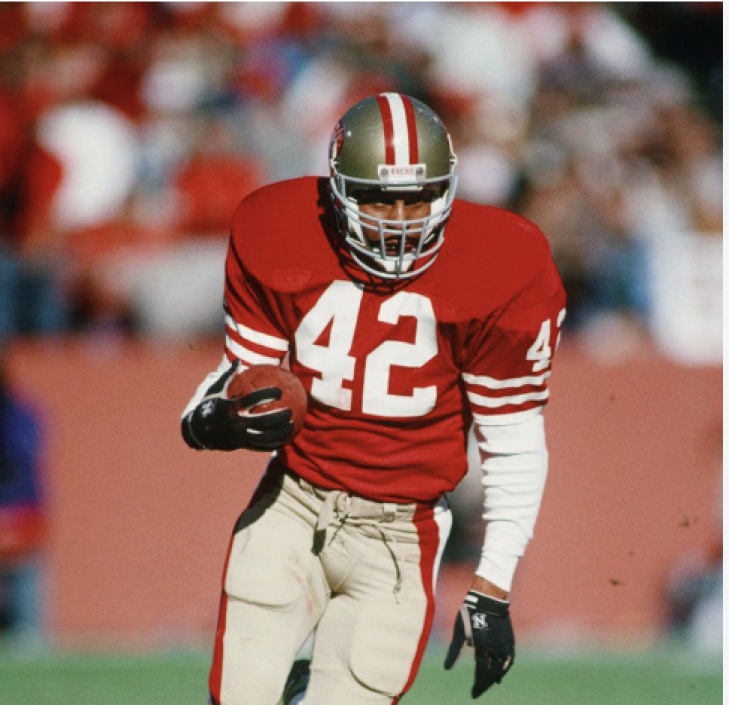
2000 SEMI-FINAL RESULTS:
Thank you for your participation in the Pro Football Hall of Fame Revisited Project. If you are unaware of what that is, we acted like the PFHOF had its first class in January 1946.
We have completed the years up to 1999.
For “2000,” a Preliminary Vote with nearly 100 players whose playing career ended by 1994. We also follow the structure in which players have 20 years of eligibility, and if they do not make it into the Hall, they are relegated to the Senior Pool.
Each voter was asked to select 25 names from the preliminary list, and the top 25 vote-getters were named Semi-Finalists.
A week later, the voters were asked to pick 15 names from the 25 Semi-Finalists, and next week, they will choose five from the remaining 15. We will continue this process every week until we catch up to the current year.
33 votes were cast, with the top 15 advancing.
This is for the “Modern Era”
Bold indicates they advanced to the Finals:
|
Player |
Year of Eligibility |
Vote Total |
|
Joe Montana QB |
1 |
32 |
|
Ronnie Lott DB |
1 |
30 |
|
L.C. Greenwood DE |
14 |
25 |
|
James Lofton WR |
2 |
25 |
|
Bob Griese QB |
15 |
22 |
|
Cliff Harris S |
16 |
20 |
|
Roger Craig RB |
2 |
19 |
|
Sterling Sharpe WR |
1 |
19 |
|
Floyd Little RB |
20 |
18 |
|
Ken Stabler QB |
11 |
18 |
|
Lester Hayes DB |
9 |
18 |
|
Joe Klecko DE-NT |
7 |
18 |
|
Andre Tippett LB |
2 |
18 |
|
Otis Taylor WR-FL |
20 |
16 |
|
Drew Pearson WR |
12 |
16 |
|
Ken Anderson QB |
9 |
16 |
|
George Kunz T |
15 |
13 |
|
Lemar Parrish DB |
13 |
13 |
|
Ken Riley DB |
12 |
13 |
|
Todd Christensen TE |
7 |
12 |
|
Billy “White Shoes” Johnson WR/R |
7 |
12 |
|
Fred Dean DE |
10 |
11 |
|
Winston Hill T |
18 |
9 |
|
Deron Cherry DB |
4 |
8 |
|
Steve McMichael DT |
1 |
6 |
This is for the “Senior Era”
*Bold indicates they advanced to the Finals:
|
Player |
Year of Eligibility |
Vote Total |
|
Bobby Boyd DB |
7 |
25 |
|
Art Powell E |
7 |
17 |
|
Alan Ameche FB |
15 |
16 |
|
Arch Ward CONTRIBUTOR |
11 |
15 |
|
John Brodie QB |
2 |
7 |
|
None of the Above |
3 |
This is for the “Coaches/Contributors Era”
*Bold indicates they advanced to the Finals:
|
Player |
Year of Eligibility |
Vote Total |
|
COACH: Marv Levy |
1 |
25 |
|
SCOUT: Eddie Kotal |
5 |
18 |
|
COACH: Tom Flores |
4 |
17 |
|
EXECUTIVE: Jim Finks |
12 |
13 |
|
EXEC: Ron Wolf |
2 |
11 |
|
None of the Above |
1 |
We will post the Class of 2000 Pro Football Hall of Fame Revisited Project next Saturday.
Thank you to all who contributed. If you want to be part of this project, please let us know!
The Pro Football Hall of Fame Revisited Project: 2000 Preliminary VOTE
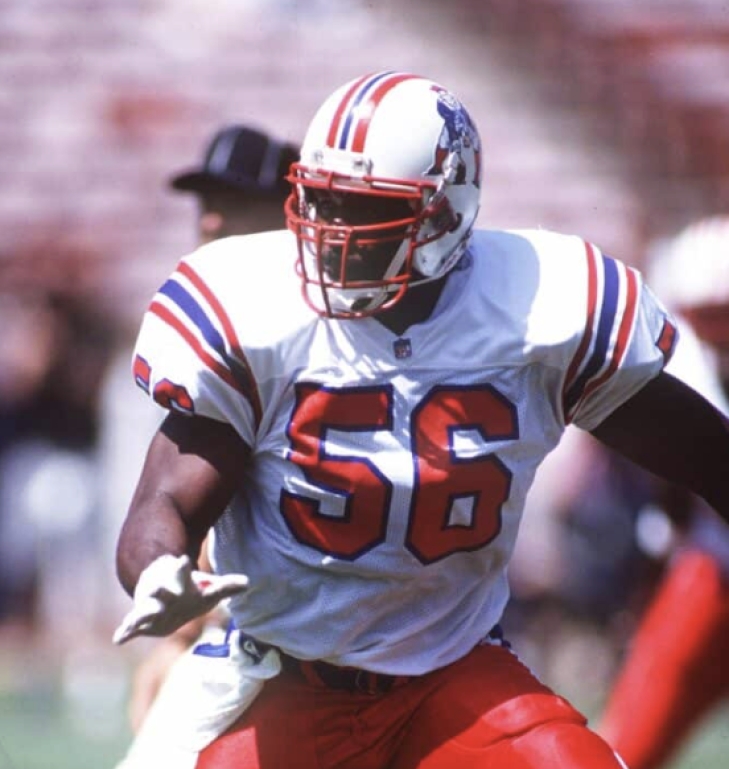
2000 PRELIMINARY RESULTS:
Thank you to all who participated in the Pro Football Hall of Fame Revisited Project. If you are still figuring that out, we treated the PFHOF as having its first class in January 1946.
For “2000,” a Preliminary Vote with over 100 players whose playing career ended by 1994. We also follow the structure in which players have 20 years of eligibility, and if they do not make it into the Hall, they are relegated to the Senior Pool.
Each voter was asked to select 25 names from the preliminary list, and the top 25 vote-getters were named Semi-Finalists.
A week later, voters will be asked to select 15 names from the 25 Semi-Finalists, then choose five from the remaining 15. We will continue this process every week until we catch up to the current year.
Please note that a significant change occurred “years ago,” allowing voters to submit fewer than the allotted number of spots.
31 Votes took place.
This is for the “Modern Era”
Bold indicates they advanced to the Semi-Finals:
*Indicates they have been removed from future ballots
|
Player |
Year of Eligibility |
Vote Total |
|
Joe Montana QB |
1 |
28 |
|
Ronnie Lott DB |
1 |
27 |
|
James Lofton WR |
2 |
24 |
|
Andre Tippett LB |
2 |
22 |
|
L.C. Greenwood DE |
14 |
21 |
|
Ken Anderson QB |
9 |
20 |
|
Roger Craig RB |
2 |
20 |
|
Sterling Sharpe WR |
1 |
19 |
|
Cliff Harris S |
16 |
18 |
|
Bob Griese QB |
15 |
17 |
|
Lester Hayes DB |
9 |
17 |
|
Ken Stabler QB |
11 |
16 |
|
Joe Klecko DE |
7 |
16 |
|
Otis Taylor WR-FL |
20 |
15 |
|
Winston Hill T |
18 |
15 |
|
Ken Riley DB |
12 |
15 |
|
Billy “White Shoes” Johnson |
7 |
15 |
|
George Kunz T |
15 |
14 |
|
Drew Pearson WR |
12 |
14 |
|
Lemar Parrish DB |
13 |
12 |
|
Floyd Little RB |
20 |
11 |
|
Fred Dean DE |
10 |
11 |
|
Deron Cherry DB |
4 |
11 |
|
Steve McMichael DT |
1 |
11 |
|
Todd Christensen TE |
7 |
10 |
|
*Walt Sweeney G |
20 |
9 |
|
Harold Carmichael WR |
11 |
9 |
|
Joe Jacoby T |
2 |
9 |
|
Curley Culp DT-NT |
14 |
9 |
|
Russ Francis TE |
5 |
9 |
|
Jim Marshall DE |
16 |
8 |
|
Jimbo Covert T |
5 |
8 |
|
Harry Carson LB |
7 |
7 |
|
Mark Gastineau DE |
7 |
7 |
|
Mike Kenn T |
1 |
7 |
|
Harold Jackson WR |
12 |
6 |
|
Doug Wilkerson G |
11 |
6 |
|
Ed White G |
10 |
6 |
|
Nolan Cromwell DB |
8 |
6 |
|
Jay Hilgenberg C |
2 |
6 |
|
Karl Mecklenburg LB |
1 |
6 |
|
Andy Russell LB |
19 |
5 |
|
Pat Fischer CB |
18 |
5 |
|
Rick Upchurch WR/R |
12 |
5 |
|
Matt Blair LB |
10 |
5 |
|
Ed “Too Tall” Jones DE |
6 |
5 |
|
Everson Walls DB |
2 |
5 |
|
Ernie McMillan T |
19 |
4 |
|
Roman Gabriel QB |
18 |
4 |
|
Bill Bergey LB |
15 |
4 |
|
Harvey Martin DE |
12 |
4 |
|
Stanley Morgan WR |
5 |
4 |
|
Ottis Anderson RB |
3 |
4 |
|
Joey Browner DB |
3 |
4 |
|
Dennis Smith DB |
1 |
4 |
|
*John Niland G |
20 |
3 |
|
Ed Budde G |
19 |
3 |
|
Lee Roy Jordan LB |
19 |
3 |
|
Dick Anderson DB |
18 |
3 |
|
Jerry Smith TE |
18 |
3 |
|
Jim Bakken PK |
17 |
3 |
|
Chuck Foreman RB |
15 |
3 |
|
Jack Tatum DB |
15 |
3 |
|
Coy Bacon DE |
14 |
3 |
|
Riley Odoms TE |
12 |
3 |
|
Lyle Alzado DE |
10 |
3 |
|
Joe Theismann QB |
10 |
3 |
|
Tom Jackson LB |
9 |
3 |
|
Steve Nelson LB |
8 |
3 |
|
Randy Cross G-C |
7 |
3 |
|
Doug Williams QB |
6 |
3 |
|
Bubba Baker DE |
5 |
3 |
|
Fred Smerlas NT |
3 |
3 |
|
Ralph Neely T |
18 |
2 |
|
Jake Scott DB |
17 |
2 |
|
Mike Wagner DB |
15 |
2 |
|
Mel Gray WR |
13 |
2 |
|
Isiah Robertson LB |
13 |
2 |
|
Gary Johnson DT |
10 |
2 |
|
Jeff Van Note C |
9 |
2 |
|
Dexter Manley DE |
4 |
2 |
|
Mark Clayton WR |
2 |
2 |
|
Bill Fralic G |
2 |
2 |
|
Keith Millard DT-NT |
2 |
2 |
|
Phil Simms QB |
2 |
2 |
|
Leonard Marshall DE |
1 |
2 |
|
Larry Brown RB |
19 |
1 |
|
Gale Gillingham G-DT |
19 |
1 |
|
Mike Curtis LB-FB |
17 |
1 |
|
Ron McDole DE-DT |
17 |
1 |
|
George Atkinson DB |
16 |
1 |
|
Lydell Mitchell RB |
15 |
1 |
|
Lawrence McCutchen RB |
14 |
1 |
|
Bert Jones QB |
13 |
1 |
|
Billy Sims RB |
11 |
1 |
|
Dwight Clark WR |
8 |
1 |
|
Dennis Harrah G |
8 |
1 |
|
Marvin Powell T |
8 |
1 |
|
Neil Lomax QB |
7 |
1 |
|
Dave Brown DB |
6 |
1 |
|
Hanford Dixon DB |
6 |
1 |
|
Mike Quick WR |
5 |
1 |
|
Curt Warner RB |
5 |
1 |
|
Raymond Clayborn DB |
4 |
1 |
|
Matt Millen LB |
4 |
1 |
|
Michael Carter NT |
3 |
1 |
|
Roy Green WR |
3 |
1 |
|
Frank Minnifield DB |
3 |
1 |
|
Christian Okoye RB |
3 |
1 |
|
Mark Bavaro TE |
1 |
1 |
|
Charles Mann DE |
1 |
1 |
|
Luis Sharpe T |
1 |
1 |
|
*Rich Saul C |
14 |
0 |
|
Wes Chandler WR |
7 |
0 |
|
Rulon Jones DE |
7 |
0 |
|
Keena Turner LB |
5 |
0 |
|
*Jerome Brown DT |
4 |
0 |
|
*Hugh Green LB |
4 |
0 |
|
*Joe Morris RB |
4 |
0 |
|
James Brooks RB |
3 |
0 |
|
Freeman McNeil RB |
3 |
0 |
|
*Neal Anderson RB |
2 |
0 |
|
*Dave Duerson DB |
2 |
0 |
|
*David Fulcher DB |
2 |
0 |
|
*Jerry Gray DB |
2 |
0 |
|
*Drew Hill WR |
2 |
0 |
|
*Bill Maas NT |
2 |
0 |
|
*John Offerdahl LB |
2 |
0 |
|
Mark Bortz G |
1 |
0 |
|
Vaughan Johnson LB |
1 |
0 |
|
Steve Jordan TE |
1 |
0 |
|
Tim Krumrie NT |
1 |
0 |
|
Carl Lee DB |
1 |
0 |
|
Max Montoya G |
1 |
0 |
|
Don Mosebar C-T-G |
1 |
0 |
|
Bill Pickel DT-NT |
1 |
0 |
Bold indicates they advanced to the Semi-Finals:
*Indicates that they will be removed from the ballot permanently.
|
Player |
Year |
Votes |
|
Bobby Boyd DB |
7 |
9 |
|
Arch Ward CONTRIBUTOR |
11 |
8 |
|
Alan Ameche FB |
15 |
7 |
|
Art Powell E |
7 |
6 |
|
John Brodie QB |
2 |
6 |
|
Greasy Neale COACH |
11 |
5 |
|
Max McGee E |
8 |
5 |
|
Fuzzy Thurston G |
8 |
5 |
|
Jack Kemp QB |
6 |
5 |
|
Houston Antwine DT |
3 |
5 |
|
Billy Wilson FL-E |
15 |
4 |
|
George Preston Marshall OWNER |
11 |
4 |
|
Dan Reeves OWNER |
11 |
4 |
|
Cookie Gilchrist FB |
8 |
4 |
|
Don Meredith QB |
7 |
4 |
|
Boyd Dowler FL-SE-LB |
4 |
4 |
|
Rich Jackson DE |
3 |
4 |
|
Daryle Lamonica QB |
1 |
4 |
|
Tank Younger FB-LB-HB |
17 |
3 |
|
Charlie Conerly QB |
14 |
3 |
|
Charles Bidwill OWNER |
11 |
3 |
|
Goose Gonsoulin DB |
8 |
3 |
|
Dave Grayson DB |
5 |
3 |
|
Larry Grantham LB |
3 |
3 |
|
Mike Stratton LB |
2 |
3 |
|
Rosey Grier DT-DE |
9 |
2 |
|
Erich Barnes DB |
4 |
2 |
|
Butch Byrd DB |
4 |
2 |
|
George Saimes DB |
3 |
2 |
|
Cornell Green DB |
1 |
2 |
|
Harlon Hill E-DB |
13 |
1 |
|
Jim Ray Smith G-T |
11 |
1 |
|
Abner Haynes HB |
8 |
1 |
|
Jim Katcavage DE |
7 |
1 |
|
Babe Parilli QB |
6 |
1 |
|
Carroll Dale WR-E |
2 |
1 |
|
Bob Jeter DB-WR |
2 |
1 |
|
Jim Nance RB-FB |
2 |
1 |
|
George Halas Jr EXEC |
1 |
1 |
This is for the “Coaches/Contributors”
Bold indicates they advanced to the Semi-Finals:
*Indicates that they will be removed from the ballot permanently.
|
Name |
Year |
Votes |
|
COACH: Marv Levy |
1 |
17 |
|
COACH: Tom Flores |
4 |
11 |
|
EXEC: Ron Wolf |
2 |
10 |
|
EXEC: Jim Finks |
12 |
9 |
|
SCOUT: Eddie Kotal |
5 |
9 |
|
TV EXEC: Roone Arledge |
14 |
7 |
|
NARRATOR: John Facenda |
5 |
7 |
|
OWNER: Eddie DeBartolo Jr. |
1 |
7 |
|
EXEC: George Young |
3 |
6 |
|
TV COMMENTATOR: Howard Cosell |
14 |
4 |
|
OWNER: Jack Kent Cooke |
5 |
4 |
|
OWNER: Bud Adams |
19 |
3 |
|
OWNER: Clint Murchison |
19 |
3 |
|
SCOUT : Jack Vainsi |
5 |
3 |
|
COACH: Chuck Knox |
4 |
3 |
|
OWNER: Art Modell |
15 |
2 |
|
COACH: Bum Phillips |
13 |
2 |
|
COACH: Lindy Infante |
12 |
2 |
|
SCOUT: Lloyd Wells |
5 |
2 |
|
COACH: Buddy Ryan |
3 |
2 |
|
COACH: Bill Arnsbarger |
15 |
1 |
|
COACH: John Robinson |
6 |
1 |
|
OWNER: William Clay Ford |
5 |
1 |
|
COACH: Jerry Glanville |
5 |
1 |
|
SCOUT: John Wooten |
5 |
1 |
|
COACH: Bud Carson |
1 |
1 |
|
EXEC: John McVay |
1 |
1 |
|
COACH: Barry Switzer |
1 |
1 |
|
COACH: Richie Petitbon |
5 |
0 |
|
*COACH: Zeke Bratkowski |
2 |
0 |
|
*EXEC: Charley Casserly |
2 |
0 |
|
*COACH: Wayne Fontes |
2 |
0 |
|
*COACH: Rich Kotite |
2 |
0 |
|
*COACH: Floyd Peters |
2 |
0 |
|
*COACH: Joe Scannella |
2 |
0 |
|
COACH: Ron Erhardt |
1 |
0 |
|
EXEC: Harry Gamble |
1 |
0 |
Next week, we will announce the Semi-Finalists for the 2000 Pro Football Hall of Fame Revisited Project.
The Pro Football Hall of Fame Revisited Project: 1999 Final VOTE
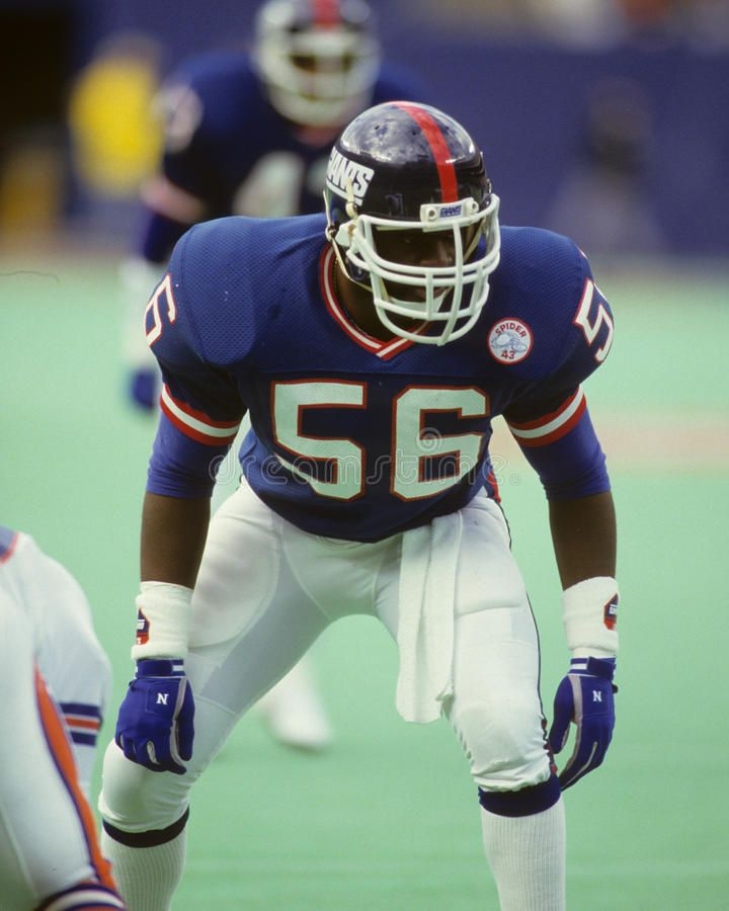
1999 Pro Football Hall of Fame Revisited Project Class.
Here we are! Again!!
If you have been following our Pro Football Hall of Fame Revisited Project, you know we have asked the question: What if the PFHOF had begun in January 1946?
After soliciting and obtaining a passionate group of football fans and historians, we sent out a ballot for a Preliminary Vote, in which each voter selected 25 names as their semi-finalists and five names for the Senior Pool.
We then asked the group to vote for their 15 Finalists in the Modern Era and 3 in the Senior Category. The final stage was to vote for their five Modern Era inductee and one Senior inductee.
This is the result of the 54th official class.
Below are the final results of this project based on 30 votes.
Remember that we have reverted back to the top five candidates entering the Hall in the Modern Era
This is for the “Modern Era”
*Bold indicates they have been elected to the Pro Football Hall of Fame Revisited Class of 1999:
|
Player |
Year of Eligibility |
Vote Total |
|
Lawrence Taylor LB |
1 |
29 |
|
Eric Dickerson RB |
1 |
21 |
|
Howie Long DE-NT |
1 |
17 |
|
Mike Munchak T |
1 |
15 |
|
Louis Wright DB |
8 |
12 |
|
L.C. Greenwood DE |
13 |
8 |
|
Ken Anderson QB |
8 |
6 |
|
Lester Hayes DB |
8 |
6 |
|
Billy “White Shoes” Johnson |
6 |
6 |
|
James Lofton WR |
1 |
6 |
|
Andre Tippett LB |
1 |
6 |
|
Cliff Harris DB |
15 |
5 |
|
Bob Griese QB |
14 |
4 |
|
Ken Stabler QB |
10 |
3 |
|
Drew Pearson WR |
11 |
2 |
|
Joe Klecko DE-NT |
6 |
2 |
This is for the “Senior Era”,
*Bold indicates they have been elected to the Pro Football Hall of Fame Revisited Class of 1999.
|
Dick Schafrath T-F-DE |
3 |
15 |
|
Alan Ameche FB |
14 |
5 |
|
Arch Ward CONTRIBUTOR |
10 |
5 |
|
Charlie Conerly QB |
13 |
2 |
|
None of the Above |
N/A |
3 |
This is for the “Coaches/Contributors”,
*Bold indicates they have been elected to the Pro Football Hall of Fame Revisited Class of 1999.
|
Bill Nunn (Scout) |
6 |
15 |
|
Ron Wolf: (Exec) |
1 |
5 |
|
Eddie Kotal (Scout) |
4 |
4 |
|
None of the Above |
N/A |
6 |
About the 1999 Inductees:
Lawrence Taylor, LB, NYG 1981-93: Inducted in the Pro Football Hall of Fame Revisited Project in 1999 on his 1st Ballot. Inducted into the actual Pro Football Hall of Fame in 1999.
There are a lot of great players who competed in the National Football League, though only a select few can be called legends. Only a few of those legends can be called game-changers. Let's meet Lawrence Taylor, one of the few who fits this description
Taylor played his entire career with the New York Giants, and his pass-rushing from the outside changed how defenses were built and how offenses had to react. He was a pioneer in chopping the ball from opponents' hands, and he became not just the face of the Giants, but defensive football. That is an icon!
L.T. was the second overall pick in 1981, and as a rookie, he won not only Defensive Rookie of the Year but also Defensive Player of the Year. This season began what was the most dominant six-year run by any Linebacker. From 1981 to 1986, Taylor was a perennial First Team All-Pro, a Pro Bowler, and never had an Approximate Value below 16. That last fact was especially incredible, considering he played only nine games in 1982, the year he won his second DPOY.
The climax of his career was 1986, when he led the NFL in Sacks with 20.5, won his third DPOY, and was also named the AP MVP, the PFWA MVP, and the Bert Bell Award. Taylor took his team to the Super Bowl, defeating the Denver Broncos. This sounds like a pretty good season, doesn’t it?
Taylor had two more First Team All-Pros after that and a second Super Bowl. Age and mileage caught up with him, and his last Pro Bowl came in 1990, but he played three more seasons, retiring in 1993. Taylor recorded 141 Sacks (132.5 official, since 1981 it wasn’t a stat yet) over his career, including a seven-year streak of double-digit numbers from 1984 to 1990.
As phenomenal as Taylor was a player, it can be argued that his drug use during his playing days hampered him from being even better. Can you imagine Taylor being even more dominant?
Eric Dickerson, RB, RAM 1983-87, IND 1987-91, RAI 1992 & ATL 1993: Inducted in the Pro Football Hall of Fame Revisited Project in 1999 on his 1st Ballot. Inducted into the actual Pro Football Hall of Fame in 1999.
Eric Dickerson made a spectacular debut in the NFL in 1983 with the Los Angeles Rams, quickly becoming one of the most formidable running backs in football history. As a rookie from SMU, his upright running style, distinctive goggles, and remarkable blend of size and speed captivated the league. He rushed for an incredible 1,808 yards and scored 18 touchdowns in his first season, earning the NFL Rookie of the Year award effortlessly. His immediate influence turned the Rams into playoff contenders instantly and set new standards for what a modern feature back could achieve.
The peak of Dickerson’s legendary career arrived just one year later, during a historic 1984 campaign that etched his name permanently into the NFL record books. Exhibiting a rare blend of fluid stride and explosive power, he terrorized opposing defenses for 16 consecutive weeks. On December 9, 1984, against the Houston Oilers, he broke O.J. Simpson's single-season rushing record. Dickerson finished the season with 2,105 rushing yards, a monumental milestone that has withstood decades of challengers and remains the gold standard for single-season rushing performances.
After a contract dispute, Dickerson was traded to the Indianapolis Colts in 1987 as part of a major three-team deal. The move initially didn't affect his performance, as he quickly energized the Colts and led them to their first playoff appearance since relocating to Indianapolis. In 1988, he became the first Colt since 1978 to win the NFL rushing title, with 1,659 yards. During his time with the Colts, he also became the fastest player in NFL history to reach 10,000 career rushing yards, accomplishing the milestone in just 91 games.
As injuries and heavy workloads took their toll, Dickerson spent his final two professional seasons with the Los Angeles Raiders and the Atlanta Falcons before retiring in 1993. Over his eleven-year career, he amassed 13,259 rushing yards, six Pro Bowl selections, and five First-Team All-Pro honors.
Howie Long, DE-NT, RAI 1981-93. Inducted in the Pro Football Hall of Fame Revisited Project in 1999 on his 1st Ballot. Inducted into the actual Pro Football Hall of Fame in 2000.
Howie Long anchored the Los Angeles Raiders' defensive line for 13 spectacular seasons, becoming one of the most feared and technically proficient defensive linemen of his era. Drafted in the second round of the 1981 NFL Draft out of Villanova, Long possessed a rare combination of explosive strength, relentless motor, and prototypical size. His versatility allowed him to dominate whether lining up as a defensive end in a 3-4 scheme or kicking inside to tackle on passing downs. His signature "rip" move and violent hands quickly made him the focal point of a ferocious Raiders defense that embodied the franchise's tough, renegade identity.
The apex of Long’s team success came in 1983, culminating in a dominant performance in Super Bowl XVIII. Throughout that championship campaign, Long was an unstoppable force, registering a career-high 13.0 sacks and earning the first of his eight Pro Bowl selections. In the Super Bowl against the heavily favored Washington Redskins, Long and the Raiders' defensive front relentlessly harassed quarterback Joe Theismann, holding Washington's high-powered offense to just 9 points in a 38-9 blowout. This definitive victory solidified Long's status as a premier superstar on football's grandest stage.
As the 1980s progressed, Long transitioned from a rising star into the veteran heartbeat of the Raiders organization. His individual brilliance earned consistent recognition from peers and talent evaluators, earning him First-Team All-Pro honors in three consecutive seasons from 1983 to 1985. He was also named the NFL Alumni Defensive Lineman of the Year twice. Long's ability to destroy opposing run games while maintaining a constant rush on the quarterback helped keep the Raiders in the postseason, bridging the gap through the franchise's transition into the early 1990s.
Injuries eventually began to slow his ironman pace, leading Long to retire after the 1993 season with 84.0 career sacks and a spot on the NFL 1980s All-Decade Team.
Mike Munchak, G, HOU, 1982-93. Inducted in the Pro Football Hall of Fame Revisited Project in 1999 on his 1st Ballot. Inducted into the actual Pro Football Hall of Fame in 2001.
Mike Munchak spent 12 seasons establishing himself as one of the most technically excellent and durable guards in NFL history. Drafted eighth overall in 1981 from Penn State, he combined exceptional lower-body strength, quick footwork, and relentless competitiveness. As a rookie, he quickly secured a starting role, providing stability and top-tier pass protection for an evolving Houston offense. His presence transformed the left side of the Oilers' line into an unbreakable barrier, raising the standard for interior blockers across the league.
In the late 1980s and early 1990s, Munchak established himself as the top offensive guard of his era, serving as a key player in Houston's renowned "Run and Shoot" offense. His exceptional agility enabled him to pull on sweep plays and make effective downfield blocks, contributing to quarterback Warren Moon's record-breaking passing game. His excellence was acknowledged through nine Pro Bowl selections and four First-Team All-Pro titles. Together with teammate Bruce Matthews, they formed perhaps the most formidable offensive guard-tackle partnership in history, guiding the Oilers to seven straight playoff berths.
Munchak’s remarkable consistency was characterized by his exceptional durability, overcoming chronic knee issues to participate in 159 regular-season games and start 156 of them. He was a master tactician who infrequently committed penalties or allowed sacks, employing leverage and precise hand placement to neutralize the league's most formidable interior pass rushers. His vigorous leadership and understated professionalism rendered him the unequivocal captain and the vital force of the locker room. Even as injuries increased towards the conclusion of his career, his distinguished performance remained unwavering, enabling him to retire at the zenith of his abilities following the 1993 season.
Louis Wright, CB, DEN 1975-86. Inducted in the Pro Football Hall of Fame Revisited Project in 1999 on his 8th Ballot. Was never inducted into the actual Pro Football Hall of Fame.
Wright anchored Denver’s defensive backfield for 12 years, establishing himself as one of the NFL's pioneering and most formidable "shutdown cornerbacks.’ Drafted 17th overall in the first round of the 1975 NFL Draft from San Jose State, he brought rare size, elite track-star speed, and exceptional toughness against the run. He quickly made a significant impact, earning All-Rookie honors, and rapidly stabilized the secondary to become the cornerstone of Denver’s renowned Orange Crush defense.
His national breakthrough came in 1977, when Wright contributed significantly to the Denver Broncos' 12–2 record and their first Super Bowl XII appearance. Throughout the late 1970s, he became a distinguished defensive player, earning three consecutive Pro Bowl selections from 1977 to 1979 and back-to-back First-Team All-Pro honors. Defensive coordinators from opposing teams routinely devised entire game strategies to circumvent passing to his side of the field, illustrating the formidable coverage capabilities that secured him a place on the NFL’s 1970s All-Decade Team.
Throughout the 1980s, Wright consistently stood out as a top playmaker and turned defensive stops into quick momentum swings. In 1983, he posted a personal best with six interceptions, and in 1984, he allowed just one touchdown pass all season. Besides his coverage skills, Wright made significant contributions on special teams and was a formidable threat when creating turnovers. His career highlights include a notable 27-yard fumble return for a touchdown during a snowstorm against Green Bay in 1984, as well as an exciting 60-yard return of a blocked field goal in overtime against San Diego in 1985.
Wright retired after the 1986 season, having guided the Broncos back to the big stage in Super Bowl XXI. Over his 12-year ironman career in Denver, he started 163 of 166 games, amassing 26 career interceptions and 11 fumble recoveries.
Dick Schafrath, T-DE, CLE 1959-71. Inducted in the Pro Football Hall of Fame Revisited Project in 1999 on his 1st Senior Ballot. Was never inducted into the actual Pro Football Hall of Fame.
Drafted in the second round (23rd overall) of the 1959 NFL Draft from Ohio State—where he served as captain of a national championship team—Dick Schafrath entered the professional arena in Cleveland as a formidable force. Throughout a 13-year career exclusively with the Browns, "The Mule" anchored left tackle with exceptional leverage and mobility, helping fuel one of football's most dominant rushing eras.
After transitioning to left tackle from defensive end in his second season, he quickly became the primary starter in 1960 and established himself as one of the league's premier offensive linemen. Throughout the 1960s, he earned four First-Team All-Pro honors (1963–1965, 1969) and was selected for seven Pro Bowls. In 1963, he was honored by his teammates with the title of Cleveland Browns' Most Valuable Player—a distinguished accolade rarely awarded to an offensive lineman.
His presence on the left side was crucial to Cleveland's historic rushing game; during his tenure, Browns running backs won eight NFL rushing titles, and Schafrath protected three future Hall of Famers: Jim Brown, Bobby Mitchell, and Leroy Kelly. His career peaked in 1964, when he anchored the offensive line in Cleveland's 27–0 victory over the Baltimore Colts to claim the 1964 NFL Championship.
Schafrath remained a dependable starter throughout the 1971 season, retiring with the team that drafted him after playing in 176 regular-season games for Cleveland.
Bill Nunn, Scout, PIT 1970-2014. Inducted in the Pro Football Hall of Fame Revisited Project in 1999 on his 6th Coach/Contributor Ballot. Inducted into the actual Pro Football Hall of Fame in 2021.
Bill Nunn revolutionized NFL personnel evaluation by opening a vital pipeline to Historically Black Colleges and Universities (HBCUs), transforming the Pittsburgh Steelers into a powerhouse. Initially a sports writer and managing editor for The Pittsburgh Courier, he developed deep relationships across southern Black colleges while compiling his annual Black College All-America team starting in 1950. Recognizing his unmatched knowledge of overlooked talent, Steelers owner Dan Rooney hired Nunn in 1968, a move that permanently reshaped professional football scouting.
His uncanny eye for talent became the driving force behind the Steelers' 1970s dynasty, which captured four Super Bowl titles in a six-year span. Nunn discovered legendary franchise cornerstones from HBCUs that other teams largely ignored, including future Hall of Fame defensive back Mel Blount and gems like safety Donnie Shell and defensive lineman L.C. Greenwood, establishing a championship core built on players other teams missed.
Nunn remained a fixture in the Steelers' front office for nearly five decades, serving as a trusted scout, advisor, and mentor until his passing in 2014. His meticulous evaluation methods became a blueprint for modern NFL personnel departments and helped bridge a significant racial gap in sports talent acquisition.
The Pro Football Hall of Fame Revisited Project: 1999 Semi-Final VOTE
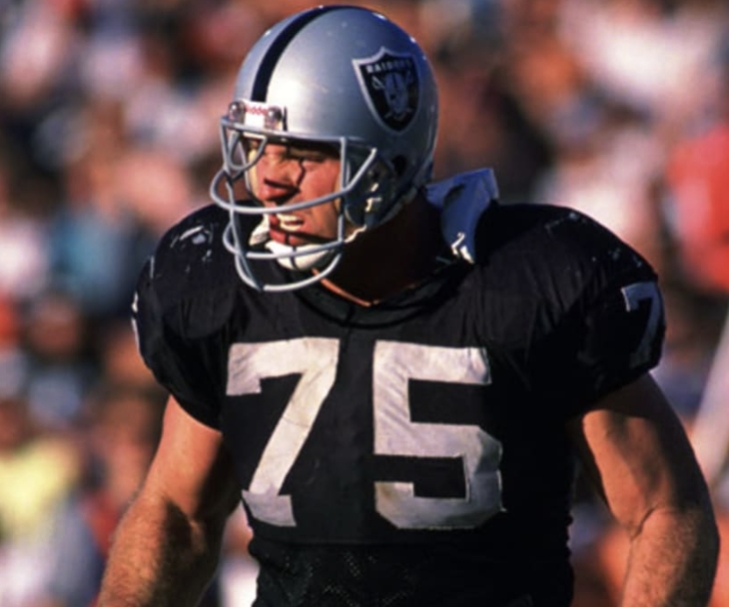
1999 SEMI-FINAL RESULTS:
Thank you for your participation in the Pro Football Hall of Fame Revisited Project. If you are unaware of what that is, we acted like the PFHOF had its first class in January 1946.
We have completed the years up to 1998.
For “1999,” a Preliminary Vote with nearly 100 players whose playing career ended by 1993. We also follow the structure in which players have 20 years of eligibility, and if they do not make it into the Hall, they are relegated to the Senior Pool.
Each voter was asked to select 25 names from the preliminary list, and the top 25 vote-getters were named Semi-Finalists.
A week later, the voters were asked to pick 15 names from the 25 Semi-Finalists, and next week, they will choose five from the remaining 15. We will continue this process every week until we catch up to the current year.
31 votes were cast, with the top 15 advancing.
This is for the “Modern Era”
Bold indicates they advanced to the Finals:
|
Player |
Year of Eligibility |
Vote Total |
|
Lawrence Taylor LB |
1 |
31 |
|
Eric Dickerson RB |
1 |
29 |
|
Howie Long DE-NT |
1 |
27 |
|
Mike Munchak G |
1 |
26 |
|
L.C. Greenwood DE |
13 |
24 |
|
James Lofton WR |
1 |
23 |
|
Louis Wright DB |
8 |
21 |
|
Cliff Harris S |
15 |
20 |
|
Bob Griese QB |
14 |
20 |
|
Andre Tippett LB |
1 |
20 |
|
Lester Hayes DB |
8 |
19 |
|
Ken Stabler QB |
10 |
17 |
|
Ken Anderson QB |
8 |
15 |
|
Billy “White Shoes” Johnson WR/R |
6 |
14 |
|
Drew Pearson WR |
11 |
13 |
|
Joe Klecko DE-NT |
6 |
13 |
|
Todd Christensen TE |
6 |
12 |
|
Roger Craig RB |
1 |
12 |
|
George Kunz T |
14 |
11 |
|
Otis Taylor WR-FL |
19 |
10 |
|
Joe Jacoby T |
1 |
10 |
|
Deron Cherry DB |
3 |
9 |
|
Lemar Parrish DB |
12 |
8 |
|
Ken Riley DB |
11 |
7 |
|
Jimbo Covert T |
4 |
5 |
This is for the “Senior Era”
*Bold indicates they advanced to the Finals:
|
Player |
Year of Eligibility |
Vote Total |
|
Dick Schafrath T-G-DE |
3 |
19 |
|
Charlie Conerly QB |
13 |
15 |
|
Alan Ameche FB |
14 |
12 |
|
Arch Ward CONTRIBUTOR |
10 |
12 |
|
Bobby Boyd DB |
6 |
10 |
|
Charles Bidwill OWNER |
10 |
9 |
|
None of the Above |
1 |
This is for the “Coaches/Contributors Era”
*Bold indicates they advanced to the Finals:
|
Player |
Year of Eligibility |
Vote Total |
|
SCOUT: Bill Nunn |
6 |
22 |
|
EXEC: Ron Wolf |
1 |
18 |
|
SCOUT: Eddie Kotal |
4 |
15 |
|
COACH: Tom Flores |
3 |
13 |
|
EXECUTIVE: Jim Finks |
11 |
7 |
|
None of the Above |
3 |
We will post the Class of 1999 Pro Football Hall of Fame Revisited Project next Saturday.
Thank you to all who contributed. If you want to be part of this project, please let us know!
The Pro Football Hall of Fame Revisited Project: 1999 Preliminary VOTE
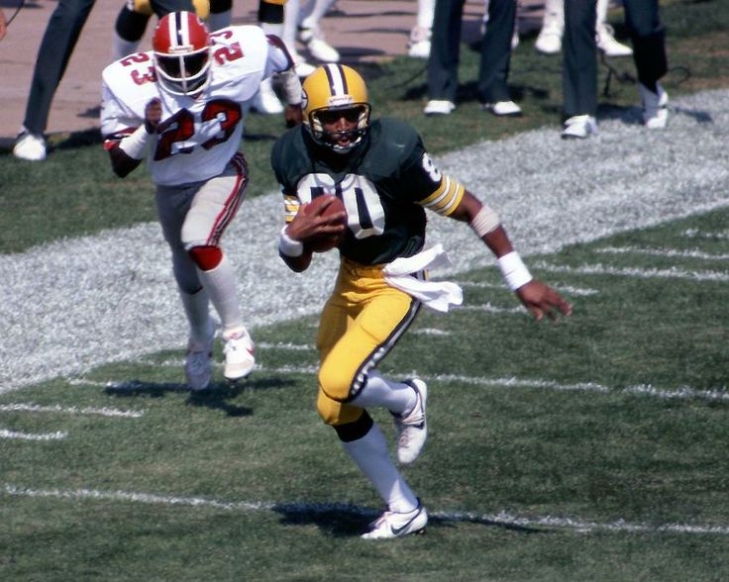
1999 PRELIMINARY RESULTS:
Thank you to all who participated in the Pro Football Hall of Fame Revisited Project. If you are still determining what that is, we treated the PFHOF as having its first class in January 1946.
We have completed the first 50 years.
For “1999,” a Preliminary Vote with over 100 players whose playing career ended by 1993. We also follow the structure in which players have 20 years of eligibility, and if they do not make it into the Hall, they are relegated to the Senior Pool.
Each voter was asked to select 25 names from the preliminary list, and the top 25 vote-getters were named Semi-Finalists.
A week later, voters will be asked to select 15 names from the 25 Semi-Finalists, then choose five from the remaining 15. We will continue this process every week until we catch up to the current year.
Please note that a significant change occurred “years ago,” allowing voters to submit fewer than the allotted number of spots.
31 Votes took place.
This is for the “Modern Era”
Bold indicates they advanced to the Semi-Finals:
*Indicates they have been removed from future ballots
|
Player |
Year of Eligibility |
Vote Total |
|
Lawrence Taylor LB |
1 |
28 |
|
Eric Dickerson RB |
1 |
26 |
|
James Lofton WR |
1 |
25 |
|
Howie Long DE-NT |
1 |
23 |
|
Mike Munchak G |
1 |
23 |
|
Andre Tippett LB |
1 |
19 |
|
Louis Wright DB |
8 |
18 |
|
Cliff Harris S |
15 |
16 |
|
L.C. Greenwood DE |
13 |
16 |
|
Drew Pearson WR |
11 |
15 |
|
Roger Craig RB |
1 |
15 |
|
Bob Griese QB |
14 |
14 |
|
George Kunz T |
14 |
14 |
|
Lemar Parrish DB |
12 |
14 |
|
Todd Christensen TE |
6 |
14 |
|
Ken Stabler QB |
10 |
13 |
|
Billy “White Shoes” Johnson |
6 |
13 |
|
Otis Taylor WR-FL |
19 |
12 |
|
Ken Riley DB |
11 |
12 |
|
Ken Anderson QB |
8 |
12 |
|
Joe Jacoby T |
1 |
12 |
|
Lester Hayes DB |
8 |
11 |
|
Joe Klecko DE |
6 |
11 |
|
Jimbo Covert T |
4 |
11 |
|
Deron Cherry DB |
3 |
11 |
|
Floyd Little RB |
19 |
10 |
|
Walt Sweeney G |
19 |
10 |
|
Curley Culp DT-NT |
13 |
9 |
|
Russ Francis TE |
5 |
9 |
|
Ottis Anderson RB |
2 |
9 |
|
Harold Carmichael WR |
10 |
8 |
|
Mark Gastineau DE |
6 |
8 |
|
Winston Hill T |
17 |
7 |
|
Jim Marshall DE |
15 |
7 |
|
Fred Dean DE |
9 |
7 |
|
Joey Browner DB |
2 |
7 |
|
Andy Russell LB |
18 |
6 |
|
Bill Bergey LB |
14 |
6 |
|
Harold Jackson WR |
11 |
6 |
|
Ed “Too Tall” Jones DE |
5 |
6 |
|
*Daryle Lamonica QB |
20 |
5 |
|
Jake Scott DB |
16 |
5 |
|
Bubba Baker DE |
4 |
5 |
|
Stanley Morgan WR |
4 |
5 |
|
Everson Walls DB |
1 |
5 |
|
Larry Brown RB |
18 |
4 |
|
Ed Budde G |
18 |
4 |
|
Doug Wilkerson G |
10 |
4 |
|
Ed White G |
9 |
4 |
|
Harry Carson LB |
6 |
4 |
|
Fred Smerlas NT |
2 |
4 |
|
Phil Simms QB |
1 |
4 |
|
*Cornell Green DB |
20 |
3 |
|
Lee Roy Jordan LB |
18 |
3 |
|
Ernie McMillan T |
18 |
3 |
|
Dick Anderson DB |
17 |
3 |
|
Pat Fischer CB |
17 |
3 |
|
Mike Curtis LB-FB |
16 |
3 |
|
Coy Bacon DE |
13 |
3 |
|
Chuck Foreman RB |
13 |
3 |
|
Jack Tatum DB |
14 |
3 |
|
Isiah Robertson LB |
12 |
3 |
|
Rick Upchurch WR/R |
11 |
3 |
|
Lyle Alzado DE |
9 |
3 |
|
Matt Blair LB |
9 |
3 |
|
Jeff Van Note C |
8 |
3 |
|
Nolan Cromwell DB |
7 |
3 |
|
Dennis Harrah G |
7 |
3 |
|
Randy Cross G-C |
6 |
3 |
|
Doug Williams QB |
5 |
3 |
|
Dexter Manley DE |
3 |
3 |
|
Roy Green WR |
3 |
3 |
|
Frank Minnifield DB |
2 |
3 |
|
Jay Hilgenberg C |
1 |
3 |
|
Gale Gillingham G-DT |
18 |
2 |
|
Jerry Smith TE |
17 |
2 |
|
Jim Bakken PK |
16 |
2 |
|
Ron McDole DE-DT |
16 |
2 |
|
Mike Wagner DB |
14 |
2 |
|
Mel Gray WR |
12 |
2 |
|
Bert Jones QB |
12 |
2 |
|
Harvey Martin DE |
11 |
2 |
|
Riley Odoms TE |
11 |
2 |
|
Gary Johnson DT |
9 |
2 |
|
Tom Jackson LB |
8 |
2 |
|
Dwight Clark WR |
7 |
2 |
|
Wes Chandler WR |
6 |
2 |
|
Neil Lomax QB |
6 |
2 |
|
Christian Okoye RB |
2 |
2 |
|
Mark Clayton WR |
1 |
2 |
|
Bill Fralic G |
1 |
2 |
|
John Niland G |
19 |
1 |
|
Roman Gabriel QB |
17 |
1 |
|
Ralph Neely T |
17 |
1 |
|
George Atkinson DB |
15 |
1 |
|
Lydell Mitchell RB |
14 |
1 |
|
Lawrence McCutchen RB |
13 |
1 |
|
Rich Saul C |
13 |
1 |
|
Billy Sims RB |
10 |
1 |
|
Joe Theismann QB |
9 |
1 |
|
Marvin Powell T |
7 |
1 |
|
Rulon Jones DE |
6 |
1 |
|
Dave Brown DB |
5 |
1 |
|
Hanford Dixon DB |
5 |
1 |
|
Mike Quick WR |
4 |
1 |
|
Keena Turner LB |
4 |
1 |
|
Curt Warner RB |
4 |
1 |
|
Raymond Clayborn DB |
3 |
1 |
|
Hugh Green LB |
3 |
1 |
|
Matt Millen LB |
3 |
1 |
|
James Brooks RB |
2 |
1 |
|
Michael Carter NT |
2 |
1 |
|
Freeman McNeil RB |
2 |
1 |
|
Neal Anderson RB |
1 |
1 |
|
Keith Millard DT-NT |
1 |
1 |
|
Steve Nelson LB |
7 |
0 |
|
Jerome Brown DT |
3 |
0 |
|
Joe Morris RB |
3 |
0 |
|
*Chip Banks LB |
2 |
0 |
|
*Bob Golic NT-DT-LB-DE |
2 |
0 |
|
*Jacob Green DE |
2 |
0 |
|
*Louis Lipps WR |
2 |
0 |
|
*Al Toon WR |
2 |
0 |
|
Dave Duerson DB |
1 |
0 |
|
David Fulcher DB |
1 |
0 |
|
Jerry Gray DB |
1 |
0 |
|
Drew Hill WR |
1 |
0 |
|
Bill Maas NT |
1 |
0 |
|
John Offerdahl LB |
1 |
0 |
This is for the Senior Era
Bold indicates they advanced to the Semi-Finals:
*Indicates that they will be removed from the ballot permanently.
|
Player |
Year |
Votes |
|
Alan Ameche FB |
14 |
8 |
|
Arch Ward CONTRIBUTOR |
10 |
8 |
|
Bobby Boyd DB |
6 |
8 |
|
Dick Schafrath T-G-DE |
3 |
8 |
|
Charlie Conerly QB |
13 |
7 |
|
Charles Bidwill OWNER |
10 |
7 |
|
Tank Younger FB-LB-HB |
16 |
6 |
|
Art Powell E |
6 |
6 |
|
Houston Antwine DT |
2 |
6 |
|
Billy Wilson FL-E |
14 |
5 |
|
Greasy Neale COACH |
10 |
5 |
|
Jim Ray Smith G-T |
10 |
5 |
|
Larry Grantham LB |
2 |
5 |
|
*Bruno Banducci G |
20 |
4 |
|
Dave Grayson DB |
4 |
4 |
|
Erich Barnes DB |
3 |
4 |
|
Rich Jackson DE |
2 |
4 |
|
Harlon Hill E-DB |
12 |
3 |
|
*Les Bingaman DG-G-C |
20 |
3 |
|
George Preston Marshall OWNER |
10 |
3 |
|
Dan Reeves OWNER |
10 |
3 |
|
Max McGee E |
7 |
3 |
|
Fuzzy Thurston G |
7 |
3 |
|
Jack Kemp QB |
5 |
3 |
|
Boyd Dowler FL-SE-LB |
3 |
3 |
|
Rosey Grier DT-DE |
8 |
2 |
|
Cookie Gilchrist FB |
7 |
2 |
|
Goose Gonsoulin DB |
6 |
2 |
|
Don Meredith QB |
6 |
2 |
|
George Saimes DB |
2 |
2 |
|
John Brodie QB |
1 |
2 |
|
Abner Haynes HB |
7 |
1 |
|
Jim Katcavage DE |
6 |
1 |
|
Butch Byrd DB |
3 |
1 |
|
*Clem Daniels HB-DB |
6 |
0 |
|
Babe Parilli QB |
5 |
0 |
|
*Howard Mudd G |
4 |
0 |
|
Carroll Dale WR-E |
1 |
0 |
|
Bob Jeter DB-WR |
1 |
0 |
|
Jim Nance RB-FB |
1 |
0 |
|
Mike Stratton LB |
1 |
0 |
This is for the “Coaches/Contributors”
Bold indicates they advanced to the Semi-Finals:
*Indicates that they will be removed from the ballot permanently.
|
Name |
Year |
Votes |
|
SCOUT: Bill Nunn |
6 |
16 |
|
COACH Tom Flores |
3 |
12 |
|
EXEC Ron Wolf |
1 |
11 |
|
SCOUT: Eddie Kotal |
4 |
10 |
|
EXEC: Jim Finks |
11 |
8 |
|
TV EXEC: Roone Arledge |
13 |
6 |
|
SCOUT : Jack Vainsi |
4 |
6 |
|
COACH: Buddy Ryan |
2 |
6 |
|
EXEC: George Young |
2 |
6 |
|
SCOUT: John Wooten |
4 |
5 |
|
EXEC: George Halas Jr. |
20 |
4 |
|
NARRATOR: John Facenda |
4 |
4 |
|
SCOUT: Lloyd Wells |
4 |
4 |
|
COACH: Chuck Knox |
3 |
4 |
|
OWNER: Bud Adams |
18 |
3 |
|
TV COMMENTATOR: Howard Cosell |
13 |
3 |
|
OWNER: Clint Murchison |
18 |
2 |
|
COACH: Bill Arnsbarger |
14 |
2 |
|
COACH: Bum Phillips |
12 |
2 |
|
OWNER: Art Modell |
14 |
1 |
|
OWNER: Jack Kent Cooke |
4 |
1 |
|
OWNER: William Clay Ford |
4 |
1 |
|
COACH: Jerry Glanville |
4 |
1 |
|
COACH: Richie Petitbon |
4 |
1 |
|
COACH: Lindy Infante |
11 |
0 |
|
COACH: John Robinson |
5 |
0 |
|
*COACH: Joe Collier |
4 |
0 |
|
*COACH: Tom Catlin |
2 |
0 |
|
*OWNER: Robert Irsay |
2 |
0 |
|
COACH: Zeke Bratkowski |
1 |
0 |
|
EXEC: Charley Casserly |
1 |
0 |
|
COACH: Wayne Fontes |
1 |
0 |
|
COACH: Rich Kotite |
1 |
0 |
|
COACH: Floyd Peters |
1 |
0 |
|
COACH: Joe Scannella |
1 |
0 |
Next week, we will announce the Semi-Finalists for the 1999 Pro Football Hall of Fame Revisited Project.
The Pro Football Hall of Fame Revisited Project: 1998 Final VOTE

1998 Pro Football Hall of Fame Revisited Project Class.
Here we are! Again!!
If you have been following our Pro Football Hall of Fame Revisited Project, you know we have asked the question: What if the PFHOF had begun in January 1946?
After soliciting and obtaining a passionate group of football fans and historians, we sent out a ballot for a Preliminary Vote, in which each voter selected 25 names as their semi-finalists and five names for the Senior Pool.
We then asked the group to vote for their 15 Finalists in the Modern Era and 3 in the Senior Category. The final stage was to vote for their five Modern Era inductee and one Senior inductee.
This is the result of the 53rd official class.
Below are the final results of this project based on 31 votes.
Remember that we have reverted back to the top five candidates entering the Hall in the Modern Era
This is for the “Modern Era”
*Bold indicates they have been elected to the Pro Football Hall of Fame Revisited Class of 1998:
|
Player |
Year of Eligibility |
Vote Total |
|
Anthony Munoz T |
1 |
27 |
|
Mike Singletary LB |
1 |
24 |
|
Dave Robinson LB |
19 |
15 |
|
Chris Hanburger LB |
15 |
10 |
|
Bob Kuechenberg G-T-C |
10 |
9 |
|
Cliff Branch WR |
8 |
9 |
|
Donnie Shell DB |
6 |
9 |
|
Louis Wright DB |
7 |
8 |
|
Bob Griese QB |
13 |
7 |
|
L.C. Greenwood DE |
12 |
6 |
|
Ken Stabler QB |
9 |
6 |
|
Lester Hayes DB |
7 |
6 |
|
Cliff Harris DB |
14 |
5 |
|
George Kunz T |
13 |
5 |
|
Ken Anderson QB |
7 |
4 |
|
Todd Christensen TE |
1 |
3 |
This is for the “Senior Era”,
*Bold indicates they have been elected to the Pro Football Hall of Fame Revisited Class of 1998.
|
Pat Harder FB |
20 |
17 |
|
Charlie Conerly QB |
12 |
6 |
|
Dick Schafrath T-F-DE |
2 |
4 |
|
None of the Above |
N/A |
4 |
This is for the “Coaches/Contributors”,
*Bold indicates they have been elected to the Pro Football Hall of Fame Revisited Class of 1998.
|
Don Shula (Coach) |
1 |
28 |
|
Bill Nunn (Scout) |
5 |
2 |
|
Eddie Kotal (Scout) |
3 |
2 |
|
None of the Above |
N/A |
2 |
About the 1998 Inductees:
Anthony Munoz, G-C, CIN 1981-91: Inducted in the Pro Football Hall of Fame Revisited Project in 1998 on his 1st Ballot. Inducted into the actual Pro Football Hall of Fame in 1992.
The 1980 Draft yielded three future Hall of Famers, and the Cincinnati Bengals, who had the third pick, took the best of them all that year, Anthony Munoz.
Two years earlier, Munoz had one of the best years that a college athlete could have, as he was a member of both the National Champions in Baseball and Football at USC. Football was where he was at his best, and he proceeded to become the best Offensive Lineman of the 1980s.
After being an All-Rookie, Munoz rattled off 11 straight Pro Bowls, and was a First Team All-Pro in nine of them, and was a Second Team Selection in the other two. Munoz was so dominant that the NFL Alumni Players Association named him the Lineman of the Year four times. While the Bengals have never won the Super Bowl, they made it to the game twice, and Munoz was without a doubt a reason for those AFC Championships. Nobody wearing the Bengals stripes worked harder in the weight room than he did, and as evidenced by his Man of the Year Award in 1991, no other athlete in Cincy gave as much back to the community. Notably, he was able to come off the line as an eligible receiver and had four Touchdown Receptions over his career. Munoz's last year was in 1992, which was beset by injuries and held him to eight Games. He attempted a return with Tampa Bay in 1993, but he was released before the season began. Munoz finished his career with 185 Games, starting all but one.
Munoz would enter the Pro Football Hall of Fame in his first year of eligibility in 1998, and he is also a member of the 1980s All-Decade, 75th Anniversary, and the 100th Anniversary Team. When the Bengals finally created a Ring of Honor in 2021, Munoz was naturally part of the first group.
Mike Singletary, DE-DT, CHI 1981-92: Inducted in the Pro Football Hall of Fame Revisited Project in 1998 on his 1st Ballot. Inducted into the actual Pro Football Hall of Fame in 1998.
Mike Singletary anchored the Chicago Bears' defense for 12 seasons from 1981 to 1992, redefining the middle linebacker position with his legendary intensity. Known as "Samurai Mike," his trademark wide-eyed stare at opposing quarterbacks became an iconic image of NFL film. As the crucial on-field general for defensive coordinator Buddy Ryan’s revolutionary "46 defense," Singletary coupled exceptional football intelligence with raw physicality, missing only two games in 179 career appearances due to his remarkable durability.
Selected 38th overall in the second round of the 1981 NFL Draft out of Baylor University, Singletary quickly asserted himself as the heartbeat of the franchise. He earned a spot on the NFL All-Rookie Team and rapidly evolved into a perennial powerhouse, securing 10 consecutive Pro Bowl selections from 1983 through his final season in 1992. His peers and coaches recognized his supreme positioning and tackling proficiency, voting him a First-Team All-Pro seven times and a Second-Team All-Pro once during a decade of absolute gridiron dominance.
The absolute pinnacle of his career arrived during the historic 1985 season, where he commanded what many consider the greatest single-season defense in NFL history. Singletary recorded 109 solo tackles, three sacks, and three fumble recoveries that year, winning his first Associated Press NFL Defensive Player of the Year award. He then led the Bears through a dominant playoff run, culminating in a 46-10 victory over the New England Patriots in Super Bowl XX, where he tied a Super Bowl record by recovering two fumbles.
Singletary retired after the 1992 season, leaving a legacy built on 1,488 career tackles, 19 sacks, and seven interceptions. He won his second AP NFL Defensive Player of the Year award in 1988 and was later named to the NFL’s 1980s All-Decade Team. His post-playing career included a notable transition to coaching, highlighted by a stint as head coach of the San Francisco 49ers from 2008 to 2010. His immense impact on the sport was forever immortalized with his first-ballot induction into the Pro Football Hall of Fame in 1998.
Dave Robinson, LB, GNB 1963-72 & WAS 1973-74. Inducted in the Pro Football Hall of Fame Revisited Project in 1998 on his 19th Ballot. Inducted into the actual Pro Football Hall of Fame in 2013.
Dave Robinson built a legendary 12-year professional football career as one of the premier outside linebackers of his era, playing for the Green Bay Packers (1963–1972) and the Washington Redskins (1973–1974). Selected 14th overall in the first round of the 1963 NFL Draft out of Penn State, he was converted from a collegiate defensive lineman into a linebacker by Hall of Fame head coach Vince Lombardi. Standing 6'3" and weighing 245 pounds, Robinson possessed a rare blend of massive strength and elite agility, making him a prototype for the modern outside linebacker and a foundational piece of the Packers' 1960s dynasty.
As the starting left outside linebacker in Green Bay, Robinson teamed up with middle linebacker Ray Nitschke and right linebacker Lee Roy Caffey to form one of the most dominant linebacking corps in NFL history. He acted as a virtually impenetrable force against the run while proving equally lethal in pass coverage, intercepting 21 passes during his ten seasons with the Packers. His clutch defensive instincts famously sealed the 1966 NFL Championship when he pressured Dallas Cowboys quarterback Don Meredith into a game-ending interception, clearing the path for Green Bay to win Super Bowl I. In total, Robinson helped pilot the franchise to three consecutive NFL Championships (1965–1967) and victories in both Super Bowl I and Super Bowl II.
Over his 155 career regular-season games, Robinson accumulated 27 interceptions, 12 fumble recoveries, and 28.5 sacks. He was voted to three Pro Bowls (1966, 1967, 1969), named a First-Team All-Pro in 1967, and earned a spot on the prestigious NFL 1960s All-Decade Team. After a decade in Green Bay, he wrapped up his career with two productive seasons under George Allen in Washington, notably grabbing four interceptions in 1973. For his pioneering play and immense impact on the game.
Chris Hanburger, LB, WAS, 1965-78. Inducted in the Pro Football Hall of Fame Revisited Project in 1998 on his 15th Ballot. Inducted into the actual Pro Football Hall of Fame in 2011.
Chris Hanburger spent his entire 14-year professional football career playing linebacker for Washington from 1965 to 1978. Entering the league as an unheralded 18th-round pick out of North Carolina in the 1965 NFL Draft, he defied his low draft position to become one of the franchise's greatest draft steals. Despite playing at a relatively light weight of around 215 pounds, Hanburger earned the fearsome nickname "The Hangman" for his signature, bone-jarring clothesline tackles, which were a legal and highly effective method of stopping ball carriers during his era.
Hanburger quickly established himself as a premier defensive playmaker, earning his first of nine Pro Bowl selections in just his second season. Renowned for his exceptional speed and tactical intellect, he possessed a rare ability to diagnose offensive plays before the snap. When legendary head coach George Allen arrived in Washington, he designated Hanburger as the defensive signal-caller and undisputed captain of the famous "Over-the-Hill Gang" defense, trusting him completely to position the unit on the field.
The peak of Hanburger's career came in 1972, when his masterful leadership guided Washington to an 11-3 regular-season record and an appearance in Super Bowl VII. That year, he tied for the team lead with a career-high four interceptions, including one returned for a touchdown against Joe Namath and the New York Jets. His dominant play throughout the season earned him NFC Defensive Player of the Year honors from the NFL 101 Club, cementing his status among the game’s elite defenders.
By the time he retired before the 1979 season, Hanburger had earned five First-Team All-Pro honors and nine Pro Bowl nods, a total that remains the most by any player in Washington franchise history. Over his 187 career games, which included a remarkable streak of 135 consecutive starts, he recorded 19 interceptions and returned three fumbles for touchdowns
Bob Kuechnerberg, G-T-C, MIA 1970-83. Inducted in the Pro Football Hall of Fame Revisited Project in 1998 on his 10th Ballot. Was never inducted into the actual Pro Football Hall of Fame.
Bob Kuechenberg anchored the interior offensive line for the Miami Dolphins for 14 seasons from 1970 to 1983, establishing himself as one of the most resilient and impactful guards of his era. Drafted by the Philadelphia Eagles in 1969 out of Notre Dame, he left the team during training camp and spent a year playing semi-pro football for the Chicago Owls. Dolphins head coach Don Shula signed him as a free agent in 1970, instantly slotting him into a powerhouse offense where his fierce competitive drive and technical blocking skills became legendary.
As a primary driving force behind Miami's dominant run game, Kuechenberg paved the way for Hall of Fame fullback Larry Csonka and running back Mercury Morris. He started every game for the historic 1972 undefeated team that went 17-0, famously playing through the postseason with a broken arm protected by a special cast. He secured back-to-back championships with victories in Super Bowl VII and Super Bowl VIII, completely neutralizing Minnesota Vikings Hall of Fame defensive tackle Alan Page in the latter game.
Kuechenberg earned six Pro Bowl selections between 1974 and 1983, a testament to his sustained excellence across two different decades. He earned First-Team All-Pro honors in 1978 and was named a Second-Team All-Pro twice, consistently ranking among the premier offensive linemen in football. His versatile talent allowed him to seamlessly shift positions when injuries struck the roster, starting games at both tackle and center without a drop in his performance.
By the time he retired after the 1983 season, Kuechenberg had played in 196 regular-season games and appeared in four Super Bowls, including Super Bowl XVII and Super Bowl XIX. He ranks fourth in Dolphins history for total games played and was inducted into the Miami Dolphins Honor Roll in 1995.
Cliff Branch, WR, OAK-RAI 1972-85. Inducted in the Pro Football Hall of Fame Revisited Project in 1998 on his 8th Ballot. Inducted into the actual Pro Football Hall of Fame in 2022.
Cliff Branch spent his entire 14-year professional football career playing wide receiver for the Raiders from 1972 to 1985. Drafted in the fourth round out of the University of Colorado, he brought world-class speed to the gridiron, having set an NCAA championship record with a 10-second 100-meter dash. This blistering pace perfectly aligned with owner Al Davis' offensive philosophy, transforming Branch into one of the most feared vertical threats of his generation and redefining how NFL offenses attacked deep coverage.
His breakout campaign occurred during his third season in 1974, when he dominated the league by pulling in 60 catches for an NFL-high 1,092 receiving yards and 13 touchdowns. He captured another league-leading milestone in 1976 by catching 12 touchdowns while averaging an astonishing 24.2 yards per reception. Over a dominant stretch from 1974 to 1978, his precise deep routes and dynamic playmaking earned him four consecutive Pro Bowl selections and three straight First-Team All-Pro honors.
Branch was at his absolute best when the lights were brightest, serving as a cornerstone for three Raiders championship teams. He caught two critical touchdowns in Super Bowl XV against the Philadelphia Eagles and added another score in Super Bowl XVIII against the Washington Redskins. When he retired, his 73 receptions and 1,289 receiving yards over 22 postseason appearances stood as NFL playoff records, cementing his reputation as a clutch big-game performer.
By the end of his career in 1985, Branch had accumulated 501 receptions for 8,685 yards and 67 touchdowns. His career average of 17.3 yards per catch highlighted his big-play ability, which included a historic 99-yard touchdown reception from Jim Plunkett in 1983.
Donnie Shell, DB, PIT 1974-87. Inducted in the Pro Football Hall of Fame Revisited Project in 1998 on his 6th Ballot. Inducted into the actual Pro Football Hall of Fame in 2020.
Donnie Shell played 14 exceptional seasons as a safety for the Pittsburgh Steelers from 1974 to 1987, anchoring the secondary of the legendary Steel Curtain defense. Despite going undrafted out of South Carolina State in 1974, he signed as a free agent and quickly earned a roster spot through his relentless work ethic and fierce special teams play. His intimidating, hard-hitting tackling style coupled with elite coverage skills soon made him an indispensable component of Pittsburgh's defensive dynasty.
As a foundational contributor to the Steelers' historic success, Shell helped pilot the franchise to four Super Bowl victories (IX, X, XIII, and XIV) during the 1970s. Originally a backup, he took over as a full-time starting strong safety in 1977 and immediately elevated the defense's dynamic playmaking. Over his career, he formed a devastating tandem with fellow Hall of Fame defensive backs Mel Blount and Mike Wagner, making the deep middle of the field a danger zone for opposing wide receivers.
Shell's individual brilliance earned him widespread recognition as one of the premier safeties of his generation, resulting in five consecutive Pro Bowl selections from 1978 to 1982. He secured First-Team All-Pro honors three times (1979, 1980, and 1982) and was named a Second-Team All-Pro in 1981. Known for his incredible durability and consistency, he appeared in 201 regular-season games, which ranks among the most in franchise history, and recorded a remarkable streak of 11 consecutive seasons with at least three interceptions.
By the time he retired after the 1987 season, Shell had compiled an astonishing stat line that included 51 career interceptions, making him the first strong safety in NFL history to surpass the 50-interception milestone. He also recovered 19 fumbles and scored two defensive touchdowns while demonstrating unmatched locker room leadership as a multi-year team captain.
Pat Harder FB, CRD 1946-50 & DET 1951-53. Inducted in the Pro Football Hall of Fame Revisited Project in 1998 on his 20th Senior Ballot. Was never inducted into the actual Pro Football Hall of Fame.
The 1944 2nd Overall Draft Pick from the University of Wisconsin, Pat Harder, lived up to the hype. He helped the Chicago Cardinals win the 1947 NFL Championship and was selected for the First Team All-Pro for three consecutive years.
Playing at fullback and also serving as the Cardinals’ place kicker, Harder became the first player in NFL history to exceed 100 points in three straight years (1947-49). Blessed with power and speed, Harder had soft receiving hands and accumulated 3,880 yards from scrimmage over eight seasons, a decent number for his time. Harder was named the MVP by UPI in 1948, and his overall accomplishments earned him a spot on the 1940s All-Decade Team.
Harder's success continued into the 1950s, as he went to the Pro Bowl in 1950. He then joined the Detroit Lions for his final three years, where he helped them win the NFL Championship in both 1952 and 1953 and was a Pro Bowler in the first of those two years.
Don Shula, COACH, BAL 1963-69 & MIA 1970-95. Inducted in the Pro Football Hall of Fame Revisited Project in 1998 on his 1st Coach/Contributor Ballot. Inducted into the actual Pro Football Hall of Fame in 1997.
Don Shula crafted the most successful coaching career in National Football League history, spanning 33 seasons with the Baltimore Colts and Miami Dolphins from 1963 to 1995. Before stalking the sidelines, he played seven seasons as a defensive back in the NFL, which helped shape his masterful understanding of the game. Shula became the ultimate standard of coaching excellence, leading his teams to a record 347 total victories, 19 postseason appearances, and six Super Bowl appearances while remarkably enduring only two losing seasons in over three decades.
After a successful stint as the head coach of the Colts, where he reached Super Bowl III, Shula joined the Miami Dolphins in 1970 and immediately transformed the young franchise into a powerhouse. His meticulous preparation and adaptability quickly paid off as he guided the Dolphins to three consecutive Super Bowl appearances from 1971 to 1973. The absolute pinnacle of his career came during the historic 1972 season, when he coached Miami to a perfect 17-0 record, culminating in a victory in Super Bowl VII. This remains the only undefeated and untied season in modern NFL history.
Shula won back-to-back titles with a victory in Super Bowl VIII, establishing a heavy run-first philosophy behind a dominant offensive line. However, his true genius lay in his ability to completely reinvent his team’s identity based on his roster's strengths. In the 1980s, Shula seamlessly transitioned the Dolphins from a ground-and-pound juggernaut into a high-flying aerial circus centered around legendary quarterback Dan Marino. This strategic shift led Miami to two more Super Bowl appearances in 1982 and 1984, proving Shula could win in any era with any style of play.
When Shula retired after the 1995 season, he stood alone at the top of the football world with 328 regular-season wins and 19 postseason triumphs. He was named the Associated Press NFL Coach of the Year four times and was later selected to the NFL 100th Anniversary All-Time Team.
The Pro Football Hall of Fame Revisited Project: 1998 Semi-Final VOTE

1998 SEMI-FINAL RESULTS:
Thank you for your participation in the Pro Football Hall of Fame Revisited Project. If you are unaware of what that is, we acted like the PFHOF had its first class in January 1946.
We have completed the years up to 1997.
For “1998,” a Preliminary Vote with nearly 100 players whose playing career ended by 1992. We also follow the structure in which players have 20 years of eligibility, and if they do not make it into the Hall, they are relegated to the Senior Pool.
Each voter was asked to select 25 names from the preliminary list, and the top 25 vote-getters were named Semi-Finalists.
A week later, the voters were asked to pick 15 names from the 25 Semi-Finalists, and next week, they will choose five from the remaining 15. We will continue this process every week until we catch up to the current year.
31 votes were cast, with the top 15 advancing.
This is for the “Modern Era”
Bold indicates they advanced to the Finals:
|
Player |
Year of Eligibility |
Vote Total |
|
Anthony Munoz T |
1 |
30 |
|
Mike Singletary LB |
1 |
29 |
|
Dave Robinson LB |
19 |
22 |
|
Chris Hanburger LB |
15 |
22 |
|
Donnie Shell DB |
6 |
21 |
|
L.C. Greenwood DE |
12 |
20 |
|
Bob Kuechenberg G-T-C |
10 |
20 |
|
Bob Griese QB |
13 |
19 |
|
Cliff Branch WR |
8 |
19 |
|
Louis Wright DB |
7 |
19 |
|
Ken Anderson QB |
7 |
17 |
|
Ken Stabler QB |
10 |
16 |
|
Lester Hayes DB |
7 |
15 |
|
Cliff Harris S |
14 |
14 |
|
George Kunz T |
13 |
13 |
|
Todd Christensen TE |
5 |
13 |
|
Mark Gastineau DE |
5 |
11 |
|
Billy “White Shoes” Johnson WR/R |
5 |
11 |
|
Joe Klecko DE-NT |
5 |
11 |
|
Jimbo Covert T |
3 |
11 |
|
Walt Sweeney G |
18 |
10 |
|
Lemar Parrish DB |
11 |
10 |
|
Ken Riley DB |
10 |
10 |
|
Otis Taylor WR-FL |
18 |
9 |
|
Drew Pearson WR |
10 |
7 |
|
Jim Marshall DE |
14 |
4 |
This is for the “Senior Era”
*Bold indicates they advanced to the Finals:
|
Player |
Year of Eligibility |
Vote Total |
|
Pat Harder FB |
20 |
17 |
|
Dick Shafrath T-G-DE |
2 |
15 |
|
Charlie Conerly QB |
12 |
13 |
|
Arch Ward CONTRIBUTOR |
9 |
12 |
|
Alan Ameche FB |
13 |
11 |
|
Art Powell E |
5 |
9 |
|
None of the Above |
1 |
This is for the “Coaches/Contributors Era”
*Bold indicates they advanced to the Finals:
|
Player |
Year of Eligibility |
Vote Total |
|
COACH: Don Shula |
1 |
30 |
|
SCOUT: Bill Nunn |
5 |
13 |
|
SCOUT: Eddie Kotal |
3 |
13 |
|
COACH: Tom Flores |
2 |
10 |
|
EXECUTIVE: Jim Finks |
9 |
8 |
|
COACH: Chuck Knox |
2 |
8 |
|
None of the Above |
0 |
We will post the Class of 1998 Pro Football Hall of Fame Revisited Project next Saturday.
Thank you to all who contributed. If you want to be part of this project, please let us know!
The Pro Football Hall of Fame Revisited Project: 1998 Preliminary VOTE

1998 PRELIMINARY RESULTS:
Thank you to all who participated in the Pro Football Hall of Fame Revisited Project. If you are still determining what that is, we treated the PFHOF as having its first class in January 1946.
We have completed the first 50 years.
For “1998,” a Preliminary Vote with over 100 players whose playing career ended by 1992. We also follow the structure in which players have 20 years of eligibility, and if they do not make it into the Hall, they are relegated to the Senior Pool.
Each voter was asked to select 25 names from the preliminary list, and the top 25 vote-getters were named Semi-Finalists.
A week later, voters will be asked to select 15 names from the 25 Semi-Finalists, then choose five from the remaining 15. We will continue this process every week until we catch up to the current year.
Please note that a significant change occurred “years ago,” allowing voters to submit fewer than the allotted number of spots.
32 Votes took place.
This is for the “Modern Era”
Bold indicates they advanced to the Semi-Finals:
*Indicates they have been removed from future ballots
|
Player |
Year of Eligibility |
Vote Total |
|
Anthony Munoz T |
1 |
30 |
|
Mike Singletary LB |
1 |
27 |
|
L.C. Greenwood DE |
12 |
23 |
|
Dave Robinson LB |
19 |
21 |
|
Chris Hanburger LB |
15 |
21 |
|
Bob Kuechenberg G-T-C |
10 |
21 |
|
Cliff Branch WR |
8 |
21 |
|
Louis Wright DB |
7 |
19 |
|
Lester Hayes DB |
7 |
18 |
|
Donnie Shell DB |
6 |
18 |
|
Joe Klecko DE |
5 |
18 |
|
Bob Griese QB |
13 |
17 |
|
Ken Stabler QB |
9 |
17 |
|
Ken Anderson QB |
7 |
17 |
|
Lemar Parrish DB |
11 |
16 |
|
Otis Taylor WR-FL |
18 |
14 |
|
Cliff Harris S |
14 |
14 |
|
George Kunz T |
13 |
14 |
|
Jim Marshall DE |
14 |
13 |
|
Drew Pearson WR |
10 |
13 |
|
Ken Riley DB |
10 |
13 |
|
Todd Christensen TE |
5 |
12 |
|
Walt Sweeney G |
18 |
11 |
|
Mark Gastineau DE |
5 |
11 |
|
Billy “White Shoes” Johnson |
5 |
11 |
|
Jimbo Covert T |
3 |
11 |
|
Deron Cherry DB |
2 |
10 |
|
Curley Culp DT-NT |
12 |
9 |
|
Fred Dean DE |
8 |
9 |
|
Russ Francis TE |
5 |
9 |
|
Ottis Anderson RB |
1 |
9 |
|
Stanley Morgan WR |
3 |
8 |
|
Joey Browner DB |
1 |
8 |
|
*Larry Grantham LB |
20 |
7 |
|
Andy Russell LB |
17 |
7 |
|
Winston Hill T |
16 |
7 |
|
Harold Jackson WR |
10 |
7 |
|
Matt Blair LB |
8 |
7 |
|
Ed “Too Tall” Jones DE |
4 |
7 |
|
Bill Bergey LB |
13 |
6 |
|
Dexter Manley DE |
2 |
6 |
|
Ed Budde G |
17 |
5 |
|
Pat Fischer CB |
16 |
5 |
|
Rick Upchurch WR/R |
10 |
5 |
|
Doug Wilkerson G |
9 |
5 |
|
Nolan Cromwell DB |
6 |
5 |
|
Harry Carson LB |
5 |
5 |
|
Fred Smerlas NT |
1 |
5 |
|
*John Brodie QB |
20 |
4 |
|
Floyd Little RB |
18 |
4 |
|
Ernie McMillan T |
17 |
4 |
|
Jerry Smith TE |
16 |
4 |
|
Coy Bacon DE |
12 |
4 |
|
Harvey Martin DE |
10 |
4 |
|
Harold Carmichael WR |
9 |
4 |
|
Lyle Alzado DE |
8 |
4 |
|
Dwight Clark WR |
6 |
4 |
|
Randy Cross G-C |
5 |
4 |
|
Bubba Baker DE |
3 |
4 |
|
Jerome Brown DT |
2 |
4 |
|
*Mike Stratton LB |
20 |
3 |
|
Daryle Lamonica QB |
19 |
3 |
|
Larry Brown RB |
17 |
3 |
|
Dick Anderson DB |
16 |
3 |
|
Chuck Foreman RB |
13 |
3 |
|
Jack Tatum DB |
13 |
3 |
|
Billy Sims RB |
9 |
3 |
|
Joe Theismann QB |
8 |
3 |
|
Ed White G |
8 |
3 |
|
Dennis Harrah G |
6 |
3 |
|
Marvin Powell T |
6 |
3 |
|
*Carroll Dale WR-E |
20 |
2 |
|
*Jim Nance RB-FB |
20 |
2 |
|
Cornell Green DB |
19 |
2 |
|
John Niland G |
18 |
2 |
|
Roman Gabriel QB |
16 |
2 |
|
Jim Bakken PK |
15 |
2 |
|
Jake Scott DB |
15 |
2 |
|
George Atkinson DB |
14 |
2 |
|
Mike Wagner DB |
13 |
2 |
|
Riley Odoms TE |
10 |
2 |
|
Billy Sims RB |
9 |
2 |
|
Hanford Dixon DB |
4 |
2 |
|
Doug Williams QB |
4 |
2 |
|
Michael Carter NT |
1 |
2 |
|
Frank Minnifield DB |
1 |
2 |
|
*Bob Jeter DB-WR |
20 |
1 |
|
Gale Gillingham G-DT |
17 |
1 |
|
Lee Roy Jordan LB |
17 |
1 |
|
Ralph Neely T |
16 |
1 |
|
Mike Curtis LB-FB |
15 |
1 |
|
Ron McDole DE-DT |
15 |
1 |
|
Lawrence McCutchen RB |
12 |
1 |
|
Rich Saul C |
12 |
1 |
|
Isiah Robertson LB |
11 |
1 |
|
Gary Johnson DT |
8 |
1 |
|
Tom Jackson LB |
7 |
1 |
|
Jeff Van Note C |
7 |
1 |
|
Steve Nelson LB |
6 |
1 |
|
Wes Chandler WR |
5 |
1 |
|
Dave Brown DB |
4 |
1 |
|
Mike Quick WR |
3 |
1 |
|
Keena Turner LB |
3 |
1 |
|
Raymond Clayborn DB |
2 |
1 |
|
Hugh Green LB |
2 |
1 |
|
Matt Millen LB |
2 |
1 |
|
Joe Morris RB |
2 |
1 |
|
Bob Golic NT-DT-LB-DE |
1 |
1 |
|
Roy Green WR |
1 |
1 |
|
Lydell Mitchell RB |
13 |
0 |
|
Mel Gray WR |
11 |
0 |
|
Bert Jones QB |
11 |
0 |
|
Rulon Jones DE |
5 |
0 |
|
Neil Lomax QB |
5 |
0 |
|
Curt Warner RB |
3 |
0 |
|
*Eddie Brown WR |
2 |
0 |
|
*Gerald Riggs RB |
2 |
0 |
|
Chip Banks LB |
1 |
0 |
|
James Brooks RB |
1 |
0 |
|
Jacob Green DE |
1 |
0 |
|
Louis Lipps WR |
1 |
0 |
|
Freeman McNeil RB |
1 |
0 |
|
Christian Okoye RB |
1 |
0 |
|
Al Toon WR |
1 |
0 |
This is for the Senior Era
Bold indicates they advanced to the Semi-Finals:
*Indicates that they will be removed from the ballot permanently.
|
Player |
Year |
Votes |
|
Pat Harder FB |
20 |
12 |
|
Arch Ward CONTRIBUTOR |
9 |
10 |
|
Charlie Conerly QB |
12 |
9 |
|
Dick Schafrath T-G-DE |
2 |
9 |
|
Alan Ameche FB |
13 |
7 |
|
Art Powell E |
5 |
7 |
|
Bobby Boyd DB |
5 |
6 |
|
Tank Younger FB-LB-HB |
15 |
5 |
|
Charles Bidwill OWNER |
9 |
5 |
|
Cookie Gilchrist FB |
6 |
5 |
|
Billy Wilson FL-E |
13 |
4 |
|
Greasy Neale COACH |
9 |
4 |
|
Max McGee E |
6 |
4 |
|
Jack Kemp QB |
4 |
4 |
|
Boyd Dowler FL-SE-LB |
2 |
4 |
|
Houston Antwine DT |
1 |
4 |
|
Rich Jackson DE |
1 |
4 |
|
Bruno Banducci G |
19 |
3 |
|
Harlon Hill E-DB |
11 |
3 |
|
George Preston Marshall OWNER |
9 |
3 |
|
Dan Reeves OWNER |
9 |
3 |
|
Rosey Grier DT-DE |
6 |
3 |
|
Fuzzy Thurston G |
6 |
3 |
|
Dave Grayson DB |
3 |
3 |
|
Larry Grantham LB |
1 |
3 |
|
*Bill Fischer T-G-DT |
20 |
2 |
|
Goose Gonsoulin DB |
6 |
2 |
|
Erich Barnes DB |
2 |
2 |
|
Butch Byrd DB |
2 |
2 |
|
Jim Ray Smith G-T |
9 |
1 |
|
Abner Haynes HB |
6 |
1 |
|
Don Meredith QB |
5 |
1 |
|
Babe Parilli QB |
4 |
1 |
|
Howard Mudd G |
3 |
1 |
|
Les Bingaman DG-G-C |
19 |
0 |
|
*Leon Hart E-FB-DE |
16 |
0 |
|
Clem Daniels HB-DB |
5 |
0 |
|
Jim Katcavage DE |
5 |
0 |
|
George Saimes DB |
1 |
0 |
This is for the “Coaches/Contributors”
Bold indicates they advanced to the Semi-Finals:
*Indicates that they will be removed from the ballot permanently.
|
Name |
Year |
Votes |
|
COACH: Don Shula |
1 |
28 |
|
SCOUT: Bill Nunn |
5 |
13 |
|
SCOUT: Eddie Kotal |
3 |
12 |
|
COACH Tom Flores |
2 |
10 |
|
EXEC: Jim Finks |
9 |
8 |
|
COACH: Chuck Knox |
2 |
8 |
|
SCOUT: John Wooten |
3 |
6 |
|
SCOUT: Lloyd Wells |
3 |
6 |
|
TV EXEC: Roone Arledge |
12 |
5 |
|
TV COMMENTATOR: Howard Cosell |
12 |
5 |
|
EXEC: George Young |
1 |
5 |
|
NARRATOR: John Facenda |
3 |
4 |
|
OWNER: Jack Kent Cooke |
3 |
3 |
|
SCOUT : Jack Vainsi |
3 |
3 |
|
EXEC: George Halas Jr. |
19 |
2 |
|
OWNER: Bud Adams |
17 |
2 |
|
OWNER: Clint Murchison |
17 |
2 |
|
OWNER: Art Modell |
13 |
2 |
|
COACH: Bum Phillips |
11 |
2 |
|
COACH: Joe Collier |
3 |
2 |
|
COACH: Buddy Ryan |
1 |
2 |
|
COACH: Bill Arnsbarger |
12 |
1 |
|
COACH: John Robinson |
4 |
1 |
|
COACH: Lindy Infante |
9 |
0 |
|
OWNER: William Clay Ford |
3 |
0 |
|
COACH: Jerry Glanville |
3 |
0 |
|
COACH: Richie Petitbon |
3 |
0 |
|
*COACH: John Sandusky |
2 |
0 |
|
*COACH: Tom Walsh |
2 |
0 |
|
*COACH: Woody Widenhofer |
2 |
0 |
|
COACH: Tom Catlin |
1 |
0 |
|
OWNER: Robert Irsay |
1 |
0 |
Next week, we will announce the Semi-Finalists for the 1998 Pro Football Hall of Fame Revisited Project.
The Pro Football Hall of Fame Revisited Project: 1997 Final VOTE

1997 Pro Football Hall of Fame Revisited Project Class.
Here we are! Again!!
If you have been following our Pro Football Hall of Fame Revisited Project, you know we have asked the question: What if the PFHOF had begun in January 1946?
After soliciting and obtaining a passionate group of football fans and historians, we sent out a ballot for a Preliminary Vote, in which each voter selected 25 names as their semi-finalists and five names for the Senior Pool. We then asked the group to vote for their 15 Finalists in the Modern Era and 3 in the Senior Category. The final stage was to vote for their five Modern Era inductee and one Senior inductee.
This is the result of the 52nd official class.
Below are the final results of this project based on 31 votes.
Remember that we have reverted back to the top five candidates entering the Hall in the Modern Era
This is for the “Modern Era”
*Bold indicates they have been elected to the Pro Football Hall of Fame Revisited Class of 1997:
|
Player |
Year of Eligibility |
Vote Total |
|
Russ Grimm G-C |
1 |
21 |
|
Dan Hampton DE-DT |
2 |
20 |
|
Charlie Joiner WR |
6 |
17 |
|
Dick LeBeau DB |
20 |
13 |
|
John Stallworth WR |
5 |
11 |
|
Chris Hanburger LB |
14 |
10 |
|
Cliff Branch WR |
7 |
10 |
|
Bob Kuechenberg G-T-C |
9 |
8 |
|
Dave Robinson LB |
18 |
7 |
|
Bob Griese QB |
12 |
7 |
|
L.C. Greenwood DE |
11 |
7 |
|
Ken Stabler QB |
8 |
7 |
|
Louis Wright DB |
6 |
7 |
|
Lester Hayes DB |
6 |
5 |
|
Ken Anderson QB |
6 |
4 |
|
Donnie Shell DB |
5 |
4 |
This is for the “Senior Era”,
*Bold indicates they have been elected to the Pro Football Hall of Fame Revisited Class of 1997.
|
Les Richter LB-C |
10 |
13 |
|
Arch Ward CONTRIBUTOR |
8 |
9 |
|
Art Powell E |
4 |
4 |
|
None of the Above |
N/A |
5 |
This is for the “Coaches/Contributors”,
*Bold indicates they have been elected to the Pro Football Hall of Fame Revisited Class of 1997.
|
Gil Brandt (Scout) |
6 |
13 |
|
Eddie Kotal (Scout) |
2 |
6 |
|
Tom Flores (Coach) |
1 |
6 |
|
Bill Nunn (Scout) |
4 |
5 |
|
None of the Above |
N/A |
2 |
About the 1997 Inductees:
Russ Grimm, G-C, WAS 1981-91: Inducted in the Pro Football Hall of Fame Revisited Project in 1997 on his 1st Ballot. Inducted into the actual Pro Football Hall of Fame in 2010.
The Washington Redskins won three Super Bowls during the 1980s and early 1990s, but unlike most championship teams, their offensive line was considered the club's defining strength. The unit not only helped deliver three Super Bowl titles but also protected three different starting quarterbacks along the way. They were known as the "Hogs," and among them, Russ Grimm stood out as the group's premier player.
An original member of the Hogs, Grimm spent his entire NFL career with Washington after being selected in the third round of the 1981 NFL Draft out of Pitt. Establishing himself at left guard, he quickly developed into one of the league's elite players at his position and was a cornerstone of Washington's first Super Bowl championship. Over the next five seasons, Grimm cemented his reputation as the NFL's best left guard, earning five consecutive Pro Bowl selections and First-Team All-Pro honors in 1983. That season, he ranked second in the NFL in Approximate Value (18), while the Hogs became one of the most celebrated position groups in professional football.
As injuries accumulated, Grimm's role diminished from 1987 until his retirement following the 1991 season. Although he was no longer the dominant force he had been at his peak, his leadership and experience remained invaluable, and he continued to play an integral role in Washington's final two Super Bowl championships.
Dan Hampton, DE-DT, CHI 1979-90: Inducted in the Pro Football Hall of Fame Revisited Project in 1997 on his 1st Ballot. Inducted into the actual Pro Football Hall of Fame in 2002.
Dan Hampton's illustrious NFL career began in 1979, when the Chicago Bears selected him fourth overall out of Arkansas. He quickly made a mark, earning All-Rookie honors with 70 tackles, 2 fumble recoveries, and 2 sacks during his first season. In 1980, his second year, Hampton led the team with 11.5 sacks, establishing himself as a top defensive player. His performance peaked in the 1982 strike-shortened season, in which he achieved 9 sacks in just nine games and was named NFC Defensive Player of the Year. Throughout these formative years, Hampton’s rare ability to play both defensive end and defensive tackle made him an invaluable asset for defensive coordinator Buddy Ryan's strategies.
By the mid-1980s, Hampton had become the anchor of a historic unit, culminating in the legendary 1985 championship season. As a focal point of the "46 defense," his presence created opportunities for teammates, leading to a Super Bowl XX victory in which the Bears defense allowed just 10 points. Throughout this peak era, Hampton earned four Pro Bowl nods and six All-Pro selections at two different positions. He reached these heights while battling severe physical adversity, famously playing through 10 knee surgeries. His selflessness and elite performance during this decade earned him a well-deserved spot on the NFL 1980s All-Decade Team.
Hampton's relentless career concluded in 1990 after 12 seasons, all spent wearing the navy and orange of the Chicago Bears. In his final season, his career-long resilience was recognized when he won the George S. Halas Courage Award for playing through persistent, grueling injuries. He retired with 152 career starts, 82 official sacks, and a legacy as one of the most versatile linemen in football history.
Charlie Joiner, WR, HOU 1969-72, CIN 1972-75 & SDG 1976-86. Inducted in the Pro Football Hall of Fame Revisited Project in 1997 on his 6th Ballot. Inducted into the actual Pro Football Hall of Fame in 1996.
Charlie Joiner entered the NFL as a fourth-round selection of the Houston Oilers in the 1969 NFL Draft out of Grambling State, but he struggled to establish himself during his first seven professional seasons. Traded to the Cincinnati Bengals midway through the 1972 season, Joiner showed flashes of his potential before being dealt again in 1976 to the San Diego Chargers, a move that transformed his career.
Under head coach Don Coryell, Joiner became a perfect fit in the Chargers' innovative vertical passing attack. Paired with quarterback Dan Fouts, he developed into one of the NFL's premier receivers, combining precise route running, dependable hands, and outstanding football intelligence. Beginning in 1978, Joiner recorded six consecutive 1,000-yard receiving seasons, earned three Pro Bowl selections, and was named a First-Team All-Pro in both 1980 and 1981. Despite sharing the field with outstanding pass catchers such as Kellen Winslow, John Jefferson, and later Wes Chandler, Joiner remained one of the focal points of the league's most explosive passing offense.
Joiner continued to produce into his late 30s, retiring after the 1986 season at the age of 39. At the time of his retirement, his 750 receptions and 12,146 receiving yards both ranked among the highest totals in NFL history, a testament to his longevity and remarkable consistency.
Dick LeBeau, DB, DET, 1959-72. Inducted in the Pro Football Hall of Fame Revisited Project in 1997 on his 20th Ballot. Inducted into the actual Pro Football Hall of Fame in 2010.
Dick LeBeau played professional football as a cornerback for the Detroit Lions from 1959 to 1972. After signing as an undrafted free agent out of Ohio State University, he quickly earned a starting role because of his speed, intelligence, and ability to anticipate opposing quarterbacks. During his rookie season, he became a key contributor in the Lions' secondary and established himself as one of the league's most dependable defensive backs.
As his career progressed, LeBeau developed a reputation as one of the NFL's premier ball hawks. He intercepted 62 passes over 14 seasons, a total that ranks among the highest in league history. His instincts, disciplined coverage, and leadership helped anchor Detroit's defense throughout the 1960s. LeBeau was selected to three Pro Bowls and earned multiple All-Pro honors, reflecting the respect he received from coaches, teammates, and opponents.
LeBeau finished his playing career after the 1972 season, having appeared in 185 regular-season games, all with the Detroit Lions. Although he never played in a Super Bowl, his consistency and outstanding production made him one of the franchise's greatest defensive players.
John Stallworth, WR, PIT 1974-87. Inducted in the Pro Football Hall of Fame Revisited Project in 1997 on his 5th Ballot. Inducted into the actual Pro Football Hall of Fame in 2002.
How good was the 1974 Draft Class for the Pittsburgh Steelers?
They drafted Lynn Swann (First Round), Jack Lambert (Second Round), Mike Webster (Fifth Round), and John Stallworth (Fourth Round).
In Stallworth's first three seasons, he was mostly used as a backup but still contributed to their first two Super Bowl Championships (IX & X). By 1977, the Alabama A&M Wide Receiver was a more substantial piece to the Steelers’ offense, and he exceeded 750 Yards in the two seasons after winning a third Super Bowl in the latter year. Stallworth had his best season of the 1970s, earning Pro Bowl and First-Team All-Pro honors and helping the Steelers to their fourth Super Bowl of the decade.
While the 1980s did not add a ring for the thumb, this was the decade in which Stallworth cemented his Hall of Fame bust. It was a poor start as he only appeared in three Games in 1980, but he had his second 1,000-yard season in 1981 (1,183), and in the strike-shortened 1982 campaign, he was a Pro Bowler for a second time.
The Wide Receiver was hurt again for most of 1983 but rebounded with his best season on the gridiron with career-highs in 1,399 Yards and 11 Touchdowns. Stallworth was a Pro Bowler for the third and final time and was awarded the PFWA Comeback Player of the Year. He played three more years, finishing in 1987, in a pro career spent entirely in the black and yellow. Stallworth retired with 8,723 Yards and 63 Touchdowns.
Les Richter LB-MG, RAM 1954-62. Inducted in the Pro Football Hall of Fame Revisited Project in 1996 on his 10th Senior Ballot. Inducted into the actual Pro Football Hall of Fame in 2011.
Drafted second overall by the New York Yanks in 1952, Les Richter never played a game for the franchise, as the team folded before the season began. His rights were transferred to the newly formed Dallas Texans, who inherited much of the Yanks' roster, but Richter never suited up for them either. Instead, the Texans traded him to the Los Angeles Rams in exchange for an astonishing 11 players. While that may seem like an uneven deal, history ultimately showed that the Rams were the true winners, as Richter became one of the greatest players in franchise history.
Richter's versatility was virtually unmatched. Primarily a linebacker, he also played guard, center, and served as the Rams' placekicker whenever needed. No matter where he lined up, he excelled, earning Pro Bowl honors in eight of his nine NFL seasons. A dominant run defender with exceptional instincts and toughness, Richter built a reputation as one of the league's most complete and dependable players.
His durability became legendary. In one game, Richter suffered a broken cheekbone but refused to leave the field, continuing to play despite the injury. Late in his career, when starting center Art Hunter was injured, Richter seamlessly shifted to the position, illustrating the rare adaptability that defined his career. Few players in NFL history possessed the combination of talent, toughness, and versatility that made Les Richter such an invaluable cornerstone of the Rams.
Gil Brandt, SCOUT, RAM 1955-57, SFO 1958-59 & DAL 1960-88. Inducted in the Pro Football Hall of Fame Revisited Project in 1996 on his 6th Coach/Contributor Ballot. Inducted into the actual Pro Football Hall of Fame in 2019.
Gil Brandt was the vice president of player personnel for the Dallas Cowboys from 1960 to 1988. He, along with coach Tom Landry and GM Tex Schramm, helped turn the Cowboys into 'America's Team’. During his 29 years, the team had 20 straight winning seasons, appeared in five Super Bowls, and won two (Super Bowl VI and XII). His talent eye helped acquire nine Hall of Fame players like Bob Lilly, Roger Staubach, and Tony Dorsett.
Brandt revolutionized the NFL by pioneering data-driven systems in player evaluation. In the 1960s, he partnered with IBM to introduce computerized analysis, turning scouting from subjective to precise. He required prospects to run the 40-yard dash and undergo psychological tests to assess mental toughness. Brandt also scouted outside traditional programs, drafting star athletes like Bob Hayes and Cornell Green, and using undrafted free agency to find impact players like Drew Pearson and Cliff Harris. His efforts led to the creation of the NFL Scouting Combine, making him a key figure in modern NFL scouting.
The Pro Football Hall of Fame Revisited Project: 1997 Semi-Final VOTE

1997 SEMI-FINAL RESULTS:
Thank you for your participation in the Pro Football Hall of Fame Revisited Project. If you are unaware of what that is, we acted like the PFHOF had its first class in January 1946.
We have completed the years up to 1996.
For “1997,” a Preliminary Vote with nearly 100 players whose playing career ended by 1990. We also follow the structure in which players have 20 years of eligibility, and if they do not make it into the Hall, they are relegated to the Senior Pool.
Each voter was asked to select 25 names from the preliminary list, and the top 25 vote-getters were named Semi-Finalists.
A week later, the voters were asked to pick 15 names from the 25 Semi-Finalists, and next week, they will choose five from the remaining 15. We will continue this process every week until we catch up to the current year.
31 votes were cast, with the top 15 advancing.
This is for the “Modern Era”
Bold indicates they advanced to the Finals:
|
Player |
Year of Eligibility |
Vote Total |
|
Charlie Joiner WR |
6 |
25 |
|
Dan Hampton DE-DT |
2 |
25 |
|
L.C. Greenwood DE |
11 |
22 |
|
Russ Grimm G-C |
1 |
22 |
|
Chris Hanburger LB |
14 |
20 |
|
Cliff Branch WR |
7 |
20 |
|
John Stallworth WR |
5 |
20 |
|
Dick LeBeau DB |
20 |
19 |
|
Ken Stabler QB |
8 |
19 |
|
Dave Robinson LB |
18 |
18 |
|
Bob Griese QB |
12 |
18 |
|
Bob Kuechenberg G-T-C |
9 |
18 |
|
Ken Anderson QB |
6 |
16 |
|
Lester Hayes DB |
6 |
15 |
|
Louis Wright DB |
6 |
15 |
|
Donnie Shell DB |
5 |
15 |
|
George Kunz |
12 |
14 |
|
Lemar Parrish DB |
10 |
12 |
|
Joe Klecko DE-NT |
4 |
12 |
|
Fred Dean DE |
7 |
9 |
|
Otis Taylor WR-FL |
17 |
8 |
|
Cliff Harris S |
13 |
8 |
|
Billy “White Shoes” Johnson WR/R |
4 |
8 |
|
Winston Hill T |
15 |
6 |
|
Jim Marshall DE |
13 |
6 |
|
Drew Pearson WR |
9 |
6 |
This is for the “Senior Era”
*Bold indicates they advanced to the Finals:
|
Player |
Year of Eligibility |
Vote Total |
|
Art Powell E |
4 |
15 |
|
Les Richter LB-C |
10 |
14 |
|
Arch Ward CONTRIBUTOR |
8 |
14 |
|
Pat Harder FB |
19 |
13 |
|
Bobby Boyd DB |
4 |
12 |
|
Dave Grayson DB |
2 |
11 |
|
None of the Above |
0 |
This is for the “Coaches/Contributors Era”
*Bold indicates they advanced to the Finals:
|
Player |
Year of Eligibility |
Vote Total |
|
SCOUT: Gil Brandt |
6 |
18 |
|
SCOUT: Bill Nunn |
4 |
15 |
|
SCOUT: Eddie Kotal |
2 |
15 |
|
COACH: Tom Flores |
1 |
15 |
|
EXECUTIVE: Jim Finks |
6 |
12 |
|
None of the Above |
2 |
We will post the Class of 1997 Pro Football Hall of Fame Revisited Project next Saturday.
Thank you to all who contributed. If you want to be part of this project, please let us know!
The Pro Football Hall of Fame Revisited Project: 1997 Preliminary VOTE

1997 PRELIMINARY RESULTS:
Thank you to all who participated in the Pro Football Hall of Fame Revisited Project. If you are still determining what that is, we treated the PFHOF as having its first class in January 1946.
We have completed the first 50 years.
For “1997,” a Preliminary Vote with over 100 players whose playing career ended by 1991. We also follow the structure in which players have 20 years of eligibility, and if they do not make it into the Hall, they are relegated to the Senior Pool.
Each voter was asked to select 25 names from the preliminary list, and the top 25 vote-getters were named Semi-Finalists.
A week later, voters will be asked to select 15 names from the 25 Semi-Finalists, then choose five from the remaining 15. We will continue this process every week until we catch up to the current year.
Please note that a significant change occurred “years ago,” allowing voters to submit fewer than the allotted spots.
31 Votes took place.
This is for the “Modern Era”
Bold indicates they advanced to the Semi-Finals:
*Indicates they have been removed from future ballots
|
Player |
Year of Eligibility |
Vote Total |
|
Cliff Branch WR |
7 |
22 |
|
Charlie Joiner WR |
6 |
22 |
|
John Stallworth WR |
5 |
21 |
|
Dan Hampton DE-DT |
2 |
21 |
|
Russ Grimm G-C |
1 |
21 |
|
George Kunz T |
12 |
20 |
|
L.C. Greenwood DE |
11 |
19 |
|
Bob Kuechenberg G-T-C |
9 |
19 |
|
Ken Anderson QB |
6 |
19 |
|
Dick LeBeau DB |
20 |
18 |
|
Dave Robinson LB |
18 |
18 |
|
Chris Hanburger LB |
14 |
18 |
|
Bob Griese QB |
12 |
17 |
|
Lemar Parrish DB |
10 |
16 |
|
Louis Wright DB |
6 |
16 |
|
Ken Stabler QB |
8 |
15 |
|
Lester Hayes DB |
6 |
15 |
|
Donnie Shell DB |
5 |
15 |
|
Billy “White Shoes” Johnson |
4 |
14 |
|
Otis Taylor WR-FL |
17 |
13 |
|
Cliff Harris S |
13 |
13 |
|
Drew Pearson WR |
9 |
13 |
|
Joe Klecko DE |
4 |
13 |
|
Fred Dean DE |
7 |
12 |
|
Winston Hill T |
15 |
11 |
|
Jim Marshall DE |
13 |
11 |
|
Ken Riley DB |
9 |
9 |
|
Todd Christensen TE |
4 |
9 |
|
Russ Francis TE |
4 |
9 |
|
Walt Sweeney G |
17 |
8 |
|
Andy Russell LB |
16 |
8 |
|
Curley Culp DT-NT |
11 |
8 |
|
Stanley Morgan WR |
2 |
8 |
|
*Larry Grantham LB |
20 |
7 |
|
Deron Cherry DB |
1 |
7 |
|
Harold Carmichael WR |
8 |
6 |
|
Bubba Baker DE |
2 |
6 |
|
Jimbo Covert T |
2 |
6 |
|
Chuck Foreman RB |
12 |
5 |
|
Matt Blair LB |
7 |
5 |
|
Nolan Cromwell DB |
5 |
5 |
|
Harry Carson LB |
4 |
5 |
|
Ed “Too Tall” Jones DE |
3 |
5 |
|
Daryle Lamonica QB |
18 |
4 |
|
Floyd Little RB |
17 |
4 |
|
Ed Budde G |
16 |
4 |
|
Ernie McMillan T |
16 |
4 |
|
Jim Bakken PK |
14 |
4 |
|
Bill Bergey LB |
12 |
4 |
|
Jack Tatum DB |
12 |
4 |
|
Harold Jackson WR |
9 |
4 |
|
Mark Gastineau DE |
4 |
4 |
|
*Houston Antwine DT |
20 |
3 |
|
John Brodie QB |
19 |
3 |
|
Mike Stratton LB |
19 |
3 |
|
Gale Gillingham G-DT |
16 |
3 |
|
Pat Fischer CB |
15 |
3 |
|
Jerry Smith TE |
15 |
3 |
|
Mike Curtis LB-FB |
14 |
3 |
|
Ron McDole DE-DT |
14 |
3 |
|
Jake Scott DB |
14 |
3 |
|
Coy Bacon DE |
11 |
3 |
|
Bert Jones QB |
10 |
3 |
|
Rick Upchurch WR/R |
9 |
3 |
|
Doug Wilkerson G |
8 |
3 |
|
Lyle Alzado DE |
7 |
3 |
|
*Rich Jackson DE |
20 |
2 |
|
Lee Roy Jordan LB |
16 |
2 |
|
Lydell Mitchell RB |
12 |
2 |
|
Mike Wagner DB |
12 |
2 |
|
Isiah Robertson LB |
10 |
2 |
|
Harvey Martin DE |
9 |
2 |
|
Billy Sims RB |
8 |
2 |
|
Ed White G |
7 |
2 |
|
Tom Jackson LB |
6 |
2 |
|
Jeff Van Note C |
6 |
2 |
|
Wes Chandler WR |
4 |
2 |
|
Dave Brown DB |
3 |
2 |
|
Curt Warner RB |
2 |
2 |
|
Dexter Manley DE |
1 |
2 |
|
*George Saimes DB |
20 |
1 |
|
Cornell Green DB |
18 |
1 |
|
John Niland G |
17 |
1 |
|
Larry Brown RB |
16 |
1 |
|
Dick Anderson DB |
15 |
1 |
|
Roman Gabriel QB |
15 |
1 |
|
Rich Saul C |
11 |
1 |
|
Mel Gray WR |
10 |
1 |
|
Riley Odoms TE |
9 |
1 |
|
Gary Johnson DT |
7 |
1 |
|
Joe Theismann QB |
7 |
1 |
|
Dwight Clark WR |
5 |
1 |
|
Dennis Harrah G |
5 |
1 |
|
Marvin Powell T |
5 |
1 |
|
Randy Cross G-C |
4 |
1 |
|
Rulon Jones DE |
4 |
1 |
|
Neil Lomax QB |
4 |
1 |
|
Hanford Dixon DB |
3 |
1 |
|
Doug Williams QB |
3 |
1 |
|
Mike Quick WR |
2 |
1 |
|
Keena Turner LB |
2 |
1 |
|
Raymond Clayborn DB |
1 |
1 |
|
Hugh Green LB |
1 |
1 |
|
Carroll Dale WR-E |
19 |
0 |
|
Bob Jeter DB-WR |
19 |
0 |
|
Jim Nance RB-FB |
19 |
0 |
|
Ralph Neely T |
15 |
0 |
|
George Atkinson DB |
13 |
0 |
|
Lawrence McCutchen RB |
11 |
0 |
|
*Jim Hart QB |
8 |
0 |
|
*Mark Moseley PK |
6 |
0 |
|
*Brad Van Pelt LB |
6 |
0 |
|
Steve Nelson LB |
5 |
0 |
|
*Dave Butz DT |
4 |
0 |
|
*Carl Hairston DE |
2 |
0 |
|
*LeRoy Irvin DB |
2 |
0 |
|
*J.T. Smith WR |
2 |
0 |
|
*James Wilder RB |
2 |
0 |
|
*Sammy Winder RB |
2 |
0 |
|
*Eric Wright DB |
2 |
0 |
|
*Fredd Young LB |
2 |
0 |
|
Jerome Brown DT |
1 |
0 |
|
Matt Millen LB |
1 |
0 |
|
Joe Morris RB |
1 |
0 |
|
Gerald Riggs RB |
1 |
0 |
This is for the Senior Era
Bold indicates they advanced to the Semi-Finals:
*Indicates that they will be removed from the ballot permanently.
|
Player |
Year |
Votes |
|
Pat Harder FB |
19 |
8 |
|
Les Richter LB-C |
10 |
7 |
|
Arch Ward CONTRIBUTOR |
8 |
7 |
|
Bobby Boyd DB |
4 |
7 |
|
Art Powell E |
4 |
7 |
|
Dave Grayson DB |
2 |
7 |
|
Billy Wilson FL-E |
12 |
6 |
|
Greasy Neale COACH |
8 |
6 |
|
Bruno Banducci G |
18 |
5 |
|
Alan Ameche FB |
12 |
5 |
|
Charles Bidwill OWNER |
8 |
5 |
|
Dick Schafrath T-G-DE |
1 |
5 |
|
George Preston Marshall OWNER |
8 |
4 |
|
Cookie Gilchrist FB |
5 |
4 |
|
Jack Kemp QB |
3 |
4 |
|
*Ray Bray G |
20 |
3 |
|
Charlie Conerly QB |
11 |
3 |
|
Harlon Hill E-DB |
10 |
3 |
|
Dan Reeves OWNER |
8 |
3 |
|
Rosey Grier DT-DE |
6 |
3 |
|
Goose Gonsoulin DB |
5 |
3 |
|
Max McGee E |
5 |
3 |
|
Boyd Dowler FL-SE-LB |
1 |
3 |
|
Les Bingaman DG-G-C |
18 |
2 |
|
Tank Younger FB-LB-HB |
14 |
2 |
|
Jim Ray Smith G-T |
8 |
2 |
|
Abner Haynes HB |
5 |
2 |
|
Erich Barnes DB |
1 |
2 |
|
Butch Byrd DB |
1 |
2 |
|
Clem Daniels HB-DB |
4 |
1 |
|
Jim Katcavage DE |
4 |
1 |
|
Don Meredith QB |
4 |
1 |
|
Babe Parilli QB |
3 |
1 |
|
Howard Mudd G |
2 |
1 |
|
Bill Fischer T-G-DT |
19 |
0 |
|
Leon Hart E-FB-DE |
15 |
0 |
|
*Earl Faison DE |
6 |
0 |
|
Fuzzy Thurston G |
5 |
0 |
This is for the “Coaches/Contributors”
Bold indicates they advanced to the Semi-Finals:
*Indicates that they will be removed from the ballot permanently.
|
Name |
Year |
Votes |
|
SCOUT: Gil Brandt |
6 |
14 |
|
COACH Tom Flores |
1 |
13 |
|
SCOUT: Bill Nunn |
4 |
11 |
|
SCOUT: Eddie Kotal |
2 |
11 |
|
EXEC: Jim Finks |
8 |
8 |
|
SCOUT: John Wooten |
2 |
7 |
|
COACH: Chuck Knox |
1 |
7 |
|
TV EXEC: Roone Arledge |
11 |
5 |
|
OWNER: Jack Kent Cooke |
2 |
5 |
|
NARRATOR: John Facenda |
2 |
5 |
|
EXEC: George Halas Jr. |
18 |
4 |
|
OWNER: Bud Adams |
16 |
4 |
|
OWNER: Clint Murchison |
16 |
4 |
|
TV COMMENTATOR: Howard Cosell |
11 |
3 |
|
COACH: Bum Phillips |
10 |
3 |
|
SCOUT: Lloyd Wells |
2 |
3 |
|
OWNER: Art Modell |
12 |
2 |
|
COACH: Lindy Infante |
8 |
2 |
|
SCOUT : Jack Vainsi |
2 |
2 |
|
COACH: Bill Arnsbarger |
12 |
1 |
|
COACH: John Robinson |
3 |
1 |
|
COACH: Joe Collier |
2 |
1 |
|
OWNER: William Clay Ford |
2 |
1 |
|
COACH: Jerry Glanville |
2 |
1 |
|
COACH: Richie Petitbon |
2 |
1 |
|
*COACH: Dick Modzelweski |
6 |
0 |
|
*COACH: Hank Bullough |
2 |
0 |
|
*EXEC: Mike Holovak |
2 |
0 |
|
*COACH: Ed Khayat |
1 |
0 |
|
*COACH: Jack Pardee |
2 |
0 |
|
*COACH: Ted Plumb |
2 |
0 |
|
*COACH: Doug Shively |
2 |
0 |
|
*COACH: LaVern Torgenson |
2 |
0 |
|
*COACH: Bob Zemen |
2 |
0 |
|
COACH: John Sandusky |
1 |
0 |
|
COACH: Tom Walsh |
1 |
0 |
|
COACH: Woody Widenhofer |
1 |
0 |
Next week, we will announce the Semi-Finalists for the 1997 Pro Football Hall of Fame Revisited Project.
The Pro Football Hall of Fame Revisited Project: 1996 Final VOTE

1996 Pro Football Hall of Fame Revisited Project Class.
Here we are! Again!!
If you have been following our Pro Football Hall of Fame Revisited Project, you know we have asked the question: What if the PFHOF had begun in January 1946?
After soliciting and obtaining a passionate group of football fans and historians, we sent out a ballot for a Preliminary Vote, in which each voter selected 25 names as their semi-finalists and five names for the Senior Pool. We then asked the group to vote for their 15 Finalists in the Modern Era and 3 in the Senior Category. The final stage was to vote for their five Modern Era inductee and one Senior inductee.
This is the result of the 51st official class.
Below are the final results of this project based on 31 votes.
Remember that we have reverted back to the top five candidates entering the Hall in the Modern Era
This is for the “Modern Era”
*Bold indicates they have been elected to the Pro Football Hall of Fame Revisited Class of 1996:
|
Player |
Year of Eligibility |
Vote Total |
|
Ozzie Newsome TE |
1 |
24 |
|
Mike Webster C |
1 |
24 |
|
Kenny Easley DB |
4 |
14 |
|
Ray Guy P |
5 |
13 |
|
Claude Humphrey DE |
10 |
12 |
|
John Stallworth WR |
4 |
10 |
|
Dan Hampton DE-DT |
1 |
10 |
|
Dick LeBeau DB |
19 |
8 |
|
Dave Robinson LB |
17 |
8 |
|
Charlie Joiner WR |
4 |
7 |
|
Ken Stabler QB |
7 |
6 |
|
Donnie Shell DB |
4 |
4 |
|
L.C. Greenwood DE |
10 |
3 |
|
Bob Kuechenberg G-T-C |
8 |
3 |
|
Cliff Branch WR |
5 |
0 |
This is for the “Senior Era”,
*Bold indicates they have been elected to the Pro Football Hall of Fame Revisited Class of 1996.
|
Gino Cappelletti FL-SE-DB-WR-K |
1 |
11 |
|
Pat Harder FB |
18 |
8 |
|
Les Richter LB-C |
9 |
8 |
|
None of the Above |
N/A |
4 |
This is for the “Coaches/Contributors”,
*Bold indicates they have been elected to the Pro Football Hall of Fame Revisited Class of 1996.
|
Ralph Wilson (Owner) |
5 |
14 |
|
Gil Brandt (Scout) |
5 |
9 |
|
Bill Nunn (Scout) |
3 |
5 |
|
None of the Above |
3 |
About the 1996 Inductees:
Ozzie Newsome, TE, CLE 1978-90: Inducted in the Pro Football Hall of Fame Revisited Project in 1996 on his 1st Ballot. Inducted into the actual Pro Football Hall of Fame in 1999.
At the time of his retirement, many felt that Ozzie Newsome was one of the most prolific Tight Ends in football history, and some say he still is.
Taken in the First Round (23rd Overall) out of Alabama, Newsome brought his blocking and receiving skills to the Browns in 1978. Known for his cerebral play, Newsome helped take the Browns to two AFC Championship Games, and he would have three 1,000-Yard seasons, which were excellent for a Tight End in the 1980s. Newsome played his entire career with Cleveland, accumulating 7,980 Yards with 47 Touchdowns.
Newsome was elected into the Pro Football Hall of Fame in 1996, his first year of eligibility, and was part of the first class of the Browns Ring of Honor in 2010. As an executive, he orchestrated teams that won two Super Bowls when the franchise relocated to Baltimore.
Mike Webster, C, PIT 1974-88 & KAN 1989-90: Inducted in the Pro Football Hall of Fame Revisited Project in 1996 on his 1st Ballot. Inducted into the actual Pro Football Hall of Fame in 1997.
After being drafted in the Fifth Round in 1974, Mike Webster worked on Special Teams, Center, and Guard in his first two seasons, contributing to the Steelers in little ways while helping them win their first two Super Bowls. What followed was one of the greatest runs ever by an NFL Center.
Webster began the 1976 season as the Steelers’ starting Center, and he would do so for the next 150 Games. He became an icon in Pittsburgh for his tenacity and ability to play through injuries, regardless of the severity. The Steelers were mostly known for their defense, but Webster ran the line that won two more Super Bowls and kept Pittsburgh competitive through the 80s.
“Iron” Mike would win two more Super Bowls and was a perennial Pro Bowl Selection from 1978 to 1985, with another one in 1987. Five of those Pro Bowl years were also First Team All-Pro seasons, with four of them being consecutive (1978-81). He would later earn the honor of being named to the 1970s and 1980s All-Decade Team, and he was also chosen for the 75th and 100th Anniversary Team. Webster played for Pittsburgh until 1988, when he signed with Kansas City for two more years. The Pro Football Hall of Fame called his name in 1997, and he was posthumously named to the Steelers Hall of Honor 20 years later.
Webster's end was tragic. The Center incurred substantial brain damage and was diagnosed with chronic traumatic encephalopathy (CTE), a degenerative brain disease that football players are now all aware of. He died at the age of 50, following years of pain, dementia, and depression.
Kenny Easley, DB, SEA 1981-87. Inducted in the Pro Football Hall of Fame Revisited Project in 1996 on his 4th Ballot. Inducted into the actual Pro Football Hall of Fame in 2017.
A star player with UCLA, Kenny Easley was the fourth overall pick by the Seattle Seahawks in 1981.
Easley came in with high expectations, which he showed with a good rookie season as their starting Strong Safety. That good start was followed by a four-year run during which he was considered the best, or among the best, Defensive Backs in the game of pro football. Easley went to the Pro Bowl in four straight years (1982-85) with a fifth in 1987, and he was also a three-time First Team All-Pro (1983-85). His best year was in 1984, when he was the Defensive Player of the Year, the first Seahawk to win the honor. That year, he led the NFL in Interceptions with 10 and would finish his career with 32.
Easley was vocal during the 1987 strike, and some believe this was why he was traded to the Cardinals in the off-season. The trade did not stick, as Easley flunked the physical, and it was learned that he had kidney problems, which forced him out of football. He would later sue the Seahawks, claiming that the overuse of Advil prescribed due to an ankle issue led to his kidney problems. After an out-of-court settlement, the two parties reconciled, and Easley was inducted into their Ring of Honor.
Ray Guy, P, OAK/RAI, 1973-86. Inducted in the Pro Football Hall of Fame Revisited Project in 1996 on his 5th Ballot. Inducted into the actual Pro Football Hall of Fame in 2014.
Ray Guy made headlines when he became the first punter drafted in the first round. Guy proved worthy of the trust the Raiders placed in him, as his booming, accurate kicks changed how special teams were thought of. Guy’s punts were not just powerful; they had long hang time and could be deadly accurate when needed.
Punters were never thought of as having the ability to win games, but there were occasions when Guy’s leg did just that for the Raiders.
Claude Humphrey, DE, ATL 1968-78 & PHI 1979-81. Inducted in the Pro Football Hall of Fame Revisited Project in 1996 on his 10th Ballot. Inducted into the actual Pro Football Hall of Fame in 2017.
The Atlanta Falcons chose Humphrey with the Third Overall Pick in 1968, and despite his obvious talent, the Defensive End played his college ball at Tennessee State, and did not face the elite competition that other draftees did. Anyone who was worried need not have been, as Humphrey won the AP Defensive Rookie of the Year and began a run of dominance in destroying Quarterbacks.
Humphrey had at least 10 Sacks in six of his first seven years, which was far more impressive considering that, beyond Tommy Nobis, there were no other Falcons defenders that offenses feared. He went to five consecutive Pro Bowls (1970-74) that included two First Team All-Pros (1972 & 1973), and had there been an All-Half Decade Team, you can bet that Humphrey would be on it.
A knee injury prevented Humphrey from competing in 1975, but he returned at a high level, adding another Pro Bowl in 1977. Humphrey joined the Philadelphia Eagles in 1979, played there for three years, and finally tasted the playoffs, which included an NFC Championship Game appearance.
Humphrey had 130 (Unofficial) Sacks over his career, with at least 10 in nine of his seasons.
Gino Cappelletti FL-SE-DB-WR-PK, BOS 1960-70. Inducted in the Pro Football Hall of Fame Revisited Project in 1996 on his 1st Senior Ballot. Was never inducted into the actual Pro Football Hall of Fame.
The New England Patriots would have a lot of talent come wear their uniform, but only one of them would have the nickname of "Mr. Patriot."
The road to the pros was a long one for Cappalletti, as he went undrafted in 1955 after an excellent college career at the University of Minnesota and would play semi-pro for a few years. The creation of the American Football League in 1960 would create opportunities, and Cappelletti signed with the Boston Patriots, where he was hired as a Kicker and Cornerback. He would find a perfect home on the East Coast, and over the 1960s, he would be the team's permanent kicker and lead the AFL in field goals three times. That, however, was not the only job that Cappalletti would have for the Pats.
Cappelletti moved away from the defensive side of the ball and would also play at Flanker and Split End, and over his 11 seasons in Boston, he would accrue 292 Receptions for 4,589 Yards and 42 Touchdowns. Four of his seasons would see him finish in the top ten in Receiving Yards.
Scoring TDs, Field Goals, and Extra Points, Cappalletti would retire by far as the franchise leader in points, though Adam Vinatieri has since eclipsed that. He is, however, the All-Time leader in Points Scored for the AFL, a record we feel certain anyone, Vinatieri included, can never touch.
Ralph Wilson, Owner, BUF 1960-2013. Inducted in the Pro Football Hall of Fame Revisited Project in 1996 on his 5th Coach/Contributor Ballot. Inducted into the actual Pro Football Hall of Fame in 2009.
Ralph Wilson was a businessman who founded the Buffalo Bills in 1959 as an original member of the American Football League (AFL). Serving as a key part of the "Foolish Club," he helped the upstart league challenge the established NFL before successfully negotiating its historic merger in 1970. Wilson's leadership early on brought Western New York two AFL Championships in 1964 and 1965.
Throughout his 54 years as owner, he became the NFL's "voice of reason," heavily advocating for league stability, revenue sharing, and keeping his franchise in its original market. His franchise saw its peak success in the 1990s, winning four consecutive AFC titles to make an unprecedented four straight Super Bowl appearances.
The Pro Football Hall of Fame Revisited Project: 1996 Semi-Final VOTE

1996 SEMI-FINAL RESULTS:
Thank you for your participation in the Pro Football Hall of Fame Revisited Project. If you are unaware of what that is, we acted like the PFHOF had its first class in January 1946.
We have completed the years up to 1995.
For “1996,” a Preliminary Vote with nearly 100 players whose playing career ended by 1990. We also follow the structure in which players have 20 years of eligibility, and if they do not make it into the Hall, they are relegated to the Senior Pool.
Each voter was asked to select 25 names from the preliminary list, and the top 25 vote-getters were named Semi-Finalists.
A week later, the voters were asked to pick 15 names from the 25 Semi-Finalists, and next week, they will choose five from the remaining 15. We will continue this process every week until we catch up to the current year.
31 votes were cast, with the top 15 advancing.
This is for the “Modern Era”
Bold indicates they advanced to the Finals:
|
Player |
Year of Eligibility |
Vote Total |
|
Mike Webster C |
1 |
27 |
|
Claude Humphrey DE |
10 |
25 |
|
Ozzie Newsome TE |
1 |
25 |
|
Ray Guy P |
5 |
24 |
|
Kenny Easley DB |
4 |
23 |
|
Charlie Joiner WR |
5 |
19 |
|
John Stallworth WR |
4 |
19 |
|
L.C. Greenwood DE |
10 |
18 |
|
Ken Stabler QB |
7 |
18 |
|
Dick LeBeau DB |
19 |
17 |
|
Dave Robinson LB |
17 |
17 |
|
Cliff Branch WR |
6 |
17 |
|
Bob Kuechenberg G-T-C |
8 |
16 |
|
Donnie Shell DB |
4 |
15 |
|
Dan Hampton DE-DET |
1 |
15 |
|
Chris Hanburger LB |
13 |
13 |
|
Cliff Harris S |
12 |
11 |
|
Bob Griese QB |
11 |
11 |
|
Otis Taylor WR-FL |
16 |
10 |
|
Lemar Parrish DB |
9 |
10 |
|
Lester Hayes DB |
5 |
10 |
|
Louis Wright DB |
5 |
10 |
|
Drew Pearson WR |
8 |
9 |
|
*Dick Schafrath T-G-DE |
20 |
8 |
|
Ken Anderson QB |
5 |
8 |
|
Joe Klecko DE-NT |
3 |
7 |
This is for the “Senior Era”
*Bold indicates they advanced to the Finals:
|
Player |
Year of Eligibility |
Vote Total |
|
Les Richter LB-C |
9 |
15 |
|
Gino Cappelletti FL-SE-DB-WR-K |
1 |
15 |
|
Pat Harder FB |
18 |
14 |
|
Arch Ward CONTRIBUTOR |
7 |
10 |
|
Art Powell E |
3 |
8 |
|
Alan Ameche FB |
11 |
7 |
|
Tank Younger FB-LB-HB |
13 |
6 |
|
None of the Above |
2 |
This is for the “Coaches/Contributors Era”
*Bold indicates they advanced to the Finals:
|
Player |
Year of Eligibility |
Vote Total |
|
OWNER: Ralph Wilson |
5 |
20 |
|
SCOUT: Gil Brandt |
4 |
15 |
|
SCOUT: Bill Nunn |
2 |
13 |
|
EXECUTIVE: Jim Finks |
6 |
12 |
|
SCOUT: Eddie Kotal |
1 |
8 |
|
None of the Above |
2 |
We will post the Class of 1996 Pro Football Hall of Fame Revisited Project next Saturday.
Thank you to all who contributed. If you want to be part of this project, please let us know!
The Pro Football Hall of Fame Revisited Project: 1996 Preliminary VOTE

1996 PRELIMINARY RESULTS:
Thank you to all who participated in the Pro Football Hall of Fame Revisited Project. If you are still determining what that is, we treated the PFHOF as having its first class in January 1946.
We have completed the first 50 years.
For “1996,” a Preliminary Vote with over 100 players whose playing career ended by 1990. We also follow the structure in which players have 20 years of eligibility, and if they do not make it into the Hall, they are relegated to the Senior Pool.
Each voter was asked to select 25 names from the preliminary list, and the top 25 vote-getters were named Semi-Finalists.
A week later, voters will be asked to select 15 names from the 25 Semi-Finalists, then choose five from the remaining 15. We will continue this process every week until we catch up to the current year.
Please note that a significant change occurred “years ago,” allowing voters to submit fewer than the allotted spots.
32 Votes took place.
This is for the “Modern Era”
Bold indicates they advanced to the Semi-Finals:
*Indicates they have been removed from future ballots
|
Player |
Year of Eligibility |
Vote Total |
|
Ozzie Newsome TE |
1 |
27 |
|
Mike Webster C |
1 |
26 |
|
Kenny Easley DB |
4 |
25 |
|
Claude Humprhrey DE |
10 |
24 |
|
Cliff Branch WR |
6 |
22 |
|
Ray Guy P |
5 |
22 |
|
John Stallworth WR |
4 |
21 |
|
Bob Griese QB |
11 |
20 |
|
Charlie Joiner WR |
5 |
20 |
|
Dave Robinson LB |
17 |
19 |
|
L.C. Greenwood DE |
10 |
19 |
|
Ken Stabler QB |
7 |
19 |
|
Chris Hanburger LB |
13 |
18 |
|
Bob Kuechenberg G-T-C |
8 |
17 |
|
Dan Hampton DE-DT |
1 |
17 |
|
Dick LeBeau DB |
19 |
15 |
|
Otis Taylor WR-FL |
16 |
15 |
|
Lemar Parrish DB |
9 |
15 |
|
Louis Wright DB |
5 |
15 |
|
Donnie Shell DB |
4 |
15 |
|
Joe Klecko DE |
3 |
14 |
|
Ken Anderson QB |
5 |
13 |
|
Lester Hayes DB |
5 |
13 |
|
Dick Schafrath T-G-DE |
20 |
12 |
|
Cliff Harris S |
12 |
12 |
|
Drew Pearson WR |
8 |
12 |
|
Walt Sweeney G |
16 |
11 |
|
George Kunz T |
11 |
11 |
|
Billy “White Shoes” Johnson |
3 |
11 |
|
Curley Culp DT-NT |
10 |
10 |
|
Todd Christensen TE |
3 |
10 |
|
Russ Francis TE |
3 |
10 |
|
Ed “Too Tall” Jones DE |
2 |
10 |
|
Jim Marshall DE |
12 |
8 |
|
Ken Riley DB |
8 |
8 |
|
Fred Dean DE |
6 |
8 |
|
Jimbo Covert T |
1 |
8 |
|
Winston Hill T |
14 |
7 |
|
Mark Gastineau DE |
3 |
7 |
|
*Boyd Dowler FL-SE-LB |
20 |
6 |
|
Matt Blair LB |
6 |
6 |
|
Bubba Baker DE |
1 |
6 |
|
Floyd Little RB |
16 |
5 |
|
Jerry Smith TE |
14 |
5 |
|
Bill Bergey LB |
11 |
5 |
|
Harold Jackson WR |
8 |
5 |
|
Lyle Alzado DE |
6 |
5 |
|
Stanley Morgan WR |
1 |
5 |
|
*Erich Barnes DB |
20 |
4 |
|
Larry Brown RB |
15 |
4 |
|
Rick Upchurch WR/R |
8 |
4 |
|
Harold Carmichael WR |
7 |
4 |
|
Ed White G |
6 |
4 |
|
Harry Carson LB |
3 |
4 |
|
Randy Cross G-C |
3 |
4 |
|
Larry Grantham LB |
19 |
3 |
|
Rich Jackson DE |
19 |
3 |
|
Mike Stratton LB |
18 |
3 |
|
Daryle Lamonica QB |
17 |
3 |
|
Ed Budde G |
15 |
3 |
|
Ernie McMillan T |
15 |
3 |
|
Andy Russell LB |
15 |
3 |
|
Pat Fischer CB |
14 |
3 |
|
Jack Tatum DB |
11 |
3 |
|
Harvey Martin DE |
8 |
3 |
|
Doug Wilkerson G |
7 |
3 |
|
Joe Theismann QB |
6 |
3 |
|
Nolan Cromwell DB |
4 |
3 |
|
*Butch Byrd DB |
20 |
2 |
|
John Brodie QB |
18 |
2 |
|
Jim Nance RB-FB |
18 |
2 |
|
Gale Gillingham G-DT |
15 |
2 |
|
Dick Anderson DB |
14 |
2 |
|
Roman Gabriel QB |
14 |
2 |
|
Ralph Neely T |
14 |
2 |
|
Mike Curtis LB-FB |
13 |
2 |
|
George Atkinson DB |
12 |
2 |
|
Mike Wagner DB |
11 |
2 |
|
Coy Bacon DE |
10 |
2 |
|
Lawrence McCutchen RB |
10 |
2 |
|
Gary Johnson DT |
6 |
2 |
|
Tom Jackson LB |
5 |
2 |
|
Dwight Clark WR |
4 |
2 |
|
Marvin Powell T |
4 |
2 |
|
Hanford Dixon DB |
2 |
2 |
|
Doug Williams QB |
2 |
2 |
|
Houston Antwine DT |
19 |
1 |
|
George Saimes DB |
19 |
1 |
|
Carroll Dale WR-E |
18 |
1 |
|
Bob Jeter DB-WR |
18 |
1 |
|
Cornell Green DB |
17 |
1 |
|
John Niland G |
16 |
1 |
|
Lee Roy Jordan LB |
15 |
1 |
|
Jim Bakken PK |
13 |
1 |
|
Ron McDole DE-DT |
13 |
1 |
|
Jake Scott DB |
13 |
1 |
|
Chuck Foreman RB |
11 |
1 |
|
Rich Saul C |
10 |
1 |
|
Mel Gray WR |
9 |
1 |
|
Isiah Robertson LB |
9 |
1 |
|
Riley Odoms TE |
8 |
1 |
|
Billy Sims RB |
7 |
1 |
|
Mark Moseley PK |
5 |
1 |
|
Dennis Harrah G |
4 |
1 |
|
Steve Nelson LB |
4 |
1 |
|
Wes Chandler WR |
3 |
1 |
|
Dave Brown DB |
2 |
1 |
|
LeRoy Irvin DB |
1 |
1 |
|
Mike Quick WR |
1 |
1 |
|
Curt Warner RB |
1 |
1 |
|
Lydell Mitchell RB |
11 |
0 |
|
Bert Jones QB |
9 |
0 |
|
*Phil Villapiano LB |
8 |
0 |
|
Jim Hart QB |
7 |
0 |
|
Jeff Van Note C |
5 |
0 |
|
Brad Van Pelt LB |
5 |
0 |
|
*Doug Betters DE |
4 |
0 |
|
Dave Butz DT |
3 |
0 |
|
Rulon Jones DE |
3 |
0 |
|
Neil Lomax QB |
3 |
0 |
|
*Jimmie Giles TB |
2 |
0 |
|
*Mark Haynes DB |
2 |
0 |
|
*Art Still DE |
2 |
0 |
|
Carl Hairston DE |
1 |
0 |
|
J.T. Smith WR |
1 |
0 |
|
Keena Turner LB |
1 |
0 |
|
James Wilder RB |
1 |
0 |
|
Sammy Winder RB |
1 |
0 |
|
Eric Wright DB |
1 |
0 |
|
Fredd Young LB |
1 |
0 |
This is for the Senior Era
Bold indicates they advanced to the Semi-Finals:
*Indicates that they will be removed from the ballot permanently.
|
Player |
Year |
Votes |
|
Pat Harder FB |
18 |
11 |
|
Arch Ward CONTRIBUTOR |
7 |
8 |
|
Gino Cappelletti FL-SE-DB-WR-K |
1 |
8 |
|
Tank Younger FB-LB-HB |
13 |
7 |
|
Alan Ameche FB |
11 |
7 |
|
Les Richter LB-C |
9 |
7 |
|
Art Powell E |
3 |
7 |
|
Charlie Conerly QB |
10 |
6 |
|
Charles Bidwill OWNER |
7 |
6 |
|
Bobby Boyd DB |
3 |
6 |
|
Ray Bray G |
19 |
5 |
|
Billy Wilson FL-E |
11 |
5 |
|
Greasy Neale COACH |
7 |
5 |
|
Dan Reeves OWNER |
7 |
5 |
|
Max McGee E |
4 |
5 |
|
George Preston Marshall OWNER |
7 |
4 |
|
Earl Faison DE |
5 |
4 |
|
Dave Grayson DB |
1 |
4 |
|
Bruno Banducci G |
17 |
3 |
|
Rosey Grier DT-DE |
5 |
3 |
|
Cookie Gilchrist FB |
4 |
3 |
|
Jack Kemp QB |
2 |
3 |
|
Bill Fischer T-G-DT |
18 |
2 |
|
Les Bingaman DG-G-C |
17 |
2 |
|
Harlon Hill E-DB |
9 |
2 |
|
Goose Gonsoulin DB |
4 |
2 |
|
Fuzzy Thurston G |
4 |
2 |
|
Leon Hart E-FB-DE |
14 |
1 |
|
Jim Ray Smith G-T |
7 |
1 |
|
Abner Haynes HB |
4 |
1 |
|
Jim Katcavage DE |
3 |
1 |
|
Babe Parilli QB |
2 |
1 |
|
Bill Fischer T-G-DT |
18 |
2 |
|
Bill Forester LB-MG-DT |
8 |
0 |
|
Clem Daniels HB-DB |
3 |
0 |
|
Don Meredith QB |
3 |
0 |
|
Howard Mudd G |
1 |
0 |
This is for the “Coaches/Contributors”
Bold indicates they advanced to the Semi-Finals:
*Indicates that they will be removed from the ballot permanently.
|
Name |
Year |
Votes |
|
SCOUT: Gil Brandt |
5 |
17 |
|
OWNER: Ralph Wilson |
5 |
16 |
|
SCOUT: Bill Nunn |
3 |
13 |
|
SCOUT: Eddie Kotal |
1 |
11 |
|
EXEC: Jim Finks |
7 |
10 |
|
NARRATOR: John Facenda |
1 |
7 |
|
TV EXEC: Roone Arledge |
10 |
6 |
|
TV COMMENTATOR: Howard Cosell |
10 |
6 |
|
OWNER: Jack Kent Cooke |
1 |
6 |
|
OWNER: Bud Adams |
15 |
4 |
|
COACH: Bill Arnsbarger |
11 |
4 |
|
SCOUT: John Wooten |
1 |
4 |
|
EXEC: George Halas Jr. |
17 |
3 |
|
OWNER: Clint Murchison |
15 |
3 |
|
SCOUT : Jack Vainsi |
1 |
3 |
|
SCOUT: Lloyd Wells |
1 |
3 |
|
OWNER: Art Modell |
11 |
2 |
|
COACH: Bum Phillips |
9 |
2 |
|
COACH: John Robinson |
2 |
2 |
|
OWNER: William Clay Ford |
1 |
2 |
|
COACH: Joe Collier |
1 |
1 |
|
COACH: Jerry Glanville |
1 |
1 |
|
COACH: Richie Petitbon |
1 |
1 |
|
COACH: Lindy Infante |
7 |
0 |
|
COACH: Dick Modzelweski |
5 |
0 |
|
*COACH: Jerry Burns |
2 |
0 |
|
*COACH: Chuck Studly |
2 |
0 |
|
*COACH: Joe Walton |
2 |
0 |
|
COACH: Hank Bullough |
1 |
0 |
|
EXEC: Mike Holovak |
1 |
0 |
|
COACH: Ed Khayat |
1 |
0 |
|
COACH: Jack Pardee |
1 |
0 |
|
COACH: Ted Plumb |
1 |
0 |
|
COACH: Doug Shively |
1 |
0 |
|
COACH: LaVern Torgenson |
1 |
0 |
|
COACH: Bob Zemen |
1 |
0 |
Next week, we will announce the Semi-Finalists for the 1996 Pro Football Hall of Fame Revisited Project.
The Pro Football Hall of Fame Revisited Project: 1995 Final VOTE

1995 Pro Football Hall of Fame Revisited Project Class.
Here we are! Again!!
If you have been following our Pro Football Hall of Fame Revisited Project, you know we have asked the question: What if the PFHOF had begun in January 1946?
After soliciting and obtaining a passionate group of football fans and historians, we sent out a ballot for a Preliminary Vote, in which each voter selected 25 names as their semi-finalists and five names for the Senior Pool. We then asked the group to vote for their 15 Finalists in the Modern Era and 3 in the Senior Category. The final stage was to vote for their five Modern Era inductee and one Senior inductee.
This is the result of the 50th official class.
Below are the final results of this project based on 31 votes.
Remember that we have reverted back to the top five candidates entering the Hall in the Modern Era
This is for the “Modern Era”
*Bold indicates they have been elected to the Pro Football Hall of Fame Revisited Class of 1995:
|
Player |
Year of Eligibility |
Vote Total |
|
Steve Largent WR |
1 |
26 |
|
Mike Haynes DB |
1 |
22 |
|
Jackie Smith TE |
12 |
20 |
|
Tommy Nobis LB |
14 |
10 |
|
Jan Stenerud PK |
5 |
10 |
|
Bob Griese QB |
10 |
9 |
|
Ray Guy P |
4 |
8 |
|
L.C. Greenwood DE |
9 |
7 |
|
Claude Humphrey DE |
9 |
7 |
|
Charlie Joiner WR |
4 |
7 |
|
Kenny Easley DB |
3 |
7 |
|
John Stallworth WR |
3 |
7 |
|
Dave Robinson LB |
16 |
6 |
|
Bob Kuechenberg G-T-C |
7 |
3 |
|
Ken Stabler QB |
6 |
3 |
|
Cliff Branch WR |
5 |
0 |
This is for the “Senior Era”,
*Bold indicates they have been elected to the Pro Football Hall of Fame Revisited Class of 1995.
|
Roger Brown DT |
1 |
12 |
|
Pat Harder E-HB-TE |
17 |
9 |
|
Arch Ward CONTRIBUTOR |
6 |
7 |
|
None of the Above |
N/A |
3 |
This is for the “Coaches/Contributors”,
*Bold indicates they have been elected to the Pro Football Hall of Fame Revisited Class of 1995.
|
Wellington Mara (Owner) |
9 |
11 |
|
Ralph Wilson (Owner) |
4 |
10 |
|
Gil Brandt (Scout) |
4 |
8 |
|
None of the Above |
2 |
About the 1995 Inductees:
Steve Largent, WR, SEA 1976-89: Inducted in the Pro Football Hall of Fame Revisited Project in 1995 on his 1st Ballot. Inducted into the actual Pro Football Hall of Fame in 1995.
A member of the Seattle Seahawks for his entire career, Steve Largent is one of the most unlikely offensive superstars in history.
Largent fell to the fourth round after having a great college run at Tulsa, but the team that drafted him (Houston) didn’t see much in him and thought they got a good return on a future eighth round pick, considering they were going to cut him anyway. This happened during his rookie pre-season, and Seattle arguably stole the player who would become their best Wide Receiver in franchise history.
Never known for his speed, Largent was one of the most sure-handed receivers in the game. He had 705 Receiving Yards as a rookie, and in 1978, he went to his first of what would be seven Pro Bowls. In all of those Pro Bowl campaigns, Largent hit four digits in Receiving Yards, and he would also have the eighth one. Largent would also lead all receivers in Yards twice (1979 & 1985), with the latter year earning him a First Team All-Pro. It is also worth mentioning that Largent won the Walter Payton Man of the Year in his penultimate season.
At the time of his retirement, he was the league-leader in Receptions (819), Receiving Yards (13,089), and Receiving Touchdowns (100).
In 1992, Largent would become the first player to have his number retired by the team. He was also named to the NFL 100th Anniversary Team.
Mike Haynes, DB, NWE 1976-82 & RAI 1983-89: Inducted in the Pro Football Hall of Fame Revisited Project in 1995 on his 1st Ballot. Inducted into the actual Pro Football Hall of Fame in 1997.
Mike Haynes is regarded as one of the greatest NFL cornerbacks, known for his speed, quickness, and man-to-man coverage. After a standout college career at Arizona State, he was drafted fifth overall by the Patriots in 1976. Haynes made an immediate impact, winning NFL Defensive Rookie of the Year after intercepting eight passes and excelling as a punt returner. Over seven seasons, he earned six Pro Bowl selections and was the first in franchise history to return a punt for a touchdown.
In 1983, Haynes joined the Los Angeles Raiders, teaming up with Lester Hayes to become one of football's most dominant cornerback duos. Arriving mid-season, he helped the Raiders win Super Bowl XVIII 38-9 over the Redskins. Over seven years, Haynes became a shutdown corner, earning three Pro Bowl selections and back-to-back first-team All-Pro honors in 1984 and 1985.
Haynes retired after the 1989 season with 46 career interceptions and a legacy of absolute defensive dominance. His career has been heavily decorated; he was named to the NFL 1980s All-Decade Team and the NFL 75th and 100th Anniversary Team.
Jackie Smith, TE, STL 1963-77 & DAL 1978. Inducted in the Pro Football Hall of Fame Revisited Project in 1995 on his 12th Ballot. Inducted into the actual Pro Football Hall of Fame in 1994.
The speed of Jackie Smith earned him a late round selection (10th Round) in 1963 by St. Louis, who converted the Flanker into a Tight End.
Smith was an excellent blocker, but his receiving skills helped transform the position, and he amassed 7,918 Yards with 40 Touchdowns from the air. He would also earn five consecutive Pro Bowl Selections (1966-70).
Notably, Smith also served as the Cardinals’ punter for his first three years.
Tommy Nobis, LB, ATL 1966-76. Inducted in the Pro Football Hall of Fame Revisited Project in 1995 on his 14th Ballot. Was never inducted into the actual Pro Football Hall of Fame.
Tommy Nobis, affectionately known as "Mr. Falcon," was a founding figure of the Atlanta Falcons franchise. As the first overall pick in the 1966 NFL Draft, he made an immediate and remarkable impact, initially with the expansion team. In his debut season, Nobis recorded an astonishing 294 combined tackles, a franchise record that still stands and is unofficially the highest single-season tackle total in NFL history. His fierce defensive play earned him the 1966 NFL Rookie of the Year award and the first of five Pro Bowl selections in his career.
Throughout his 11-year career with the Falcons, Nobis was celebrated as one of football's most formidable and intimidating middle linebackers. He led Atlanta in tackles in nine seasons, earned First-team All-Pro honors in 1967, and was included in the NFL 1960s All-Decade Team despite playing for a struggling expansion team. Remarkably, even after major knee surgeries, his legendary toughness enabled him to return to top form, earning his final Pro Bowl selection in 1972. Nobis retired after the 1976 season with 12 career interceptions, and his No. 60 jersey was the first ever retired by the Falcons organization.
Jan Stenerud, PK, KC 1967-79, GNB 1980-83 & MIN 1984-85. Inducted in the Pro Football Hall of Fame Revisited Project in 1995 on his 5th Ballot. Inducted into the actual Pro Football Hall of Fame in 1991.
From Norway, Jan Stenerud arrived in the U.S. on a ski jumping scholarship at Montana State. The Football Coach learned of Stenerud’s kicking abilities and offered him a tryout, which he made. Stenerud would set a then-record 59 Yard Field Goal, and following college, he was selected by the Kansas City Chiefs, where he became one of the first dedicated Place Kickers in the game.
Stenerud’s soccer style of kicking took over the game, and he was consistently among one of the most accurate kickers for years. A two-time AFL All-Star and four-time Pro Bowl Selection over three different decades. Stenerud helped the Chiefs win Super Bowl IV and remained with them until 1979, then spent four years with Green Bay before concluding his career with two years in Minnesota.
Roger Brown DT, DET 1960-66 & RAM 1967-69. Inducted in the Pro Football Hall of Fame Revisited Project in 1995 on his 1st Senior Ballot. Was never inducted into the actual Pro Football Hall of Fame.
It is alleged that Roger Brown was the first legitimate 300-pounder in the National Football League. Nowadays, this is commonplace, but Brown proved that a much larger man could be very athletic. It is also amazing that someone so big could be forgotten so quickly.
Brown was good, but he played alongside other greats of the sport. As a Detroit Lion, he played with Alex Karras, who got all the headlines. Later, he became a Los Angeles Ram and was the fourth cog in the Rams’ Fearsome Foursome defense behind the big names of Deacon Jones and Merlin Olsen. Roger Brown may not have become a household name, but his size and skill made him one of the most feared defensive linemen in the league, and his Pro Bowls were earned, not by riding the coattails of his more famous teammates.
What would Roger Brown’s legacy be if he had been the featured defensive star of his team? He was good enough to have been, but circumstances blessed him with the chance to play with the greats and cursed him to be in their shadows; nevertheless, he is now in the Pro Football Hall of Fame Revisited Project.
Wellington Mara, Owner, NYG 1930-2004. Inducted in the Pro Football Hall of Fame Revisited Project in 1995 on his 9th Coach/Contributor Ballot. Inducted into the actual Pro Football Hall of Fame in 1997.
Wellington Mara had an 81-year career with the New York Giants, transforming the club from a startup to a key NFL franchise. Starting as a nine-year-old ball boy for his father's team, Mara and his brother Jack became co-owners in 1930 when he was 14. After graduating from Fordham and serving as a U.S. Navy officer during WWII, he returned to manage player personnel. His talent for spotting skilled players led to drafting legends like Frank Gifford and Roosevelt Brown and making key trades, building the dominant Giants teams of the late 1950s and early 1960s. He became team president in 1965, guiding the franchise through a rebuilding era that resulted in Super Bowl wins.
Beyond his dedication to New York, Mara was a key figure in the NFL, advocating for policies that promoted the sport's growth. He prioritized league interests over his own for fairness, supporting equal sharing of TV revenues, which helped small-market teams thrive. Mara also played a crucial role in league leadership, breaking a 1960 deadlock to elect Pete Rozelle as commissioner and serving as the National Football Conference president from 1984 until his death in 2005. Each official game ball bears his nickname, "The Duke,” honoring his systemic impact.
The Pro Football Hall of Fame Revisited Project: 1995 Semi-Final VOTE

1995 SEMI-FINAL RESULTS:
Thank you for your participation in the Pro Football Hall of Fame Revisited Project. If you are unaware of what that is, we acted like the PFHOF had its first class in January 1946.
We have completed the years up to 1994.
For “1995,” a Preliminary Vote with nearly 100 players whose playing career ended by 1989. We also follow the structure in which players have 20 years of eligibility, and if they do not make it into the Hall, they are relegated to the Senior Pool.
Each voter was asked to select 25 names from the preliminary list, and the top 25 vote-getters were named Semi-Finalists.
A week later, the voters were asked to pick 15 names from the 25 Semi-Finalists, and next week, they will choose five from the remaining 15. We will continue this process every week until we catch up to the current year.
31 votes were cast, with the top 15 advancing.
This is for the “Modern Era”
Bold indicates they advanced to the Finals:
|
Player |
Year of Eligibility |
Vote Total |
|
Steve Largent WR |
1 |
28 |
|
Mike Haynes DB |
1 |
26 |
|
Jackie Smith TE |
12 |
23 |
|
Ray Guy P |
4 |
22 |
|
Jan Stenerud PK |
5 |
21 |
|
Kenny Easley DB |
3 |
21 |
|
L.C. Greenwood DE |
9 |
20 |
|
Charlie Joiner WR |
4 |
20 |
|
Claude Humphrey DE |
9 |
19 |
|
Bob Griese QB |
10 |
17 |
|
Dave Robinson LB |
16 |
16 |
|
Tommy Nobis LB |
14 |
16 |
|
Bob Kuechenberg G-T-C |
7 |
16 |
|
Ken Stabler QB |
6 |
16 |
|
Cliff Branch WR |
5 |
14 |
|
John Stallworth WR |
3 |
14 |
|
Gino Cappelletti FL-SE-DB-WR-K |
20 |
13 |
|
Dick LeBeau DB |
18 |
13 |
|
Chris Hanburger LB |
12 |
13 |
|
Ken Anderson QB |
4 |
12 |
|
Louis Wright DB |
4 |
12 |
|
Lemar Parrish DB |
8 |
10 |
|
George Kunz T |
10 |
9 |
|
Lester Hayes DB |
4 |
8 |
|
Otis Taylor WR-FL |
15 |
7 |
|
Russ Francis TE |
2 |
7 |
|
Ken Riley DB |
7 |
5 |
|
Billy “White Shoes” Johnson PR/KR |
2 |
4 |
This is for the “Senior Era”
*Bold indicates they advanced to the Finals:
|
Player |
Year of Eligibility |
Vote Total |
|
Roger Brown DT |
1 |
17 |
|
Pat Harder FB |
17 |
16 |
|
Arch Ward CONTRIBUTOR |
6 |
11 |
|
Alan Ameche FB |
10 |
10 |
|
Greasy Neale COACH |
6 |
10 |
|
Art Powell E |
2 |
10 |
|
None of the Above |
2 |
This is for the “Coaches/Contributors Era”
*Bold indicates they advanced to the Finals:
|
Player |
Year of Eligibility |
Vote Total |
|
OWNER: Ralph Wilson |
4 |
20 |
|
OWNER: Wellington Mara |
9 |
16 |
|
SCOUT: Gil Brandt |
4 |
15 |
|
SCOUT: Bill Nunn |
2 |
13 |
|
EXECUTIVE: Jim Finks |
6 |
12 |
|
None of the Above |
2 |
We will post the Class of 1995 Pro Football Hall of Fame Revisited Project next Saturday.
Thank you to all who contributed. If you want to be part of this project, please let us know!
