
The Pro Football Hall of Fame Revisited Project: 1987 Final VOTE

1987 Pro Football Hall of Fame Revisited Project Class.
Here we are! Again!!
If you have been following our Pro Football Hall of Fame Revisited Project, you know we have asked the question: What if the PFHOF had begun in January 1946?
After soliciting and obtaining a passionate group of football fans and historians, we sent out a ballot for a Preliminary Vote, in which each voter selected 25 names as their semi-finalists and 5 names for the Senior Pool. We then asked the group to vote for their 15 Finalists in the Modern Era and 3 in the Senior Category. The final stage was to vote for their five Modern Era inductee and one Senior inductee.
This is the result of the 42nd official class.
Below are the final results of this project based on 35 votes.
Remember that we have reverted back to the top five candidates entering the Hall in the Modern Era
This is for the “Modern Era”
*Bold indicates they have been elected to the Pro Football Hall of Fame Revisited Class of 1987:
|
Player |
Year of Eligibility |
Vote Total |
|
Joe Greene DT |
1 |
30 |
|
Alan Page DT |
1 |
29 |
|
Mick Tingelhoff C |
4 |
19 |
|
Gene Upshaw G |
1 |
18 |
|
Nick Buoniconti LB |
6 |
12 |
|
Ken Houston DB |
2 |
11 |
|
Bob Hayes SE-WR |
7 |
9 |
|
Tommy Nobis LB |
6 |
8 |
|
Rayfield Wright T-TE |
3 |
8 |
|
Larry Csonka FB |
3 |
7 |
|
Bob Griese QB |
2 |
7 |
|
Jackie Smith TE |
4 |
5 |
|
Larry Little FB |
2 |
5 |
|
Jim Langer C |
1 |
4 |
|
Dave Robinson LB |
8 |
3 |
|
Tom Mack G |
4 |
3 |
This is for the “Senior Era”,
*Bold indicates they have been elected to the Pro Football Hall of Fame Revisited Class of 1987.
|
Buckets Goldenberg G-BB |
17 |
12 |
|
Charlie Conerly QB |
1 |
8 |
|
Pat Harder FB |
9 |
7 |
|
None of the Above |
N/A |
8 |
This is for the “Coaches/Contributors”,
*Bold indicates they have been elected to the Pro Football Hall of Fame Revisited Class of 1987.
|
George Allen (Coach) |
8 |
16 |
|
Ed Sabol (Filmmaker) |
4 |
14 |
|
Wellington Mara (Owner) |
1 |
4 |
|
None of the Above |
|
1 |
About the 1987 Inductees:
Joe Greene, DT, PIT 1969-81: Inducted in the Pro Football Hall of Fame Revisited Project in 1987 on his 1st Ballot. Inducted into the actual Pro Football Hall of Fame in 1987.
Playing his college ball at North Texas, the Steelers drafted Joe Greene with the number 4 pick, and he was the player around whom the Steel Curtain was built. You can take it a step further and say that everything changed when Greene and Head Coach Chuck Noll arrived in 1969, as, despite the Steelers' longevity, they had never won a Championship.
The Steelers had no winning culture, and Greene had said in past interviews that he was not happy to have been drafted by Pittsburgh. The wins did not come in his rookie year, as Pittsburgh had only one "W," but Greene was a bright spot, named to the Pro Bowl and the Defensive Rookie of the Year.
The Steelers acquired more talent through the draft, and by 1972, they assembled one of the most dominating defensive lines ever. The Steel Curtain had arrived, and they were now Super Bowl contenders. Greene won the 1972 Defensive Player of the Year Award, and two years later, he did so again, but it was a far more special year for Mean Joe.
The Steelers lived up to their promise by winning the Super Bowl that year, and they did so again the season after. The Steelers' defense remained the most vaunted unit in football, and with Greene as their leader, they won two more Super Bowls before the decade closed out.
Injuries compiled on the Defensive Tackle, and he retired after the 1981 season with 78.5 "unofficial tackles" and 10 Pro Bowl Selections. Greene led by example, often without saying a word, and it is not without merit to say that, if it were not for Greene, the Steelers wouldn't be the Steelers.
Greene entered the Pro Football Hall of Fame in his first year on the ballot, and 30 years later was named to the Steelers Hall of Honor. Greene is also one of two legendary Steelers whose numbers have been retired.
Alan Page, DT, MIN 1967-78 & CHI 1978-81: Inducted in the Pro Football Hall of Fame Revisited Project in 1987 on his 1st Ballot. Inducted into the actual Pro Football Hall of Fame in 1988.
Alan Page was a National Champion and Consensus All-American at Notre Dame and achieved a level of collegiate success that places him in the top 1%. He breached the same level as an NFL Player.
The Minnesota Vikings chose Page with the 15th Overall Pick in 1967, and the Defensive Tackle began a nine-year run of Pro Bowls as a sophomore. Page became the heart of the Vikings’ “Purple People Eaters” Defense and their top pass rusher. Leading his team to four Super Bowl appearances, Page was a six-time First Team All-Pro, and in 1971, he made history as the first defensive player to win the MVP. He also led the NFL in Approximate Value three years in a row (1969-71).
Page would close his career with three-and-a-half seasons with the Chicago Bears.
Mick Tingelhoff, C, MIN 1962-78. Inducted in the Pro Football Hall of Fame Revisited Project in 1987 on his 4th Ballot. Inducted into the actual Pro Football Hall of Fame in 2015.
Undrafted in 1962 from Nebraska, Tingelhoff took over as the Vikings' starting center and never missed a game in 240 contests, starting every one. The former Cornhusker began a six-year streak of Pro Bowls in 1964, with five of them earning him a First Team All-Pro Selection. With Tingelhoff anchoring the Vikings' line, Minnesota won ten Division Titles and made it to four Super Bowls
Minnesota retired his number 53 and named him to their Ring of Honor.
Gene Upshaw, G, OAK, 1967-81. Inducted in the Pro Football Hall of Fame Revisited Project in 1987 on his 1st Ballot. Inducted into the actual Pro Football Hall of Fame in 1987.
One of the greatest Offensive Guards in Football history, Gene Upshaw, was the first player in football history to appear in Super Bowls in three different decades.
A First Round Pick from Texas A&M in 1967, Upshaw immediately became the Raiders' starting Left Guard, and he remained so until he retired after the 1981 Season. Upshaw was a dominating presence in the Raiders’ Offensive Line, starting a whopping 207 Games, and for a decade-plus in the conversation for the NFL’s best blocker. The Raiders went to three Super Bowls with Upshaw, winning two (XI & XV), and the lineman won five First Team All-Pro honors.
Nick Buoniconti, TE, DET 1968-77. Inducted in the Pro Football Hall of Fame Revisited Project in 1987 on his 6th Ballot. Inducted into the actual Pro Football Hall of Fame in 2001.
Very few Linebackers owned Nick Buoniconti’s combination of intensity, instinct, and football I-Q, and it was all completed in an undersized 5-foot-11, 220 Pound package.
Drafted by the Boston Patriots in the 13th round of the 1962 AFL draft. During his seven seasons with the Patriots, he quickly became a star, earning six AFL All-Star selections and recording 24 interceptions. He was traded to the Miami Dolphins in 1969, where he became the captain and emotional leader of the legendary "No-Name Defense." Buoniconti anchored the Dolphins' defense during their dominant run, which included three consecutive Super Bowl appearances and the NFL's only perfect 17-0 season in 1972. He retired in 1976 as an eight-time Pro Bowler and a two-time Super Bowl champion.
George Allen, Coach, RAM 1966-70 & WAS 1971-77. Inducted in the Pro Football Hall of Fame Revisited Project in 1987 on his 8th Coach/Contributor Ballot. Inducted into the actual Pro Football Hall of Fame in 2002.
George Allen was a transformative NFL head coach best known for his ability to immediately turn struggling franchises into contenders through his "The Future Is Now" philosophy, which prioritized trading draft picks for experienced veterans. Over a 12-season head coaching career with the Los Angeles Rams (1966–1970) and Washington Redskins (1971–1977), Allen never suffered a losing season, compiling a formidable regular-season record of 116–47–5. His intense, detail-oriented approach—which included a defensive background and pioneering emphasis on special teams—led Washington to an appearance in Super Bowl VI.
Our All Time Top 50 Minnesota Vikings have been revised to reflect the 2025 Season

Yes, we know that this is taking a while!
As many of you know, we at Notinhalloffame.com are slowly generating the top 50 of each major North American sports team. That being said, we maintain and update our existing Top 50 lists annually. As such, we are delighted to present our post-2024 revision of our top 50 Minnesota Vikings.
As for all of our top 50 players in football, we look at the following:
1. Advanced Statistics.
2. Traditional statistics and how they finished in the National Football League.
3. Playoff accomplishments.
4. Their overall impact on the team and other intangibles that are not reflected in a stat sheet.
Last year, the Vikings had a phenomenal season, finishing 14-3, but were taken out in the opening round by the Los Angeles Rams. There were two elevations on our Top 50.
As always, we present our top five, which remain unchanged.
1. Alan Page
2. Fran Tarkenton
3. Randall McDaniel
4. Carl Eller
5. Mick Tingelhoff
You can find the entire list here.
Safety Harrison Smith rocketed to #19 from #28.
The second elevation was Wide Receiver Justin Jefferson, who made a significant jump to #30 from #46.
We thank you for your continued support of our lists on Notinhalloffame.com.
Our All-Time Top 50 Minnesota Vikings Have Been Revised to Reflect the 2023 Season
Yes, we know that this is taking a while!
As many of you know, we at Notinhalloffame.com are slowly generating the top 50 of each major North American sports team. That being said, we have existing Top 50 lists and consistently look to update them when necessary and based on necessity. As such, we are delighted to present our post-2023 revision of our top 50 Minnesota Vikings.
As for all of our top 50 players in football, we look at the following:
1. Advanced Statistics.
2. Traditional statistics and how they finished in the National Football League.
3. Playoff accomplishments.
4. Their overall impact on the team and other intangibles that are not reflected in a stat sheet.
Last year, Minnesota had a losing record (7-10) but still saw some fluctuation in our Top 50 with one new entrant and three elevations.
As always, we present our top five, which saw no changes:
1. Alan Page
2. Fran Tarkenton
3. Randall McDaniel
4. Carl Eller
5. Mick Tinglehoff
You can find the entire list here.
Safety Harrison Smith inched up one spot to #28.
Defensive End Danielle Hunter, now with the Houston Texans, moved to #30 from #36.
Now, with the Atlanta Falcons, Quarterback Kirk Cousins has moved from #38 to #43.
The lone new entrant is former Offensive Player of the Year, Wide Receiver Justin Jefferson. He debuts at #46.
We thank you for your continued support of our lists on Notinhalloffame.com.
Our All-Time Top 50 Minnesota Vikings have been revised to reflect the 2022 Season
Yes, we know that this is taking a while!
As many of you know, we here at Notinhalloffame.com are slowly generating the 50 of each major North American sports team. That being said, we have existing Top 50 lists out and we always consistently look to update them when we can and based on necessity. As such, we are very happy to present our post 2022 revision of our top 50 Minnesota Vikings.
As for all of our top 50 players in football we look at the following:
1. Advanced Statistics.
2. Traditional statistics and how they finished in the National Football League.
3. Playoff accomplishments.
4. Their overall impact on the team and other intangibles not reflected in a stat sheet.
Last year, the Vikings had an excellent regular season, but were unable to go deep into the playoffs. There were three new elevations and one new entrant based on the 2022 Season.
As always, we present our top five, which was not affected by the last season:
1. Alan Page
3. Randall McDaniel
4. Carl Eller
You can find the entire list here.
Safety, Harrison Smith, inched up one rung to #29.
Running Back, and (as of this writing) Free Agent, Dalvin Cook, advanced nine spots to #32.
Defensive End, Danielle Hunter climbed up four spots to #36.
Quarterback, Kirk Cousins, who added his third Pro Bowl in Minnesota went from #48 to #43.
The new entrant is Linebacker, Eric Kendricks, who is now with the Los Angeles Chargers. He enters at #50.
It is notable that Wide Receiver, Justin Jefferson, just missed out on a spot despite only playing three seasons.
We welcome your input and comments and as always, we thank you for your support.
The Top 50 Minnesota Vikings are now up!
We have another Top 50 All Time to announce and we have returned to the National Football League, specifically the NFC North, where we tackled the monstrous legacy of the Green Bay Packers and the Detroit Lions previously. This time we look at their division rival, the Minnesota Vikings.
Minnesota went to four Super Bowls in the 1970’s, all in losing efforts, but to get to that many title games you know that team was loaded with talent in that era. Not surprisingly, that is where many of our Top 50 come from.
This was a very hard process for us, perhaps the hardest one to date!
The entire list begins here:
We invite you to click through to see where Fran Tarkenton, Adrian Petersen, Cris Carter, Alan Page and Randy Moss are, but we will tell you who we ranked #1, and we know it will shock you a little.
It is Hall of Famer, Carl Eller.
We bet while you weren’t expecting that one, were you?
This list is up to the end of the 2015 Season.
We look forward to your feedback and remember the intent is to change this annually, so your opinions and comments do matter!
1. Alan Page
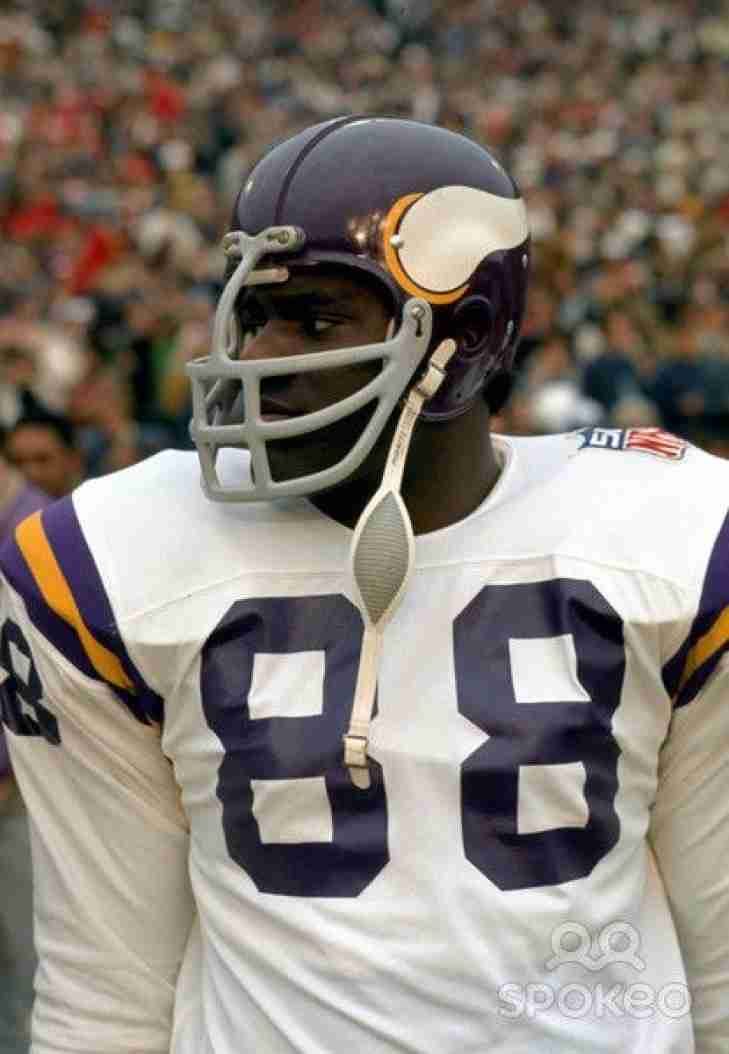
There are so many cases for who should be at the top of this all-time Minnesota Vikings list. Carl Eller for the star power he brought to the Purple People Eaters. Jim Marshall for his unequaled longevity. Fran Tarkenton, who, when he retired, held every major quarterback record. Adrian Peterson, the superstar running back.
In the end, we went with Alan Page. While his teammate Carl Eller won the NEA Defensive Player of the Year Award in 1971, Page won the inaugural AP Defensive Player of the Year Award that same year. He became the first defensive player to win the AP Most Valuable Player of the Year, a recognition that remains rare.
Page arrived as a first-round pick in 1967 out of Notre Dame and quickly moved into the starting lineup on the defensive line. He joined Marshall, Eller, and Gary Larsen as one of the Purple People Eaters, a group that defined the Vikings defense for years. His quickness off the ball set him apart even among that talented front.
Over his time in Minnesota, he earned nine straight Pro Bowl selections from 1968 through 1976 and was a six-time first-team All-Pro. He was the heart of a defense that helped the Vikings reach four Super Bowls. Page’s ability to disrupt the passer and control the line of scrimmage made him one of the finest defensive linemen of his day. He recorded roughly 108.5 sacks with the Vikings and recovered 19 fumbles during his years in purple. The numbers reflected consistent production across more than a decade as a starter. He played in 160 games for Minnesota and started nearly all of them once he locked down the position.
Page’s peak came in 1971 when he was named both the AP Most Valuable Player and the inaugural AP Defensive Player of the Year. That season he started all 14 games and helped the Vikings defense allow the fewest points in the NFL for the third straight year. He finished with 109 tackles, nine sacks, three fumble recoveries, and two safeties, including one on a blocked punt against Detroit. The performance made him the first defensive player ever to win MVP, a distinction only Lawrence Taylor has matched since. It was the clearest statement of how dominant he had become in the middle of the Purple People Eaters.
He remained a core piece through the mid-1970s even as the team’s Super Bowl appearances continued. Page played in all four of Minnesota’s Super Bowls (IV, VIII, IX, and XI) and was one of only 11 Vikings to appear in every one of them. His presence forced offenses to account for him on every snap, and the combination with Eller and Marshall created matchup problems few teams could solve. He stayed a first-team All-Pro in 1973, 1974, and 1975 while continuing to pile up Pro Bowl selections. Page’s motor and technique kept him effective year after year, even as the Super Bowl losses never diminished that front four's dominance.
The Vikings released him midway through the 1978 season after a disagreement with coach Bud Grant over his reduced weight and training methods. The Chicago Bears claimed him off waivers, and he finished his career there. The departure ended an 11-plus-year run that had shaped the franchise’s defensive identity.
Page entered the Pro Football Hall of Fame in 1988, the same year Minnesota retired his number 88. In 1998, he was among the first players inducted into the Vikings Ring of Honor. With the team, he was a nine-time Pro Bowler, six-time All-Pro, and the rare defensive player to win MVP.
As good as he was on the field, Page was regarded as an even finer human being. He later became a lawyer and served on the Minnesota Supreme Court. His impact extended well beyond the sack totals and the Super Bowl appearances that defined his years in Minnesota.
