
28. Rick Volk
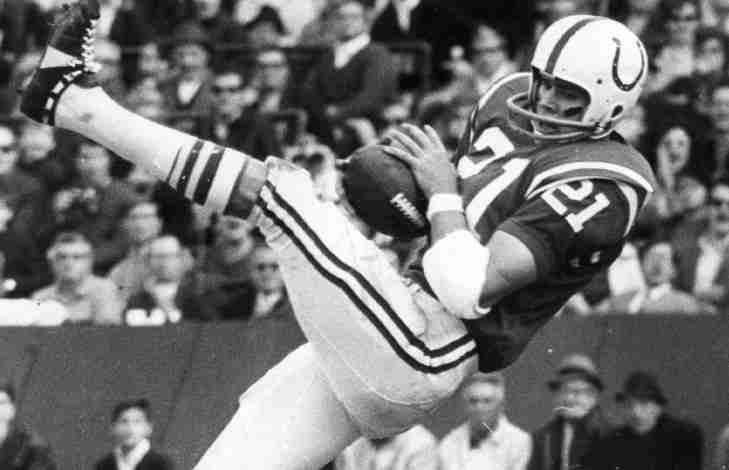
Selected in the second round (45th overall) of the 1967 NFL Draft out of Michigan, Rick Volk completed a rare football progression by transitioning straight from a Rose Bowl appearance with the Wolverines to starting in the NFL as a rookie. Arriving in Baltimore, the tough, cerebral safety immediately won the starting free safety job, bringing instincts, sharp tackling, and ball-hawking range to the back end of the Baltimore secondary.
Volk's impact was immediate, helping propel Baltimore to a 11–1–2 record as a rookie in 1967 while earning his first career Pro Bowl selection and First-Team AP All-Pro honors. The following season, he helped lead the Colts to the NFL Championship and an appearance in Super Bowl III. However, that championship clash turned tragic for Volk when he suffered a severe concussion in a collision in the second half, forcing him to be hospitalized while Baltimore suffered a shocking upset loss to the New York Jets.
Redemption arrived two years later in Super Bowl V against the Dallas Cowboys. Playing with a shoulder harness and relentless determination, Volk made one of the game's defining plays in the fourth quarter. Snagging a critical interception off Cowboys quarterback Craig Morton, he returned it 30 yards to the Dallas 2-yard line, setting up Tom Nowatzke’s game-tying touchdown run and paving the way for Baltimore's 16–13 victory to claim the Lombardi Trophy.
By the time his tenure with the franchise concluded after the 1975 season, Volk had intercepted 31 passes in a Colts uniform—ranking among the top marks in franchise history. He closed out his career with brief stints in New York (Giants) and Miami, but his legacy was permanently established in Baltimore as a big-game playmaker.
27. Fred Miller
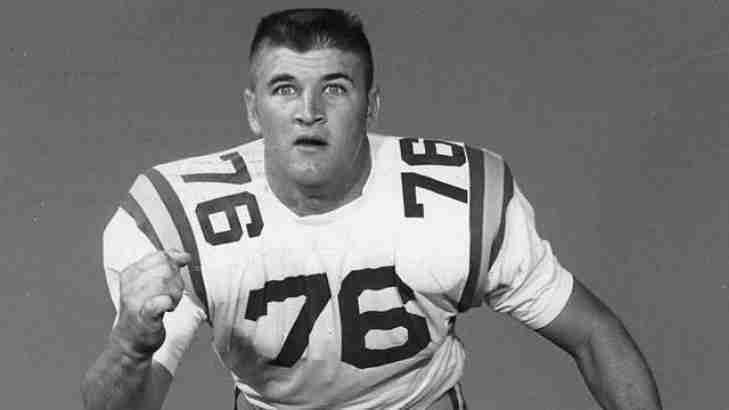
Selected in the seventh round (93rd overall) of the 1962 NFL Draft out of LSU, Fred Miller arrived in Charm City as a raw, physical prospect along the interior defensive line. Settling into the Baltimore Colts' starting lineup by 1964, the 6-foot-3, 250-pound defensive tackle quickly transformed into an unyielding anchor, anchoring one of the most formidable defensive fronts in professional football alongside Bubba Smith and Billy Ray Smith.
Operating as a relentless run-stuffer with exceptional lateral mobility, Miller made a career out of blowing up interior running plays before they could develop. His ability to collapse the pocket from the inside allowed Baltimore's pass rushers to wreak havoc off the edge. During his prime from 1967 to 1969, Miller earned three consecutive Pro Bowl selections, solidifying his reputation as one of the league’s premier defensive tackles.
Miller’s tenure in Baltimore was defined by relentless championship contention, as he suited up in three separate title games for the franchise. He anchored the defense during the historic 1968 campaign, helping propel the Colts to an NFL Championship victory over Cleveland before falling in Super Bowl III. Two years later, Miller got his redemption on the game's biggest stage, starting at left defensive tackle in Super Bowl V as Baltimore defeated the Dallas Cowboys 16–13 to claim the Lombardi Trophy.
Beyond his big-game pedigree, Miller’s hallmark was durability. Over his decade-long career spent entirely in Baltimore, he played in 133 regular-season games, missing only five games total throughout his ten years with the team. His quiet leadership and iron-man reliability along the front four steadied the Colts through two coaching changes and the transition into the post-merger NFL era.
Retiring following the 1972 season, Miller walked away with a championship ring and a permanent spot in Baltimore football lore. He compiled 52 unofficial sacks with 125 starts in 133 games.
17. Alan Ameche
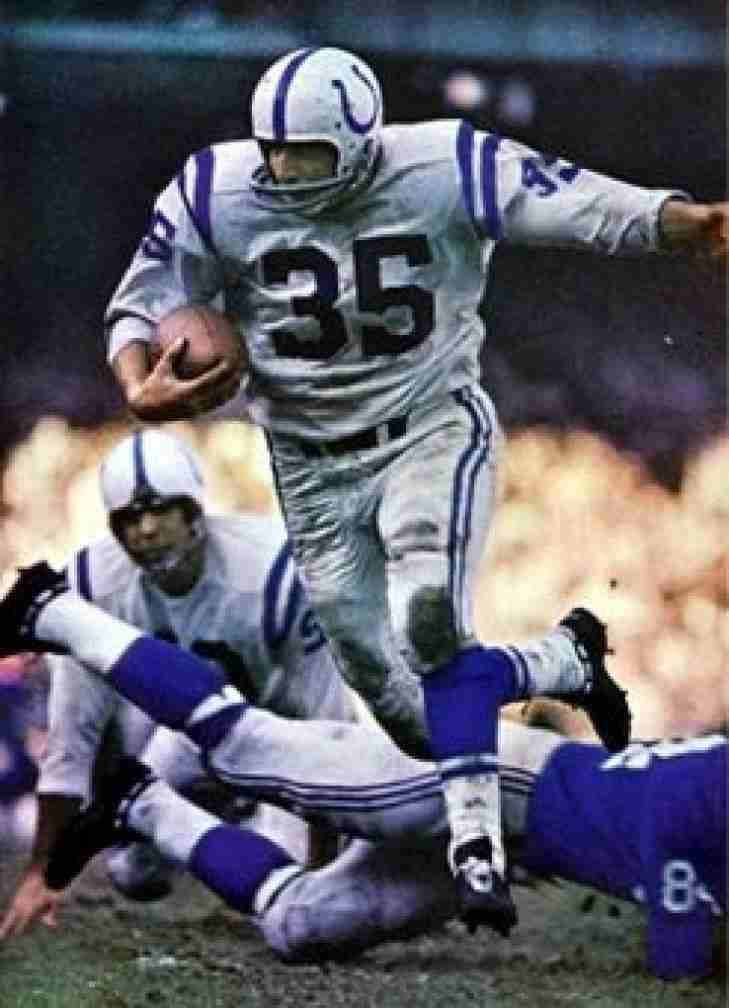
Fresh off winning the 1954 Heisman Trophy at Wisconsin, Alan "The Horse" Ameche arrived in Baltimore as the third overall pick in the 1955 NFL Draft and immediately established himself as a dominant focal point for the Colts. Combining a power-packed 218-pound frame with elite speed, he burst onto the professional scene by rushing for 194 yards in his very first career game against the Chicago Bears, featuring a staggering 79-yard touchdown run. Ameche capped his stellar debut campaign by winning the NFL rushing crown with 961 yards and a league-leading nine rushing touchdowns, sweeping Rookie of the Year honors and earning a First-Team AP All-Pro selection.
Ameche served as the ideal backfield anchor for head coach Weeb Ewbank and quarterback Johnny Unitas, delivering punishing runs between the tackles while absorbing heavy workloads. He earned Pro Bowl selections in each of his first four seasons (1955–1958) and added three Second-Team AP All-Pro selections (1956, 1958, 1959). His peak seasons provided the physical backbone for Baltimore's offensive explosion: in 1956, he eclipsed 1,000 yards from scrimmage and racked up nine touchdowns, following that up in 1958 with a dominant 791-yard, eight-touchdown effort on the ground. His career became forever etched in gridiron lore during the 1958 NFL Championship Game against the New York Giants—widely remembered as "The Greatest Game Ever Played". In sudden-death overtime, Ameche capped a grueling drive with a legendary one-yard touchdown dive into the end zone, securing Baltimore's first world championship.
He remained a vital weapon the following season as the Colts captured back-to-back titles in 1959, powering through defenses for 679 rushing yards and five scores while opening up passing lanes for Unitas and Raymond Berry. Tragically, Ameche’s stellar trajectory was cut short during his sixth season in 1960 when he suffered a severe Achilles tendon injury that forced him to retire at just 27 years old. Despite his brief career, his impact across the decade earned him a selection to the NFL 1950s All-Decade Team.
Overall, Ameche amassed 4,045 rushing yards, 40 rushing touchdowns, 101 receptions, 733 receiving yards, and four receiving touchdowns.
23. Bert Jones
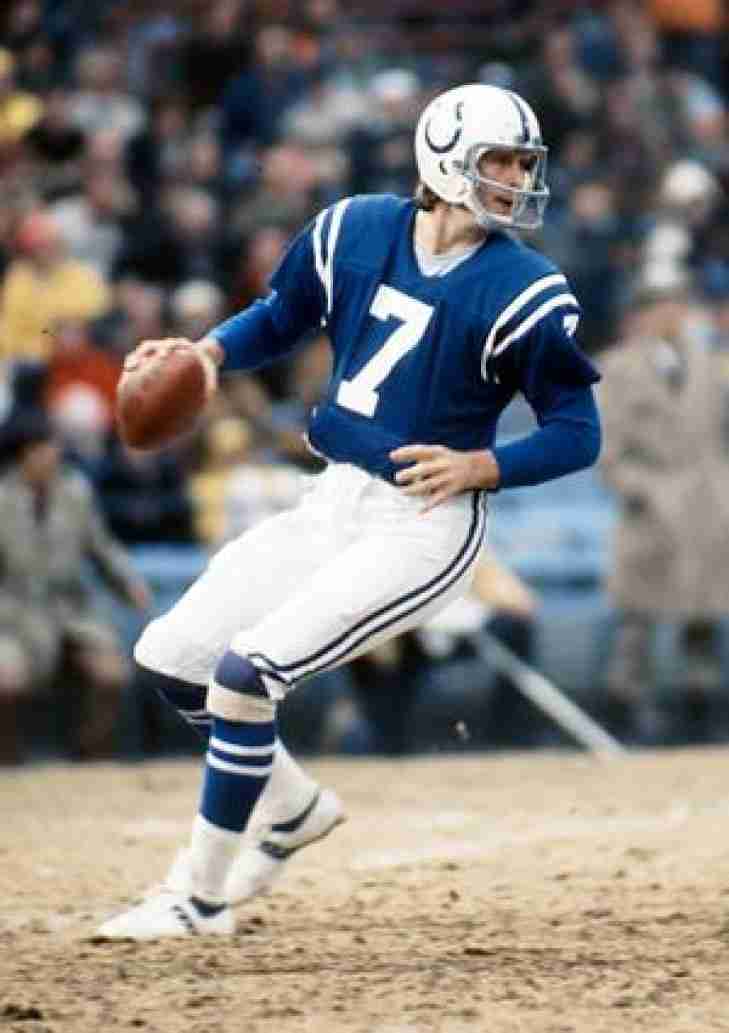
Taking over the reins of a franchise directly following a legend like Johnny Unitas is one of the most daunting assignments in football history. Selected second overall out of LSU in the 1973 NFL Draft, Bert Jones met that challenge head-on, earning the nickname "The Ruston Rifle" for a bullet pass and fearless pocket presence that quickly won over the fan base.
Without the deep championship cast that surrounded Unitas in the late 1950s, Jones willed the Colts back into national prominence through sheer individual excellence. Orchestrating head coach Ted Marchibroda's offense, he led Baltimore to three consecutive AFC East division crowns from 1975 to 1977. The crown jewel of his tenure came in 1976—a dominant season where he led the NFL with 3,104 passing yards, threw 24 touchdowns against nine interceptions, and compiled a league-leading 102.5 passer rating. That brilliant run swept the league's top honors, earning him the 1976 AP NFL Most Valuable Player award, AP Offensive Player of the Year, and First-Team All-Pro honors.
Known as one of the toughest and purest arm talents of his era, Jones routinely earned the admiration of opposing coaches and players. Regrettably, persistent shoulder injuries beginning in 1978 siphoned away his prime years and limited his availability. After nine seasons anchoring the offense in Maryland, Jones played a single final campaign with the Los Angeles Rams in 1982 before a neck injury brought his career to an early close.
With the Colts, Jones had a 56.1% completion percentage for 17,663 passing yards, a 122-97 TD-INT ratio, alongside 1,350 rushing yards and 14 rushing touchdowns.
22. Bob Vogel
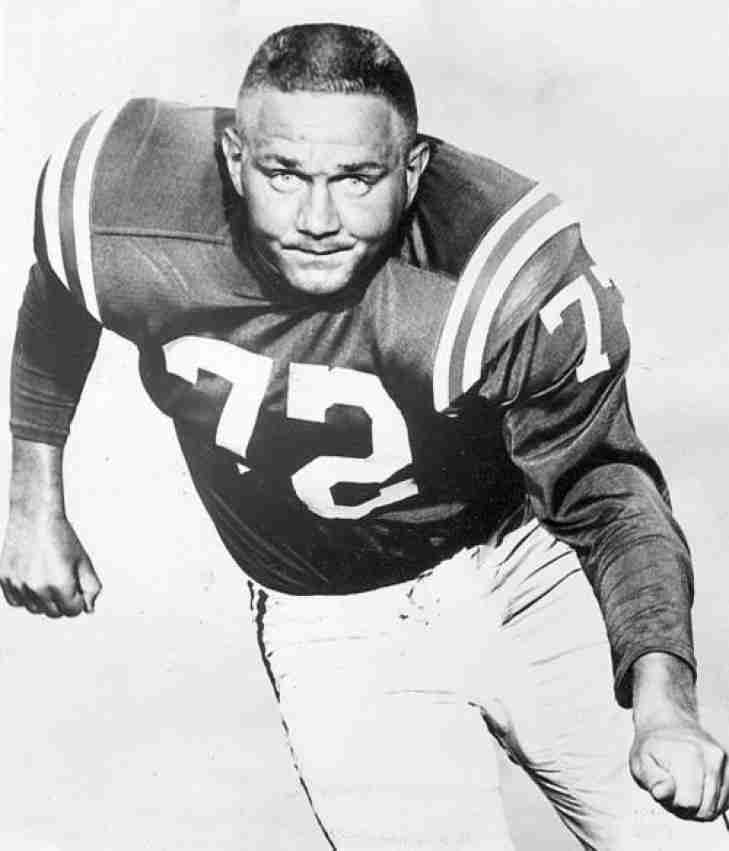
Taken fifth overall in the first round of the 1963 NFL Draft out of Ohio State, Bob Vogel landed in Baltimore and immediately stepped into one of the most demanding assignments in football: protecting the blind side of Hall of Fame quarterback Johnny Unitas. Vogel took over as the starting left tackle from day one and locked down the position for a decade, serving as the unsung protector who allowed Baltimore's explosive passing attack to flourish.
Vogel’s time in the blue and white was marked by exceptional durability and precise technique. He started all but one game for the franchise over 10 seasons, becoming one of the top offensive tackles of the 1960s and routinely challenging the league's most formidable defensive ends. He received five Pro Bowl selections (1964, 1965, 1967, 1968, 1971) and two Second-Team AP All-Pro honors (1965, 1968). Vogel was a key contributor to the 1968 team that claimed the NFL Championship, leading an offensive line that helped Baltimore finish 13–1 in the regular season.
His decade of elite play culminated on the game's ultimate stage in Super Bowl V against the Dallas Cowboys. Starting at left tackle, Vogel helped neutralize a suffocating Dallas pass rush, paving the way for Baltimore's dramatic 16–13 victory to capture the franchise's first Super Bowl title. Vogel retired after the 1972 season at just 31, walking away on his own terms as one of the most respected offensive linemen of his era.
18. Mike Curtis
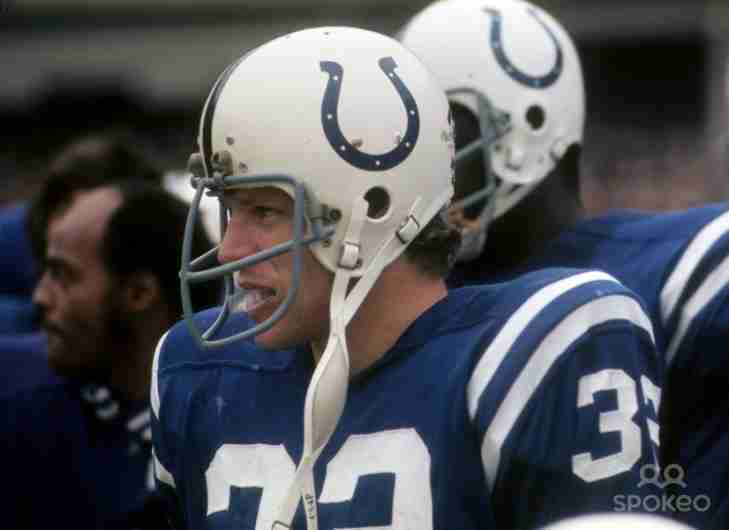
Selected in the first round of the 1965 NFL Draft out of Duke, Mike "Mad Dog" Curtis arrived in Baltimore with a reputation for raw, unchecked intensity. Initially deployed as a fullback on offense during his rookie season, the Colts quickly realized his vicious hitting and fiery demeanor belonged on defense. Upon shifting to linebacker in 1966, Curtis became the terrifying, central enforcer of a Baltimore defense that routinely punished opposing backfields.
Curtis weaponized a reckless, sideline-to-sideline playing style that made him one of the most feared middle linebackers of his generation. Known for his zero-tolerance attitude on the field—famously leveling a fan who ran onto the field to steal the game ball—Curtis proved to be as skilled as he was intimidating. His career reached its zenith in 1970, when the Kansas City Committee of 101 named him AFC Defensive Player of the Year. That same season, Curtis provided the defining play of Super Bowl V against Dallas: with the game tied late in the fourth quarter, he intercepted a Craig Morton pass and returned it to the Cowboys' 28-yard line, setting up Jim O'Brien's game-winning field goal to secure Baltimore's 16–13 victory.
A four-time Pro Bowler (1968, 1970, 1971, 1974) and a First-Team AP All-Pro selection in 1968, Curtis anchored the Colts' defense through both their 1968 NFL Championship and Super Bowl V title runs. Although sacks weren't officially recorded in the NFL then, PFR retrospective research credits him with 16.5 sacks during his Baltimore tenure, complementing his elite pass coverage. Curtis spent 11 seasons terrorizing offenses in blue and white before finishing his career with brief stops in Seattle and Washington.
For the Colts, Curtis accumulated 21 interceptions for 248 return yards, two defensive touchdowns, eight fumble recoveries, 16.5 unofficial sacks, and when you count his numbers elsewhere, he is an unofficial member of the defensive 20/20 club.
11. Bobby Boyd
9. Lenny Moore
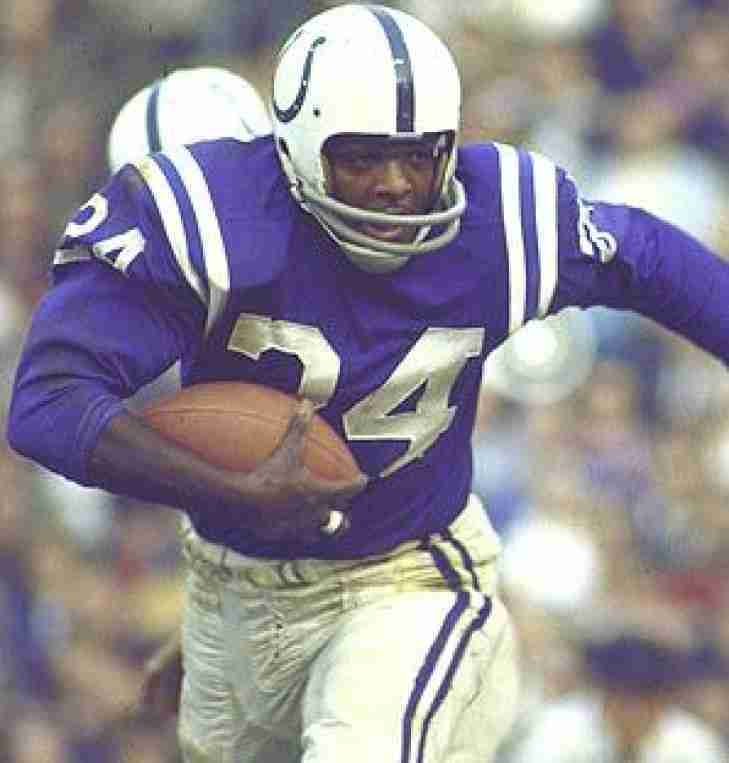
14. Art Donovan
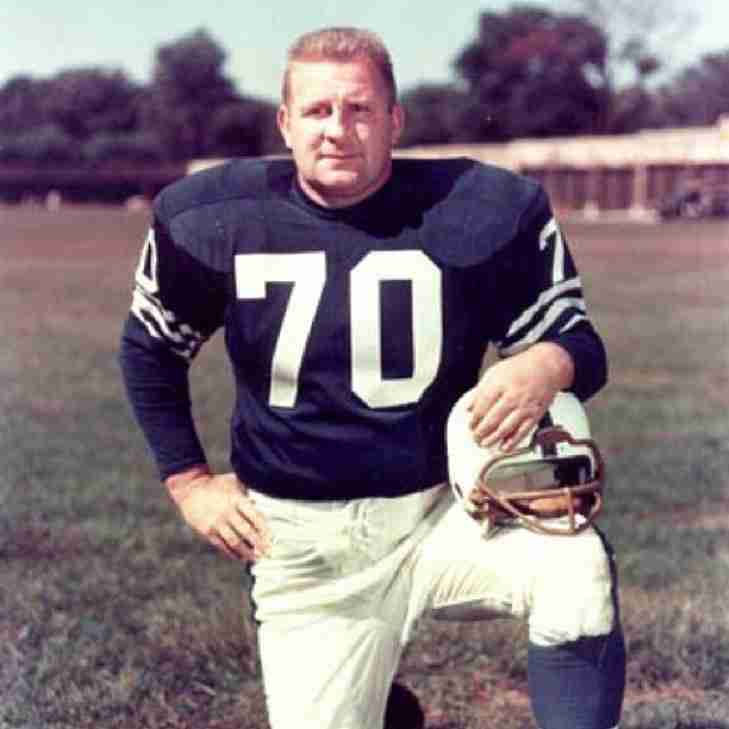
Before his razor-sharp wit made him a late-night television sensation, Arthur "Fatso" Donovan Jr. established himself as one of the most destructive interior defensive linemen in the early history of professional football. A World War II Marine Corps veteran who saw combat at Luzon and Iwo Jima, Donovan joined the original, short-lived Baltimore Colts as a 26-year-old rookie in 1950. When that franchise dissolved, his early career took a bizarre path: he played for the New York Yanks in 1951 and the Dallas Texans in 1952, earning the unique distinction of playing for three consecutive franchises that folded in back-to-back-to-back seasons.
Donovan's wild journey stabilized in 1953 when the NFL awarded a new franchise to Baltimore, purchasing the defunct Texans' assets and returning the stout defensive tackle to Maryland. Anchoring the interior alongside Gino Marchetti and "Big Daddy" Lipscomb, Donovan weaponized a 263-pound frame, tremendous leverage, and an uncanny ability to diagnose plays before they unfolded. Known for his relentless motor and "bulldog" tenacity, he earned five consecutive Pro Bowl selections from 1953 through 1957 and four straight First-Team AP All-Pro selections from 1954 through 1957.
Donovan's peak coincided with the franchise's rise to the top of the gridiron. He was the defensive anchor for the historic 1958 and 1959 Baltimore squads that captured back-to-back NFL Championships, including the iconic 1958 title game victory over the New York Giants—widely celebrated as "The Greatest Game Ever Played". Beyond his on-field destruction of opposing ground games, Donovan served as the heart and soul of the locker room, utilizing his legendary storytelling and infectious humor to keep teammates loose during high-stakes championship runs.
After retiring in 1961, Donovan was honored on the NFL 1950s All-Decade Team. In 1968, he became the first Baltimore Colts player in the Hall of Fame. The Colts retired his No. 70 jersey, cementing his key role in franchise history.
4. Jim Parker
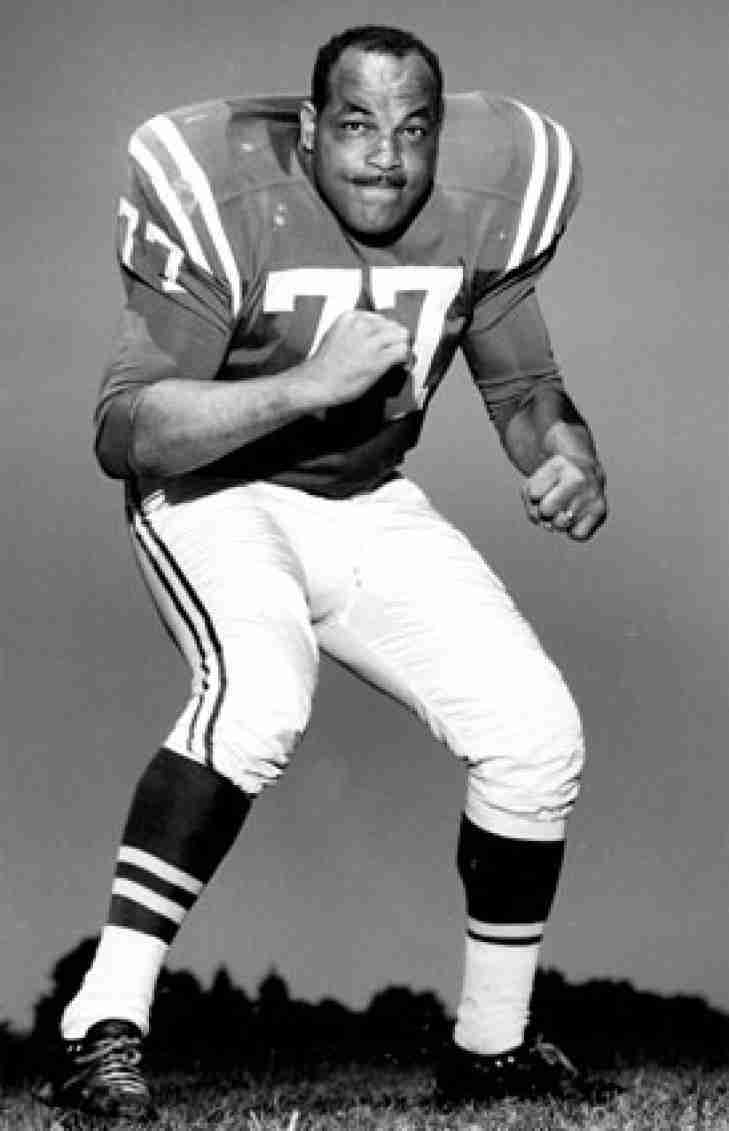
When the Baltimore Colts selected Jim Parker eighth overall from Ohio State in 1957, Woody Hayes lost his prized lineman, but Johnny Unitas gained a pivotal asset that would change pro football history. After winning the Outland Trophy and a national championship with the Buckeyes, Parker arrived in Maryland at 6-foot-3 and 273 pounds—a formidable powerhouse for his era who moved with the agility of a middleweight boxer.
Head coach Weeb Ewbank handed Parker a singular mandate: keep Johnny Unitas untouched. Parker executed that task with clinical perfection, transforming left tackle into an impenetrable fortress. Possessing exceptionally quick feet and wide, punishing hands, he routinely thwarted premier edge rushers, providing Unitas with the pristine pocket time necessary to revolutionize the NFL's passing offense.
After dominating at left tackle for five years, Parker seamlessly kicked inside to left guard in 1962, demonstrating extraordinary versatility without missing a beat. His pulling ability in the run game opened up massive lanes for Lenny Moore and Alan Ameche, giving the Colts a balanced, punishing attack to complement their vertical passing scheme.
His peak years yielded an unmatched run of individual brilliance. From 1958 through 1965, Parker was selected as a First-Team All-Pro for eight consecutive seasons—four times as a tackle and four times as a guard—while earning eight straight Pro Bowl nods. He served as the primary physical anchor for back-to-back world championship teams in 1958 and 1959, including an iconic performance in "The Greatest Game Ever Played."
After retiring following the 1967 campaign, Parker became the first player in NFL history elected to the Pro Football Hall of Fame based exclusively on his achievements as an offensive lineman, earning first-ballot enshrinement in 1973. A member of the NFL 1950s All-Decade Team, 75th Anniversary All-Time Team, and 100th Anniversary All-Time Team, Parker was inducted into the Colts Ring of Honor as a true titan of the game.
7. John Mackey
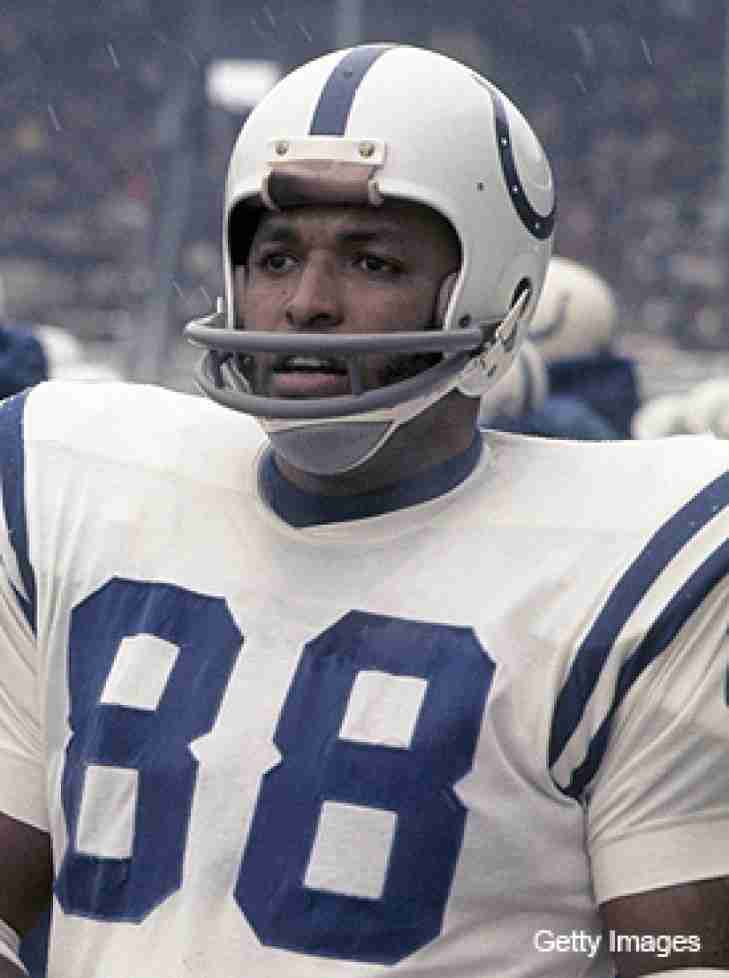
Drafted in the second round out of Syracuse in 1963, John Mackey arrived in Baltimore as a formidable athlete who revolutionized the tight end position. With a height of 6-foot-2 and a weight of 224 pounds, combined with sprinting speed and remarkable open-field balance, Mackey changed the role from mere blocker to a significant deep threat, consistently outrunning linebackers and breaking through secondaries.
Playing alongside legendary Hall of Fame quarterback Johnny Unitas, Mackey quickly established himself as one of football's most dynamic run-after-catch threats. Of his 38 career receiving touchdowns with the Colts, six covered 50 or more yards, including a career-high 89-yard catch against Detroit in 1966. His combination of raw power and top speed transformed simple seam passes into highlight-reel plays, and his exceptional blocking solidified the Colts' ground game. A three-time First-Team AP All-Pro (1966-1968) and five-time Pro Bowler in Baltimore, he was a key offensive force during the franchise's late-1960s period of winning dominance.
Mackey's most memorable moment came in Super Bowl V against the Dallas Cowboys. In the second quarter, Unitas's pass was tipped by receiver Eddie Hinton and Cowboys defensive back Mel Renfro, then caught by Mackey, who ran 75 yards unimpeded for a historic touchdown. This play ignited Baltimore's 16–13 win and earned him his first Super Bowl ring, adding to his 1968 NFL Championship.
Beyond his staggering athletic feats, Mackey served as the second president of the NFL Players Association following the 1970 AFL-NFL merger, courageously fighting for player free agency and pension rights. After concluding his playing career with a single season in San Diego in 1972, his game-changing impact earned him selection to the NFL 1960s All-Decade Team and enshrinement as only the second tight end in the Pro Football Hall of Fame in 1992.
In Baltimore, Mackey compiled 320 receptions, 5,126 receiving yards, and 38 receiving touchdowns.
2. Johnny Unitas
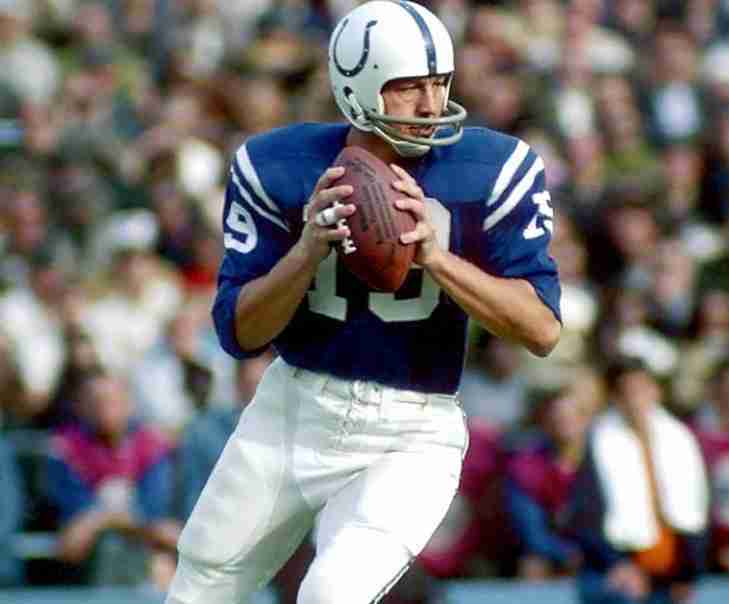
Drafted in the ninth round of the 1955 NFL Draft by the Pittsburgh Steelers—who notoriously cut him before he ever played a down—Johnny Unitas was forced to play semi-pro ball for $6 a game on a dirt field in Pittsburgh while working construction to support his family. Baltimore Colts head coach Weeb Ewbank offered him a second chance in 1956, signing him as a backup. When starter George Shaw broke his leg early that season, Unitas stepped off the bench, threw an interception on his first attempt, and then laid the blueprint for every modern quarterback that followed.
What made "Johnny U" standout among his peers was his exceptional mastery of the passing game, earning him the nickname "The Golden Arm.” Wearing his signature black high-top cleats, Unitas showed unwavering confidence in the pocket, often holding the ball until the last moment to throw accurate passes while absorbing hits from unblocked defenders. He introduced the two-minute drill, made the hurry-up offense popular, and called his own plays from the huddle with a bold, calculated approach that kept defenses guessing and off-balance.
By 1957, Unitas had fully assumed control in Baltimore, leading the franchise to its first winning season while ranking first in the NFL for passing yards (2,550) and touchdown passes (24). The next season was truly remarkable. Unitas guided the Colts to the 1958 NFL Championship Game against the New York Giants, famously called "The Greatest Game Ever Played.” During the league's inaugural sudden-death overtime, Unitas remained calm under pressure as he methodically moved Baltimore down the field, culminating in Alan Ameche’s game-winning touchdown run—a nationally televised moment that propelled professional football into America's top sport.
In 1959, Unitas reached a career high by winning his first AP NFL MVP award, leading the league with 2,899 passing yards and 32 touchdown passes. He finished the season by spearheading a fourth-quarter comeback to beat the Giants in a rematch of the title game, securing back-to-back championships for Baltimore. During this period, Green Bay legend Vince Lombardi famously said about Unitas: "Without him, they're just ordinary. With him, they're great.”
His consistent performance during the regular season set numerous historical records, most famously a streak of 47 straight games with at least one touchdown pass from 1956 to 1960. This record remained unbroken for 52 years, highlighting his dependability week after week during an era when passing rules provided quarterbacks little protection from severe hits.
In 1964, Unitas secured his second NFL MVP award after leading the Colts to a 12–2 season, passing for 2,824 yards and achieving a league-leading 9.3 yards per attempt. He won a third MVP in 1967, completing a league-high 58.5% of his passes for 3,428 yards. Despite injuries toward the end of his career, his veteran leadership helped guide the Colts to victory in Super Bowl V, where they defeated the Dallas Cowboys, and he earned his final world championship ring.
Throughout 17 seasons in Baltimore (1956–1972), Unitas played 206 games, with 39,768 passing yards and 287 touchdowns. A three-time NFL MVP, five-time First-Team All-Pro, and 10-time Pro Bowler, he retired as the NFL's all-time leader in passing yards, completions, and touchdowns. Named to the NFL’s 50th, 75th, and 100th Anniversary All-Time Teams, his No. 19 jersey was retired by the Colts. Enshrined in the Hall of Fame in 1979, Unitas is regarded as the father of modern quarterback play.
6. Raymond Berry
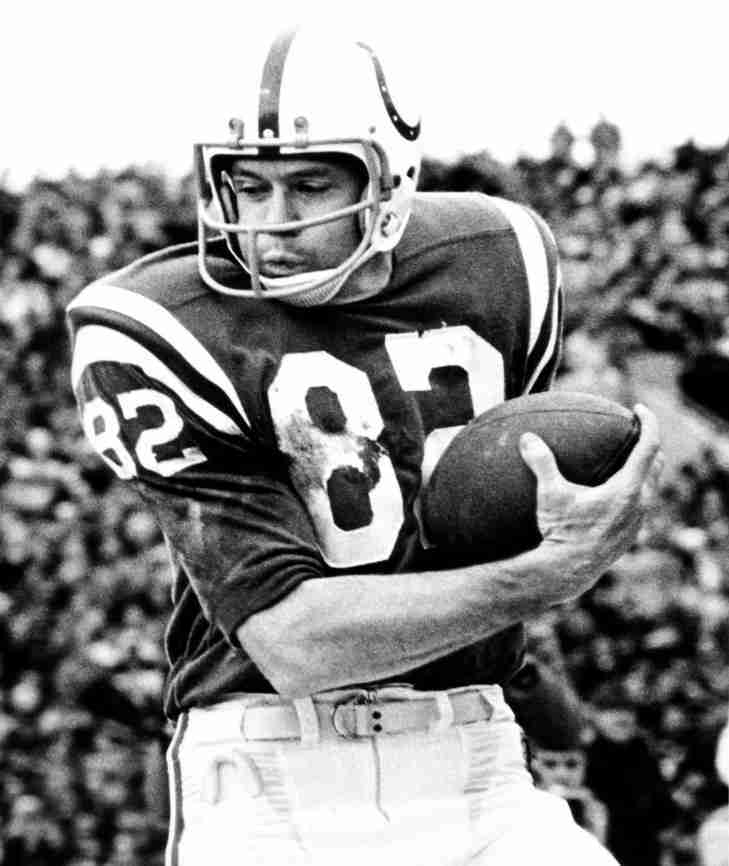
Overcoming a shortened leg, wearing a back brace, and dealing with poor eyesight that required thick-lensed glasses on the field, Raymond Berry turned physical adversity into legendary mastery. Drafted out of SMU in the 20th round in 1954, Berry spent hours after practice running routes until dark, pioneering precise route running and turning wide receiver play into a science.
Berry's relentless pursuit of perfection made him an ideal opponent for Johnny Unitas, forming the iconic passing duo of the 1950s. Though he lacked top-tier speed, Berry designed more than 50 different route variations, employing deceptive head fakes, quick cuts, and precise footwork to break away from defenders. With soft, dependable hands and a well-known grip-strengthening routine, he rarely let the ball slip and significantly reduced fumble occurrences.
His peak years, from 1957 through 1960, saw him dominate the league with mechanical precision. Berry led the NFL in receiving yards three times (1957, 1959, 1960) and in receptions three times (1958–1960), capturing the receiving "Triple Crown" in 1959 by leading the league in catches (66), yards (959), and receiving touchdowns (14). He earned three consecutive First-Team All-Pro honors (1958–1960) and was selected to six Pro Bowl rosters.
When championship stakes were highest, Berry was untouchable. In "The Greatest Game Ever Played"—the 1958 NFL Championship Game against the New York Giants—Berry caught 12 passes for 178 yards and a touchdown, including three critical receptions on the game-tying drive late in regulation to set up Baltimore's overtime victory. He followed that up with another title in 1959, cementing the Colts as a dominant force of the era.
Retiring as the NFL's all-time leader in receptions and receiving yards at the time, Berry's relentless work ethic established the modern template for route-running technique.
Berry compiled 631 receptions, 9,275 receiving yards, and 68 receiving touchdowns, along with two NFL Championship titles (1958, 1959). He was named to the NFL 1950s All-Decade Team, 75th Anniversary Team, and 100th Anniversary Team. Berry was enshrined in the Pro Football Hall of Fame in 1973 and inducted into the Colts Ring of Honor.
3. Gino Marchetti
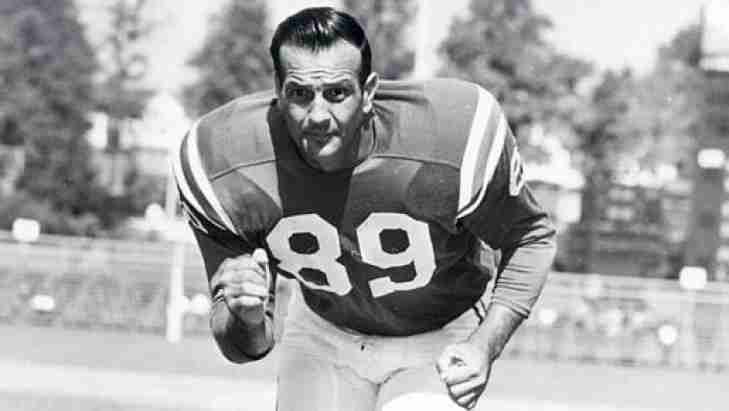
A World War II veteran who fought in the Battle of the Bulge before starring at the University of San Francisco, Gino Marchetti arrived in Baltimore in 1953 via the Dallas Texans dispersal draft. Standing 6-foot-4 and 245 pounds at defensive end, Marchetti redefined edge play in pro football, deploying an explosive speed rush, elite leverage, and cat-like agility that made him virtually unblockable for a decade.
Technically, Marchetti operated ahead of his time. He was one of the first defensive ends to weaponize a true "arm-over" swim move, slapping away an offensive tackle’s hands the instant the ball was snapped to burst into the backfield untouched. When blockers tried to set up wide to counter his outer-edge speed, Marchetti would convert his momentum into raw, bull-rushing power, collapsing the pocket directly into the quarterback’s face. Opposing coaches routinely assigned two or three blockers to slow him down, but his motor never idled, opening up easy pass-rushing lanes for teammates like Art Donovan and Eugene Lipscomb.
Beyond his pass-rushing acrobatics, Marchetti set a gold standard for interior edge setting against the run. He possessed extraordinary peripheral vision and spatial awareness, diagnosing play-action fakes in a heartbeat and shedding blocks to shut down sweep plays before they could develop. Hall of Fame offensive tackle Forrest Gregg once called Marchetti the single hardest player he ever had to block, marveling at how a player could combine such ferocious physical contact with absolute tactical discipline.
His peak years from 1956 through 1964 represent one of the most dominant individual stretches in NFL history, yielding nine First-Team All-Pro selections across his career. In 1957, Marchetti spearheaded a defense that turned Baltimore into an elite contender, and by 1958, he was the undisputed heart of the squad. In 1960, informal film charts credit him with leading the league in sacks, and unofficial Colts team tracking once recorded him logging an astounding 43 sacks in a single 12-game season—a testament to how completely he destroyed opposing game plans.
His defining moment unfolded during "The Greatest Game Ever Played"—the 1958 NFL Championship Game against the New York Giants. With Baltimore clinging to a late lead, Marchetti made a game-saving tackle on third down to stop Frank Gifford short of a first down, breaking his own leg in a violent pileup. Refusing to leave the field for treatment, Marchetti watched from a stretcher behind the end zone as his teammates rallied to win in overtime, securing the franchise's first world title before returning the following season to captain a repeat championship in 1959.
From 1954 through 1964, Marchetti earned 11 consecutive Pro Bowl selections, cementing his place as the cornerstone of Weeb Ewbank’s defense. Though sacks were not an official NFL statistic during his playing days, modern film study credits him with 138.0 unofficial career sacks (though only 56.0 via the work of Pro Football Reference), making him one of the premier pass rushers in gridiron history.
Marchetti was also a member of the NFL’s 1950s, 75th, and 100th Anniversary Teams; he was inducted into the Hall of Fame in 1972, and the Colts retired his No. 89.
40. Bobby Boyd
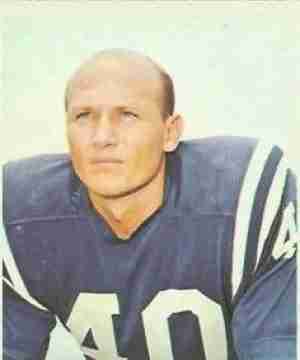
As much as football changes, some statistics will always remain critical to the game. One such stat is the Interception, which is one of the biggest game-changers regardless of era. In the ’60s, Bobby Boyd was one of the masters of the pick.
Although Bobby Boyd was only in two Pro Bowls (though he was a three-time First Team All-Pro) it is hard to look at his career and really find a down year. In his nine years in the National Football League, Boyd nearly averaged an interception for every two games he played. Basically, Bobby Boyd could be counted on to turn the tide of a game several times in a season. As an excellent runner, Boyd was extremely dangerous once he intercepted the ball, and rarely would his picks result in zero yards.
Although he was very good, he is one of many who slipped through the cracks. He had the misfortune of joining the Colts the year after they won a championship, and though they were good through the ’60s, they never won a title during his tenure. Had they done so (let’s say Super Bowl III perhaps?), would Boyd have been the recipient of a Hall of Fame legacy?
Should Bobby Boyd be in the Hall of Fame?
106. George Kunz
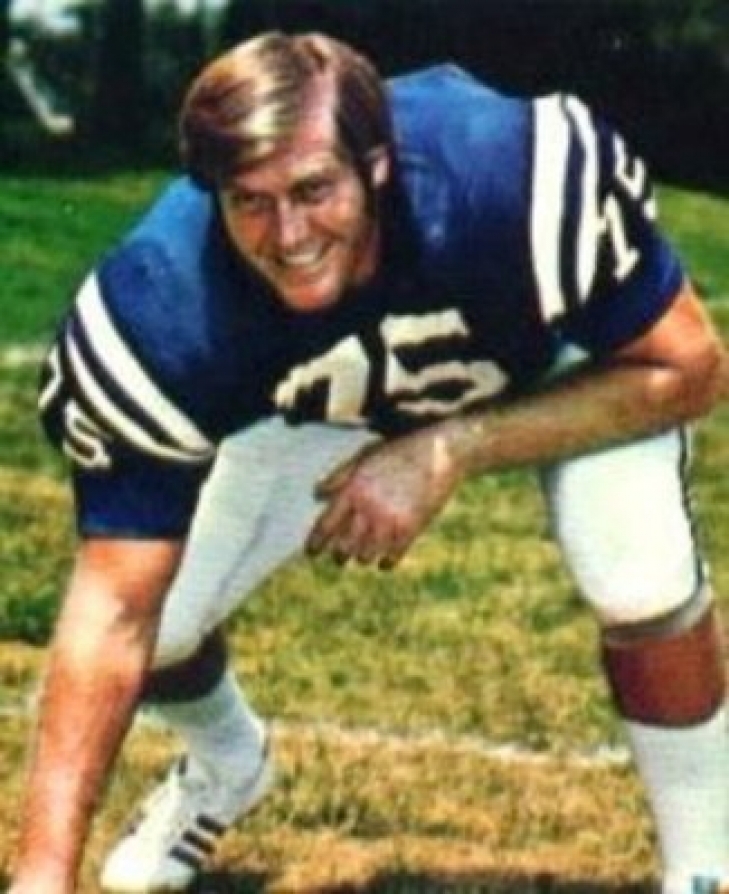
As the second draft pick of 1969, George Kunz had the fortune of playing for Notre Dame (when that mattered) and winning a National Championship there. He didn’t have the same luck when the Atlanta Falcons selected him.
This isn’t to say that it was all bad, but the Falcons could only reach average status at best during the 1970s. This was no fault of Kunz, who earned five Pro Bowl selections during his tenure in Atlanta. It got better for Kunz as he was traded to a better Baltimore Colts team, and he received a First Team All-Pro selection and three more Pro Bowls.
George Kunz was one of the better Right Tackles of his era, and had he made it to the All-Decade Team, he might have received some serious Hall consideration.
