

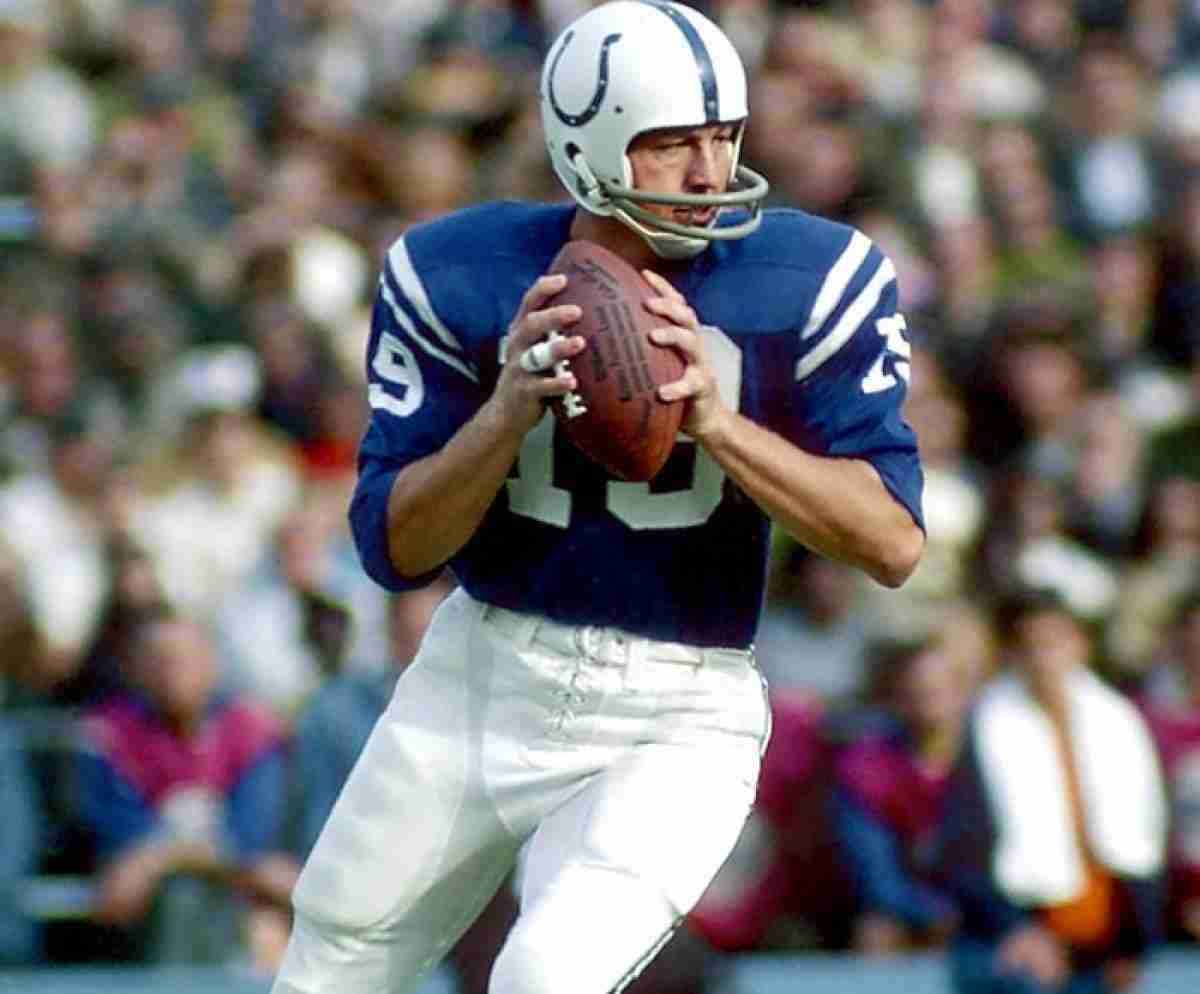
Drafted in the ninth round of the 1955 NFL Draft by the Pittsburgh Steelers—who notoriously cut him before he ever played a down—Johnny Unitas was forced to play semi-pro ball for $6 a game on a dirt field in Pittsburgh while working construction to support his family. Baltimore Colts head coach Weeb Ewbank offered him a second chance in 1956, signing him as a backup. When starter George Shaw broke his leg early that season, Unitas stepped off the bench, threw an interception on his first attempt, and then laid the blueprint for every modern quarterback that followed.
What made "Johnny U" standout among his peers was his exceptional mastery of the passing game, earning him the nickname "The Golden Arm.” Wearing his signature black high-top cleats, Unitas showed unwavering confidence in the pocket, often holding the ball until the last moment to throw accurate passes while absorbing hits from unblocked defenders. He introduced the two-minute drill, made the hurry-up offense popular, and called his own plays from the huddle with a bold, calculated approach that kept defenses guessing and off-balance.
By 1957, Unitas had fully assumed control in Baltimore, leading the franchise to its first winning season while ranking first in the NFL for passing yards (2,550) and touchdown passes (24). The next season was truly remarkable. Unitas guided the Colts to the 1958 NFL Championship Game against the New York Giants, famously called "The Greatest Game Ever Played.” During the league's inaugural sudden-death overtime, Unitas remained calm under pressure as he methodically moved Baltimore down the field, culminating in Alan Ameche’s game-winning touchdown run—a nationally televised moment that propelled professional football into America's top sport.
In 1959, Unitas reached a career high by winning his first AP NFL MVP award, leading the league with 2,899 passing yards and 32 touchdown passes. He finished the season by spearheading a fourth-quarter comeback to beat the Giants in a rematch of the title game, securing back-to-back championships for Baltimore. During this period, Green Bay legend Vince Lombardi famously said about Unitas: "Without him, they're just ordinary. With him, they're great.”
His consistent performance during the regular season set numerous historical records, most famously a streak of 47 straight games with at least one touchdown pass from 1956 to 1960. This record remained unbroken for 52 years, highlighting his dependability week after week during an era when passing rules provided quarterbacks little protection from severe hits.
In 1964, Unitas secured his second NFL MVP award after leading the Colts to a 12–2 season, passing for 2,824 yards and achieving a league-leading 9.3 yards per attempt. He won a third MVP in 1967, completing a league-high 58.5% of his passes for 3,428 yards. Despite injuries toward the end of his career, his veteran leadership helped guide the Colts to victory in Super Bowl V, where they defeated the Dallas Cowboys, and he earned his final world championship ring.
Throughout 17 seasons in Baltimore (1956–1972), Unitas played 206 games, with 39,768 passing yards and 287 touchdowns. A three-time NFL MVP, five-time First-Team All-Pro, and 10-time Pro Bowler, he retired as the NFL's all-time leader in passing yards, completions, and touchdowns. Named to the NFL’s 50th, 75th, and 100th Anniversary All-Time Teams, his No. 19 jersey was retired by the Colts. Enshrined in the Hall of Fame in 1979, Unitas is regarded as the father of modern quarterback play.


Comments powered by CComment