

Committee Chairman
Our All-Time Top 50 Texas Rangers have been revised to reflect the 2022 Season
Yes, we know that this is taking a while!
As many of you know, we here at Notinhalloffame.com are slowly generating the 50 of each major North American sports team. That being said, we have existing Top 50 lists out and we always consistently look to update them when we can and based on necessity. As such, we are very happy to present our post 2021 revision of our top Texas Rangers.
As for all of our top 50 players in basketball we look at the following:
1. Advanced Statistics.
2. Traditional statistics and how they finished in the American League.
3. Playoff accomplishments.
4. Their overall impact on the team and other intangibles not reflected in a stat sheet.
Last year, Texas signed some talent, but was not able to do much in regards to the standings and were basement dwellers. There was a returnee, that allowed a new entrant to the Top 50, but that did not impact the upper tier.
As always, we present our top five, which was not impacted by last season:
5. Frank Howard
You can find the entire list here.
The only new entrant on the list is All-Star and Starting Pitcher, Martin Perez, who debuts at #45.
We welcome your input and comments and as always, we thank you for your support.
17. Yordan Alvarez
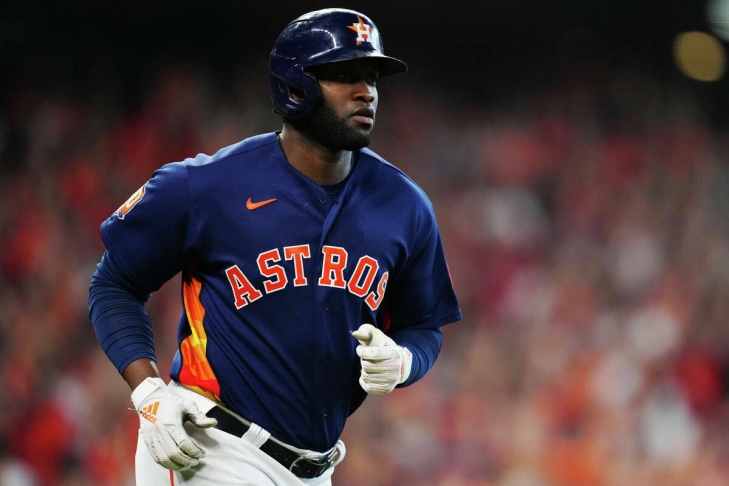
Yordan Alvarez arrived in Houston as a quiet acquisition from the Dodgers, a player traded before he even suited up for his original club. It did not take long for that transaction to become one of the most lopsided in modern history. Since his debut, the man known as "Air Yordan" has functioned as a pure force of nature in the heart of the order, providing a left-handed power threat that feels like a throwback to the most feared sluggers of the previous century.
Yordan Alvarez arrived in Houston as a quiet acquisition from the Dodgers, a player traded before he even suited up for his original club. It did not take long for that transaction to become one of the most lopsided in modern history. Since his debut, the man known as "Air Yordan" has functioned as a pure force of nature in the heart of the order, providing a left-handed power threat that feels like a throwback to the most feared sluggers of the previous century.
Alvarez’s rise in Houston began with a 2019 debut that shattered rookie expectations. Despite only receiving 369 plate appearances, he reached a career-defining breakout by launching 27 home runs and posting a massive .655 slugging percentage. He was the unanimous American League Rookie of the Year, signaling a transition from a promising prospect to an elite middle-of-the-order anchor. He possessed a focused intensity at the plate even in the highest stakes, batting .412 during the World Series that fall and proving he was already a championship-caliber hitter.
The heart of his time in Houston has been marked by a surge into the top tier of global superstars, occasionally interrupted by the physical toll of his massive frame. After a dominant 2021 in which he drove in 104 runs, he reached a career peak in 2022. Finishing third in the MVP voting, Alvarez provided the definitive moment of the franchise’s second title, a towering three-run blast in Game 6 of the World Series that remains a local legend. He followed that with another high-frequency offensive year in 2023, smacking 31 homers and earning his second straight All-Star nod.
The story in Houston took a difficult turn between 2024 and 2025. He maintained his elite status in 2024 by launching 35 home runs to reach a career total of 164, but his 2025 campaign was largely erased by injury. He managed to add 6 home runs in limited action before being sidelined, bringing his career tally to 170. This forced him to navigate a frustrating plateau while the team fought for position without its primary engine. As he prepares to enter the 2026 season, the focus is entirely on his health and the power he brings back to the lineup. He remains the most potent bat on a perennial contender, a player whose exit velocity and plate discipline make him a nightmare for any pitching staff.
44. Martin Perez
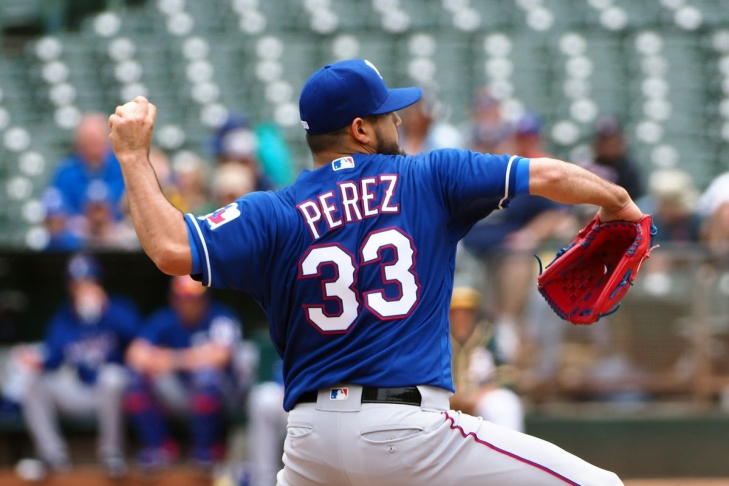
Martín Pérez's journey in Texas has been winding and challenging yet ultimately successful. Signed from Venezuela in 2007 as a promising 16-year-old, he was seen as the franchise's future ace. His full-time MLB debut in 2012 marked a struggle with inconsistency, injuries, and thriving in a hitter-friendly park.
For nearly seven years, Pérez functioned as a notably volatile member of the back end of the rotation. Although he demonstrated unmistakable signs of potential—including a commendable debut in 2013 with a 3.62 ERA and two 10-win seasons in 2016 and 2017—his overall effectiveness was significantly impeded by a lack of strikeout capability and notable vulnerability to base runners. He regularly struggled to control hits and walks, leading to elevated WHIP values consistently exceeding 1.40. After a particularly poor, injury-affected 2018 season during which his record declined to 2–7 and his ERA surged to 6.22, the organization decided to part ways, enabling him to join the free agent market.
Pérez spent the subsequent three summers traveling through Minnesota and Boston, reformulating his pitching sequence and refining his cut fastball. When he discreetly returned to Arlington on a modest one-year contract prior to the 2022 season, no one anticipated the historic resurgence that was imminent.
Returning to his original mound, the veteran lefty engineered an absolute masterpiece of a season. Pérez completely paralyzed American League hitters, inducing weak groundballs at an elite clip, and posted a spectacular 12–8 record with a career-best 2.89 ERA and a sharp 1.25 WHIP. As the defining bright spot on a transitioning Texas roster, his relentless mastery earned him a well-deserved inaugural career All-Star selection.
That individual breakthrough perfectly set the stage for an unforgettable 2023 victory lap. Though he eventually transitioned into a lower-end starter and a high-leverage reliever as the season progressed, his veteran poise and durable presence helped anchor the staff all the way to the finish line. When the dust settled in October, Pérez officially achieved baseball immortality, celebrating on the diamond as a crucial component of the Rangers' historic first-ever World Series championship squad.
Pérez departed the franchise for a second time that winter, signing a free-agent contract with Pittsburgh for the 2024 season. With the Rangers, Pérez appeared in 213 games (185 starts) and posted a winning 65–61 record while logging 1,102.1 innings. He also had 642 strikeouts.
The Los Angeles Dodgers will retire Fernando Valenzuela's #34 this August
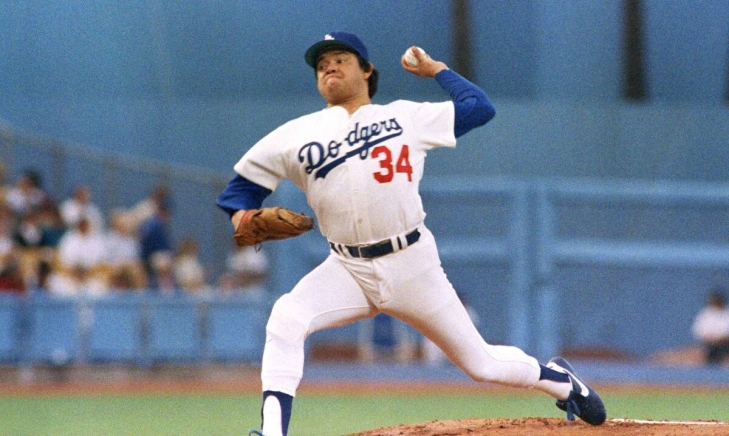
Regular visitors of Notinhalloffame.com know that we are slowly working on the top 50 of every major team in the NHL, NBA, NFL and MLB. Once that is done, we intend to look at how each team honor their past players, coaches and executives. As such, it is important to us that the Seattle Mariners have announced that the Los Angeles Dodgers will retire Fernando Valenzuela’s #34 this August.
The Dodgers accidentally discovered Valenzuela as they were scouting a Shortstop in Mexico. They were dazzled by the rotund hurler and signed him, buying out his Mexican League contract in 1979. A year later, he was a September callup, and in 17.2 Innings, he never allowed a run. It didn't take a clairvoyant to see what might happen in 1981.
"El Toro" helped the Dodgers win the 1981 World Series. That season, he won the Rookie of the Year and Cy Young, making him the first player to accomplish that in the same year. Valenzuela was the opening day starter, and everyone in Los Angeles took the Mexican star to heart.
The mania surrounding Valenzuela cooled, but he was still an elite pitcher for many years. He was an All-Star each year from 1981 to 1986, and he had three more top-five finishes in Cy Young voting. Valenzuela would have three 200 Strikeout years, and he was also a decent batter, winning two Silver Sluggers, as well as aiding L.A to a World Series win in 1988.
Valenzuela will join Pee Wee Reese, Tommy Lasorda, Duke Snider, Gil Hodges. Jim Gilliam, Don Sutton, Walter Alston, Sandy Koufax, Roy Campanella, Jackie Robinson and Don Drysdale who have their number retired by the Dodgers.
Pitchers had better careers, but many of those never captured the imagination of baseball fans like Fernando Valenzuela.
We here at Notinhalloffame.com would like to congratulate Fernando Valenzuela for this impending honor.
