


Committee Chairman
2. Roy Halladay

Selected in the first round of the 1995 amateur draft out of high school, Roy Halladay didn't simply soar to major league fame; he had to thoroughly overhaul his entire pitching approach to endure. Making his debut with the Toronto Blue Jays in 1998, the tall right-hander showcased exceptional velocity but lacked a solid technical foundation, leading to a difficult 2000 season with an ERA of 10.64. Instead of panic, he embraced a significant demotion to Single-A to reinvent his arm slot and mindset under pitching expert Mel Queen. From this intense period emerged a masterful pitcher—a relentless, highly efficient sinkerball specialist known as “Doc,” who would become one of the most respected right-handed pitchers of his era.
His breakthrough moment occurred in 2002, marking a decisive year. Halladay made deep, dominating starts a daily habit, pitching 239.1 innings—leading the American League—and finishing with a 19–7 record, which earned him his first All-Star selection.
The pinnacle of his hardware-certified legacy blossomed beautifully during a memorable summer in 2003. That season, Halladay truly showcased old-school resilience and grit. He consistently dominated against junior circuit lineups, leading all of Major League Baseball with an impressive 22–7 record. Additionally, he topped the American League in innings pitched (266.0), complete games (9), and achieved a remarkable 6.38 strikeout-to-walk ratio. These outstanding achievements earned him the highly prized 2003 American League Cy Young Award, truly establishing him as a legendary figure in his organization.
After a challenging two-year period with minor shoulder issues that briefly slowed him down, Halladay bounced back to showcase his elite skills just before 2006. What followed was an incredible four-year streak of dominating performances in the major leagues. From 2006 to 2009, he consistently shut down opposing batters, achieving an impressive 69–33 record. He earned three more All-Star selections, won a WHIP title in 2008, and impressively secured a top-five spot in the Cy Young voting every summer of that period—including a fantastic second-place finish in 2008.
While Halladay was truly exceptional, the small-market team around him wasn't able to break through the tough AL East competition to reach the postseason. Recognizing the natural point in his career to seek new challenges, the beloved ace reached out to management for a fresh start with a team that had a real shot at competing. The front office responded by making a major move, trading him to the Philadelphia Phillies in December 2009 in a blockbuster deal that brought back a talented package including Travis d'Arnaud and Kyle Drabek. Halladay quickly made his mark in his new team’s history, pitching a perfect game and a historic postseason no-hitter on his way to winning his second Cy Young award in the National League.
As a Blue Jay, Halladay accumulated a spectacular 148–76 record, a sharp 3.43 ERA, and 1,495 strikeouts over 2,046.2 innings of work. Advanced analytical anchors heavily reinforce his inner-circle footprint under the dome, anchoring his localized legacy with a magnificent 48.4 franchise pitching bWAR, a total that sits second in club history behind only Dave Stieb. The baseball world was shattered by immense heartbreak in November 2017 when the legendary hurler tragically lost his life in a plane crash over the Gulf of Mexico at just 40 years old.
The final, official acknowledgments of his legendary career on the diamond came precisely as befitted an inner-circle hero. The organization honored his memory by retiring his iconic number 34 on Opening Day in 2018 and inducting him into the Canadian Baseball Hall of Fame and the Blue Jays Level of Excellence.
This was followed by the BBWAA triumphantly electing Roy "Doc" Halladay into the National Baseball Hall of Fame in Cooperstown as a first-ballot legend in 2019.
1. Dave Stieb
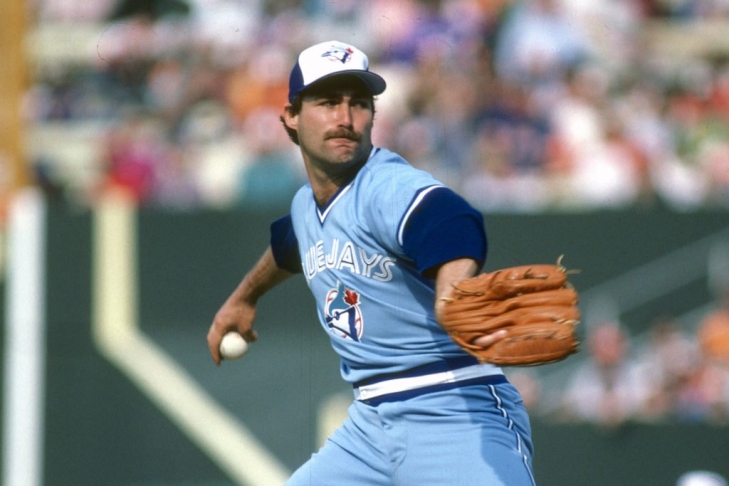
Dave Stieb did not merely lead the original pitching pipeline north of the border; he served as the definitive, formidable cornerstone upon which the entire credibility of the franchise was constructed. Making his Major League debut in 1979 and securing the undisputed ace position the following summer, the former college outfielder combined an exceptionally powerful, high-velocity slider with a renowned determination. Throughout a significant 15-season tenure in Toronto, he established himself as the leading right-handed starting pitcher of the 1980s minor league circuit and the inaugural true superstar in Blue Jays history.
His introductory phase immediately changed opponents’ perceptions of a visit to Canada. Stieb aspired to translate deep-innings durability into a disciplined personal routine, which culminated in his first career All-Star selection in 1980. During the first half of the decade, the young team was burdened by common expansion-roster vulnerabilities, often undermining his exceptional performances and denying him clear opportunities for a 20-win season.
Nonetheless, Stieb's exceptional dominance was incontrovertible; he achieved consecutive 17-win seasons in 1982 and 1983, pitching over 270 innings each summer. Although baseball journalists in the United States frequently overlooked his statistics owing to Toronto's limited media coverage, he commanded significant respect within the sport's community. In 1982, he led the American League with an impressive 19 complete games, which led The Sporting News to officially designate him as the American League Pitcher of the Year. He was a skilled thrower with a sharp arsenal, blending elite movement and an unpredictable temper that sometimes caused friction, but teammates always wanted him on the mound in high-stakes games.
The ultimate pinnacle of his hardware-certified legacy was demonstrated during the historic 1985 campaign. Stieb delivered an exemplary performance in frontline command, systematically neutralizing junior circuit lineups to achieve the American League ERA title with a microscopic 2.48 over 265.0 innings. This accomplishment anchored the Toronto Blue Jays to their inaugural postseason appearance and the East Division championship. He consistently maintained a position at the top of the rotation throughout the remainder of the decade; by the end of the 1980s, no pitcher in Major League Baseball had accumulated more total victories than his 140, with the exception of Jack Morris.
Local historians recognize that his long march toward a championship ring was paved with severe physical heartbreak. On the final afternoon of the 1990 regular season, Stieb righted his historic ledger of narrow near-misses by throwing the first and only official no-hitter in franchise history against Cleveland.
However, a brutal series of chronic back ailments and shoulder problems restricted him to minimal frames in 1991 and 1992. As the front office aggressively constructed the star-studded roster that would ultimately capture the 1992 Fall Classic, their long-time ace was forced into a painful structural backseat, initiating a quiet first business exit that winter when he signed with the Chicago White Sox before a brief 1993 retirement. Though he famously orchestrated a highly nostalgic, four-game comeback cameo with Toronto five years later in 1998, his peak chapters had long since closed.
He continues to be the all-time, undisputed leader of the Blue Jays in numerous categories, including wins (175), innings pitched (2,873.0), strikeouts (1,656), starts (408), and complete games (103). Advanced analytics strongly support his status as an all-time great, highlighting his exceptional career with a remarkable 56.9 career pitching bWAR—the highest in the organization's history, just surpassing Roy Halladay's impressive peak.
The final punctuation on his legacy was his induction into the Toronto Blue Jays Level of Excellence and the Canadian Baseball Hall of Fame, ensuring Dave Stieb's legendary status remains a cornerstone of Toronto baseball lore.
Reasons that Allure you to Sign Up at Online Casinos

The feeling of gambling in a brick-and-mortar casino is influenced by the flashing lights, the constantly fascinating people staring at you, and the desire to come out on top. Gamblers can play at casinos online, sometimes referred to as online casinos. This sport has advanced with technology to include online casinos where winning money may be done anytime, anyplace. The following are the top benefits of visiting businesses:
You can access it Easily
The benefit of having a nice casino right around the corner is only available to those who live in urban areas. Online casinos like situs slot online eliminate the need to travel to and from venues, pay parking costs, locate casinos and their buildings, and play quickly. It simply takes a few seconds to upload funds, select the ideal game, and begin betting. Players may visit gambling websites at anytime, anyplace, and at the convenience of their own homes. A smartphone casino and high-speed internet connectivity would be helpful.
Beginner Friendly
Gambling sites are the best place to start if you are new to gaming. It is user-friendly for beginners, and several of the games include comprehensive explanations and help. However, it might be challenging for a trainee to keep up before entering the field where gaming masters are found. The game has tales and experiences that put pressure on you and leave you with little to no time to comprehend the game. Because there is no need to interact in person with the veterans in an online casino, there is less pressure and tension, which makes learning more enjoyable.
Bonus
Casinos make every effort to win your patronage, which leads to offers like early payment matching, entrance fee competitions, and more. Gambling gets more enjoyable as you extract more money from casino sites. Examine the guidelines governing the minimum deposit and wager amounts to make sure you benefit from eye-catching marketing.
Plenty of Games
You have a lot of options when it comes to making money at online casinos. With the several fantastic gaming possibilities offered on numerous websites, winning is achievable. Before placing a wager, you must first find the game you wish to play. You may gamble on baccarat, blackjack, roulette, and horse racing in addition to other games. Your knowledge of betting will increase if you play a range of games. The secret to winning is having a full understanding of the game you're playing.
Safety and Security
You don't need to be concerned about someone stealing your money when playing at an online casino. Your money is always assured to be secure at online casinos. Companies have teamed up with reputable online financial advisory providers to offer the safest possible environment for transactions. To make sure their customer is on a safe platform, they also use the most recent security procedures.
You need to discover a decent platform like slot online terbaik to take advantage of fantastic chances and work without stress if you want to prevent falling victim to scammers and being vulnerable. You may plan and establish objectives for your pleasure of casinos using the aforementioned advice.
The Pro Football Hall of Fame announces the Class of 2023

For us, this is as big as the Super Bowl
Tonight, at the NFL Honors, the Pro Football Hall of Fame announced the nine new members of the Canton based institution.
The Class of 2023 is:
Joe Thomas, Offensive Tackle, Cleveland Browns 2007-17: Thomas was expected to be a first ballot inductee, and that is what transpired for the former Outland Trophy winner. The runner-up for the 2007 Offensive Rookie of the Year, Thomas played a record-breaking 10,363 Snaps and allowed only 30 Sacks. Charting new territory as the first Offensive Lineman to make the Pro Bowl in his first ten years, Thomas was a six-time First Team All-Pro and 2010’s All-Decade player.
Darrelle Revis, Cornerback, New York Jets 2007-12 & 2015-16, Tampa Bay Buccaneers 2013, New England Patriots 2014, Kansas City Chiefs 2017: Along with Joe Thomas, Revis is a first ballot inductee, and the Super Bowl Champion with the Pats went to seven Pro Bowls with four First Team All-Pros and was a 2010s All-Decade player. The proprietor of Revis Island had 29 Interceptions and was second in 2009 Defensive Player of the Year voting.
DeMarcus Ware, Linebacker, Dallas Cowboys 2005-13, Denver Broncos 2014-16: Many expected Ware to enter on year one, but here he is on his second go. Amassing 138.5 Sacks and twice leading the league, the Linebacker was a nine-time Pro Bowl and four-time First Team All-Pro and a Super Bowl Champion late in his career with the Broncos.
Zach Thomas, Linebacker, Miami Dolphins 1995-2007, Dallas Cowboys 2008: Thomas was a Finalist the last four years, and is now a Hall of Famer on his tenth year on the ballot. The Linebacker had eleven years where he broke at least 100 Tackles, and he was a five-time First Team All-Pro as well as a seven-time Pro Bowler.
Ronde Barber, Cornerback, Tampa Bay Buccaneers 1997-2012: With all due respect to Barber, this was a slight surprise, as his selection gave us three Corners (including Revis and Riley) in the 2023 Class. A Super Bowl Champion, Barber is the only player in history with at least 45 Interceptions and 25 Sacks. A 2000’s All-Decade Selection, Barber went to five Pro Bowls.
Chuck Howley, Linebacker, Chicago Bears 1958-59, Dallas Cowboys 1961-73: This was a long time coming for Howley, who has been eligible for 45 years, and had never been a Finalist. The first, and only player to win the Super Bowl MVP on a losing team, Howley got the Super Bowl Ring later, and also had six Pro Bowls and five First Team All-Pros on his docket.
Ken Riley, Cornerback, Cincinnati Bengals 1969-83: Riley was never a Finalist before this year, and the career Bengal was used to being snubbed, having only one First Team All-Pro despite 65 career Interceptions. This gives the Bengals their second Hall of Famer, behind Offensive Lineman, Anthony Munoz.
Joe Klecko, Defensive Tackle, New York Jets, 1977-87, Indianapolis Colts 1988. Klecko enters the Hall of Fame after 30 years of eligibility and now the “New York Sack Exchange” has a Hall of Fame inductee. He was the second player (after Frank Gifford) to earn Pro Bowl honors at three different positions and he was named by UPI as their Defensive Player of the Year in 1981.
Don Coryell, Head Coach, St. Louis Cardinals 1973-77, San Diego Chargers 1978-86: Coyell was one of the most influential minds in football, revolutionizing the passing game with his “Air Coryell” offense. A Finalist six previous times, Coryell finally receives his due, albeit 12 years after his death.
As per Clark Judge, the first five Finalists cut were Devin Hester, Willie Anderson, Darren Woodson, Dwight Freeney and Patrick Willis. Hester, is a bit of a surprise, as he made it to the final ten last year.
The three Wide Receivers on the ballot, Andre Johnson, Torry Holt and Reggie Wayne made it to the top ten, but none advanced, meaning that the logjam at Wide Receiver remains clogged. Jared Allen, who has been a Finalist every year since eligible, also made it to the final cut. The biggest disappointment was for Albert Lewis, who had to wait until his final year of modern eligibility to make it as a Finalist (or even a Semi-Finalist) was also in the final ten and now is in the very deep Seniors pool.
We will be revising our Notinhalloffame.com list next month, where we will remove those inducted, add those now eligible, and alter the list based on your votes and comments.
We here at Notinhalloffame.com would like to congratulate the Pro Football Hall of Fame Class of 2023.
