


Site Admin
7. Pedro Martinez
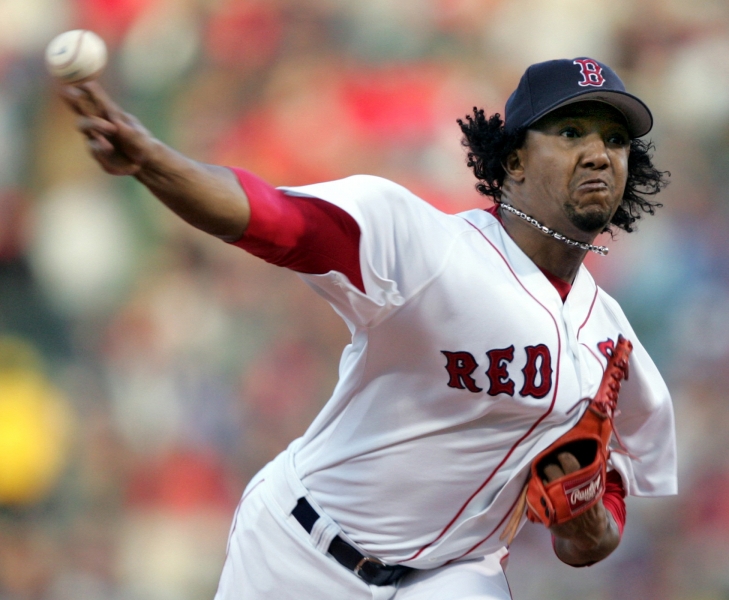
The Montreal Expos’ loss was the Boston Red Sox's eternal gain. Arriving via trade in 1998, Pedro Martinez didn’t just join the Boston rotation; he revolutionized it. After a stellar debut season where he finished second in Cy Young voting, Martinez embarked on a two-year stretch that defied the laws of physics. In 1999, he secured the Pitching Triple Crown, leading the American League in Wins (23), ERA (2.07), and Strikeouts (313). His 1.39 FIP that year remains a beacon of dominance, signaling a pitcher who was entirely independent of his defense.
If 1999 was a masterpiece, 2000 was a miracle. Martinez authored a 1.74 ERA in an era where the league average was nearly three runs higher. He set an MLB record at the time with a 0.737 WHIP, essentially rendering the opposition's bats obsolete. While he finished fifth in MVP voting that year, his second consecutive Cy Young confirmed what the Lab already knew: Pedro was the most dominant force on the planet. His postseason contributions during this peak were equally legendary, particularly his six hitless relief innings against Cleveland in the 1999 ALDS—a definitive highwater mark.
Despite a shoulder injury in 2001, Pedro remained untouchable upon his return. In 2002, he went 20–4, leading the league in ERA (2.26), Strikeouts (239), and WHIP (0.923). Though he was controversially denied a third straight Cy Young in favor of Barry Zito, the metrics proved Pedro was the superior outlier. He followed this with another ERA title in 2003 (2.22), continuing to suppress runs at a rate that seemed impossible given the offensive explosion occurring across the rest of the league.
The final chapter of his Boston story was the most emotional. While 2004 was statistically his "weakest" regular season, it served as his crowning achievement. Pedro was the emotional and competitive heart of the team that broke the 86-year curse. His performance in the 2004 World Series—seven shutout innings to earn a win in Game 3, was the perfect exclamation point on his Fenway tenure, ensuring that he left Boston not just as a statistical titan, but as a champion.
Pedro left Boston for the Mets in 2005, carrying with him a spectacular record of 117–37, a 2.52 ERA, and 1,683 strikeouts. His winning percentage in a Red Sox uniform is a staggering testament to his efficiency. Inducted into the Baseball Hall of Fame in 2015, the Red Sox wasted no time retiring his Number 45 that same year. Pedro represents the pinnacle of peak value, a player who proved that in the right hands, a baseball could be a weapon of pure mathematical dominance.
5. Cy Young
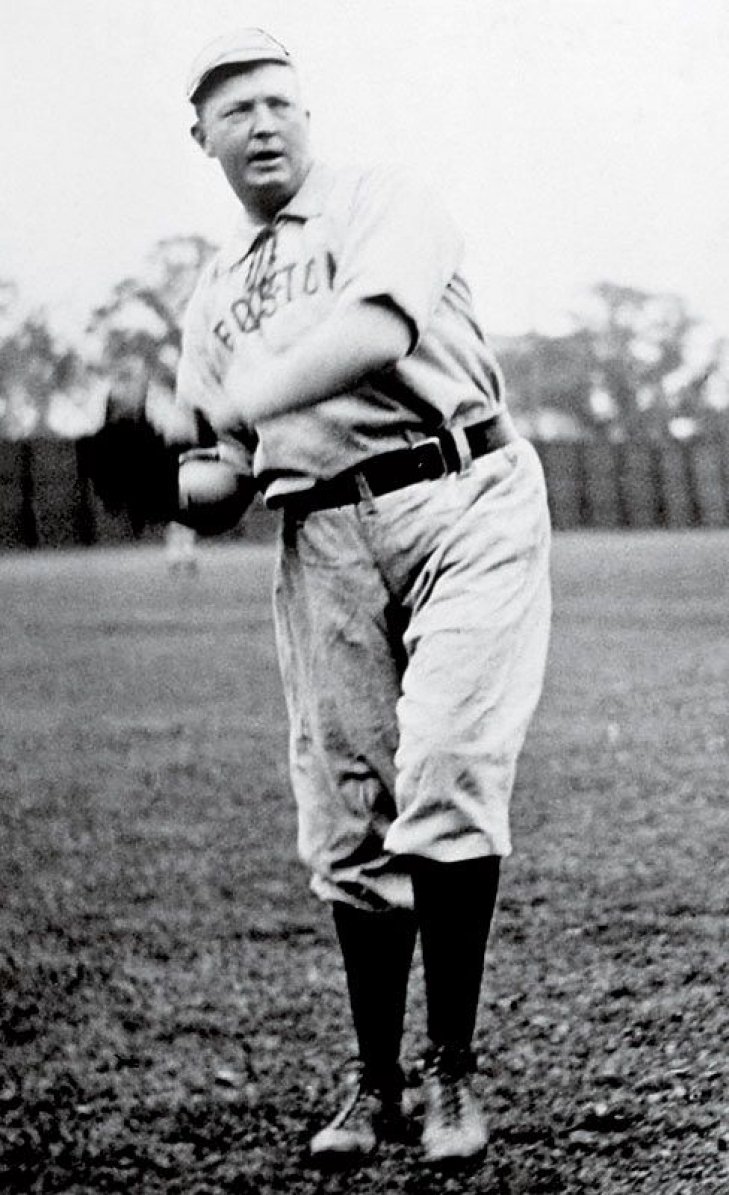
By the time Denton True "Cy" Young joined the upstart Boston Americans for their inaugural 1901 season, he was already a legend with 267 wins to his name. Many expected the 34-year-old to be in the twilight of his career, but "The Cyclone" instead authored a second act that defined the birth of modern baseball. In his first year in Boston, he secured the American League’s first Pitching Triple Crown, leading the league in Wins (33), ERA (1.62), and Strikeouts (158).
Young’s dominance in the early 1900s was a clinic in efficiency. He followed his Triple Crown with back-to-back seasons leading the AL in Wins (32 in 1902 and 28 in 1903). His 1903 campaign was a masterpiece, as he famously threw the first pitch in modern World Series history and earned two wins to lead Boston to the inaugural championship. His control was so precise that he led the AL in WHIP and Strikeout-to-Walk ratio nearly every year, proving that velocity was nothing without his signature "cyclone" precision.
On May 5, 1904, Young achieved a feat of such advanced quality that remains one of the greatest single-game performances in history: the first perfect game in American League history. Out-dueling the eccentric Rube Waddell, Young retired all 27 Philadelphia Athletics in just 83 minutes. This was part of a staggering stretch where he didn't allow a hit for 24 consecutive innings, a record that stood as a testament to his untouchable command during the Deadball Era.
Young remained a workhorse for Boston through 1908, remarkably recording three more 20-win seasons as he pushed past the age of 40. Before being traded to Cleveland in 1909, he amassed 192 wins in a Boston uniform—a franchise record he currently shares with Roger Clemens. He finished his Boston tenure with a microscopic 2.00 ERA, 1,341 strikeouts, and a 0.970 WHIP, figures that set an impossible bar for every Red Sox pitcher who followed.
Inducted into the Baseball Hall of Fame in 1937 as part of its second class, Young was later honored as a charter member of the Boston Red Sox Hall of Fame. As for this high rank, it is a testament to how good he was, even though eight of his legendary 22 seasons were in Boston.
4. Wade Boggs
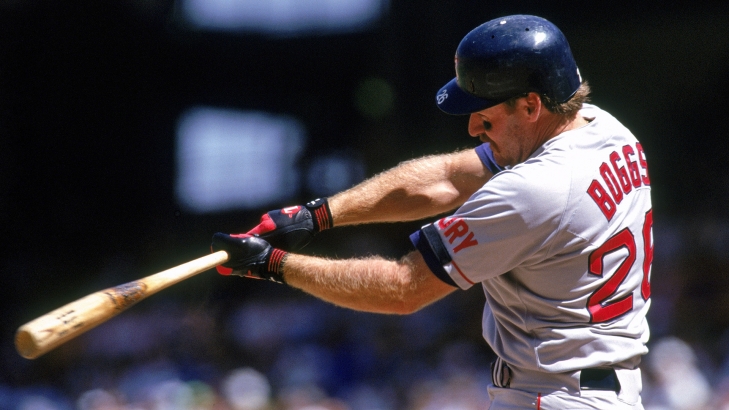
Wade Boggs didn't just play baseball; he orchestrated it. Arriving in Boston in 1982, Boggs immediately signaled his arrival with a remarkable rookie season, batting .349 over 104 games. It was a performance that would have secured the batting title had he reached the required plate appearances, and it served as a mere prelude to a decade of offensive dominance that saw him become the most consistent hitter in the American League.
From 1983 to 1988, Boggs authored one of the greatest peaks in the history of the sport, securing five batting titles in six seasons. During this stretch, he hit over .350 five times, with his only "off" year being a still-elite .325 campaign. Boggs was a master of the strike zone; if a pitcher didn't give him exactly what he wanted, he simply didn't swing. This discipline led to six On-Base Percentage titles and two seasons leading the AL in walks, whose efficiency at the plate was virtually unrivaled in the mid-80s.
Though his hitting acumen never quite secured him an MVP award—largely due to the power-hitting biases of the era—Boggs was a perennial contender, finishing in the top ten of the voting four times. His peers and coaches recognized his technical brilliance, rewarding him with six Silver Slugger Awards and eight All-Star selections during his time in Boston. Even as his power numbers remained modest, his ability to manipulate the bat and find the "Green Monster" at will made him the most feared contact hitter of his generation.
Boggs’ tenure in Boston concluded after the 1992 season when he signed with the rival New York Yankees, but his legacy at Fenway remained untouched. Over his twelve years with the Red Sox, he compiled 2,098 hits and maintained a staggering slash line of .338/.428/.462. He was a "Machine" in the truest sense, famously following a rigid pre-game routine involving chicken and ground balls that ensured he was the most prepared player on the field every single night.
Inducted into the Baseball Hall of Fame in 2005, Boggs was honored by the Red Sox in 2016 when they retired his Number 26, officially placing him among the immortals on the right-field facade.
3. Roger Clemens
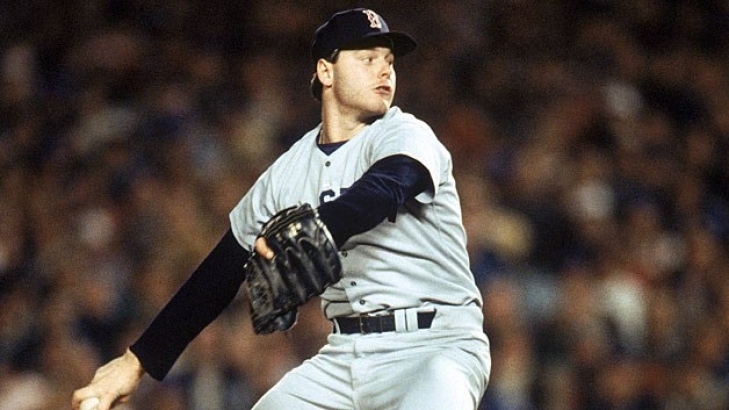
Roger Clemens arrived in Boston in 1984 as a power-pitching revelation, a Texas-sized arm that would redefine the "Rocket" nickname at Fenway Park. While his first two seasons showed glimpses of brilliance, his 1986 campaign was a historic explosion that remains the gold standard for Red Sox pitching. That year, Clemens became the rare pitcher to sweep the AL MVP and Cy Young awards, leading the league in Wins (24), ERA (2.48), and WHIP (0.969) while carrying Boston to the brink of a World Series title.
The “Rockets’" dominance was a nightly attraction. From 1986 to 1992, he was arguably the premier hurler in the game, securing two more Cy Young Awards (1987 & 1991) and authoring a monumental 20-strikeout game that stands as one of the most dominant single-game performances in baseball history. During this stretch, he was an efficiency machine, winning three more ERA titles and two Strikeout crowns, proving that his high-velocity "fuel" was inexhaustible.
Even as injuries slowed his pace in the early 90s, his metrics remained elite. Despite a losing record in 1995, Clemens showcased his enduring power by securing his third Strikeout Title with 257 punchouts. While the Red Sox front office infamously believed his peak was behind him when he departed for Toronto in 1997, his 13 seasons in Boston had already built a resume that remains unmatched in the franchise's modern era.
Clemens left Boston with a staggering record of 192–111, a 3.06 ERA, and 2,590 strikeouts. Though his career remains shadowed by PED suspicions that have barred him from Cooperstown, his place in Boston history was formalized with his induction into the Red Sox Hall of Fame in 2014. He remains the statistical ceiling for Boston pitchers, an anchor who proved that for over a decade, the road to the AL East title went directly through the Rocket's right arm.
While later chapters of his career would bring World Series rings and more hardware in other uniforms, his foundational years at Fenway defined an era of Boston baseball.