


Site Admin
6. Raymond Berry
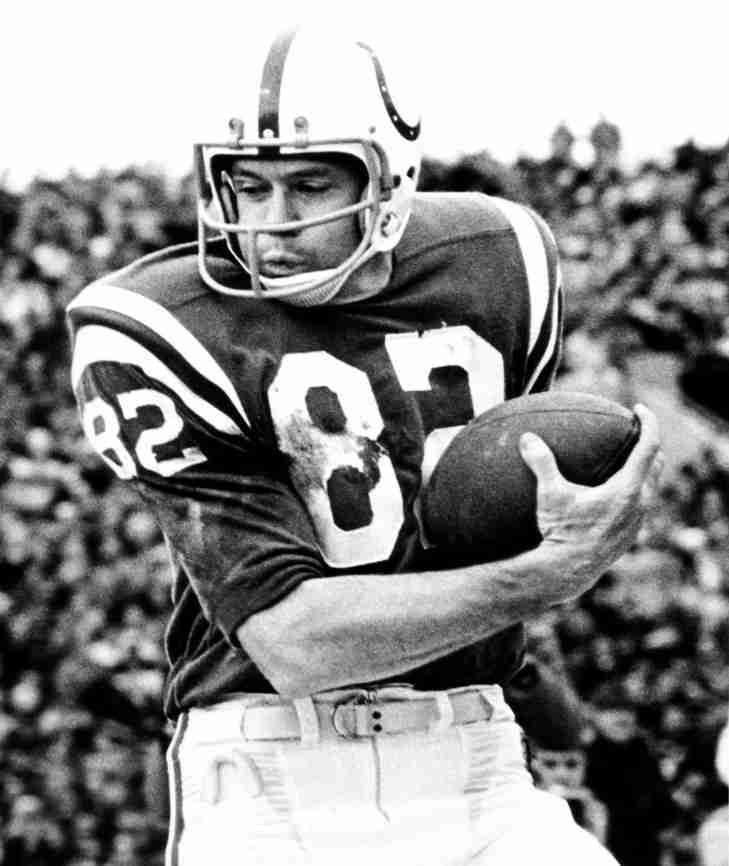
Overcoming a shortened leg, wearing a back brace, and dealing with poor eyesight that required thick-lensed glasses on the field, Raymond Berry turned physical adversity into legendary mastery. Drafted out of SMU in the 20th round in 1954, Berry spent hours after practice running routes until dark, pioneering precise route running and turning wide receiver play into a science.
Berry's relentless pursuit of perfection made him an ideal opponent for Johnny Unitas, forming the iconic passing duo of the 1950s. Though he lacked top-tier speed, Berry designed more than 50 different route variations, employing deceptive head fakes, quick cuts, and precise footwork to break away from defenders. With soft, dependable hands and a well-known grip-strengthening routine, he rarely let the ball slip and significantly reduced fumble occurrences.
His peak years, from 1957 through 1960, saw him dominate the league with mechanical precision. Berry led the NFL in receiving yards three times (1957, 1959, 1960) and in receptions three times (1958–1960), capturing the receiving "Triple Crown" in 1959 by leading the league in catches (66), yards (959), and receiving touchdowns (14). He earned three consecutive First-Team All-Pro honors (1958–1960) and was selected to six Pro Bowl rosters.
When championship stakes were highest, Berry was untouchable. In "The Greatest Game Ever Played"—the 1958 NFL Championship Game against the New York Giants—Berry caught 12 passes for 178 yards and a touchdown, including three critical receptions on the game-tying drive late in regulation to set up Baltimore's overtime victory. He followed that up with another title in 1959, cementing the Colts as a dominant force of the era.
Retiring as the NFL's all-time leader in receptions and receiving yards at the time, Berry's relentless work ethic established the modern template for route-running technique.
Berry compiled 631 receptions, 9,275 receiving yards, and 68 receiving touchdowns, along with two NFL Championship titles (1958, 1959). He was named to the NFL 1950s All-Decade Team, 75th Anniversary Team, and 100th Anniversary Team. Berry was enshrined in the Pro Football Hall of Fame in 1973 and inducted into the Colts Ring of Honor.
5. Marvin Harrison
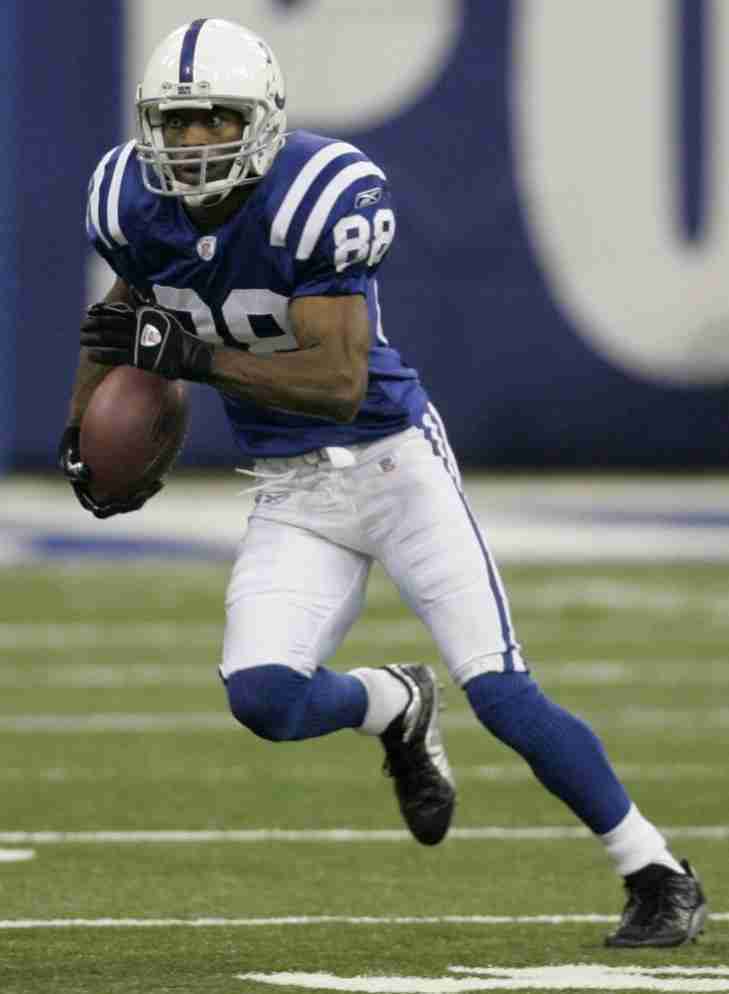
Quiet, unassuming, and ruthlessly clinical on the field, Marvin Harrison redefined route-running precision from the moment the Indianapolis Colts selected him 19th overall out of Syracuse in 1996. While he showed immediate promise over his first two seasons, his career reached supersonic speeds in 1998 with the arrival of rookie quarterback Peyton Manning. Together, they forged the most prolific and telepathic passing partnership in pro football history, completely torching NFL secondary schemes for a decade.
Harrison’s playing style relied on spatial mastery rather than physical frame. Operating at a lean 6-foot-0, he possessed an uncatchable release off the line of scrimmage, using sudden, violent footwork and quick hands to render press coverage completely useless. Opposing cornerbacks couldn't jam him, and his ability to sink his hips and make full-speed breaks on 90-degree angles left defenders flailing in open space.
Beyond his routes, Harrison was arguably the greatest boundary artist the sport has ever seen. He specialized in tiptoeing the sidelines, adjusting late to deep balls over his shoulder, and plucking passes out of the air with sticky, effortless hands before defenders could even react. His refusal to engage in trash talk or elaborate celebrations only heightened his terrifying aura; he simply handed the ball to the referee and lined up to destroy the defense again on the very next snap.
His absolute statistical peak from 1999 through 2002 stands as one of the most blistering four-year stretches by any receiver in gridiron history. During this span, Harrison averaged 120 receptions, 1,580 yards, and nearly 13 touchdowns per season. The masterpiece arrived in 2002, when he shattered Herman Moore's single-season record by hauling in an astonishing 143 receptions for 1,722 yards and 11 touchdowns—a mark that stood untouched for 17 years.
When the Colts finally broke through to win Super Bowl XLI over Chicago, Harrison served as the veteran offensive anchor. By the time he hung up his cleats, his telepathic chemistry with Manning had yielded NFL records for the most completions (953), passing yards (12,766), and passing touchdowns (112) by a QB-WR duo.
Harrison played in 190 regular-season games with 188 starts. He compiled 1,102 receptions, 14,580 receiving yards, and 128 receiving touchdowns, along with a Super Bowl XLI championship ring. An eight-time Pro Bowler, three-time First-Team All-Pro, two-time NFL receiving yardage leader, and member of the NFL’s 2000s All-Decade Team, Harrison was inducted into the Colts Ring of Honor in 2011 and enshrined into the Pro Football Hall of Fame in 2016.
3. Gino Marchetti
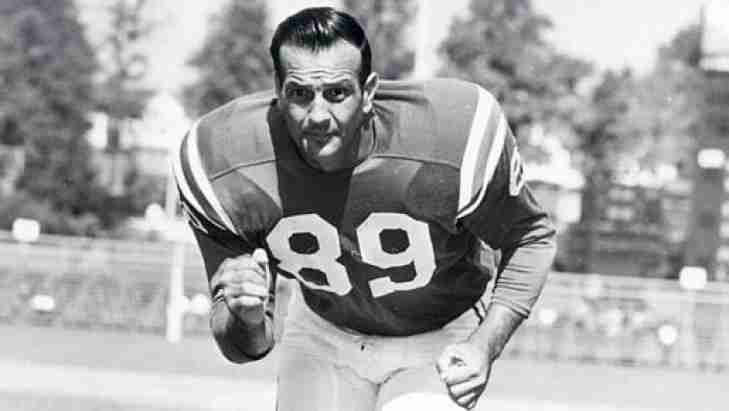
A World War II veteran who fought in the Battle of the Bulge before starring at the University of San Francisco, Gino Marchetti arrived in Baltimore in 1953 via the Dallas Texans dispersal draft. Standing 6-foot-4 and 245 pounds at defensive end, Marchetti redefined edge play in pro football, deploying an explosive speed rush, elite leverage, and cat-like agility that made him virtually unblockable for a decade.
Technically, Marchetti operated ahead of his time. He was one of the first defensive ends to weaponize a true "arm-over" swim move, slapping away an offensive tackle’s hands the instant the ball was snapped to burst into the backfield untouched. When blockers tried to set up wide to counter his outer-edge speed, Marchetti would convert his momentum into raw, bull-rushing power, collapsing the pocket directly into the quarterback’s face. Opposing coaches routinely assigned two or three blockers to slow him down, but his motor never idled, opening up easy pass-rushing lanes for teammates like Art Donovan and Eugene Lipscomb.
Beyond his pass-rushing acrobatics, Marchetti set a gold standard for interior edge setting against the run. He possessed extraordinary peripheral vision and spatial awareness, diagnosing play-action fakes in a heartbeat and shedding blocks to shut down sweep plays before they could develop. Hall of Fame offensive tackle Forrest Gregg once called Marchetti the single hardest player he ever had to block, marveling at how a player could combine such ferocious physical contact with absolute tactical discipline.
His peak years from 1956 through 1964 represent one of the most dominant individual stretches in NFL history, yielding nine First-Team All-Pro selections across his career. In 1957, Marchetti spearheaded a defense that turned Baltimore into an elite contender, and by 1958, he was the undisputed heart of the squad. In 1960, informal film charts credit him with leading the league in sacks, and unofficial Colts team tracking once recorded him logging an astounding 43 sacks in a single 12-game season—a testament to how completely he destroyed opposing game plans.
His defining moment unfolded during "The Greatest Game Ever Played"—the 1958 NFL Championship Game against the New York Giants. With Baltimore clinging to a late lead, Marchetti made a game-saving tackle on third down to stop Frank Gifford short of a first down, breaking his own leg in a violent pileup. Refusing to leave the field for treatment, Marchetti watched from a stretcher behind the end zone as his teammates rallied to win in overtime, securing the franchise's first world title before returning the following season to captain a repeat championship in 1959.
From 1954 through 1964, Marchetti earned 11 consecutive Pro Bowl selections, cementing his place as the cornerstone of Weeb Ewbank’s defense. Though sacks were not an official NFL statistic during his playing days, modern film study credits him with 138.0 unofficial career sacks (though only 56.0 via the work of Pro Football Reference), making him one of the premier pass rushers in gridiron history.
Marchetti was also a member of the NFL’s 1950s, 75th, and 100th Anniversary Teams; he was inducted into the Hall of Fame in 1972, and the Colts retired his No. 89.
2. Johnny Unitas
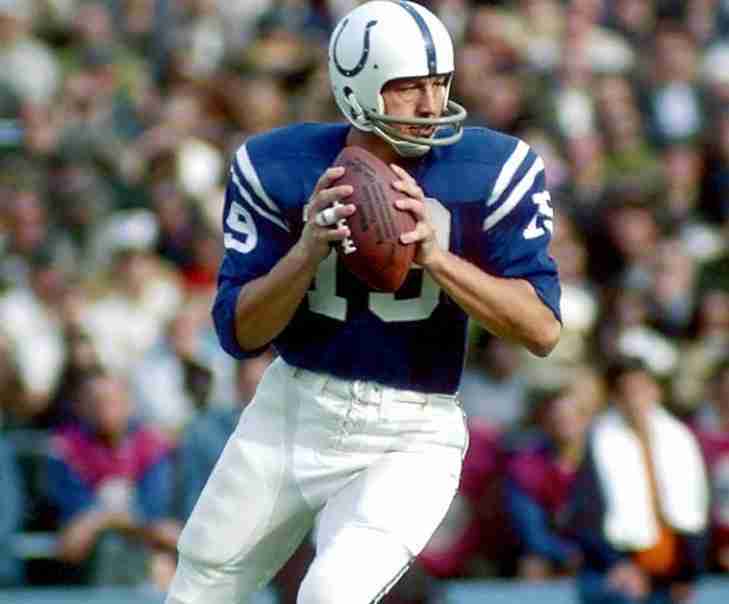
Drafted in the ninth round of the 1955 NFL Draft by the Pittsburgh Steelers—who notoriously cut him before he ever played a down—Johnny Unitas was forced to play semi-pro ball for $6 a game on a dirt field in Pittsburgh while working construction to support his family. Baltimore Colts head coach Weeb Ewbank offered him a second chance in 1956, signing him as a backup. When starter George Shaw broke his leg early that season, Unitas stepped off the bench, threw an interception on his first attempt, and then laid the blueprint for every modern quarterback that followed.
What made "Johnny U" standout among his peers was his exceptional mastery of the passing game, earning him the nickname "The Golden Arm.” Wearing his signature black high-top cleats, Unitas showed unwavering confidence in the pocket, often holding the ball until the last moment to throw accurate passes while absorbing hits from unblocked defenders. He introduced the two-minute drill, made the hurry-up offense popular, and called his own plays from the huddle with a bold, calculated approach that kept defenses guessing and off-balance.
By 1957, Unitas had fully assumed control in Baltimore, leading the franchise to its first winning season while ranking first in the NFL for passing yards (2,550) and touchdown passes (24). The next season was truly remarkable. Unitas guided the Colts to the 1958 NFL Championship Game against the New York Giants, famously called "The Greatest Game Ever Played.” During the league's inaugural sudden-death overtime, Unitas remained calm under pressure as he methodically moved Baltimore down the field, culminating in Alan Ameche’s game-winning touchdown run—a nationally televised moment that propelled professional football into America's top sport.
In 1959, Unitas reached a career high by winning his first AP NFL MVP award, leading the league with 2,899 passing yards and 32 touchdown passes. He finished the season by spearheading a fourth-quarter comeback to beat the Giants in a rematch of the title game, securing back-to-back championships for Baltimore. During this period, Green Bay legend Vince Lombardi famously said about Unitas: "Without him, they're just ordinary. With him, they're great.”
His consistent performance during the regular season set numerous historical records, most famously a streak of 47 straight games with at least one touchdown pass from 1956 to 1960. This record remained unbroken for 52 years, highlighting his dependability week after week during an era when passing rules provided quarterbacks little protection from severe hits.
In 1964, Unitas secured his second NFL MVP award after leading the Colts to a 12–2 season, passing for 2,824 yards and achieving a league-leading 9.3 yards per attempt. He won a third MVP in 1967, completing a league-high 58.5% of his passes for 3,428 yards. Despite injuries toward the end of his career, his veteran leadership helped guide the Colts to victory in Super Bowl V, where they defeated the Dallas Cowboys, and he earned his final world championship ring.
Throughout 17 seasons in Baltimore (1956–1972), Unitas played 206 games, with 39,768 passing yards and 287 touchdowns. A three-time NFL MVP, five-time First-Team All-Pro, and 10-time Pro Bowler, he retired as the NFL's all-time leader in passing yards, completions, and touchdowns. Named to the NFL’s 50th, 75th, and 100th Anniversary All-Time Teams, his No. 19 jersey was retired by the Colts. Enshrined in the Hall of Fame in 1979, Unitas is regarded as the father of modern quarterback play.
