


Site Admin
9. Tom Mack
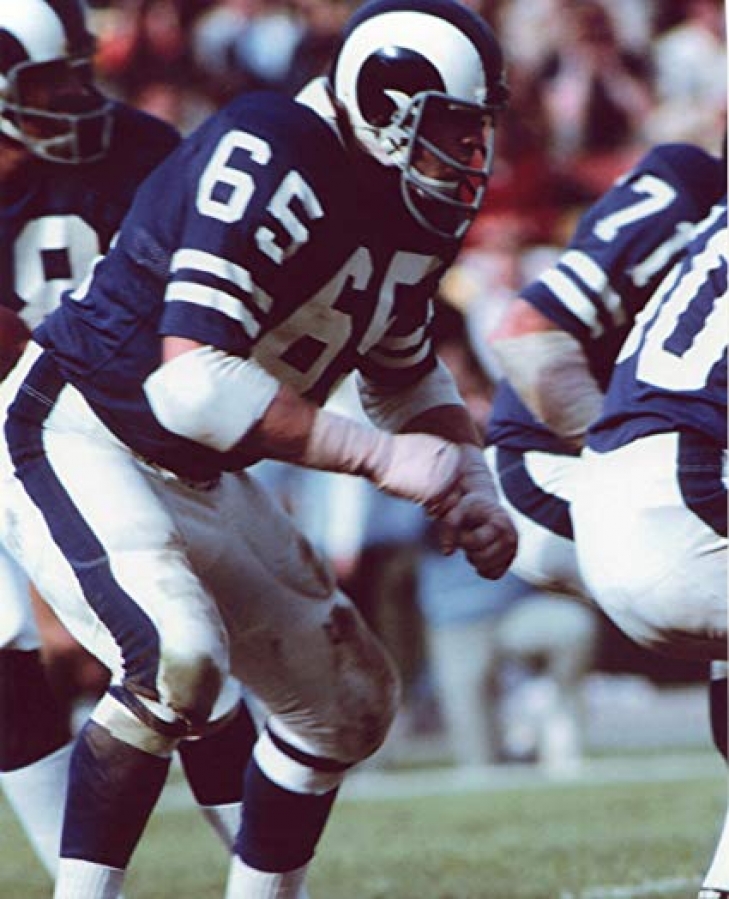
Tom Mack entered the NFL in Los Angeles as the second overall pick in the 1966 NFL Draft out of Michigan, and the Rams quickly figured out what they had. He worked into the starting left guard job midway through his rookie year and never really gave it back. By his second season, he was already a Pro Bowl selection, the first of eleven straight trips that spanned most of his career.
For more than a decade the Rams simply didn’t have to worry about left guard. Mack was a steady, technically sound blocker who preferred the run game and used his speed on sweeps. He wasn’t the biggest or most punishing guard of his era, but he was consistent enough to earn first- or second-team All-Pro honors in most years and keep the left side of the line solid, no matter who played next to him.
The durability was just as impressive as the production. Mack appeared in 184 consecutive games over thirteen seasons and never missed a start once he locked down the job. That streak ranked near the top of Rams history at the time, and it meant the offense could count on the same reliable presence week after week while the team stayed competitive.
During his years, the Rams were one of the league’s better clubs, winning their division eight times and reaching four NFC Championship Games. Mack was a big part of the offensive line that helped make that possible, protecting the quarterback and opening lanes for the running game while the rest of the roster turned over around him. He stayed with the Rams for his entire career and retired after the 1978 season.
He finished with 176 starts and a reputation as one of the most dependable guards of his generation. The individual awards were plentiful, but the real story was the quiet consistency that kept the left side of the line from ever becoming a problem.
The Pro Football Hall of Fame called him in 1999, a well-earned recognition for the second overall pick who turned into an eleven-time Pro Bowler and one of the steadiest offensive linemen the Rams have ever had.
14. Kurt Warner
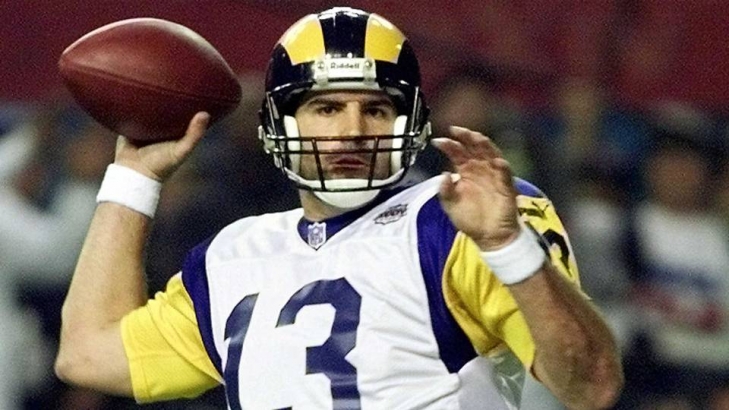
Kurt Warner’s path to the Rams was unlike almost anyone else’s. He went from Northern Iowa to stocking shelves, then the Arena League and NFL Europe before landing with St. Louis. When starter Trent Green went down in the 1999 preseason, Warner stepped in and never looked back. He became the starter that year and immediately looked comfortable in an offense built on timing, quick decisions, and downfield throws to Isaac Bruce, Torry Holt, and Marshall Faulk.
In 1999, he led the NFL in completion percentage and touchdown passes while throwing for 4,353 yards and 41 scores. The Rams went 13-3, and Warner won the MVP. In the playoffs, he kept producing, including a Super Bowl XXXIV performance that set a then-record with 414 passing yards. He threw the game-winning touchdown to Isaac Bruce late in the fourth quarter as the Rams beat Tennessee 23-16. Warner also earned Super Bowl MVP, becoming one of the few players to win both the regular-season and Super Bowl MVP awards in the same year.
He stayed at a high level in 2000 even though the Rams fell short of another Super Bowl run. Warner earned another Pro Bowl selection and again led the league in completion percentage. The offense still scored at a historic rate, and he remained the clear starter despite some turnover issues that season.
The peak came in 2001. Warner led the NFL in completions, completion percentage (for the third straight year), passing yards (4,830), and touchdown passes (36). He won his second MVP as the Rams went 14-2 and returned to the Super Bowl. This time they lost to the Patriots, but Warner’s three-year stretch had established him as one of the best quarterbacks in the league. He was an accurate passer with a quick release who thrived in a system that asked him to get the ball out fast and hit receivers in stride.
Injuries limited him the next two seasons. He played only seven games in 2002 and two in 2003 before the Rams released him. His time in St. Louis was relatively short, but the peak production was unmatched.
With the Rams, he threw for 14,447 yards and 102 touchdowns in those six seasons. Those numbers, concentrated in the 1999-2001 window, still rank among the best stretches any quarterback has put together for the franchise.
Warner later took the Arizona Cardinals to their first Super Bowl appearance. The Pro Football Hall of Fame inducted him in 2017, recognition for the quarterback who went from an undrafted long shot to the engine of one of the most explosive offenses the league has ever seen.
11. Elroy "Crazy Legs" Hirsch
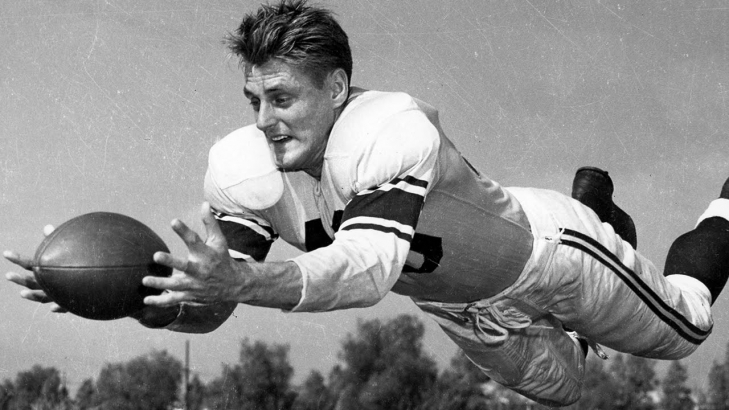
Elroy Hirsch earned the nickname “Crazy Legs” for the distinctive way he ran, legs gyrating in different directions as he shifted into top speed. He was already a known athlete by the time he reached the Rams, having starred at Michigan, served in the Marines, and then led a College All-Star team to a shutout win over the defending champion Rams in an exhibition. Drafted fifth overall by Los Angeles, he instead signed with the Chicago Rockets of the All-America Football Conference and played three seasons there before securing his release and joining the Rams in 1949.
His first two seasons in Los Angeles were solid but not spectacular. He worked mostly as a halfback before the Rams moved him to end, and he gradually settled into the role of a deep threat in an offense that was already throwing the ball more than most teams of the era. The breakthrough came in 1951. Hirsch caught 66 passes for 1,495 yards and 17 touchdowns in only 12 games. That yardage total nearly doubled the next-closest receiver in the league, and ten of his scores came on long bombs. He averaged 124.6 yards per game, a mark that stood for decades and still ranks among the highest single-season averages ever recorded.
The production helped the Rams win the NFL championship that year. Hirsch’s ability to stretch the field and make plays after the catch forced defenses to respect the deep ball, which opened things up for the rest of the offense. He wasn’t just a straight-line speed guy; the “Crazy Legs” gait made him hard to tackle once he got the ball in space, and he had a knack for tracking deep passes over his shoulder.
He never matched that 1951 season again, but he remained a productive receiver for the Rams through 1957. He posted solid numbers in several of those later years, including a 941-yard season in 1953, and he stayed a reliable part of the attack even as the roster changed. Hirsch retired after that 1957 campaign.
With the Rams he finished with 343 receptions for 6,299 yards and 53 touchdowns. Those numbers were outstanding for the era, especially the yardage total in a 12-game schedule. He also appeared in films during the 1950s, playing himself in a biopic that leaned into the nickname.
After his playing days he worked as a Rams executive and later served as athletic director at the University of Wisconsin. The Pro Football Hall of Fame inducted him in 1968, and he was later named to the NFL’s 100th Anniversary Team, recognition for the receiver whose unique running style and 1951 explosion helped define the early years of the modern passing game in Los Angeles.
10. Isaac Bruce
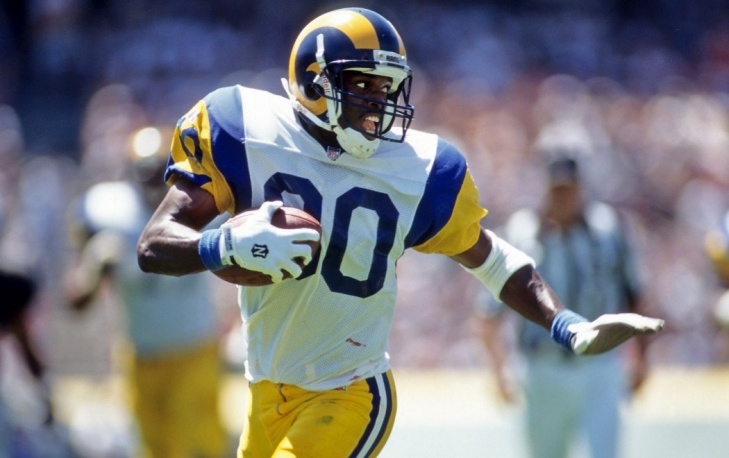
Isaac Bruce arrived as a second-round pick out of Memphis in 1994 and spent his first year mostly learning the NFL. The next season he exploded. In 1995, he caught 119 passes for 1,781 yards and 13 touchdowns, a total that still ranks among the highest single-season receiving yards in league history. He somehow missed the Pro Bowl that year, but the production announced him as one of the league’s better young receivers. He followed it in 1996 by leading the NFL with 1,338 yards and earning the first of his four Pro Bowl selections.
Bruce was a precise route-runner who could win at all levels and had the speed to stretch the field. He wasn’t the flashiest player, but he was reliable and tough enough to keep producing even as the Rams figured out what they wanted to be. After a couple of injury-shortened seasons, he was ready when the offense finally clicked.
Everything came together in 1999 when the Rams became the Greatest Show on Turf. Bruce caught 77 passes for 1,165 yards and 12 touchdowns as the offense tore through the league and finished 13-3. In Super Bowl XXXIV, he caught six passes for 162 yards, including a 73-yard touchdown from Kurt Warner late in the fourth quarter that proved to be the game-winner. The following year he posted 87 catches for 1,471 yards and nine touchdowns, then added 64 catches for 1,106 yards and six scores in 2001 as the Rams returned to the Super Bowl (this time losing to the Patriots). Those three seasons cemented him as the clear number-one target on one of the most explosive offenses the league has ever seen.
Bruce kept producing after the peak years. He posted more 1,000-yard seasons in 2002, 2004, and 2006, and he remained a steady target even as the roster turned over. He left for a brief stint with the 49ers after the 2007 season, then was traded back to the Rams so he could retire as a Ram in 2010.
With the Rams, he finished with 942 receptions, 14,109 receiving yards, and 84 touchdowns. Those numbers still sit at the top of the franchise’s receiving charts. The Rams retired his number 80 in 2010.
The Pro Football Hall of Fame inducted him in 2020, recognizing the receiver who went from a quiet second-round pick to the leading man of one of the most explosive offenses the league has ever seen.
