


Site Admin
16. Les Richter
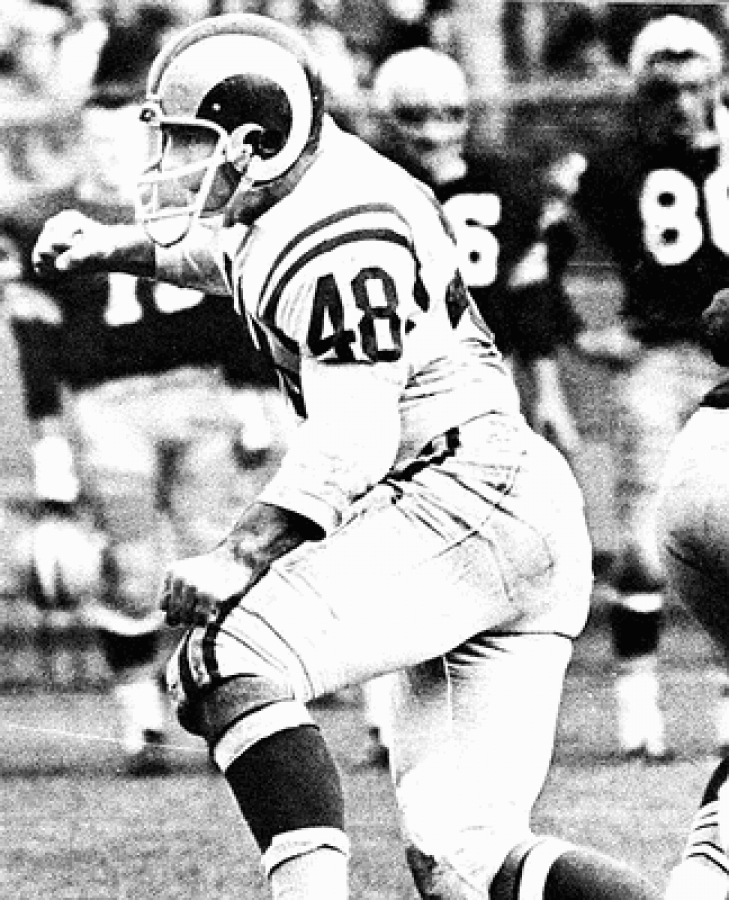
Les Richter never played for the team that drafted him. The New York Yanks took the California All-American second overall in 1952, but the franchise folded almost immediately. His rights moved to the new Dallas Texans, who then traded him to the Los Angeles Rams for 11 players. It looked like a steep price, but the Rams got the better end of the deal. After two years in the military, Richter joined the Rams in 1954 and quickly became a fixture.
He was unusually versatile from the start. Richter played primarily at linebacker, but he also lined up at guard early on and handled placekicking duties in his first few seasons. He led the team in scoring in 1955 and 1956 while converting field goals and extra points. On defense, he was a hard-hitting middle linebacker who excelled against the run and could also cover well enough to pick off 16 passes over his career. In one game, he broke his cheekbone and kept playing, showing the toughness that defined him.
Richter earned Pro Bowl selections in eight of his nine NFL seasons, missing the honor only in his final year. He earned first- or second-team All-Pro honors multiple times and became one of the era’s better linebackers. The Rams reached the championship game in 1955, and Richter’s physical play and reliability were a big part of the defense. He never missed a game across 112 appearances with the club.
In his last season, the Rams needed a center after Art Hunter went down, so Richter shifted over and handled the job. It was the kind of move only a player with his background could make. He retired after 1962, having spent his entire professional career in Los Angeles.
With the Rams, he recorded 16 interceptions and 193 points while making eight Pro Bowls. The Pro Football Hall of Fame inducted him posthumously in 2011 as a senior candidate, recognition for the tough, versatile linebacker who anchored the Rams defense through the 1950s and early 1960s.
13. Torry Holt
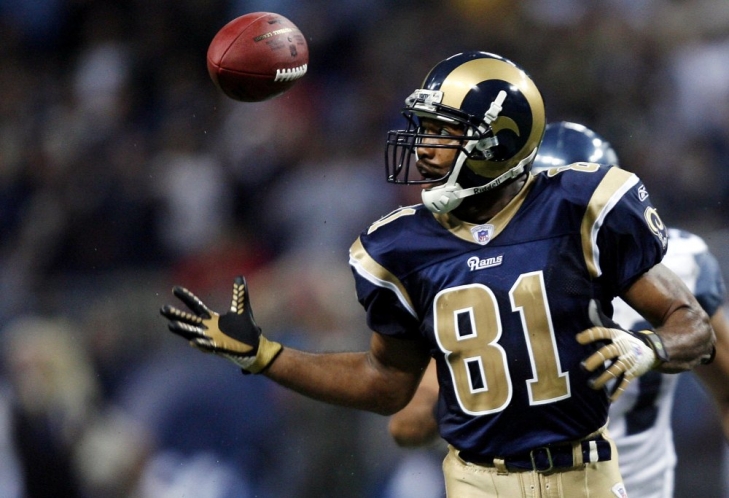
Torry Holt entered the league as the sixth overall pick out of North Carolina State in 1999 and immediately joined the Greatest Show on Turf. As a rookie, he caught 52 passes for 788 yards and six touchdowns while helping the Rams win Super Bowl XXXIV. In that game, he caught seven passes for 109 yards and a score, giving the offense another reliable option alongside Isaac Bruce. Holt was a precise route-runner with the speed to stretch the field and the hands to make contested catches, fitting perfectly into an attack that was already lighting up scoreboards.
He broke out the next season by leading the NFL with 1,635 receiving yards. In 2003, he topped that with a career-high 1,696 yards and an NFL-leading 117 receptions, earning First-Team All-Pro honors. From 2000 through 2005, he posted six straight seasons of at least 1,300 yards, a stretch of consistency few receivers have matched. He kept producing after that with two more 1,100-yard campaigns, staying a primary target even as the roster turned over and quarterbacks changed.
Holt earned seven Pro Bowl selections during his time with the Rams and remained one of the league’s most dependable receivers. Defenses knew he would be targeted, yet he kept creating separation and producing big plays week after week. The production never really dropped off until late in his run in St. Louis.
He left after the 2008 season and finished his career in Jacksonville. With the Rams, he totaled 869 receptions, 12,660 receiving yards, and 74 touchdowns. Those numbers rank among the best in franchise history and reflect a decade of steady excellence.
Holt was named to the NFL’s 2000s All-Decade Team. He has been a frequent Hall of Fame finalist in recent years, recognition for the receiver who went from a Super Bowl champion as a rookie to one of the most consistent producers of his era in St. Louis.
15. Norm Van Brocklin
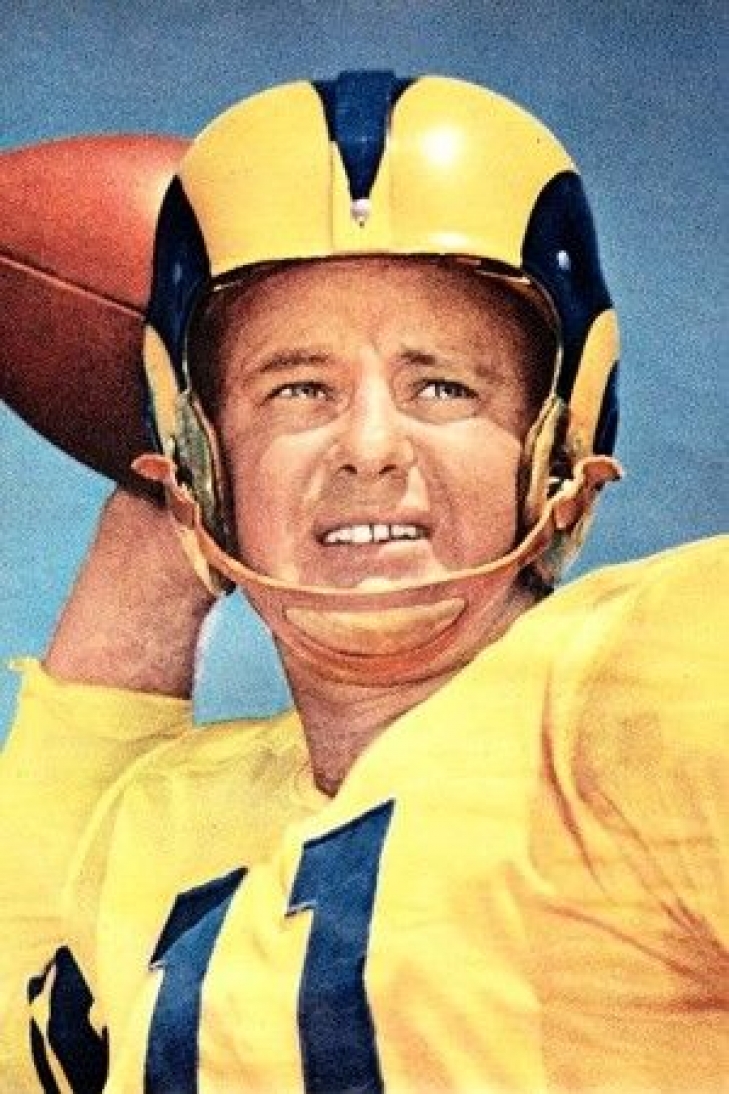
The Rams got a bargain when they took Norm Van Brocklin in the fourth round of the 1949 draft. Teams had assumed he would return to Oregon for his senior year, so he fell further than his talent warranted. He arrived in Los Angeles and joined a quarterback tandem with Bob Waterfield that powered one of the league’s most explosive offenses. The two split time early on, and in 1951 they helped the Rams win the NFL championship. Van Brocklin threw the game-winning 73-yard touchdown to Tom Fears in the title game against Cleveland.
He was a strong-armed passer who thrived throwing deep and could also handle punting duties. In 1951, he set a still-standing single-game record by throwing for 554 yards against the New York Yanks. After Waterfield retired, Van Brocklin became the full-time starter. In 1954, he led the NFL in passing yards, and he finished first in yards per attempt four times during his Rams career. He earned six Pro Bowl selections while in Los Angeles and was widely regarded as one of the better quarterbacks of the 1950s.
Van Brocklin remained productive through the mid-1950s, posting solid yardage totals even as the roster changed. He was known for his competitiveness and willingness to throw deep, which fit the Rams’ wide-open attack. By the end of the 1957 season, he had grown frustrated with the coaching situation and briefly retired.
He came back after agreeing to a trade to the Philadelphia Eagles, where he played three more seasons and won another championship. With the Rams, he finished with 16,114 passing yards and 118 touchdowns in nine seasons. Those numbers were outstanding for the era and reflected a consistent presence in one of the league’s most pass-heavy offenses.
After his playing days, he coached and later worked in broadcasting. The Pro Football Hall of Fame inducted him in 1971, recognizing the quarterback who shared the job early, then took over and helped define the Rams’ passing game in the 1950s.
12. Eric Dickerson
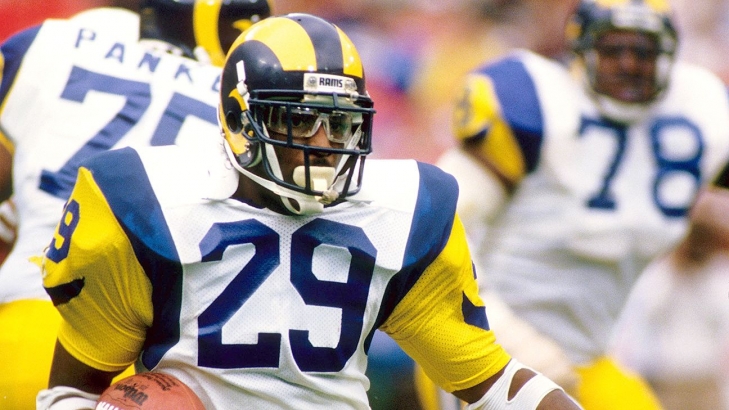
Eric Dickerson arrived in Los Angeles as the second overall pick out of SMU in 1983 and immediately looked like the league’s most explosive runner. As a rookie, he led the NFL with 1,808 rushing yards and 18 touchdowns on 390 carries, earning Offensive Rookie of the Year honors while also catching 51 passes for another 404 yards. He ran upright with a long, smooth stride that made him hard to bring down once he got into the open, combining rare size and speed in a way that forced defenses to account for him on every play. That season he had multiple 100-yard games and scored in bunches, including a three-touchdown performance against Detroit.
The following year he broke O.J. Simpson’s single-season rushing record with 2,105 yards and 14 touchdowns on 379 carries. He topped 100 yards in twelve games, including a 215-yard outing against Houston and a 208-yard day against the Cardinals. That total still stands as the NFL mark. Dickerson was a First-Team All-Pro that season, and the production carried the Rams into the playoffs. He followed it with another solid year in 1985 (1,234 yards and 12 scores despite missing time), then topped 1,800 yards again in 1986 on a league-high 404 carries. In those peak seasons, he earned multiple First-Team All-Pro nods and led the league in rushing more than once.
He was just as dangerous in the postseason. In the 1985 playoffs, he ran for a then-record 248 yards and two touchdowns in a win over Dallas, a performance that still ranks among the greatest single-game rushing efforts in playoff history. The combination of volume and big-play ability made him the clear centerpiece of the Rams’ offense for four seasons. Contract issues eventually ended the run. Midway through the 1987 season, the Rams traded him to Indianapolis in a multi-team deal after prolonged disputes over money. His time in Los Angeles was relatively short, but the production was unmatched.
With the Rams, he finished with 7,245 rushing yards and 56 touchdowns in 65 games. Those numbers remain among the best stretches any back has ever put together for the franchise.
The Pro Football Hall of Fame inducted him in 1999, and the Rams retired his number 29. It recognized the runner who set the single-season record and redefined what a franchise back could look like in Los Angeles.
