gold star for USAHOF
Committee Chairman

Committee Chairman

Kirk Buchner, "The Committee Chairman", is the owner and operator of the site.  Kirk can be contacted at [email protected] .

Ken Anderson was drafted in the third round (67th overall) of the 1971 NFL Draft from Division III Augustana College. He joined Cincinnati quietly, without the fanfare typically given to marquee college stars. Throughout his 16-year career with the Bengals, Anderson developed into an accurate passer, a trailblazer of contemporary offensive strategies, and one of the most productive quarterbacks in franchise history.

Anderson provided a clear blueprint for effective passing. Under offensive coordinator Bill Walsh's guidance, he became the primary driver of what is now called the "West Coast Offense." Anderson emphasized quick reads, precise dropback footwork, and accurate ball placement on short and intermediate horizontal routes. While he had the arm strength to challenge defenses deep, his true skill was in his decision-making—consistently taking what defenses allowed and avoiding costly turnovers.

Anderson assumed the permanent starting role in 1972, guiding Cincinnati to a 7-6 record before emerging as a top-tier passer in the following two years. In 1974, he won his first league passing titles, leading the NFL in passing yards (2,667) and passer rating (95.7), with a completion percentage of 64.9%.

He led the NFL in passing yards again in 1975, with 3,169 yards and 21 touchdowns, earning his first Pro Bowl and Second-Team All-Pro honors. Off the field, his character was recognized with the 1975 Walter Payton NFL Man of the Year award. He continued his excellence with another Pro Bowl appearance in 1976, consistently helping Cincinnati remain in playoff contention despite roster changes late in the decade.

Anderson's career reached its peak in 1981. After overcoming early-season setbacks, he delivered an outstanding season, achieving career bests with 3,754 passing yards, 29 touchdown passes, and a league-best 98.4 passer rating. He secured all major individual awards, including the AP NFL MVP, AP Comeback Player of the Year, AP Offensive Player of the Year, and the Bert Bell Award, along with First-Team All-Pro honors.

Most importantly, Anderson guided Cincinnati to a 12–4 record, a legendary victory over San Diego in the icy "Freezer Bowl," and the franchise's first-ever appearance in Super Bowl XVI. In the championship game against San Francisco, Anderson completed 25 of 34 passes for 300 yards and two touchdowns, setting a then-Super Bowl record for completion percentage (73.5%).

During the strike-shortened 1982 season, Anderson set an NFL single-season record by completing 70.6% of his passes (218 of 309 for 2,495 yards), a record that stood for nearly three decades. He earned his fourth career Pro Bowl nod and led the league in completion percentage once more in 1983 (66.7%).

As injuries began to take their toll, Anderson transitioned into a backup role behind Boomer Esiason before retiring following the 1986 campaign. Across 16 seasons in Cincinnati, he played in 192 regular-season games, holding enduring franchise records with 32,838 passing yards and 197 touchdown passes, while adding 2,220 rushing yards and 20 rushing touchdowns on the ground. At the time of his retirement, he ranked sixth in NFL history in career passing yardage.

Long regarded as one of the finest quarterbacks not yet enshrined in Canton, Anderson reached the final doorstep as a Senior Finalist for the Pro Football Hall of Fame Class of 2026. When the franchise created the Cincinnati Bengals Ring of Honor in 2021, Anderson was fittingly enshrined as one of the four inaugural charter members alongside Anthony Muñoz, Paul Brown, and Ken Riley.

Who else could it possibly be?

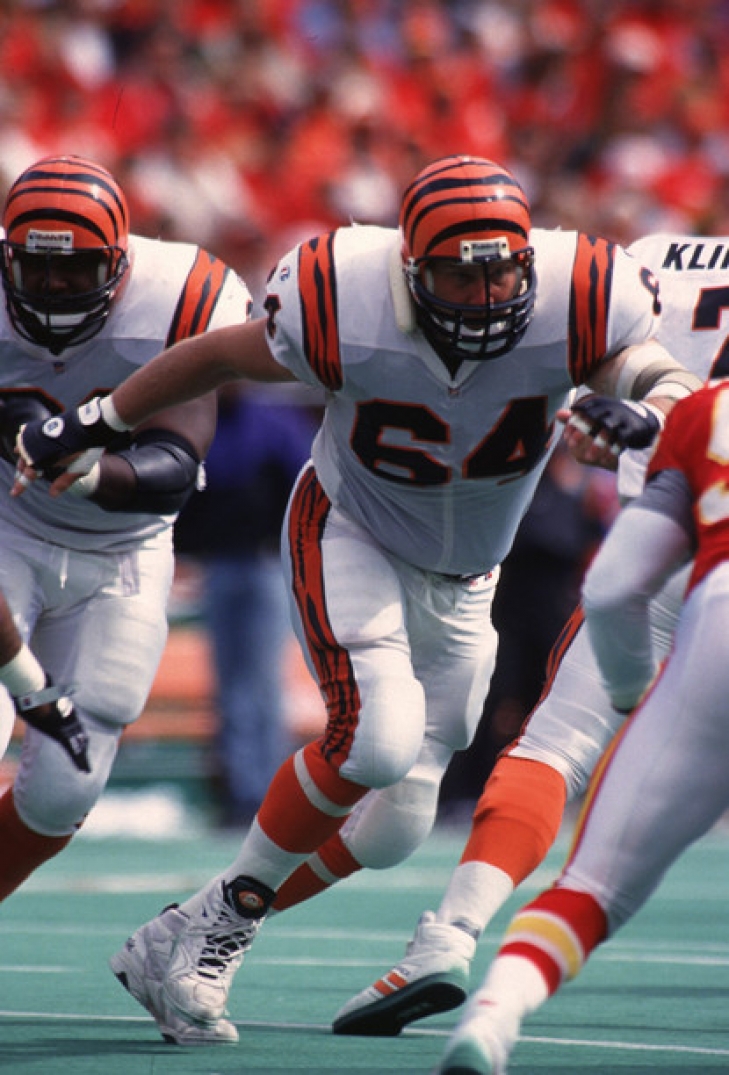
Drafted third overall in the 1980 NFL Draft from USC, Anthony Muñoz joined Cincinnati after excelling in both football and baseball at college, winning national titles in each. Despite significant knee injuries that kept him out for most of his last two college seasons and led several teams to pass on him, the Bengals made a strategic gamble. This choice laid the groundwork for the franchise's success over the next 13 years and is often regarded as producing the NFL's greatest offensive tackle.

Muñoz, standing 6 feet 6 inches and weighing 278 pounds, redefined what edge pass protectors are capable of. With basketball-style footwork and exceptional upper-body strength, he could handle top pass rushers independently, without assistance from tight ends or running backs. His intense offseason training—lifting heavy weights and running stadium stairs—built his exceptional fourth-quarter stamina. In pass protection, his wide stance and forceful hand strikes effectively countered both speedy rushers and powerful bull-rushers. In the running game, he demonstrated explosive lateral quickness, allowing him to reach block interior tackles or ascend to the second level to block linebackers.

Muñoz made an instant impact as a rookie in 1980, starting all 16 games and earning PFWA All-Rookie Team honors while nearly halving the sacks surrendered by Cincinnati's offensive line. His sophomore season in 1981 launched an unmatched decade of individual dominance. Anchoring Ken Anderson's blind side, Muñoz earned his first First-Team All-Pro selection and Pro Bowl trip while powering the Bengals to an AFC Central title, a victory in the icy "Freezer Bowl," and an appearance in Super Bowl XVI.

From 1981 to 1991, Muñoz achieved an impressive streak of 11 consecutive Pro Bowl selections. He was awarded First-Team All-Pro honors in nine of those seasons (1981–1983, 1985–1990) and received Second-Team All-Pro recognition in two (1984, 1991). Additionally, he was named NFL Players Association Lineman of the Year four times (1981, 1985, 1988, 1989) and was recognized as NFL Alumni Association Offensive Lineman of the Year four times (1987, 1989–1991).

His athletic versatility made him a weapon near the goal line. Lining up as a tackle-eligible receiver on short-yardage plays, Muñoz caught seven career passes for 18 yards and four touchdowns, including a touchdown reception from rookie Boomer Esiason against Cleveland in 1984.

During Cincinnati's 1988 championship season, Muñoz served as the physical anchor for the league's top-ranked rushing attack. He led the way for Ickey Woods and James Brooks as the Bengals stormed to a 12–4 record and advanced to Super Bowl XXIII, where his line gave up zero sacks in a heartbreaking 20-16 loss to San Francisco.

Off the field, Muñoz established himself as a Pillar in the Queen City community. His charitable devotion earned him the 1991 Walter Payton NFL Man of the Year award, highlighting a career dedicated to youth programs and civic leadership across Southwestern Ohio.

Battling lingering injuries in 1992, Muñoz played eight games in his final year in Cincinnati before retiring after 13 seasons. Across his regular-season career in stripes, he played in 185 games, starting 182 of them.

Selected to the NFL 1980s All-Decade Team, the NFL 75th Anniversary All-Time Team, and the NFL 100th Anniversary All-Time Team, Muñoz represents the gold standard for his position. His legacy received its ultimate national recognition when he was elected to the Pro Football Hall of Fame in 1998 on his first ballot, standing as the first primary Bengal to enter Canton. In 2021, when the franchise created the Cincinnati Bengals Ring of Honor, Muñoz was enshrined as an inaugural charter member.

Muñoz will likely be number one for decades to come.

2020 has been a brutal year for us all, and it isn’t over yet.

It was announced today that Hall of Fame Linebacker, Kevin Greene, passed away today at the age of 58.  It was not announced at this time how he died.

Playing his college ball at Auburn, Greene was taken in the Fifth Round in 1985 by the Los Angeles Rams.  After three years coming off the bench in a pass-rush role, Greene became a starter in 1988, and posted 16.5 Sacks, a number he matched in 1989, while also going to his first Pro Bowl.  

The Linebacker joined the Pittsburgh Steelers in 1993, where he not only joined a competitive team but was gaining national attention.  A Steeler from 1993 to 1995, Greene helped the Steelers reach Super Bowl XXX, and in 1994, he led the NFL in Sacks with 14.0, while also earning First Team All-Pro honors.  

Greene moved to Carolina for 1996, where his 14.5 Sacks led the NFL, and he was a First Team All-Pro for the second time.  He was in the NFL for three more years, one with San Francisco and two more with Carolina.  

He would accumulate 160.0 Sacks and was a five-time Pro Bowl Selection.

Greene was elected to the Pro Football Hall of Fame in 2016.

We here at Notinhalloffame.com would like to extend our condolences to the friends, fans and family of Kevin Greene.

We here at Notinhalloffame.com thought it would be fun to take a look at the major awards in North American team sports and see how it translates into Hall of Fame potential.

Needless to say, different awards in different sports yield hall of fame potential.  In basketball, the team sport with the least number of players on a roster, the dividend for greatness much higher.  In baseball, it is not as much as a great individual season does not have the same impact.

Last time, we looked at the now defunct Rolaids Reliever of the Year, an award that was mathematically calculated to honor the best closer. This time, we have another award from the past, in the Delivery Man of the Year.

Existing from 2005 to 2013, the Delivery Man of the Year was not awarded in each league, but the rather to best Relief Pitcher in Baseball. Its time overlapped the Rolaids Reliever of the Year (which ended in 2012) and ended when the Mariano Rivera AL Reliever of the Year and Trevor Hoffman NL Reliever of the Year came into fruition in 2014.

So how many Delivery Man of the Year winners have made the Baseball Hall of Fame?

Let’s find out!

The following are the past players who have won the Delivery Man of the Year Award who are eligible for the Baseball Hall of Fame and have been enshrined.

Mariano Rivera, New York Yankees: 7-4, 43 Saves, 1.38 ERA, 80 SO, 2005   

Who else should win this first?  Rivera, who was also the Rolaids Reliever of the Year also led the American League in Games Finished (67), and this was the first year he had an ERA under 1.50.  He finished second in Cy Young voting and ninth in MVP voting.

Inducted into the Hall of Fame in 2019.

Mariano Rivera, New York Yankees: 5-5, 34 Saves, 1.80 ERA, 55 SO, 2006 (2)   

An All-Star for the eighth time, Rivera again kept his ERA under two (1.80) and WHIP under one (0.960), a sick statistic considering he did that seven times! 

Inducted into the Hall of Fame in 2019.

Mariano Rivera, New York Yankees: 3-3, 44 Saves, 1.76 ERA, 72 SO, 2009 (3) 

This was Rivera’s third and final Delivery Man of the Year win and it also coincided with his fifth (and final) Rolaids Reliever of the Year Award. Rivera would later take the Yankees to another World Series win, his fifth.  He played until 2013, was a thirteen-time All-Star, and retired with 652 Saves, the most all-time.  Rivera entered the Baseball Hall of Fame with a perfect ballot, the first man to do so.

Inducted into the Hall of Fame in 2019.


The following are the players who have won the Delivery Man of the Year who are eligible for the Baseball Hall of Fame and have not been selected:

Brad Lidge, Philadelphia Phillies: 2-0, 41 Saves, 1.95 ERA, 92 SO, 2008

After six years with the Houston Astros, Brad Lidge was traded to the Houston Astros where in his first year, he was an All-Star for the second time, won the Rolaids Relief Award, the Delivery Man of the Yeat, and helped the Phillies win the World Series.  He would also finish fourth in Cy Young voting.  Lidge played five more years, but it was up and down, and he never came close to his 2008 season again.  He retired with 225 Saves.

Eligible since 2018.  Lidge was on the ballot for one year on 2018 but did not receive any votes.  Unranked on Notinhalloffame.com.

Heath Bell, San Diego Padres: 6-1, 47 Saves, 1.93 ERA, 86 SO, 2010 

Bell went back-to-back for the Rolaids Award, exceeding his 42 Save mark to 47.  Winning his only Delivery Man of the Year Award, this would be the only year where he dropped his ERA to below two, and he was an All-Star again.  Bell had 43 Saves in 2011, and was an All-Star for the third straight year.  His All-Star runs were over, as was his stay in San Diego.  Bell played three more seasons, one with Miami, Arizona and Tampa Bay, and accrued 168 Saves over his career. 

Eligible since 2020.  Bell was on the ballot for one year on 2020 but did not receive any votes.  Unranked on Notinhalloffame.com.

Jose Valverde, Detroit Tigers: 2-4, 49 Saves, 2.56 ERA, 78 SO, 2011 

Joining the Detroit Tigers in 2010, Valverde led the AL in Saves (49), Games Finished (70) and Games Pitched (75) this season. He would also win the Rolaids Reliever of the Year, and was fifth in Cy Young voting.  Valverde played until 2014, with a final year as a Met, and he accrued 288 Saves.

Eligible since 2020.  Valverde was on the ballot for one year but did not receive any votes.  Unranked on Notinhalloffame.com. 

Let’s update our tally, shall we?       

Award in Question

Percentage of recipients who have entered the HOF

Percentage of recipients by year who have entered the HOF.

NBA MVP

100%

100%

NHL Art Ross

100%

100%

NHL Hart Trophy

93.6%

96.3%

NBA Finals MVP

91.3%

94.9%

NHL Norris

90.5%

96.4%

NHL Ted Lindsay Award

90.0%


NBA All-Star Game MVP

89.5%

91.7%

NHL Conn Smythe

74.2%

85.4%

NFL Bert Bell Award

73.7%

71.4%

NFL AP Offensive Player of the Year

73.1%

79.4%

NFL AP MVP

68.3%

74.0%

NFL Walter Payton Man of the Year

66.7%

66.7%

NHL Lady Byng

63.8%

76.0%

NFL Defensive Player of the Year

60.8%

71.1%

NFL Super Bowl MVP

60.6%

64.9%

NHL Mark Messier Leadership Award

60.0%

60.0%

NBA Defensive Player of the Year

58.3%

56.5%

NHL Vezina

57.1%

66.3%

NBA Rookie of the Year

56.5%

56.5%

MLB MVP

55.0%

60.2%

NFL Pro Bowl MVP

52.3%

54.8%

MLB Lou Gehrig Award

51.9%

51.9%

MLB Roberto Clemente Award

47.4%

47.4%

NHL Calder Trophy

46.5%

46.5%

NBA J. Walter Kennedy Citizenship Award

46.0%

46.0%

MLB/NL/AL Cy Young Award

44.4%

55.4%

MLB Babe Ruth Award

37.0%

39.3%

NHL King Clancy Award

36.8%

36.8%

NHL Frank J. Selke Trophy

33.3%

36.7%

MLB World Series MVP

33.3%

36.8%

MLB Hutch Award

33.1%

33.1%

NFL Offensive Rookie of the Year

28.6%

28.6%

NHL Bill Masterton Memorial Trophy

27.9%

27.9%

MLB Edgar Martinez Award

26.7%

17.2%

MLB Delivery Man of the Year

25.0%

50.0%

MLB (NL/AL) Silver Slugger (Designated Hitter)

25.0%

30.8%

MLB Comeback Player of the Year

25.0%

25.0%

MLB (NL/AL) Silver Slugger (Shortstop)

23.5%

52.6%

MLB (NL/AL) Gold Glove

21.7%

36.8%

NHL William M. Jennings Trophy

20.7%

40.4%

NFL Defensive Rookie of the Year

20.6%

20.6%

MLB (NL/AL) Silver Slugger (Catcher)

20.0%

22.5%

MLB (NL/AL) Gold Glove (Second Base)

18.8%

39.8%

MLB Rolaids Reliever of the Year

18.6%

33.3%

MLB (NL/AL) Gold Glove (Shortstop)

18.2%

35.1%

MLB (NL/AL) Silver Slugger (Pitcher)

18.2%

20.1%

MLB (NL/AL) Silver Slugger (Second Base)

16.7%

32.7%

MLB (NL/AL) Gold Glove (Outfield)

16.7%

30.1%

MLB (NL/AL) Silver Slugger (Outfield)

15.7%

25.2%

MLB (NL/AL) Gold Glove (Third Base)

14.3%

14.3%

MLB (NL/AL) Silver Slugger (Third Base)

13.6%

14.3%

MLB (NL/AL) Silver Slugger (First Base)

13.6%

13.3%

MLB (NL/AL) Rookie of the Year

13.3%

13.3%

MLB (NL/AL) Gold Glove (Catcher)

10.3%

15.2%

NBA Most Improved Player of the Year

5.3%

3.2%

MLB (NL/AL) Gold Glove (First Base)

3.8%

3.2%

NFL AP Comeback Player of the Year

0.0%

0.0%

So, who is up next?

The following are the players who have won the Delivery Man of the Year Award in MLB who have retired but have not met the mandatory years out of the game to qualify for the Baseball Hall of Fame:

Jonathan Papelbon, Boston Red Sox: 1-3, 37 Saves, 1.85 ERA, 84 SO, 2007

A year after finishing second for the Rookie of the Year and going to his first All-Game, Papelbon was again an All-Star, and the winner of the Delivery Man of the Year.  Papelbon and the Red Sox won the World Series that year, and he would later go to four more All-Star Games, continuing his career with Philadelphia and Washington.  He retired after 2016 with 368 career Saves.

Eligible in 2022.

Fernando Rodney, Tampa Bay Rays: 2-2, 48 Saves, 0.60 ERA, 76 SO, 2012

Fernando Rodney debuted in 2002 at the age of 25, and a decade later after playing for the Detroit Tigers and Los Angeles Angels, he debuted for the Tampa Bay Rays and had a season unlike any other he had previously.  Rodney went to his first All-Star Game, and his ERA of 0.60 was anemic, as was his 0.777 WHIP.  Rodney was fifth in Cy Young voting.  He played another seven years, going to two more All-Star Games, one with Seattle and one with San Diego.  Rodney also played for Chicago (NL), Miami, Arizona, Minnesota, Oakland, and he closed his career with Washington in 2019, going out on top as a World Series Champion. He accumulated 327 Saves.

Eligible in 2025.

The following are the players who have won the Delivery Man of the Year who are still active.

Craig Kimbrel, Atlanta Braves: 4-3, 50 Saves, 1.21 ERA, 98 SO, 2013

Two year earlier, Craig Kimbrel won the National League Rookie of the Year while leading the NL in Saves (46).  The year after Kimbrel’s save totals were a little less this year (42), but was still league-leading, and it won him the last National League Rolaids Reliever of the Year of the Year Award.  This year, Kimbrel led the NL in Saves for the third straight year with 50, a career-high, and he was fourth in Cy Young voting.  Later in his career, Kimbrel won a World Series Ring with the Cubs.

33 Years Old, Playing for the Chicago Cubs.

The only way this tally changes is if Craig Kimbrel makes the Hall, as realistically, there are no other past winners who will make their ways to Cooperstown.

So, what is up next?

We venture away from the defunct awards for closers and to the current ones, the Mariano Rivera AL Reliever of the Year and Trevor Hoffman NL Reliever of the Year.

As always, we thank you for your support, and look for that soon.