

Committee Chairman
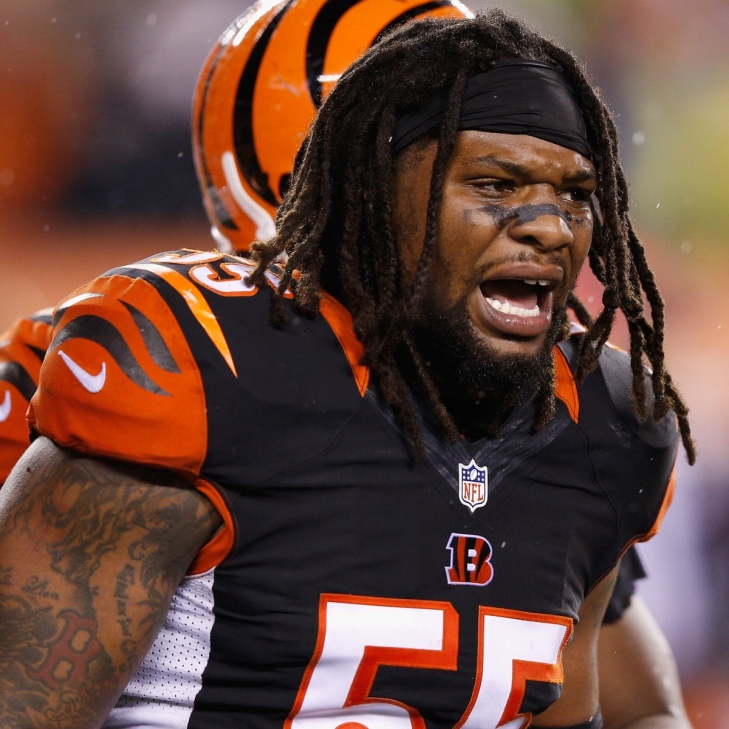
39. Vontaze Burfict
This one should be interesting.
Signed as an undrafted free agent out of Arizona State in 2012, Vontaze Burfict arrived in Cincinnati with a reputation as a volatile, first-round talent whose draft stock plummeted following a disastrous Combine and off-field concerns. In Southern Ohio, Burfict evolved into one of the most brilliant—and deeply controversial—defensive linebackers of his generation, serving as the ferocious center of Marvin Lewis's defense.
At 6 feet 1 inch and 248 pounds, Burfict possessed elite football IQ, rapid-fire processing, and a bone-crushing physical presence over the middle. He cracked the starting lineup at weakside linebacker by Week 3 of his 2012 rookie campaign, compiling 127 combined tackles. He elevated his game to an all-pro level in 2013, leading the entire NFL with 171 combined tackles while adding 3.0 sacks and an interception. His dominant sophomore masterclass earned him First-Team All-Pro honors and his sole career Pro Bowl selection.
However, Burfict’s relentless style routinely crossed the threshold of legal play, resulting in a career defined as much by league discipline as elite instincts. After a severe concussion and knee surgery limited him to five games in 2014, he returned in 2015 to anchor another playoff run. That season ended in infamy during the 2015 AFC Wild Card Game against Pittsburgh, where Burfict delivered a brutal late hit to a defenseless Antonio Brown. The ensuing 15-yard penalty, paired with an unsportsmanlike conduct flag on Adam Jones, gifted the Steelers 30 field position yards to kick the game-winning field goal, cementing one of the most painful postseason collapses in Bengals history.
Suspensions for safety violations and banned substances repeatedly disrupted his availability over his final three seasons in Cincinnati (2016–2018). While his processing and diagnostic skills remained elite whenever he stepped on the field, he was never able to play a full 16-game slate again. Following the 2018 campaign, the Bengals released Burfict, and he spent one final, suspension-shortened season with the Oakland Raiders in 2019 before his NFL career ended.
Burfict played in 75 regular-season games (73 starts) and two playoff contests. He generated 604 combined tackles, 8.5 sacks, 34 tackles for loss, five interceptions, and four forced fumbles.
38. Tommy Casanova
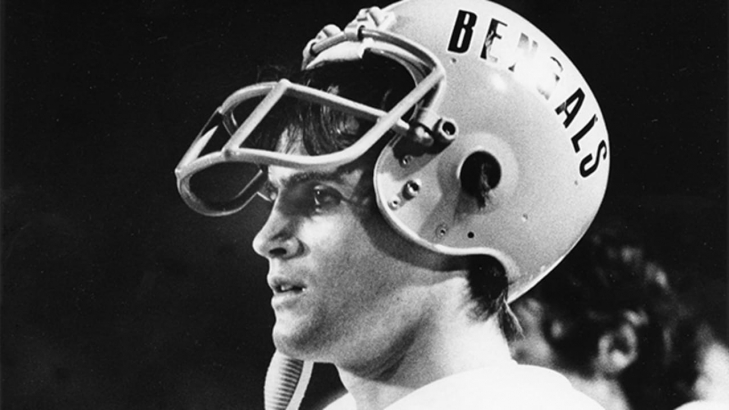
Tommy Casanova was a second-round pick from LSU who had a legendary pedigree as a three-time consensus All-American and future College Football Hall of Famer. A rare multi-dimensional athlete who played both ways in college, Casanova brought fluid range, sharp instincts, and versatility to Paul Brown’s secondary.
Casanova confidently entered the starting lineup as a rookie at free safety, instantly catching attention with five interceptions and two returned for touchdowns. His impressive play earned him his first Pro Bowl honor in 1974, after securing four interceptions and providing vital stability to the Bengals' secondary. When the coaches moved him to strong safety in 1975, his tough physical style in stopping runs flourished, all while maintaining his sharp coverage abilities.
His best individual campaign came in 1976, when he earned a second Pro Bowl selection while serving as the defensive cornerstone of a top-10 Bengals scoring defense. Casanova achieved a third Pro Bowl selection in 1977, thereby solidifying a period of dominance during which he was acknowledged as one of the premier safeties in the AFL/AFC across the middle. In addition to his responsibilities in the secondary, Casanova demonstrated his versatility as a dynamic special teams contributor, returning 90 punts for 784 yards during his tenure with the Cincinnati Bengals.
Casanova made the unexpected decision to retire at the top of his game following the 1977 season at just 27 years old to pursue an ophthalmology degree. Following his medical career, he transitioned into politics, eventually serving as a Republican state senator in the Louisiana State Senate.
During his six seasons with the Bengals (1972–1977), Casanova played 71 regular-season games (62 starts) and two postseason games, recording 17 interceptions, three defensive touchdowns, five fumble recoveries, and 784 punt return yards.
37. Jeff Blake
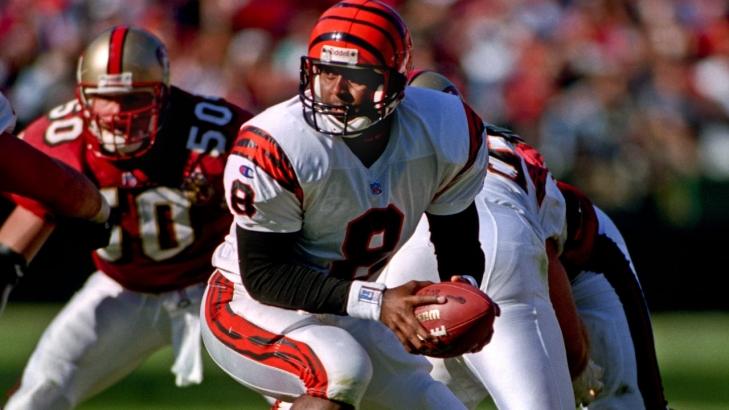
Jeff Blake spent his first two NFL seasons as a third-stringer for the New York Jets, getting little chance to display the deep-ball flair that earned him a sixth-place Heisman finish. That all changed in 1994 when the Cincinnati Bengals claimed him off waivers, setting the stage for one of the most exciting individual turnarounds in franchise history.
Inserted into the starting lineup midway through the 1994 season, Blake provided an instant spark to a dormant offense. Known for his majestic, sky-high deep ball—dubbed the "Shake and Bake" connection with wideouts Carl Pickens and Darnay Scott—Blake started 10 games and led the entire NFL with 13.8 yards per completion. His explosive downfield attack injected life back into the franchise, winning over the fan base with his improvisational style.
In 1995, Blake hit his peak, leading a standout campaign that earned him a Pro Bowl. He achieved career highs with 3,822 passing yards and 28 touchdowns, helping the Bengals stay in wild-card contention. Although Cincinnati didn't break its playoff drought, Blake's strong arm and efficiency kept the team competitive into the mid-1990s.
Although he was the main starter through the 1997 season, Blake was unable to recreate the success of his 1995 season as turnovers and injuries on offense hindered the team's progress. He ultimately lost the starting position to Akili Smith in 1999 and left in free agency to join the New Orleans Saints in 2000.
Across six seasons with Cincinnati (1994–1999), Blake played in 84 regular-season games (66 starts). He threw for 15,134 passing yards and 93 touchdowns while adding another 1,281 yards and five scores on the ground.
35. Eddie Brown
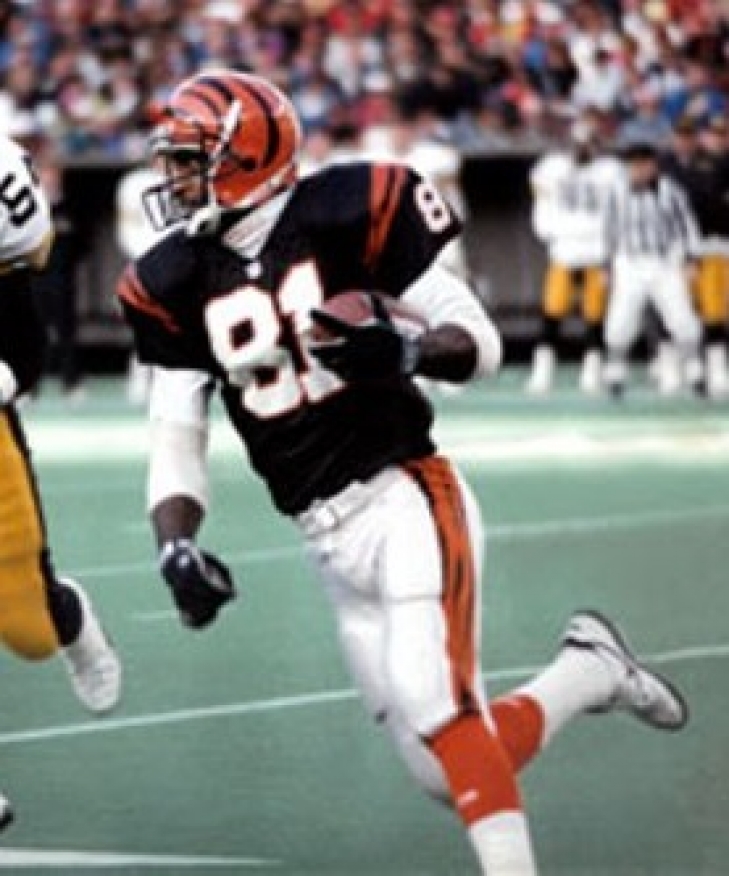
Eddie Brown proved to be worthy of Cincinnati’s 13th Overall Pick. Armed with fluid route-running, explosive top-end speed, and exceptional downfield tracking, Brown stepped in as the immediate vertical focus of the Bengals' aerial attack.
Brown made an impressive start in 1985, achieving a remarkable debut season with 53 receptions for 942 yards and eight touchdowns, earning the AP Offensive Rookie of the Year award. He demonstrated that his early success was not a coincidence as a sophomore in 1986, recording 48 receptions for 964 yards and five touchdowns. After a slight decrease in performance during the strike-shortened 1987 season, Brown delivered a career-best performance in 1988.
During that historic 1988 season, Brown established an exceptional rapport with MVP quarterback Boomer Esiason. He achieved personal bests across various metrics, securing 53 receptions for 1,273 receiving yards and nine touchdowns. His remarkable average of 24.0 yards per reception ranked second in the NFL, providing an explosive, game-changing dimension that propelled Cincinnati's high-powered offense to Super Bowl XXIII. In recognition of his outstanding performance, Brown was named to the Second-Team All-Pro and received his first career selection to the Pro Bowl.
While chronic injuries began to chip away at his longevity over the next three seasons, Brown remained a remarkably steady producer. He reached at least 700 receiving yards in each of his final three campaigns (1989–1991), serving as a reliable starter opposite Tim McGee. Injuries ultimately forced an early end to his career after seven seasons.
Overall, he generated 363 receptions, 6,134 receiving yards, and 41 touchdowns.
