


Committee Chairman
35. Pat Harder
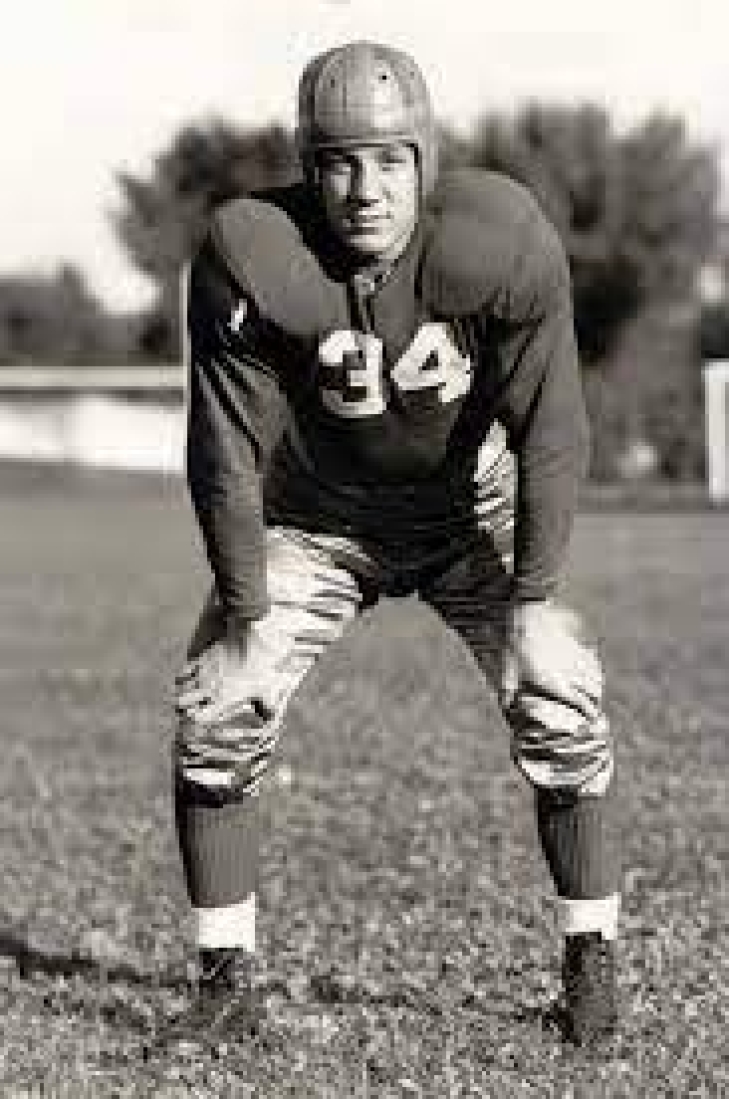
Pat Harder, drafted second overall in the 1944 NFL Draft from Wisconsin, paused his football career to serve in the U.S. Marine Corps during World War II. He debuted with the Chicago Cardinals in 1946, joining a legendary backfield as the power-running fullback in Chicago's renowned "Million Dollar Backfield" with Paul Christman, Charley Trippi, and Marshall Goldberg.
At 5 feet 11 inches and a solid 205 pounds, Harder brought a low-center-of-gravity, downhill rushing style that delivered punishment to opposing linebackers. What made him truly irreplaceable, however, was his dual-phase scoring capability. Beyond his rugged inside running and bone-crushing lead blocking, Harder took over placekicking duties for Chicago and quickly turned himself into the most lethal point-producer in professional football.
Harder's early career in Chicago saw one of the most impressive three-year stretches by any back of that time. In 1947, he topped the league with 102 points and played a key role in Chicago's victory over the Philadelphia Eagles to win the 1947 NFL Championship, which was the franchise's last world title.
He reached the peak of his career in 1948, earning UPI NFL Most Valuable Player honors after leading the league with 110 points, perfect on all 53 extra-point attempts, and rushing for 554 yards. In 1949, he again led the NFL in scoring with 102 points, becoming the first player in NFL history to surpass 100 points in three consecutive seasons. His exceptional performance earned him three consecutive First-Team All-Pro selections (1947–1949) and a place on the NFL 1940s All-Decade Team. Harder scored over 100 points during three straight seasons from 1947 to 1949, leading the league each year and setting a record for individual scoring consistency in the NFL.
After a standout Pro Bowl season in 1950, Harder was traded to the Detroit Lions in 1951. He maintained his winning form in Detroit, playing as fullback and placekicker for consecutive NFL championship teams in 1952 and 1953 until knee injuries led to his retirement. During his five seasons with the Cardinals, Harder racked up 2,371 rushing yards, 510 receiving yards, made 25 field goals, 171 extra points, and scored a total of 412 points across 58 regular-season games.
34. Larry Stallings
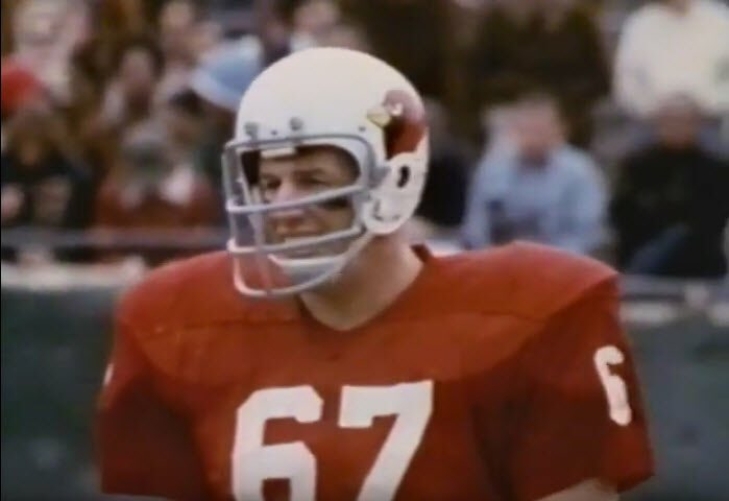
Securing a genuine defensive cornerstone in the 18th round of the NFL Draft is extremely rare, but in 1963, the St. Louis Cardinals achieved this by choosing Georgia Tech’s Larry Stallings as the 241st pick overall. Despite never playing linebacker in college, Stallings was inserted into the starting lineup as a rookie and rapidly adapted, holding the left outside linebacker position for fourteen seasons straight (1963–1976).
Stallings applied a tough, blue-collar mentality to the second level of the Big Red defense. He excelled at setting the edge against the run, strongly resisting being pushed out by pulling guards, and had the agility to drop into boundary coverage. Despite facing early-career knee surgeries in 1964 and 1965, Stallings returned as a full-time starter in 1966 and demonstrated remarkable durability. From 1966 until the end of his career, he played all but two games over an eleven-year period.
His consistent performance earned him early recognition from his teammates, who named him the Cardinals Team MVP after the 1969 season. Stallings hit his career peak in 1970, achieving his best season with 4.0 sacks, two fumble recoveries, an interception, and earning First-Team All-NFC honors from UPI, along with his first Pro Bowl selection. From 1966 to 1976, Stallings was a mainstay at left linebacker, starting 149 of 151 regular-season games.
Stallings served as the defensive team's core through the mid-1970s, offering veteran leadership for the back-to-back NFC East division champions under Don Coryell in 1974 and 1975. When he retired after the 1976 season, he had played all 181 games with the Cardinals, starting 175 of them, and recording 9 interceptions, 13 fumble recoveries, 3 defensive touchdowns, and 27.5 unofficial sacks.
He retired following the 1976 season, finishing with 9 interceptions, 13 fumble recoveries, and 3 defensive touchdowns.
33. Sonny Randle
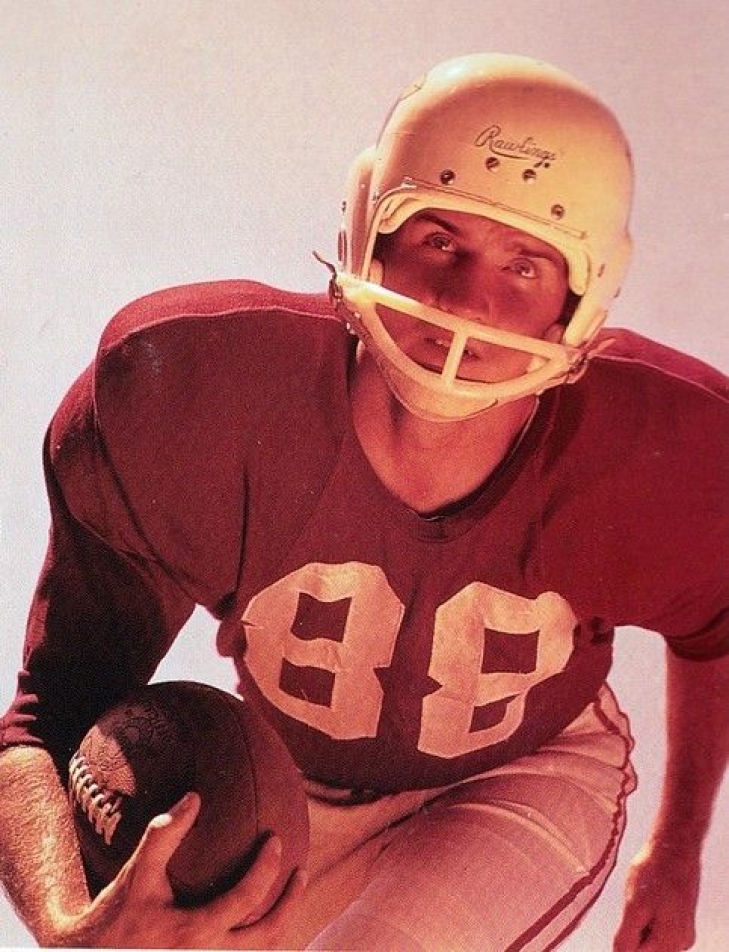
Sonny Randle was selected in the 19th round (218th overall) of the 1958 NFL Draft as a "futures" pick from Virginia. During his final college year, he focused on improving his track speed before joining the Chicago team in 1959. As a rookie, his playing time was limited, but he dedicated the offseason to refining his route running, practicing against teammates Dick "Night Train" Lane and Jimmy Hill. This effort helped convert his raw vertical speed into a highly developed skill. When the franchise relocated to St. Louis in 1960, Randle became a key player, leading the Big Red's passing attack and gaining national recognition.
Randle had explosive long strides that often outpaced coverage. His precise head fakes and quick breaks made him nearly unstoppable on double moves. In the red zone, his tracking ability and body position made him a top goal-line threat of his time.
His breakout season in 1960 showcased exceptional scoring efficiency. Randle led the NFL with 15 receiving touchdowns, setting a franchise record for a single season, and also recorded 62 receptions for 893 yards. His outstanding performance earned him First-Team All-Pro honors and initiated a three-year streak of Pro Bowl appearances from 1960 to 1962.
In the 1962 season, he achieved a career-high in yardage, with 63 receptions for 1,158 yards and 7 touchdowns, earning Second-Team All-Pro honors. The season’s highlight was a remarkable game at Yankee Stadium on November 4, 1962, when Randle set franchise records with 16 catches and 256 receiving yards against the New York Giants, records that remain unbroken.
Randle proved equally lethal in 1963, catching 51 passes for 1,014 yards and 12 touchdowns. After a shoulder injury shortened his 1964 campaign, he returned to peak form in 1965 with 845 receiving yards and 9 touchdowns, earning his fourth career Pro Bowl invitation.
Randle's 15 touchdown catches in 1960 remain the single-season Cardinals benchmark, and his 16 receptions for 256 yards against the Giants in 1962 stand as the team's untouched single-game records. Randle departed for San Francisco in 1967, leaving St. Louis with an extraordinary legacy. Across eight seasons in a Cardinals uniform, he accumulated 328 receptions, 5,438 receiving yards, and 60 touchdown catches.
32. Dale Meinert
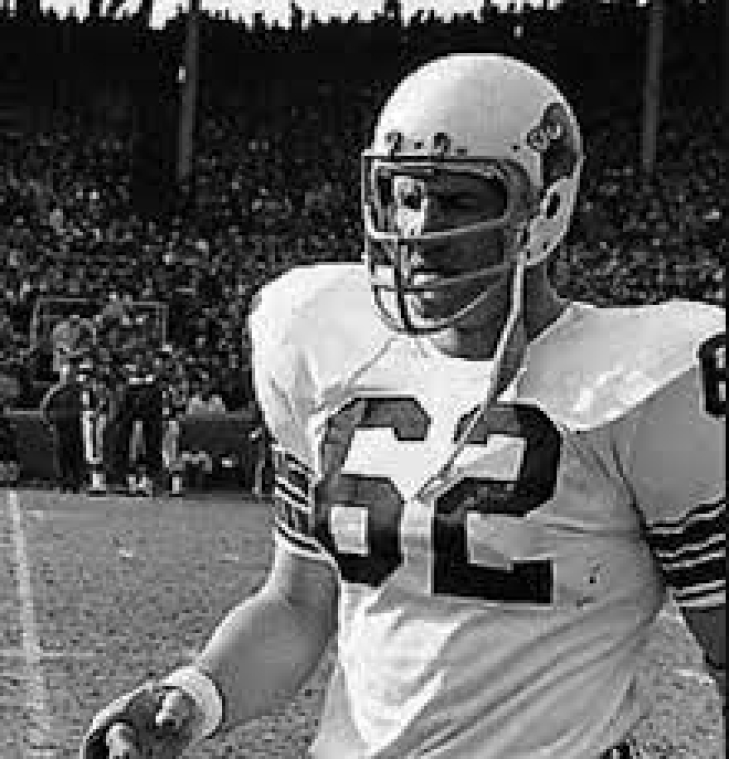
Drafted in the eighth round of the 1955 NFL Draft by the Baltimore Colts from Oklahoma A&M, Dale Meinert originally took a different route to professional football. He moved north to Canada, playing three seasons with the Edmonton Eskimos under coach Pop Ivy and earning two Grey Cups as an offensive lineman. When Ivy became head coach of the Chicago Cardinals in 1958, Meinert followed him to the United States, beginning as a guard for his first two NFL seasons before a positional change significantly altered his career.
Meinert was initially seen as undersized for interior offensive line positions. Switching permanently to middle linebacker in 1960 turned out to be an excellent decision. With sharp instincts, quick lateral pursuit, and a tough, downhill tackling approach, he soon became the strategic leader of the defense. Meinert assumed pre-snap play-calling responsibilities, often using a laid-back Oklahoma voice and sometimes tapping his defensive tackles on the buttocks to shift the defensive front into the correct position.
Following the franchise's move to St. Louis in 1960, Meinert's defensive impact was immediate. He picked off a pass in his very first start at linebacker and earned St. Louis Cardinals Team MVP honors in 1961. Over the next several seasons, he anchored the middle of the field against the run while dropping efficiently into pass coverage, picking up three Pro Bowl selections (1963, 1965, 1967). His pinnacle individual campaign arrived in 1967, when his leadership and field vision earned him Second-Team All-Pro honors alongside his third Pro Bowl invitation. Teammates frequently compared Meinert's impact directly to Hall of Fame contemporaries like Ray Nitschke and Dick Butkus, noting that his play-calling speed and range made him the heartbeat of the Big Red defense.
After capping off his career with that 1967 All-Pro campaign, Meinert decided it was time to step away from the game ahead of the 1968 training camp. It wasn't a spur-of-the-moment choice; after a decade of grinding collisions in the NFL trenches, he felt it was the right time to hang up his cleats and return to his home state of Oklahoma. He transitioned seamlessly into life after football, farming, teaching junior high math, and coaching eight-man high school football at Lone Wolf High School for 15 years.
Over his ten-year NFL career (all as a Cardinal), Meinert recorded 9 interceptions, 13 fumble recoveries, 12 unofficial sacks, and a defensive touchdown in 125 games.
