


Site Admin
43. Fuzzy Thurston
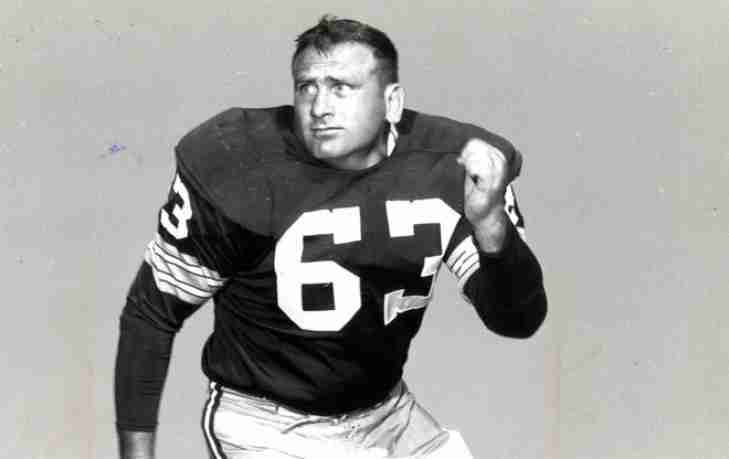
Long before he became a beloved Wisconsin cultural icon, Fred "Fuzzy" Thurston took a circuitous route to Titletown. Drafted out of Valparaiso—where he played basketball and football—Thurston earned an NFL championship ring as a reserve lineman with the Baltimore Colts in 1958 before Vince Lombardi acquired him in a 1959 trade. Returning home to his native state, the Alton, Wisconsin, native slotted directly at left guard, pairing with right guard Jerry Kramer to form the most celebrated interior tandem in professional football history.
Thurston's elite mobility and relentless pulling speed served as the crucial engine behind Lombardi's famed power sweep. Leading interference around the edge for Paul Hornung and Jim Taylor, Thurston cleared running lanes with punishing accuracy. He reached the pinnacle of his craft in 1961, earning First-Team AP All-Pro honors while helping Green Bay win its first title under Lombardi, followed by back-to-back Second-Team All-Pro selections in 1962 and 1963.
As one of only a handful of players in pro football history to possess six NFL championship rings, Thurston stood at the center of Green Bay's dominant 1960s run. He started at left guard on five Green Bay title teams (1961, 1962, 1965, 1966, and 1967), helping secure victories in Super Bowls I and II while embodying the infectious personality and blue-collar spirit of the era's Packers.
After retiring in 1967, Thurston stayed active in Green Bay, running businesses and greeting fans who saw him as a vital link to the dynasty. In 1975, the Packers inducted him into their Hall of Fame for his championship legacy and dominant interior blocking. He had 89 starts for the team on the O-line.
44. Frank Winters
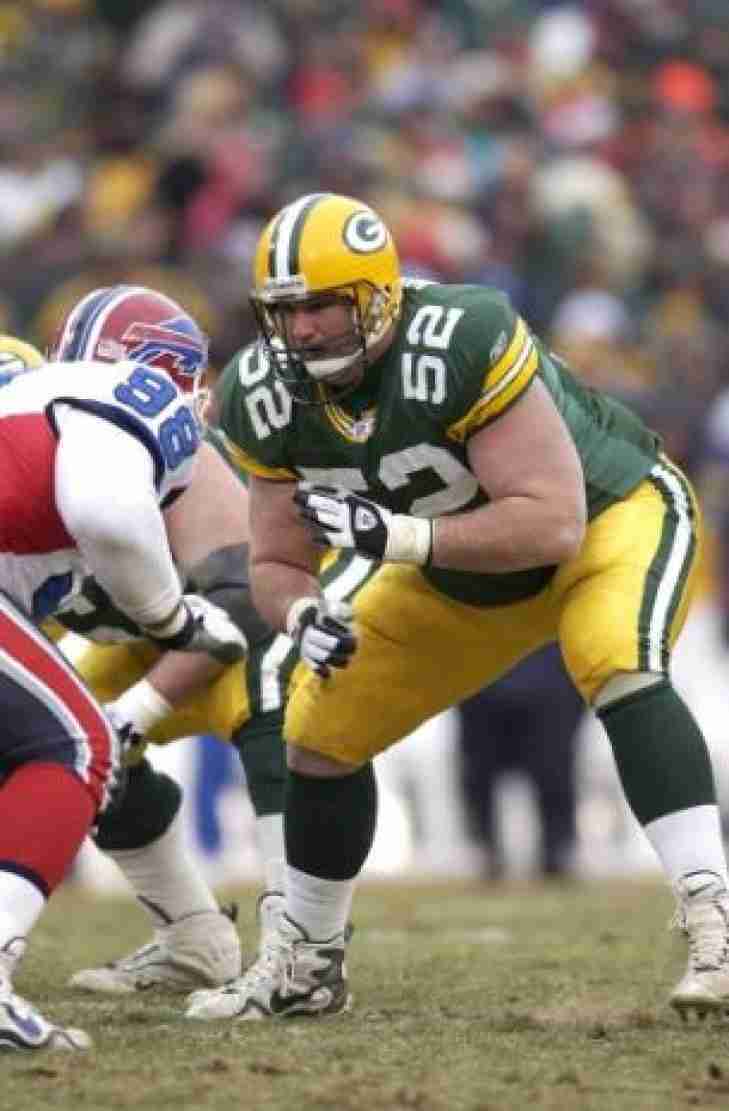
Before he anchored the line for a Super Bowl champion in Titletown, Frank Winters spent the first five years of his NFL career bouncing around as a journeyman interior blocker. Selected in the tenth round of the 1987 draft out of Western Illinois, Winters logged rotational snaps across stops with Cleveland, the New York Giants, and Kansas City before landing in Green Bay in 1992. What looked like a simple depth signing turned into a massive win when head coach Mike Holmgren moved Winters full-time to center, unlocking his true potential at the heart of the offense.
Affectionately dubbed "Old Bag of Donuts" by quarterback Brett Favre due to his thick frame and no-nonsense personality, Winters developed a legendary bond with his Hall of Fame signal-caller. As the pre-snap caller for Green Bay's West Coast system, Winters handled protections with sharp instincts and brought a blue-collar edge to the trench warfare. His snapping accuracy, mobility in screen setup, and inside wall-building paved the way for dynamic rushing attacks featuring Dorsey Levens and Edgar Bennett.
Winters reached the pinnacle of his personal craft during the magical 1996 season. Starting every contest at center, he earned a Pro Bowl selection while directing a front five that helped Green Bay lead the NFL in scoring offense and points allowed on defense. His relentless blocking inside culminated in a 35–21 victory over New England in Super Bowl XXXI, bringing the Lombardi Trophy back to Wisconsin for the first time in nearly three decades.
Across 11 seasons, Winters anchored the Packers' offensive line, starting 141 games and leading during a highly successful era. In 2008, the team inducted him into its Hall of Fame, honoring his tenure and championship leadership.
30. Cal Hubbard
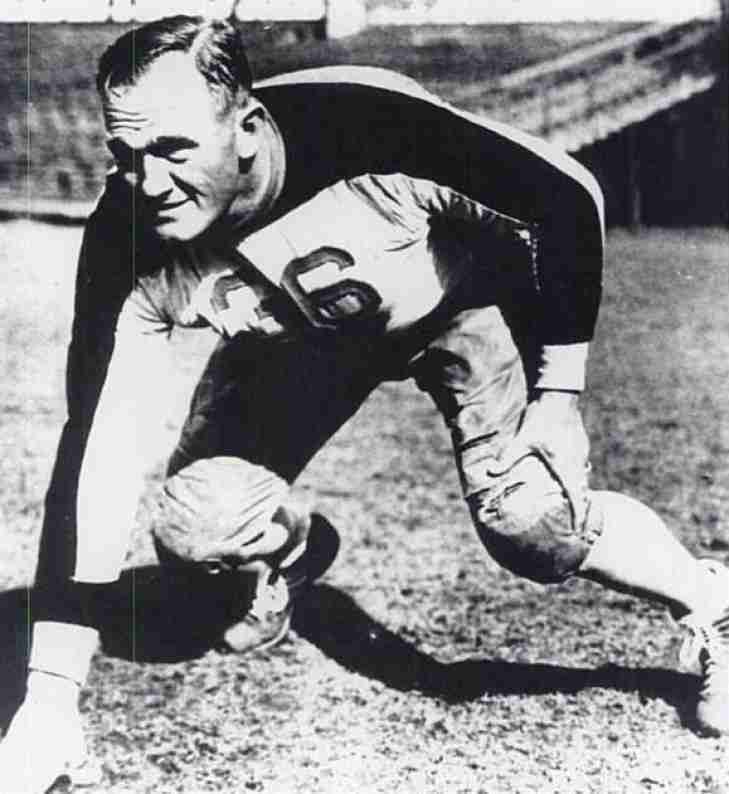
Standing 6-foot-2 and tipping the scales at over 250 pounds, Robert "Cal" Hubbard was a terrifying apparition on the gridiron during an era when most players resembled ordinary men. A multi-sport standout who played college ball at Centenary College and Geneva College, Hubbard entered the professional ranks with the New York Giants in 1927, immediately establishing himself as a ferocious, immovable object along the line of scrimmage.
The course of football history shifted permanently during a late-1928 road trip to Wisconsin. Playing against the Green Bay Packers at Bellevue Park, Hubbard fell completely under the spell of the small-town, blue-collar atmosphere and rabid fan base. As the legend goes, he grew so enamored with the environment that he flatly demanded a trade to Titletown, threatening to retire from professional football entirely if management refused. Packers founder and coach Curly Lambeau worked out the transaction, bringing Hubbard to Green Bay ahead of the 1929 campaign.
Hubbard's arrival transformed the Packers from a competitive contender into an absolute dynasty. Anchoring both offensive and defensive tackle positions with rare athleticism and brutal physical leverage, he spearheaded Green Bay's historic three-peat, capturing three consecutive NFL Championships in 1929, 1930, and 1931. Operating in an era of iron-man football, Hubbard's ability to clear massive running lanes while collapsing opposing backfields single-handedly dictated the physical terms of every game.
Honored as a three-time First-Team All-Pro during his tenure in green and gold, Hubbard earned universal respect from opponents and referees alike—though his fiery competitiveness occasionally tested umpires. Ironically, after hanging up his football cleats, Hubbard embarked on an extraordinary second career as a legendary Major League Baseball umpire, patrolling the diamond for 35 years and becoming the only person in sports history to achieve elite, Hall of Fame-level prominence in both professional football and Major League Baseball.
Hubbard's national validation for his gridiron dominance came when he was inducted into the Pro Football Hall of Fame in 1963, alongside legends like Red Grange and Jim Thorpe. The Packers also honored him in 1970 as an inaugural Hall of Fame member.
39. Max McGee
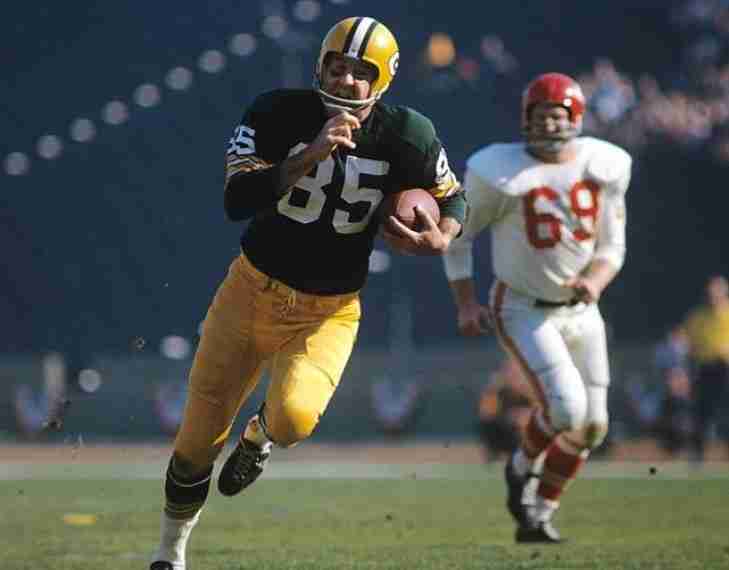
Drafted in the fifth round (51st overall) of the 1954 NFL Draft out of Tulane, Max McGee made an instant impression as a dual-threat rookie for Green Bay, pacing the offense with nine touchdown catches while leading the entire NFL in punting yardage (2,739 yards). His budding career was put on hold when he spent the 1955 and 1956 seasons serving as a pilot in the U.S. Air Force. Upon returning to Titletown in 1957, McGee quickly re-established himself as the primary downfield target in the Packers' passing game, topping the team in receiving yards three straight years from 1958 through 1960.
When Vince Lombardi took over, McGee became an essential perimeter weapon for Bart Starr alongside Boyd Dowler. His best statistical season came in 1961, when he caught 51 passes for 883 yards and seven touchdowns, earning his first Pro Bowl selection while helping lead Green Bay to an NFL Championship. Beyond his receiving, McGee remained a special-teams weapon, leading the NFL in punting yards for a second time in 1959 and booming 256 career punts for over 10,000 yards.
By 1966, the veteran receiver had transitioned into a reserve role behind Boyd Dowler and Carroll Dale, expecting little playing time entering Super Bowl I against the Kansas City Chiefs. Legendary folklore has it that after an unexpected night out in Los Angeles, a sleep-deprived McGee was pressed into action when Dowler suffered an early shoulder injury. McGee responded with a performance for the ages, snagging seven passes for 138 yards and scoring the first two touchdowns in Super Bowl history—including a memorable one-handed snare—to propel Green Bay to a 35–14 victory.
McGee retired following Green Bay’s victory in Super Bowl II, concluding a 12-season run spent entirely in dark green and gold. Over his career, McGee caught 345 passes for 6,346 yards and 50 touchdowns, and punted 256 times for 10,647 yards.
