


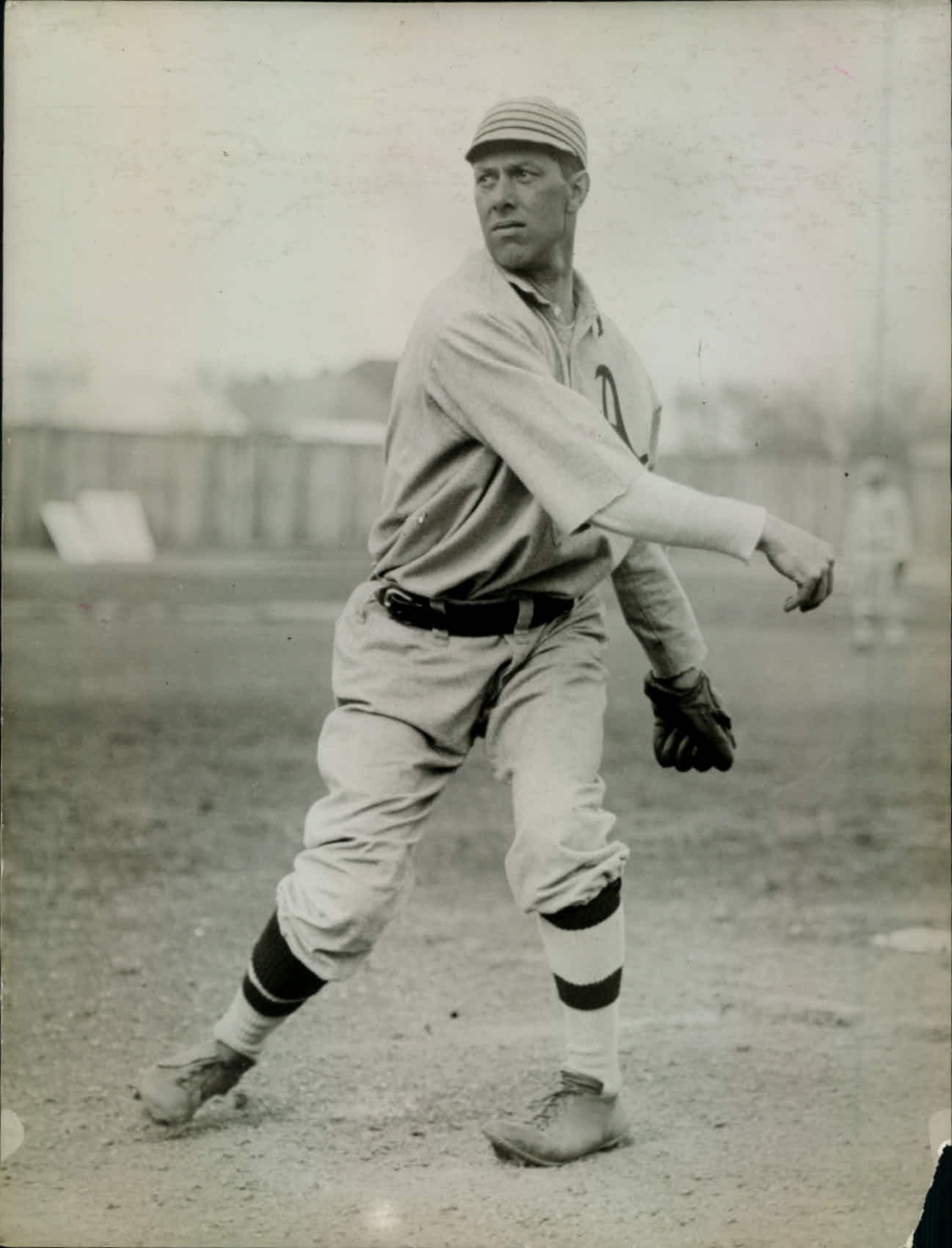


During the initial four years of his Major League career, Jack Coombs showed minimal indication that he would eventually rewrite the franchise record books. Upon his arrival in Philadelphia from Colby College in 1906, the right-handed pitcher epitomized an average, unrefined player. He maintained a perfectly balanced record of 35-35 entering the 1910 season, and when his early performances that spring were inconsistent, Connie Mack became sufficiently frustrated to demote him to the bullpen.
Then, baseball alchemy took place. According to dugout lore, during his exile to the relief corps, Coombs entirely rediscovered the release point on his overhand, drop-off-the-table curveball. Equipped with a new, deadly secondary pitch to complement his powerful fastball, he launched a summer streak unmatched in Athletics history.
Coombs rejoined the rotation and quickly became nearly unbeatable, dominating the A.L. like a natural phenomenon. He concluded the notable 1910 season with an astonishing 31-9 record, maintaining a minimal 1.30 ERA over an impressive 353 innings. During this period, he threw 13 shutouts, including a remarkable streak of 53 consecutive scoreless innings.
Fittingly, his regular-season mastery carried directly into October. Coombs single-handedly battered the Chicago Cubs in the 1910 World Series, throwing three complete-game victories in a span of just six days to carry Philadelphia to its first Title.
Instead of resting on his laurels, "Colby Jack" once again proved to be a relentless performer during the 1911 title defense. He secured his second straight American League wins title with 28 victories, despite the league's widespread offensive increase due to the new cork-centered ball, which caused his ERA to rise to 3.53 over 336.2 innings.
When the Athletics advanced to the Fall Classic to face the New York Giants, Coombs etched his name more deeply into baseball folklore. In a legendary, high-stakes duel, he out-slugged and outlasted the immortal Christy Mathewson on the mound, securing a signature postseason victory that helped secure back-to-back world titles.
He pushed through to secure another 21-win season in 1912, but the constant and extensive workload eventually wore him down. Before the 1913 season, Coombs contracted a severe typhoid fever, an illness so intense it nearly took his life and kept him out for most of the next two years. Realizing that the passionate right-hander was no longer at his peak physically, a financially strained Mack decided to release him. This move later allowed Coombs to make a successful second career as a veteran stabilizer for the Brooklyn Robins.
He concluded his dramatic, high-variance tenure in Philadelphia with a stellar 115-67 record, a 2.60 ERA, and 850 strikeouts. Coombs would be added to the Philadelphia Baseball Wall of Fame in 1992.

Comments powered by CComment