


Site Admin
39. Bobby Shantz
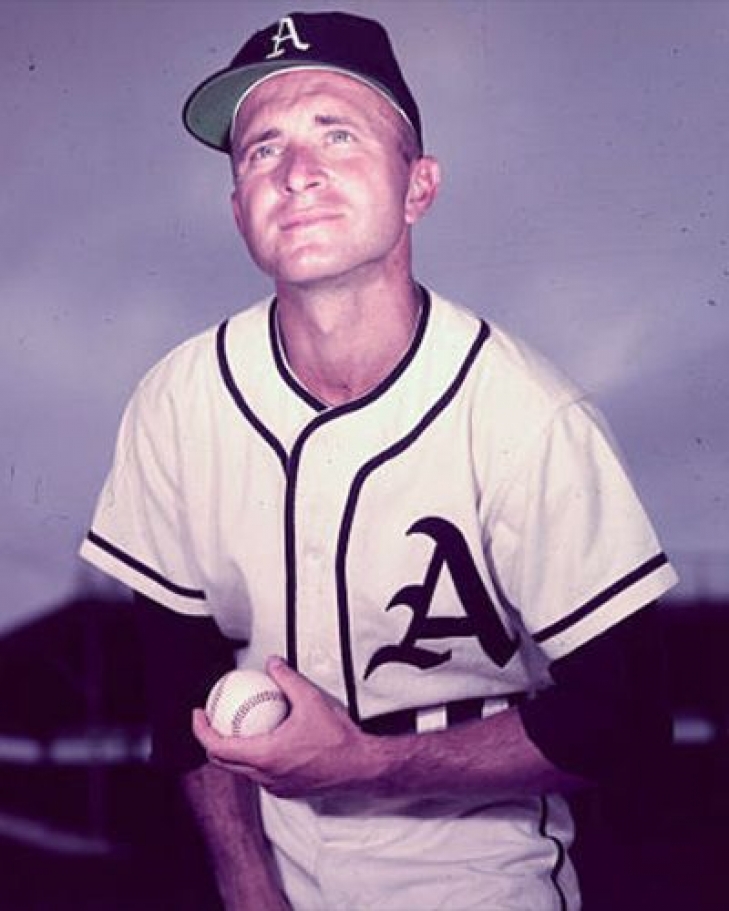
Back in the late 1940s, when Bobby Shantz was working his way through the semi-pro circuits of Pennsylvania, traditional baseball wisdom didn't see him as a future star. Scouts from major league teams mostly overlooked this little left-hander, thinking his 5-foot-6, 140-pound frame might be too small for the tough demands of a big-league starting pitcher. However, Connie Mack looked beyond his size, recognizing a quick, powerful arm and an impressive, fading changeup. The Philadelphia Athletics took a chance on him in 1948. After a few modest developmental summers, this undersized southpaw rose to unexpected heights, delivering a brief but stunning peak that captured the whole baseball world’s attention.
Shantz first discovered his frontline potential during the 1951 campaign. He amazed junior circuit hitters with his precise control and a sharp, biting curveball. His impressive performances earned him his first career All-Star selection, and he finished the season with a solid 18-12 record for a team going through changes in Philadelphia.
That breakout summer truly caught everyone's attention, but it was just the beginning of an incredible, award-winning season in 1952. Shantz became an unstoppable force on the mound, dominating the American League with an impressive 24 wins and only 7 losses. His efficiency was nothing short of spectacular, leading all of baseball with a tiny 1.048 WHIP, along with a stellar 2.0 walks per nine innings and a powerful 2.41 strikeout-to-walk ratio. The entire baseball world recognized his outstanding performance, overwhelmingly voting this small but mighty ace as the 1952 American League Most Valuable Player.
With the baseball world at his feet, tragedy unexpectedly struck the young lefty's delivery. Later in that fantastic 1952 season, Shantz suffered a serious, chronic shoulder injury that cost him his usual velocity and altered the course of his career. He spent the next four years courageously working on his mechanics and pushing through intense pain, but he simply wasn’t the same explosive pitcher anymore. From 1953 to 1956, a challenging period that included the franchise's move to Missouri, Shantz struggled with frustratingly poor records and rising ERAs. Recognizing that his days as a top starter were behind him, the financially struggling Kansas City front office finally made the tough decision to trade him to the powerful New York Yankees before the 1957 season.
With the Athletics, Shantz had a 69-65 record with a 3.80 ERA. Philadelphia later honored Shantz by placing him in their Baseball Wall of Fame in 1994.
36. Elmer Valo
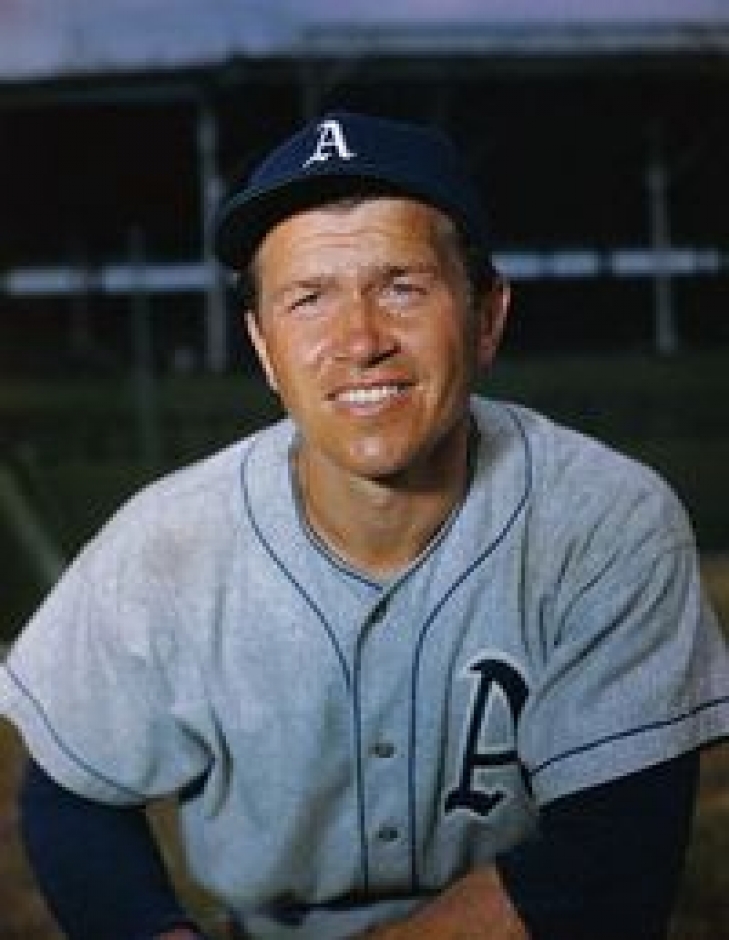
Born in Czechoslovakia, Imrich "Elmer" Valo moved to the U.S. at age six, settling in Pennsylvania. He embodied the American dream, channeling his athletic energy into a long MLB career. When he debuted with the Philadelphia Athletics in 1940, he brought a fierce, uninhibited style to Shibe Park that won him fans for generations.
Valo was far from a conventional, headline-grabbing superstar, yet he possessed an exceptionally keen baseball intellect and a legendary degree of physical resilience. He gained recognition throughout the junior circuit for his complete disregard for personal physical safety in the outfield. Long before stadiums were equipped with padded walls, Valo regularly collided at full speed with concrete barriers and chain-link fences to prevent extra-base hits by opposing batters. This unwavering intensity was complemented by an elite, notably sophisticated approach within the batter's box.
Although he did not have the raw power of the top sluggers of his time, Valo compensated by leveraging a tiny strike zone and a highly disciplined eye, resulting in high traffic. During his lengthy career with the organization, from 1940 to 1956, including a two-year military service during World War II, he recorded nine seasons with at least 100 hits.
His ability to draw walks and control the running game was truly exceptional; he achieved a remarkable .403 on-base percentage as an Athletic, finishing in the top ten of that important metric in the American League three times. This persistent blend of consistent on-base skill and fearless defense made him one of Connie Mack's most reliable players during a tough, transitional period for the team. Valo stayed deeply loyal to the organization, holding down the outfield as the team packed up and moved to Missouri for the 1955 season. He spent a year and a half as a veteran leader for the Kansas City Athletics before some roster changes led to his release. This paved the way for a highly successful second phase of his career, where he became one of the game's most formidable pinch-hitters for the Brooklyn Dodgers, Philadelphia Phillies, and New York Yankees.
Over 15 seasons as an Athletic, Valo compiled 1,229 hits, 218 doubles, and 595 walks. In 1990, he was honored with a spot on the Philadelphia Baseball Wall of Fame.
35. Jimmy Dykes
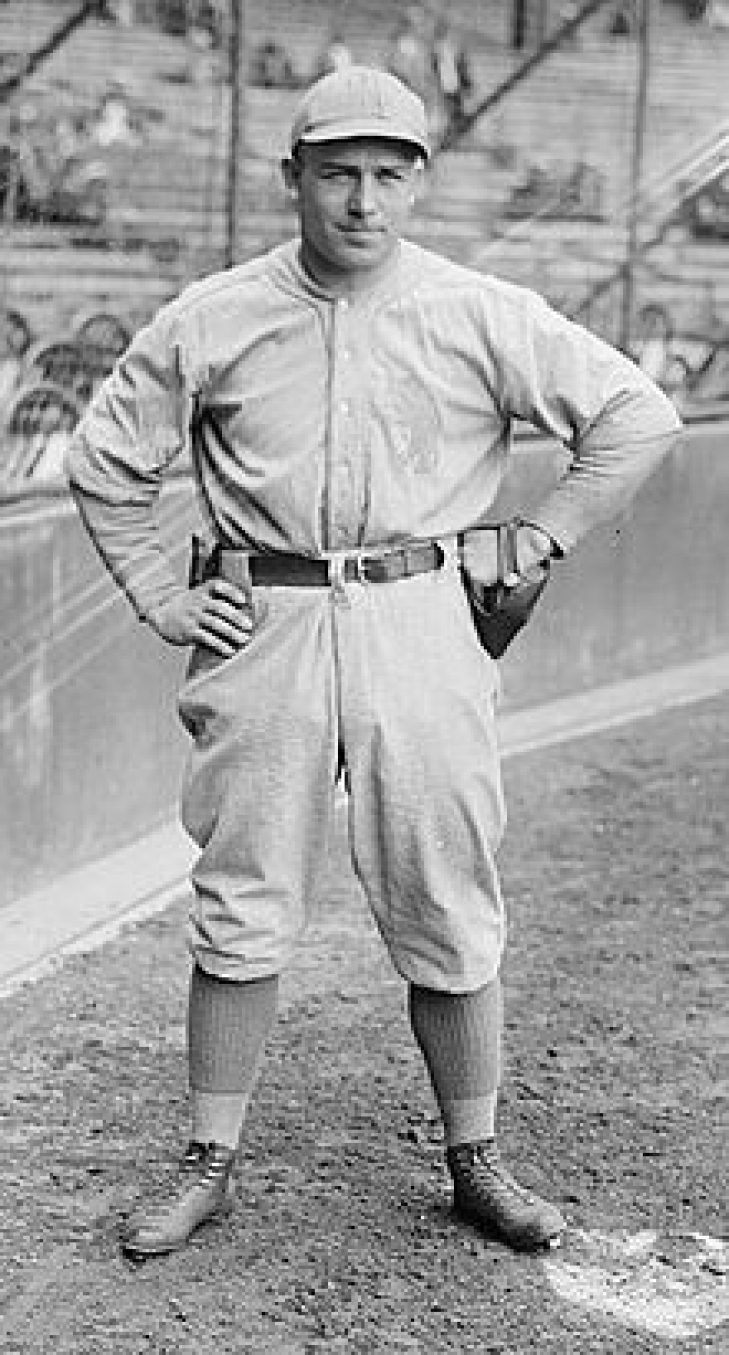
A Rule 5 Draft acquisition ahead of the 1918 season, expectations for Jimmy Dykes’s offensive production were incredibly low. Scouts widely regarded the gritty infielder as a premium glove-first prospect who possessed severe limitations at the plate. That scouting report looked entirely accurate during his first two brief tastes of the big leagues, as he slumped to a bleak, sub-.200 batting average that left many wondering if his bat would ever catch up to his defensive instincts. However, Connie Mack saw Dykes’ determination and baseball IQ despite a slow start. Given the second base job in 1920, Dykes transformed into a durable, respected franchise anchor.
His versatility became a crucial strategic asset for Mack as the roster evolved. Dykes managed second base flawlessly until the front office acquired additional middle-infield depth, prompting a smooth transition to third base. He secured the position with the same impeccable efficiency, employing an exceptional internal clock and a fast, accurate throwing arm to turn extra-base hits into routine outs.
As his defensive vacuum solidified the infield, his right-handed swing matured significantly. Dykes addressed his early critics by surpassing the .300 batting average threshold on four occasions while playing for Philadelphia, most notably by achieving a remarkable career-high .327 in 1929.
This exemplifies the ideal combination of superior defensive versatility and consistent, high-contact batting, which played a pivotal role in the organization’s development of its second legendary powerhouse dynasty. Dykes served as the cornerstone of the infield, leading the Athletics to secure three consecutive American League pennants from 1929 to 1931, including consecutive World Series titles in 1929 and 1930. He was an unwavering performer under high-pressure conditions at the sport's most significant events, notably driving in four runs during the remarkable eight-run rally in Game 4 of the 1929 Fall Classic against the Chicago Cubs.
While the roster remained an elite American League force into the early 1930s, the harsh financial realities of the Great Depression soon forced a painful institutional transition. With plummeting attendance threatening the franchise's solvency, a cash-strapped Mack was forced to liquidate his high-priced stars. Following the 1932 campaign, Dykes was packaged with legendary outfielder Al Simmons and Mule Haas and sold to the Chicago White Sox in a massive blockbuster deal designed to keep the Philadelphia front office afloat.
With the Athletics, Dykes accumulated 1,705 hits, 365 doubles, and gained entry into the Philadelphia Baseball Wall of Fame in 1984.
28. Rollie Fingers
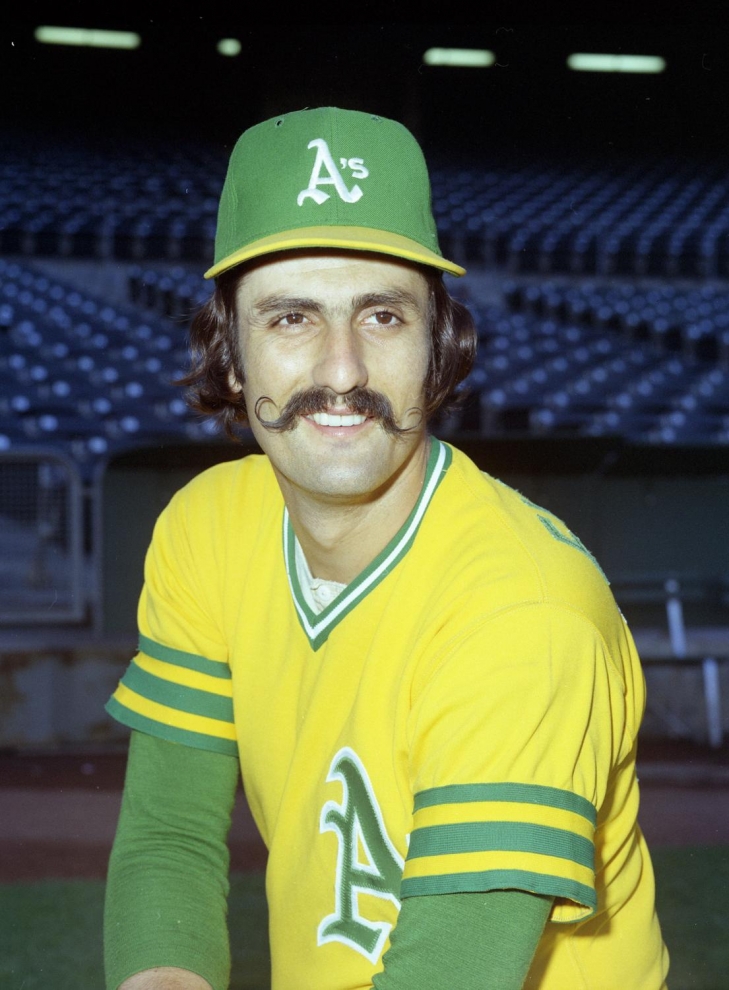
By the late 1960s, the idea of a relief pitcher wasn't new, but Rollie Fingers changed everything when he became the backbone of the Oakland Athletics’ bullpen. Before he stepped into the scene, relievers were often seen as either unsuccessful starters or veteran players nearing the end of their careers, fighting to stay on the team. Fingers broke those old stereotypes, turning the bullpen into an exciting and desirable role, and he was among the first relief pitchers to be celebrated as a true superstar in the sport.
Fingers operated predominantly as a starting pitcher during his tenure in the minor leagues. Upon his official debut in the Major Leagues with Oakland late in the 1968 season, manager Dick Williams ultimately acknowledged that his ability to throw a sharp, sinking fastball and his resilient character made him an ideal candidate for high-pressure, late-inning roles. By 1971, the transition to relief pitching had become permanent, a strategic decision that significantly influenced the course of baseball history.
He quickly became the charismatic face of the franchise’s unique identity, charming fans with his distinctive style. It all started when eccentric owner Charlie Finley encouraged him to grow a fabulous, waxed handlebar mustache. Finley even offered a $300 cash bonus to any player who could sport facial hair for a special promotion. That look, however, quickly became Fingers' signature style for life, endearing him even more to fans.
On the baseball field, he showcased incredible durability, often pitching multiple innings to secure victories long before the era of the single-inning save. From 1971 to 1976, Fingers was remarkably consistent, achieving at least 17 saves in six straight seasons while playing for the green and gold. His impressive rise to fame led to his first All-Star selection in 1973, starting a streak of four straight appearances in the Midsummer Classic as a key member of the renowned "Mustache Gang" team.
His real legacy was established when the regular season ended. Fingers became the ultimate high-pressure weapon for the historic team that won three straight World Series titles from 1972 to 1974; the only non-New York Yankees team to achieve a modern "three-peat." He was completely dominant on the sport's biggest stage, with 8 career postseason saves for the Athletics. The absolute apex of his playoff dominance arrived during the 1974 Fall Classic against the Los Angeles Dodgers. Fingers appeared in four of the five games, weaponizing his heavy sinker to earn a victory and two saves, single-handedly securing the 1974 World Series MVP honors.
Even as the historic core began to splinter under small-market financial strains, he remained a premier bullpen force, finishing third in the 1975 American League Cy Young balloting and eighth in 1976. That final summer in Oakland featured one of the most bizarre corporate episodes in baseball folklore: in June 1976, Finley abruptly sold Fingers and outfielder Joe Rudi to the Boston Red Sox for $1 million during a dramatic fire sale. However, baseball commissioner Bowie Kuhn intervened just three days later, voiding the transaction "in the best interests of baseball" and ordering both players back to Oakland.
Following the conclusion of the 1976 schedule, Fingers exercised his prerogative to evaluate the newly established free-agent market by departing from the East Bay to establish a lucrative contractual agreement with the San Diego Padres. Subsequently, he achieved significant accolades by securing both the American League Cy Young Award and the Most Valuable Player Award with the Milwaukee Brewers in 1981.
Fingers would be elected to the Baseball Hall of Fame in 1992, and was part of the first class of the Athletics Hall of Fame in 2018. With the Athletics, he had 136 saves, 67 victories, and a sharp 2.91 ERA in 502 appearances.
