

Rodney Harrison named to the Los Angeles Chargers Hall of Fame

Regular visitors of Notinhalloffame.com know that we are slowly working on the top 50 of every major team in the NHL, NBA, NFL, and MLB. Once that is done, we will examine how each team honors its past players, coaches, and executives. As such, it is important to us that the Los Angeles Chargers announced that Rodney Harrison will be inducted into their franchise Hall of Fame on October 23 during the Chargers' home game against the Minnesota Vikings.
Drafted in the fifth round in 1994 from Western Illinois, Harrison helped the Chargers reach their only Super Bowl as a rookie. The hard-hitter became San Diego’s starting Strong Safety in 1996, and he was selected to two Pro Bowls (1998 & 2001) and was a First Team All-Pro once (1998). Harrison joined the New England Patriots in 2003 (where he won two Super Bowls) and left behind 26 Interceptions and 21.5 Sacks as a Charger.
Harrison is already a member of the Chargers' 40th and 50th Anniversary Teams and is also part of the Patriots' 50th Anniversary Team. He still holds the record for the most Sacks for a Defensive Back in NFL history (30.5).
We here at Notinhalloffame.com would like to congratulate Rodney Harrison for his impending honor.
180. Lorenzo Neal
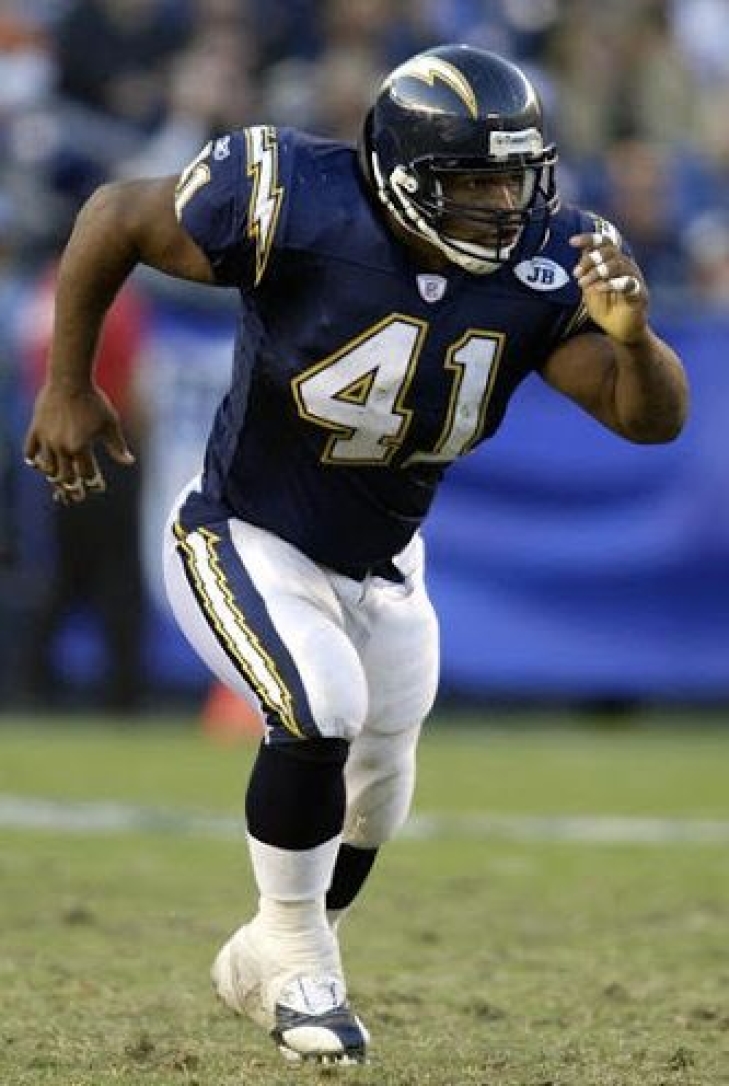
The modern fullback seems like a relic of football’s past, but when used correctly, it is a thing of beauty to watch. Lorenzo Neal might be the game’s last great Fullback.
A traditional back at Fresno State, Neal was converted to a Fullback by the team that drafted him, New Orleans, to the position. In 1997, he set a record by blocking for 11 consecutive 1,000-yard rushers in history. After playing for multiple teams, his best and most recognized run came in San Diego, where he paved the way for Hall of Fame Running Back LaDainian Tomlinson and earned multiple Pro Bowls and an All-Decade Selection.
The odds of him getting enshrined in Canton are not strong, but his accomplishments set him apart from most fullbacks from his era.
Alex and Faye Spanos to be inducted into the Los Angeles Chargers Hall of Fame

Regular visitors of Notinhalloffame.com know that we are slowly working on the top 50 of every major team in the NHL, NBA, NFL, and MLB. Once that is done, we will examine how each team honors its past players, coaches, and executives. As such, it is important to us that the Los Angeles Chargers will be inducting former owners, Alex and Faye Spanos to their franchise Hall of Fame.
This will bring a total of 43 members to the Hall.
Alex Spanos bought the San Diego Chargers in 1984 and oversaw the team until his death in 2018. His wife, Faye, died two months later.
The team is now owned and run by their son, Dean Spanos, who credited their parents for the vision of the team and that the team would not have relocated to Los Angeles.
335. Gary Johnson

Gary Johnson received the nickname “Big Hands” innocently enough. In eighth grade, Johnson grabbed a basketball in gym class, and the P.E. teacher yelled the following:
“Get your big hands off my basketball!”
Those meat hooks would be put to good use on the gridiron, first at Grambling, where he was a three-time Little All-American, and then for the San Diego Chargers, who drafted Johnson eighth overall in 1975.
An All-Rookie Selection, Johnson had his first double-digit sack year in 1977 (13.5). As the Chargers offense improved by a decade’s end under Don Coryell and Quarterback Dan Fouts, the defensive corps also shaped up, making the Bolts serious AFC contenders.
From 1979 to 1982, Johnson was named to the Pro Bowl, with First Team All-Pros coming his way in 1980 and 1981. Johnson led the NFL in Sacks in 1980 with 17.5, but the Chargers were unable to get over the hump, and he was able to join the mighty San Francisco 49ers and help them win Super Bowl XIX, where Johnson got three Sacks in that postseason.
344. Russ Washington

Russ Washington played both Offensive Tackle and Defensive Tackle at the University of Missouri, and the man who stood at 6’ 5” and nearly 300 pounds made the mouths of NFL scouts water. The San Diego Chargers selected him fourth overall in 1968, where he was used as a Defensive Tackle over his first two seasons. He did well, but the Chargers saw more value in him on the O-Line, and that is where he moved in 1970 and was their starting Right Tackle for 13 years.
Washington’s size was a better fit on offense, especially on pass protection. When the team moved to a more pass-heavy offense under Don Coryell, Washington was in his element, and it showed with five trips to the Pro Bowl in the second half of his career. Rarely hurt, Washington played 200 Games for the Chargers and entered the franchise Hall of Fame in 1985.
240. Ed White

Ed White was a consensus All-American at the University of California and split his 17-year professional career in the NFL between the Minnesota Vikings and San Diego Chargers.
White was part of several successful Vikings teams that made multiple Super Bowl runs, and he played a major role in protecting Fran Tarkenton and other offensive weapons. The Guard was traded to San Diego, helped protect another Hall of Fame quarterback, Dan Fouts, and earned four Pro Bowl selections.
White played in 241 Games, and is one of the most tenured Offensive Lineman in NFL history.
188. Doug Wilkerson

Doug Wilkerson was all set to play college ball at Michigan State, but an incident with another student in his senior year of high school led to its revocation. It didn't derail his path to the pros; though he attended the small HBCU North Carolina Central, he shone so brightly that the Houston Oilers selected him in the first round in 1970. As a rookie, Wilkerson did not start and was also playing at Defensive End. The Oilers traded the Guard to San Diego, and he would play a large part in the “Air Coryell” Offense of the Chargers.
Wilkerson was San Diego’s starting Left Guard from 1971 to 1984, and with the arrival of Dan Fouts in 1973 and Coryell’s arrival in 1978, Wilkerson became the protector of the Chargers offense. Fouts was routinely throwing for unprecedented passing yards at the time, and Wilkerson was one of the top guards who rarely got his due, with the exception of the San Diego media. Wilkerson was finally rewarded with three straight Pro Bowls (1980-82) and a First Team All-Pro in 1982. Arguably one of the best Offensive Linemen in Chargers history, Wilkerson is part of the Chargers Hall of Fame and Black College Hall of Fame.
RIP; John Hadl

Former Quarterback, John Hadl, who played most notably with the San Diego Chargers, passed away at the age of 82.
A College Football Hall of Famer from the University of Kansas, Hadl played 11 years for the Chargers and was a three-time AFL leader in Passing Yards, compiling 33,503 Yards with 244 Touchdown Passes. He also played for the Rams, Green Bay and Houston, and was a six-time AFL All-Star/Pro Bowl Selection.
In our latest Notinhalloffame list of those to consider for the Pro Football Hall of Fame, Hadl was ranked at #92.
We here at Notinhalloffame.com would like to extend our condolences to the fans, friends and family of John Hadl.
37. Joey Bosa
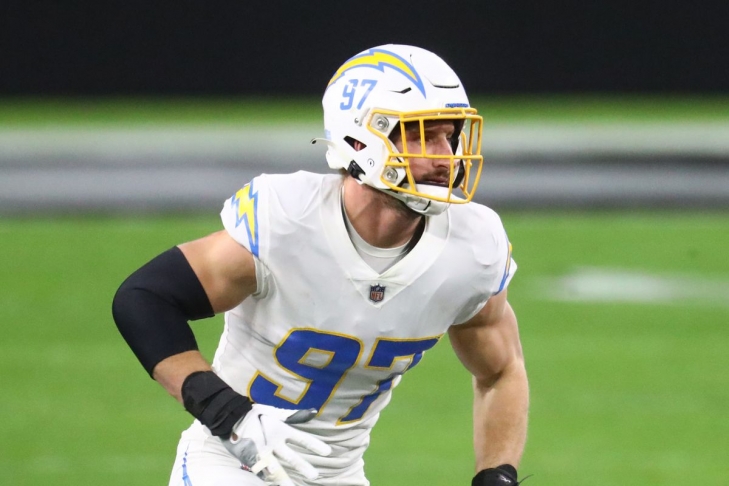
Joey Bosa came to the Chargers as the third overall pick out of Ohio State in 2016 after a dominant college career that included two All-American honors, the Nagurski-Woodson Defensive Player of the Year award, and a national title. The big, explosive edge rusher from the Buckeyes wasted little time proving the selection was right. In a 2016 season that earned him Defensive Rookie of the Year honors, he posted 10.5 sacks and 17 tackles for loss (second in the league) despite a contract holdout that delayed his debut. He was a power-speed hybrid who used violent hands, a quick first step, and relentless effort to collapse the pocket or set the edge against the run. He set an early NFL mark by recording 19 sacks through his first 20 games, giving the Chargers an immediate difference-maker off the edge.
He followed that up with a 12.5-sack season in 2017 and his first Pro Bowl. Injuries limited him to seven games in 2018, but he bounced back with Pro Bowl selections in 2019, 2020, and 2021 while continuing to rank among the league’s better pass rushers when healthy. He teamed with Melvin Ingram for stretches to form one of the more disruptive edge duos in the AFC. In 2022, a groin injury cost him most of the regular season; when he returned for the playoffs, a penalty for removing his helmet helped seal a Wild Card loss to Jacksonville. Injuries kept coming after that, and while he still earned a fifth Pro Bowl nod in 2024, he was no longer the consistent force he had been earlier in his career, finishing as a solid but diminished contributor in his final two seasons. Even so, he remained a reliable presence when available, still capable of generating pressure and forcing offenses to account for him on every snap.
The Chargers released him after the 2024 season. Across nine years with the franchise, he left with 72 sacks and 87 tackles for loss, production that ranks second in team history for sacks and marked him as one of the most productive edge rushers the Chargers have ever had.
He was the last remaining player who had been with the organization continuously from its final years in San Diego through the move to Los Angeles, and his early dominance helped set a standard for the pass rush that the team has been trying to rebuild around ever since.
141. Eric Weddle

From the University of Utah, where he was a two-time Mountain West Defensive Player of the Year, Eric Weddle joined the San Diego Chargers as a Second-Round Pick in 2007. He played off the bench as a rookie. Weddle won the starting job at Free Safety as a sophomore and became one of the top safeties of the 2010s.
Weddle usually played at FS, but could slide into Strong Safety and provide elite man-to-man coverage when needed. Lauded for his high football IQ, Weddle became a de facto on-field coach for his squads. Weddle went to his first Pro Bowl in 2011, the same year he co-led the league in Interceptions (7) and was also a First Team All-Pro. He added two more Pro Bowls (2013 & 2014) and a second First Team All-Pro as a Charger, but his run in the sun ended when he signed with the Baltimore Ravens in 2016.
The Ravens had Weddle for three seasons, during which he was an annual Pro Bowl selection. Recording 10 Picks as a Raven, Weddle was released as a cost-cutting measure, and he joined the Los Angeles Rams for 2019. He had a good year but elected to retire, seemingly ending his career, but the Rams made an offer he couldn’t refuse.
In 2021, Los Angeles made the playoffs but saw the Safety position decimated by injury. Weddle was coaxed out of retirement, and with his ability to learn defensive schemes quickly, he started in the Rams' Super Bowl LVI win over Cincinnati. Weddle retired a second time, but this time as a champion. He accumulated 39 Sacks and 1,179 Tackles over his career.
41. Dick Harris

Dick Harris was one of those undrafted long shots who found a home when the AFL opened up new opportunities in 1960. Coming out of McNeese State, he made the inaugural Los Angeles Chargers roster and quickly became a cornerback starter for Sid Gillman. In that first season, he picked off five passes and earned First-Team All-AFL honors, then followed it up the next year with seven interceptions (three returned for touchdowns) and another First-Team selection. He was a ball-hawking corner who played tight man coverage, baited quarterbacks into throws, and then closed on the ball with enough speed and timing to create turnovers.
The production kept coming. He had five more interceptions in 1962 and then a career-high eight in 1963, the year the Chargers won the AFL championship. Across those first four seasons, he totaled 25 interceptions and earned Second-Team All-AFL recognition in 1963 and 1964. He was the kind of defender who could take away half the field and still jump routes when the quarterback tried to force something into his area, giving the early Chargers a reliable presence in the secondary during their most successful stretch. Injuries began to limit him after that. He appeared in only six games in 1964 and saw reduced action in 1965 before retiring following the season.
Over his six years with the Chargers, he finished with 29 interceptions in 76 games, still ranking among the franchise’s all-time leaders in picks and among the better totals for a cornerback from the AFL era. He never earned a Chargers Hall of Fame induction, but the undrafted corner who arrived with the franchise’s first roster and helped it win its only championship remains one of the team's most productive defensive backs in its early years.
47. Chuck Allen

In the second year of the Chargers’ existence, Washington Linebacker, Chuck Allen was a very late Draft Pick (28thRound), so for him just to make the team was a bit of a long shot. Allen would accomplish a lot more than that.
46. Vincent Jackson

Vincent Jackson’s NFL start was slow after the Chargers took the Northern Colorado wide receiver in the second round of the 2005 draft. Injuries limited him to eight games as a rookie, and he barely saw the field, but he gradually earned more snaps and became a serious threat opposite the more established receivers on the roster. By 2008, he posted his first 1,000-yard season (1,098 yards and seven touchdowns), followed by another in 2009 (1,167 yards and nine scores), while earning his first Pro Bowl nod. He was a big, physical target who could win contested catches downfield and run intermediate routes, giving Philip Rivers a reliable option when the offense needed a vertical threat.
A contract dispute and subsequent suspension limited him to just five games in 2010, cutting short what looked like another strong year. He returned in 2011 and put up a third 1,000-yard season (1,106 yards and nine touchdowns) while earning a second Pro Bowl selection with the Chargers. The production was consistent when he was available, but the 2010 holdout left lingering frustration. After that season, he left for the Tampa Bay Buccaneers in free agency.
Across his seven years with the Chargers, he finished with 4,754 receiving yards and 37 touchdowns. He never earned a Chargers Hall of Fame induction, but the second-round pick who developed into a multi-year 1,000-yard receiver remains one of the franchise's most productive outside threats in the Rivers era.
39. Keith Lincoln

Keith Lincoln came out of Washington State and chose the Chargers over the Buffalo Bills, who had also drafted him in 1961, signing with San Diego as a second-round AFL pick. He saw limited action as a rookie, then became a regular the following year and earned AFL All-Star honors for the next four seasons. He was a tough, versatile back who could run between the tackles, catch passes out of the backfield, and even throw the occasional option pass, giving Sid Gillman’s offense another weapon who could move the chains or break a big play.
His peak arrived in 1963, when he rushed for 826 yards and earned First-Team All-AFL honors. That year the Chargers won the AFL championship, and Lincoln was named the game’s MVP after a dominant performance against the Boston Patriots. He carried 13 times for 206 yards (including a 67-yard touchdown), caught seven passes for 123 yards and a score, and even completed a 20-yard pass, finishing with a then-record 329 yards from scrimmage in the 51-10 rout. He repeated as a First-Team All-AFL selection in 1964 and remained a productive dual-threat through the mid-1960s, mixing power runs with receiving production that kept defenses from focusing solely on halfback Paul Lowe or the serious threats outside.
Lincoln stayed with the Chargers until he joined the Bills in 1967. Across his primary stretch in San Diego, he accumulated roughly 7,000 all-purpose yards, making him one of the more complete offensive contributors of the early Chargers era.In 1980, the franchise enshrined him in its Hall of Fame, recognizing the multi-purpose back whose championship-game performance remains one of the most memorable individual efforts in the franchise’s history.
36. Kenny Graham

Kenny Graham became a Charger after the 1963 college season when San Diego selected the Washington State safety in the 13th round of the AFL draft. The Baltimore Colts also selected him in the NFL Draft, but in May 1964 he signed with the Chargers, joining the team the year after it won its only AFL championship. The late-round pick out of the Cougars quickly stepped into a starting role at safety and began producing turnovers right away.
At about 6-foot and 210 pounds, he was a rangy, physical safety who could cover deep and still come up and deliver hits against the run. In his first season, he picked off four passes, then followed with five interceptions in three of the next four years. He was an AFL All-Star four times (1965, 1967, 1968, and 1969) and earned First-Team All-AFL honors in 1966—ironically one of the two years he did not make the All-Star team. He returned five of his interceptions for touchdowns during his Chargers run, including a 68-yarder in 1967 and a pair of scores in 1969. He was the kind of safety who could erase a deep throw one play, then turn a short interception into a big return the next, giving San Diego a reliable playmaker in the back end throughout the mid-to-late 1960s.
After the 1969 season, Graham left for the Cincinnati Bengals, where he played one final year before wrapping up his career. Across his six seasons with the Chargers, he finished with 25 interceptions and five return touchdowns, production that still ranks among the better totals for a safety in franchise history.
He was later named to the AFL All-Time Second Team, recognition for the productive, ball-hawking safety who spent most of the 1960s locking down the back end for San Diego.
50. Ernie Wright

Ernie Wright was one of the original Los Angeles Chargers when the AFL launched in 1960, and the Ohio State tackle took full advantage of the chance. He locked down the starting left tackle job as a rookie and held it through the team’s early years in both Los Angeles and San Diego. Wright earned AFL All-Star nods in 1961, 1963, and 1965, with the 1963 season also bringing an AFL Championship as the Chargers rolled over the Boston Patriots 51-10. Sid Gillman later called the Wright-and-Mix tandem one of the best pairs of offensive tackles in pro football at the time, a nod to the steady pass protection and run support Wright provided for the early Chargers offenses.
He spent his first eight seasons with the franchise before the expansion Bengals selected him in their inaugural draft. Wright played four years in Cincinnati, then returned to San Diego for one final season in 1972 before retiring. He was one of only 20 players who appeared in all ten years of the AFL.
Wright never piled up the individual stats that jump off a page, but he was a durable starter who helped anchor the line during the Chargers’ first decade. He was later named to the franchise’s 50th-anniversary team, recognition for the original tackle who held down the left side for most of the AFL era.
48. Stan Humphries

Stan Humphries is the kind of quarterback who gets overlooked until you remember he’s still the only one who ever got the Chargers to a Super Bowl. He spent his early years as a backup in Washington (including a Super Bowl ring as a spectator in 1991) before the Redskins traded him to San Diego prior to the 1992 season. He won the starting job right away, and even with a rough touchdown-to-interception ratio, he threw for 3,356 yards and helped turn a team that had gone 4-12 the year before into an 11-5 playoff squad—the only NFL team ever to reach the postseason after a 0-4 start.
Two years later he was back in the postseason, and this time he steered the Chargers all the way to Super Bowl XXIX. He wasn’t a flashy passer, but he was tough and competitive enough to keep the offense moving through a couple of gritty playoff wins, including a comeback against Dan Marino’s Dolphins and a road win over the Steelers. The Chargers got run over by San Francisco in the Super Bowl, but Humphries had done something no other San Diego quarterback had managed. He had another solid year in 1995 before concussions started piling up, and he was forced to retire after the 1997 season.
With the Chargers, he finished with roughly 17,000 passing yards, 89 touchdowns, and 84 interceptions. He wasn’t the most polished quarterback the franchise has had, but he got them closest to a championship.
The Chargers put him in their Hall of Fame in 2002, a fitting nod to the backup who showed up, took the hits, and became the only quarterback in team history to reach a Super Bowl.
29. Don Macek

The Chargers selected Don Macek out of Boston College in the second round of the 1976 draft, and the guard-turned-center became one of the franchise's most quietly valuable picks. As a rookie, he earned All-Rookie honors while starting at right guard, then shifted to center in 1979 and stayed there for the rest of his career. At 6-foot-3 and about 260 pounds, he was a durable, technically sound blocker who could handle the constant collisions in the middle of the line and still get out to the second level when the play called for it. He started 150 of his 162 games in San Diego, missing only a handful of starts across 14 seasons.
Most of those years lined up with Dan Fouts and the Air Coryell offense. Macek snapped the ball and helped anchor a line that allowed the fewest sacks per pass attempt in the NFL from 1981 to 1983, giving Fouts the time to lead the league in passing yards for four straight seasons. The Chargers won three consecutive AFC West titles from 1979 to 1981 and reached the AFC Championship Game twice during that stretch. Teammates such as Ed White lined up next to him for years, and the unit’s ability to keep the pocket clean helped the offense stretch the field the way it did. Macek never made a Pro Bowl, but he was the steady, understated presence who started nearly every snap for more than a decade.
He retired after the 1989 season. Throughout his career with the Chargers, he was the long-term center who helped protect one of the most prolific passing attacks the franchise has ever had.
The team later inducted him into its Hall of Fame in 2004 alongside Ed White, recognizing the durable center who spent 14 years at center during the Air Coryell era.
45. Dave Kocourek

Dave Kocourek’s pro career began in 1959 with a brief stop in the CFL with the Winnipeg Blue Bombers before he landed with the Los Angeles Chargers in the AFL’s first year. He quickly became one of the more productive offensive pieces on Sid Gillman’s early teams, lining up as a flanker and later settling in at tight end. He was a reliable target who could stretch the field and also contribute as a blocker, and from 1961 through 1964 he earned AFL All-Star recognition each season. In 1961, he led the team with 55 catches for 1,055 yards, and he remained a consistent option in the passing game even as the Chargers moved to San Diego and built one of the more explosive offenses in the league.
He was part of the 1963 squad that won the AFL Championship, and he collected four Second-Team All-AFL selections across his time with the team. Kocourek’s size and receiving ability made him a difficult matchup in an era when tight ends were still evolving into more than blockers, and he held up as a starter through the Chargers’ strongest early years.
After the 1965 season, he joined the Miami Dolphins, although his most productive years were already behind him. During his six seasons with the Chargers, he recorded approximately 3,720 receiving yards and 21 touchdowns. He later played briefly for the Raiders, earning a second championship ring, but most of his contributions came in San Diego. He was named to the AFL All-Time Second Team and is remembered as one of the early Chargers who helped establish the franchise’s offensive identity in the 1960s.
38. Melvin Ingram

Melvin Ingram arrived in San Diego as a first-round pick out of South Carolina in 2012 and spent his rookie season mostly as a backup linebacker and special-teams contributor. A torn ACL in his second training camp wiped out nearly all of 2013, but he returned late that year and helped the Chargers reach the playoffs for the first time since 2009. From there, he steadily worked his way into a starting role on the edge. He was a versatile, athletic rusher who could line up as a stand-up linebacker or with his hand in the dirt, using speed, spin moves, and quick hands to get around tackles or work inside on stunts.
His breakout came in 2015, when he posted 10.5 sacks, 19 tackles for loss, and four forced fumbles while starting every game. He matched that sack total in 2017, earned AFC Defensive Player of the Month honors for September, and made his first Pro Bowl. That started a three-year run of Pro Bowl selections from 2017 through 2019, during which he formed a productive edge tandem with Joey Bosa. He finished 2017 with another 10.5 sacks and added a 39-yard scoop-and-score touchdown, and he remained a consistent pressure generator through 2018 and 2019 even as the Chargers’ defensive line evolved. He was the kind of player who could win with pure speed off the edge one snap, then counter with a spin or bull rush the next, forcing quarterbacks to hurry throws and creating opportunities for the rest of the front. After the 2020 season, Ingram left for the Pittsburgh Steelers.
In his nine years with the Chargers, he finished just shy of 50 sacks and ranked among the franchise's more productive edge defenders during that stretch.
He never quite reached the same individual heights after leaving San Diego, but his multi-year stretch of Pro Bowls and double-digit sack seasons with the Chargers marked him as one of the more reliable pass rushers the team has had in the modern era.
