

Committee Chairman
9. Walt Sweeney

The San Diego Chargers struck gold in the first round of the 1963 AFL Draft (second overall) when they selected Syracuse standout offensive lineman Walt Sweeney. A towering, imposing figure at 6-foot-4, Sweeney was a self-professed hard drinker off the gridiron and universally recognized by opponents as a hard-hitting enforcer on it. Stepping into a championship environment as a rookie, he secured an AFL Championship ring in 1963 before settling into the starting right guard spot, quickly evolving into one of the most feared interior line blockers of his era.
Sweeney quickly established total dominance along the line of scrimmage, embarking on an incredible streak of six consecutive AFL All-Star selections from 1964 through 1969. Operating with raw physical power and a nasty, relentless edge, he earned First-Team All-AFL honors in back-to-back seasons (1967 and 1968), opening up massive running lanes for San Diego’s backfield while providing stellar interior pass protection for quarterback John Hadl.
After the 1970 AFL-NFL merger, when the leagues consolidated, Sweeney proved his elite standing wasn’t bound to a single league. He earned three consecutive NFL Pro Bowl selections from 1970 to 1972, bringing his grand total to nine straight all-star selections across both leagues. His extraordinary iron-man durability became legendary in Southern California, as he started 140 consecutive regular-season games for the Chargers between 1964 and 1973.
After 11 seasons anchoring San Diego’s interior line, Sweeney joined the Washington Redskins in 1974 for two final professional seasons, starting another 27 consecutive games in the nation's capital before retiring. Beyond his stellar play on the field, Sweeney later became widely known for his groundbreaking, courageous legal battle against the NFL, filing a high-profile lawsuit regarding the league's prescription practices that contributed to his severe addiction to pain medication and drugs during his playing days.
The Chargers honored his legacy by inducting him into the Hall of Fame in 1981. Sweeney was also named to the 50th Anniversary Team and as a second-team guard on the All-Time AFL Team, cementing his status among top interior blockers.
10. Charlie Joiner
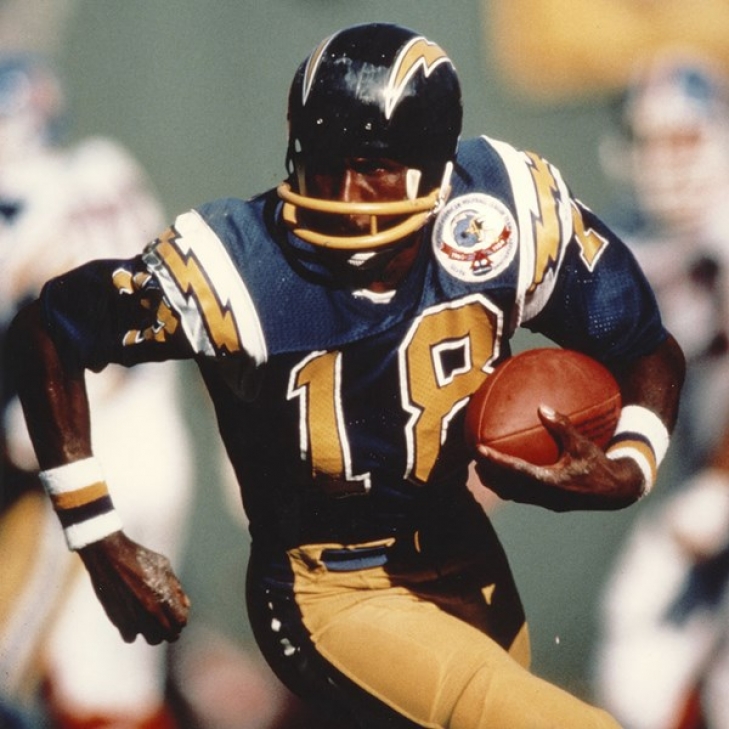
Drafted in the fourth round of the 1969 AFL-NFL Draft out of Grambling State, Charlie Joiner launched his professional football journey with the Houston Oilers. After four years in Texas, the Bengals traded him to Cincinnati midway through the 1972 season, where he stayed through 1975. By the time the Bengals dealt him to San Diego before the 1976 season, the 28-year-old receiver had logged seven solid seasons and accumulated 2,943 receiving yards. It was a respectable total, but it paled in comparison to the historic explosion that awaited him in Southern California.
In San Diego, Joiner found the ideal offensive environment under visionary head coach Don "Air" Coryell. As the vertical passing revolution took hold, Coryell and Hall of Fame quarterback Dan Fouts aired it out at a volume unprecedented in professional football. Joiner became the tactical focal point of the scheme—a cerebral third-down converter and deep-route specialist who exploited intermediate zones while Kellen Winslow and John Jefferson stretched defenses vertically.
Operating as Fouts’ most trusted target, Joiner earned three Pro Bowl nods in lightning bolts (1976, 1979, 1980) and posted four 1,000-yard receiving campaigns (1976, 1979–1981). His ultimate weapon was not pure track speed, but exquisite, razor-sharp route running and elite spatial awareness. Because his game relied on craft, intelligence, and flawless execution rather than raw acceleration, Joiner appeared virtually ageless on the field, producing at a high level well into his late thirties.
Joiner rarely made mental errors, and his ability to absorb physical hits while maintaining precise timing made him a fixture of San Diego’s offense for 11 seasons. By the time he retired following the 1986 campaign at age 39, he had accumulated nearly 10,000 receiving yards in a Chargers uniform alone. His sheer longevity stood as a testament to his preparation, structural discipline, and deep understanding of secondary coverages. When he finally hung up his cleats, his 750 career receptions, 12,146 receiving yards, and 239 games played were all NFL records for a wide receiver.
The franchise recognized his immense contributions by inducting him into the Chargers Hall of Fame in 1993 and retiring his No. 18 jersey. Canton called three years later when Joiner was enshrined in the Pro Football Hall of Fame as part of the Class of 1996. In powder blue, Joiner had 9,203 yards with 47 touchdowns.
6. Kellen Winslow
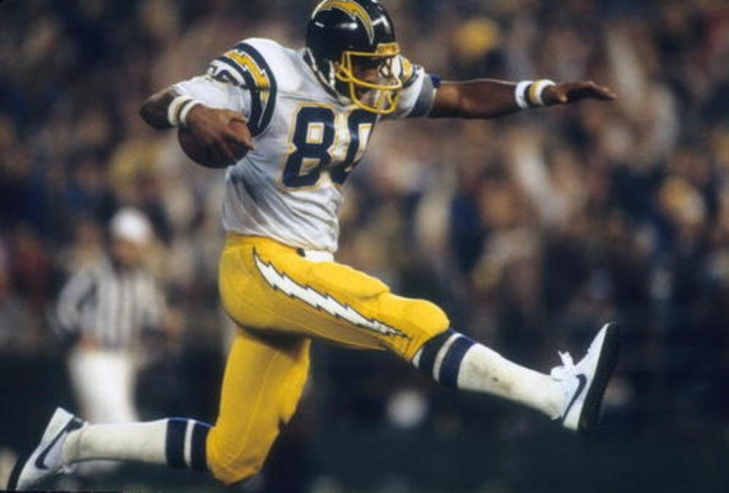
The San Diego Chargers utilized their first-round pick (13th overall) in the 1979 NFL Draft to select Kellen Winslow, a towering tight end out of the University of Missouri. A severe knee injury limited the rookie to just seven games in his debut campaign, but once healthy, he exploded onto the national scene. Over the next four seasons, Winslow redefined the tight end position entirely, establishing himself as the indisputable gold standard of pass-catching threats across the National Football League.
From 1980 through 1983, Winslow embarked on an unprecedented run of dominance, earning four consecutive Pro Bowl honors and three straight First-Team AP All-Pro selections (1980–1982). He crossed the 1,000-yard receiving mark in three of those four campaigns, and undoubtedly would have cleared it in all four had the 1982 strike not shortened the regular season to nine games. Decades ahead of his era, Winslow set a single-season tight end receiving record with 1,290 yards in 1980—a benchmark that stood for 31 years until Rob Gronkowski surpassed it in 2011.
Head coach Don Coryell deployed Winslow as the ultimate weapon in his "Air Coryell" passing scheme, routinely lining him up in motion, in the slot, or wide on the boundary to create brutal schematic mismatches for opposing linebackers and safeties. That offensive wizardry peaked in January 1982 during the legendary "Epic in Miami" playoff clash against the Dolphins. Winslow delivered one of the most heroic postseason performances in NFL history, hauling in 13 passes for 166 yards and a touchdown, while also blocking a potential game-winning field goal at the end of regulation to send the game into overtime despite suffering from severe exhaustion and dehydration.
Devastating knee injuries began to take a heavy toll in 1984, severely limiting his availability over his final few campaigns. Nevertheless, Winslow persevered to earn a fifth and final Pro Bowl selection in 1987 before lingering knee complications ultimately forced him to retire. A two-time NFL receptions leader (1980, 1981), he concluded his playing days with 6,741 receiving yards and 45 touchdowns—phenomenal cumulative stats for a tight end in his era.
The Chargers inducted Winslow into their Hall of Fame in 1989 for his impact, and he was enshrined in the Pro Football Hall of Fame in 1995. His influence also earned him spots on the NFL 1980s All-Decade Team, the NFL 75th and 100th Anniversary All-Time Teams.
Over his career, Winslow had 541 receptions for 6,741 receiving yards and 45 receiving touchdowns.
11. John Hadl
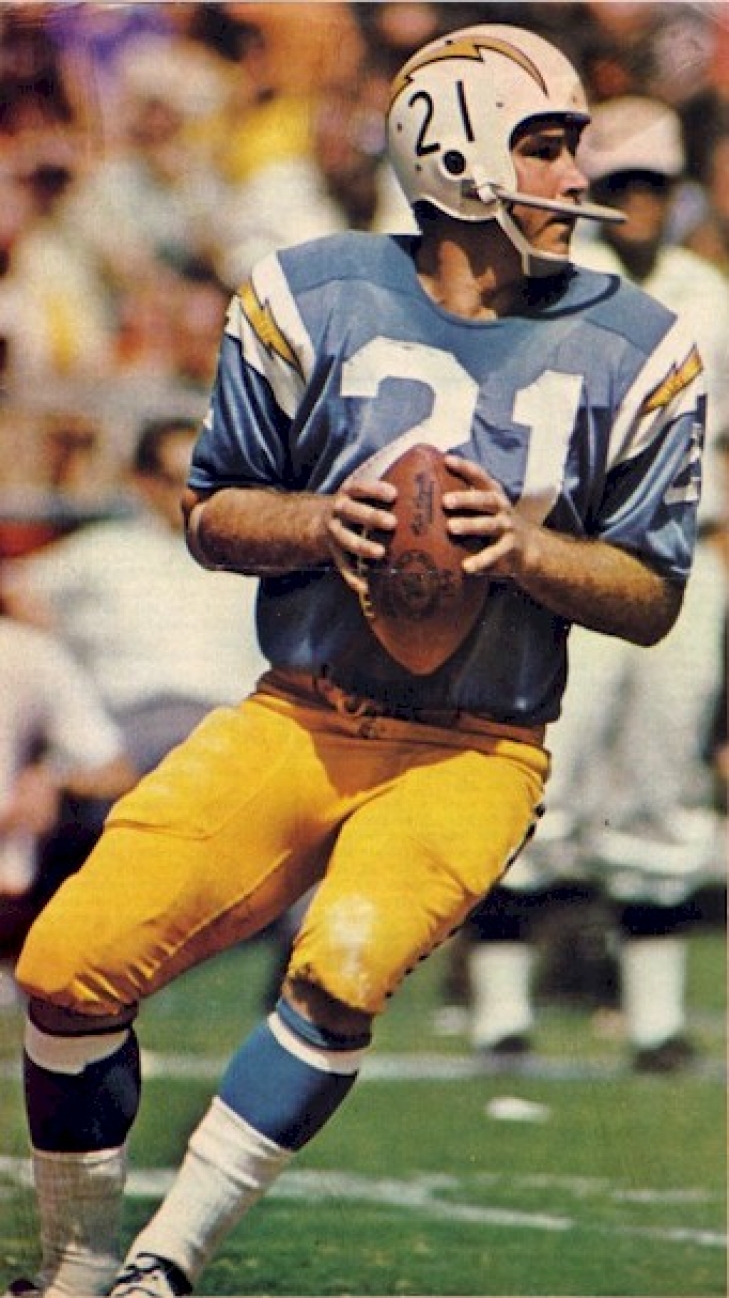
Selected 10th overall in the first round of the 1962 AFL Draft out of Kansas, where he was a two-time All-American, John Hadl chose Sid Gillman’s San Diego Chargers over the NFL’s Detroit Lions. In the Chargers’ explosive offense, Hadl initially split time and backed up veteran Tobin Rote during his first two seasons, helping San Diego win the 1963 AFL Championship with a dominant 51–10 victory over Boston.
After becoming the primary starting quarterback in 1964, Hadl quickly justified Gillman's faith in him. That season, he earned his first AFL All-Star selection and led the Chargers back to the AFL title game. In 1965, he led the AFL in passing yards (2,798) and earned his second All-Star nod. Hadl continued to build on that production, throwing for 2,846 yards in 1966 and 3,365 in 1967. In 1968, he led the league in both passing yards (3,473) and touchdown passes (27), while also topping the interception leaderboard with 31 in his high-risk, high-reward passing style.
Hadl’s deep-ball prowess made the Chargers' offense one of the most feared aerial attacks in pro football history. Pairing with Hall of Fame receiver Lance Alworth, Hadl mastered the deep post and wheel routes that defined Air Coryell’s predecessor. In 1971, Hadl delivered another stellar campaign, once again leading the league in passing yards (3,075) and touchdown passes (21). He closed out his 11-year run in San Diego with a Pro Bowl campaign in 1972, demonstrating his staying power through the AFL-NFL merger.
Traded to the Los Angeles Rams in 1973, Hadl earned First-Team All-Pro honors in LA before finishing his 16-year career with the Packers and Oilers. Yet his legacy remains forever anchored in Southern California, where his #21 jersey and high-flying arm helped build the Chargers' modern offensive identity.
In 1983, the franchise officially recognized his massive contributions by inducting Hadl into the Chargers Hall of Fame. As a Charger, Hadl threw for 26,938 passing yards, 201 passing touchdowns, 211 interceptions, and 1,241 rushing yards with 16 rushing touchdowns.
