

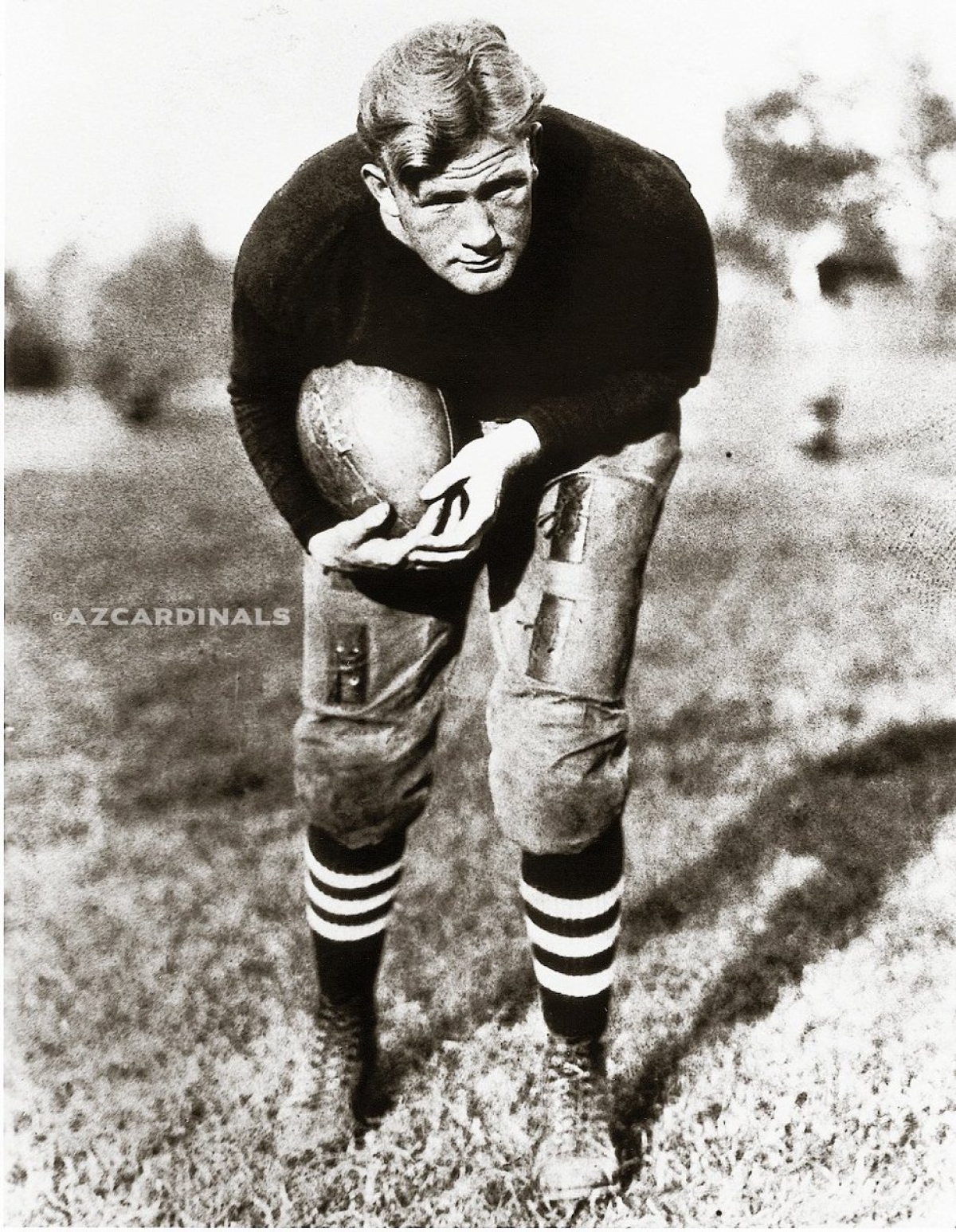
The origins of modern professional football record books can be traced back to the rough sandlots and cold fields of the 1920s. Ernie Nevers, a legendary "triple-threat" back and a consensus All-American under Glenn "Pop" Warner at Stanford, was one of America's most sought-after football stars. After excelling as a tough player-coach for the itinerant Duluth Eskimos in 1926 and 1927, Nevers briefly left playing to become a coach at Stanford. However, the era's competitive spirit was too strong to resist, leading him to return to the field in 1929 with the Chicago Cardinals, where he launched one of the most outstanding individual offensive seasons in football history.
Nevers was a relentless and high-volume power back, known for his bruising, low-center-of-gravity running style. As a versatile "triple-threat" player, he had a strong arm for passing and also excelled as a drop-kicker and placekicker. His aggressive approach required high snap counts; he consistently touched the ball on almost every play and would quickly switch to linebacker to anchor the defense, willingly enduring tough physical hits each series.
Nevers’s 1929 debut in Chicago marked the most legendary individual offensive game in NFL history. During a cold Thanksgiving game at Comiskey Park against George Halas and the Chicago Bears, he delivered an extraordinary performance. As a solo force, he scored six rushing touchdowns and kicked four extra points, totaling all 40 points in a 40–6 victory. His six rushing touchdowns set a league record, still tied but never surpassed, and his 40 points in one game remain the oldest untouched NFL record. Nevers finished his remarkable 1929 season by earning consensus First-Team All-Pro honors.
During his last two active seasons in 1930 and 1931, Nevers took on the additional role of player-head coach for the Cardinals, increasing his workload significantly. Despite intense physical defenses dedicated to stopping him, he maintained his individual dominance on the field. He earned consensus First-Team All-Pro honors in both years, leading the team in rushing, passing, and kicking, all while calling plays from the backfield.
Nevers, the top fullback and a dominant force in the game, finally reached his physical limit after the 1931 season due to relentless pounding. Aware of the intense toll on his body, he retired permanently, leaving a brief but impactful legacy with 5 First-Team All-Pro selections over five NFL seasons—two with Duluth and three with Chicago.
Nevers was selected to the NFL 1920s All-Decade Team, and in 1963, he earned the ultimate honor when he was enshrined as a charter member of the inaugural Pro Football Hall of Fame class. He would later be an inaugural member of the Cardinals Ring of Honor in 2006.