
Notinhalloffame List Update: 276-300 on Football Revised
The problem with running a Hall of Fame-related website is that many of the big ones we cover all have announcements within months of each other. The backbone of what we do is list-related, resulting in a long push to revise what we already have, specifically now with our Football and Basketball Lists.
At present, we have a minor update as we have completed the next twenty-five of the 2024 Football List, which you can comment on and vote on:
The new 276 to 300:
276. Keith Millard
277. Derrick Johnson
278. Stanley Morgan
279. Leon Gray
280. David Akers
281. Buster Ramsey
282. Beattie Feathers
283. Russ Francis
284. Carson Palmer
285. Keith Brooking
286. Dennis Smith
287. Frank Cope
288. Charles Mann
289. Ed “Too Tall” Jones
290. Rich Gannon
291. Seth Joyner
292. E.J. Holub
293. Mel Gray
294. Bart Oates
295. Fred Arbanas
296. Michael Vick
297. Bill Stanfill
298. George Svendsen
299. Hanford Dixon
300. Mike Quick
*Denotes First Year of Eligibility.
Rankings are impacted annually based on your comments and votes.
Thank you all for your patience. We will soon unveil more changes to the football and basketball lists.
320. E.J. Holub

E.J. Holub was an All-American at Texas Tech, where he was such a great player that the Red Raiders would later retire his number. Drafted 6th overall by the Dallas Texans in 1961, Holub played linebacker, and in the first five of his six years, he was an AFL All-Star and was named a First Team All-Pro in both 1962 and 1963. In those two seasons, he finished sixth and third, respectively, in Approximate Value, a testament to his skill.
A member of the AFL Championship Team in 1962 with Dallas and 1966 in Kansas City, when the franchise relocated, Holub’s mounting knee issues saw him move to center, where he would play the last half of his career until he retired after 1970. He won a third AFL Title in 1969 and a Super Bowl that year.
31. E.J. Holub
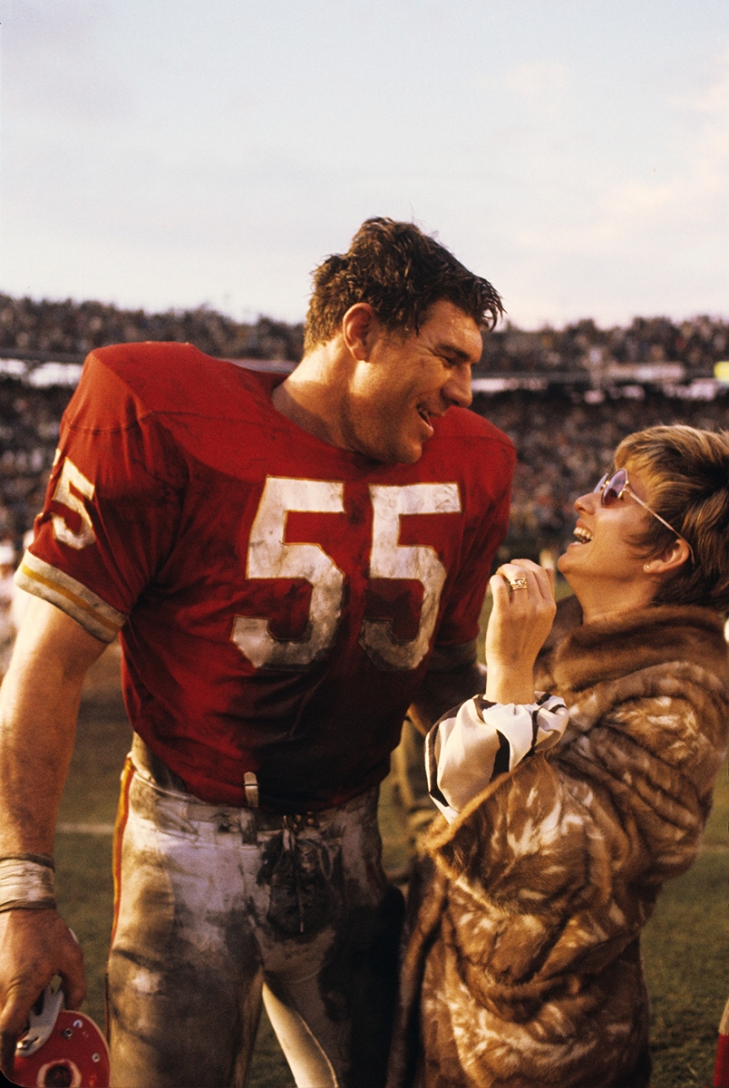
The first football player Texas Tech retired a jersey for, E.J. Holub entered pro football with the legendary nickname "The Beast"—and spent the next decade proving he earned every syllable of it. Selected sixth overall by the Dallas Texans in the 1961 AFL Draft, Holub made immediate professional history by doing what modern football specialization renders practically impossible: starting at two completely different, physically demanding positions on opposite sides of the ball.
Holub stepped onto the gridiron as an instant defensive anchor at linebacker. Over his first six seasons with the franchise, he commanded Hank Stram’s defense with relentless intensity, picking off 10 passes—returning one for a touchdown—and collecting five AFL All-Star selections (1961, 1962, 1964, 1965, 1966) alongside back-to-back First-Team All-AFL honors in 1962 and 1963. He was the emotional heartbeat of the 1962 Dallas squad that captured the AFL Championship in a dramatic overtime thriller over Houston.
Sustained collisions eventually levied a massive toll on his lower body, resulting in nine knee surgeries during his playing days. Rather than step away when knee instability ended his tenure at linebacker, Holub pulled off a miraculous mid-career transition: he moved full-time to offense and took over as the team's starting center in 1968, extending his career while giving Kansas City an elite interior anchor.
That unbelievable positional versatility yielded unique championship lore. Holub remains the only player in gridiron history to start two Super Bowls at two different positions, having started at middle linebacker in Super Bowl I and later at center in Kansas City’s Super Bowl IV victory over the Minnesota Vikings.
After the 1970 season, Holub retired after 10 years with the Texans/Chiefs, playing every pro snap for the organization. He entered the Chiefs Hall of Fame in 1976.
