


Site Admin
25. Rico Petrocelli
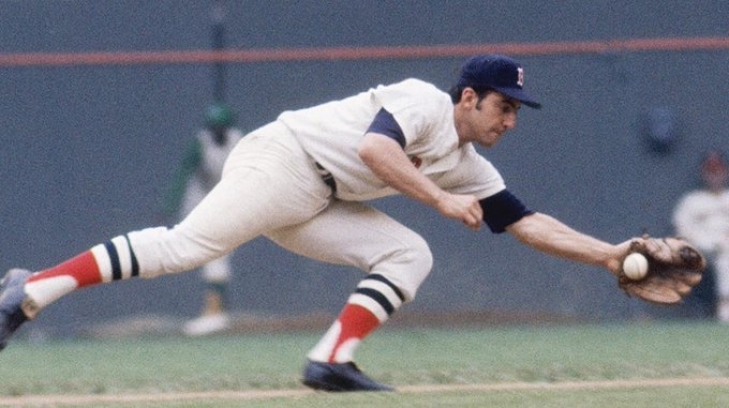
After a brief debut in 1963 and a final polish in Triple-A, he became the bedrock of the Boston infield in 1965. While he was initially known for his steady glove, Petrocelli evolved into the most dangerous offensive shortstop of his era. By the "Impossible Dream" season of 1967, he was an All-Star and a defensive wizard, finishing in the top six for defensive bWAR for four consecutive seasons (1966–1969).
The 1969 campaign stands as one of the greatest individual seasons in franchise history. Petrocelli shattered the expectations for his position, launching 40 home runs—a record for American League shortstops that would stand for decades. His batting efficiency was staggering: he batted .297 with a .403 OBP and led all Major League position players with a 10.0 bWAR.
Petrocelli’s versatility was highlighted by his seamless transition to third base in 1971 to accommodate the arrival of Luis Aparicio. Rather than decline, Rico mastered the "hot corner," leading the league in fielding percentage and continuing to provide double-digit home run power. A Red Sox mainstay, he appeared in two World Series (1967 and 1975), notably hitting two home runs in the '67 Fall Classic. He remained a productive force until his retirement in 1976, finishing his Red Sox journey with 1,352 hits and 210 home runs.
He was Inducted into the Red Sox Hall of Fame in 1997.
26. Johnny Pesky
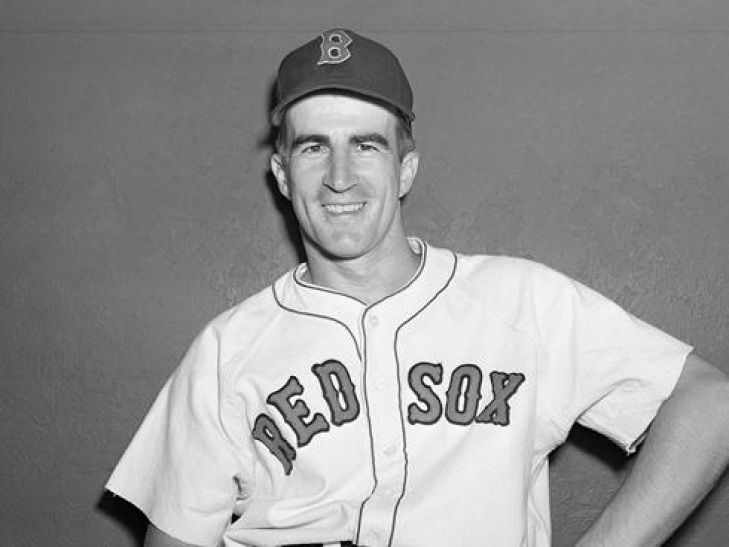
Johnny Pesky authored what many consider the greatest rookie season in Red Sox history. Debuting in 1942 as the starting shortstop, he immediately dismantled American League pitching, leading the league with 205 hits and batting a blistering .331. He finished third in the MVP voting, a peer comparison marker that signaled the arrival of a generational table-setter. However, like so many of his era, Pesky sacrificed his physical prime to military service, missing the next three seasons (1943–1945) due to World War II.
When Pesky returned in 1946, he picked up exactly where he left off, leading the AL in hits in both 1946 (208) and 1947 (207). This made him the first player in MLB history to record 200+ hits in each of his first three seasons. During this stretch, he was the primary catalyst for the 1946 pennant-winning team, batting .313 and posting a massive .401 career On-Base Percentage in a Red Sox uniform.
Pesky’s identity eventually transcended his playing days. Though he was traded to Detroit in 1952 as his production began to wane, he returned to the organization to serve as a manager, coach, and goodwill ambassador for over 60 years. It is estimated that his three-year military absence likely cost him upwards of 600 hits, which would have easily pushed his Boston total past the 2,000-hit threshold. Despite the lost time, his impact was so profound that the Red Sox retired his Number 6 in 2008, an honor usually reserved for Hall of Famers.
He left Boston with 1,277 hits and a reputation as the most beloved figure in the clubhouse. Inducted into the Red Sox Hall of Fame in 1995.
The Buck Stops Here -- Hall of Fame News -- Season 1 Episode 23
27. Smoky Joe Wood
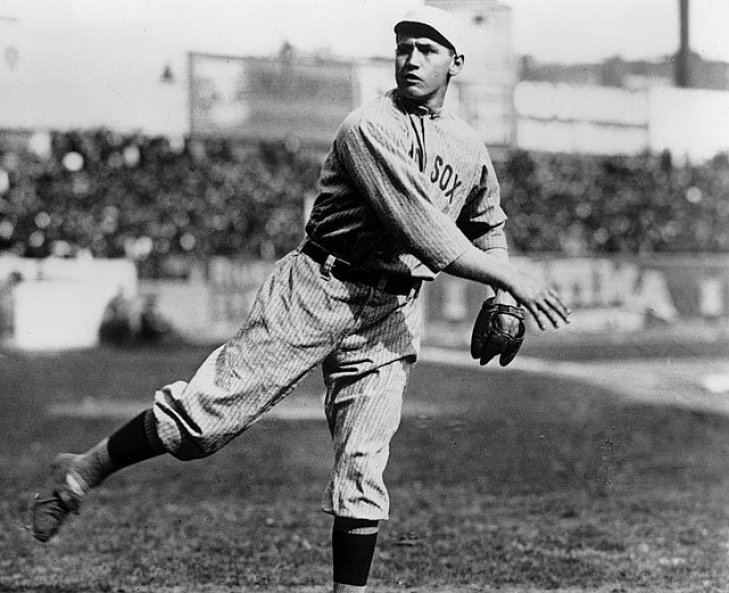
Howard Ellsworth Wood didn't just pitch; he threw "smoke." Debuting as a teenager in 1908, he quickly established himself as the hardest thrower of the Deadball Era. By 1910, he was already an "Efficiency Outlier," posting a 1.69 ERA. In 1911, he led the American League in FIP (2.13) and Strikeouts per 9 innings (7.5), a metric that proved his dominance was no fluke of defense; he was simply missing bats at a rate his peers couldn't match.
The 1912 campaign remains a statistical monument in the Red Sox wing of the Lab. Wood authored a season for the ages, winning a league-leading 34 games against only 5 losses. He paired that massive win total with a 1.91 ERA and a career-best 1.015 WHIP. This was a statistical accomplishment that propelled the Red Sox to the 1912 World Series title. In that Fall Classic, Wood cemented his legacy by winning three games, proving he was the ultimate high-leverage weapon when the championship was on the line.
While arm fatigue eventually caught up to him, Wood’s efficiency remained elite until the very end of his Boston tenure. In 1915, he secured the AL ERA Title with a 1.49 mark, though his declining workload limited him to only 25 appearances. Wood was an exceptional hitting pitcher who batted .244 for Boston, a skill that eventually allowed him to transition into a full-time outfielder later in his career with Cleveland.
Wood departed Boston after 1915 with a staggering 117–56 record and a career 1.99 ERA—one of the lowest marks in franchise history. Though his pitching career was cut short, his impact on the Red Sox's first golden era was undeniable. Inducted into the Red Sox Hall of Fame in 1995, he remains the definitive example of a "shooting star,” a pitcher who burned twice as bright for half as long. In the Lab, Joe Wood is the benchmark for pure, unadulterated power in the Deadball Era.