

18. Bill Willis
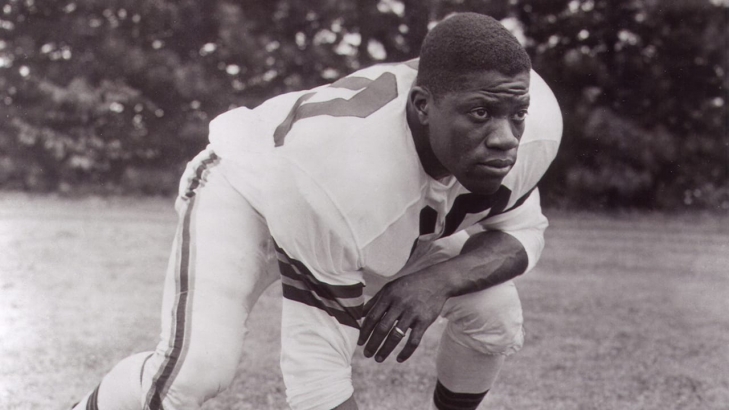
Bill Willis played for Paul Brown at Ohio State, where he was a part of the 1942 National Championship Team. Willis graduated in 1945 and wanted to play pro football, but as a black man with the knowledge that the NFL had an unspoken rule about African-Americans, there was nowhere for him to go.
Enter the All-American Football Conference.
In 1946, his former Head Coach, Brown, was the Head Coach of the new team that bore his name, and Willis received an opportunity to try out for the Cleveland Browns. Willis made the team, and along with Marion Motley, were among the first two black players in pro football.
Playing at Guard, he was a part of the Browns dominance of the short-lived league, winning all four Championships. Willis proved to be one of the top Guards in the AAFC, especially on the defensive side of the ball. When the AAFC migrated with the NFL, Willis was recognized as a three-time Pro Bowl and three-time First Team All-Pro. The Browns won the 1950 NFL Championship, and Willis was a colossal component of Cleveland's success in their early existence.
Willis retired in 1953, and the Pro Football Hall of Fame called his name for induction in 1977. The Browns also chose Willis for their Ring of Honor in 2010 as part of the first group.
17. Paul Warfield
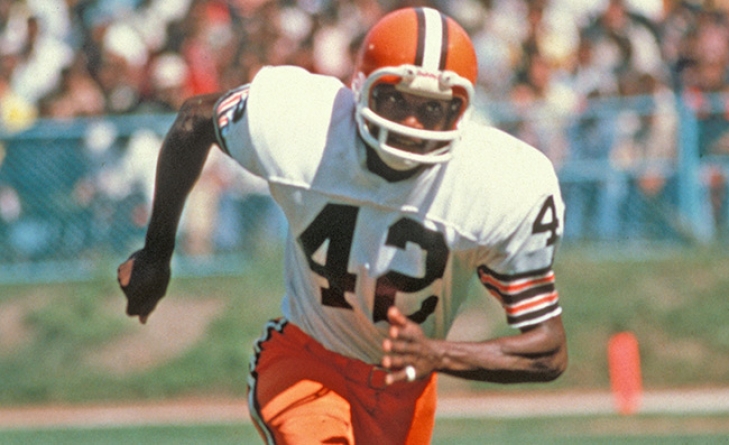
Paul Warfield was a National Champion at Ohio State in 1961, an All-American in 1963, and would stay in the state as a professional football player when the Cleveland Browns used the 11th Overall Pick to select the End.
Warfield joined an already potent Cleveland offense, led by Jim Brown. He was immediately plugged into the scheme, accumulating 920 Yards as a rookie and helping Cleveland win the NFL Championship. The Browns returned to the Title Game in 1965, though he missed nearly the entire season due to a broken collarbone.
He returned healthy in 1966 and was back to his old self, earning Pro Bowls in 1968 and 1969. He would lead the NFL in Rushing Touchdowns in 1968 (12) and had ten the year after. Warfield was an upper-tier Receiver, but the Browns inexplicably thought he was nearing the end, and they dealt him to Miami for only a Third Round pick in return. Warfield got even better and would win two Super Bowls with the Dolphins. After one year with the Miami Southmen of the World Football League, he returned to the Browns in 1976, playing two more years before retiring.
Warfield caught 271 passes for 5,210 Yards and 52 Touchdowns with Cleveland and was inducted into the Pro Football Hall of Fame in 1983. He would later receive another prestigious accolade when he was named to the NFL 100thAnniversary Team. Warfield was also inducted to the Browns Ring of Honor as part of the first group in 2010.
19. Mike McCormack
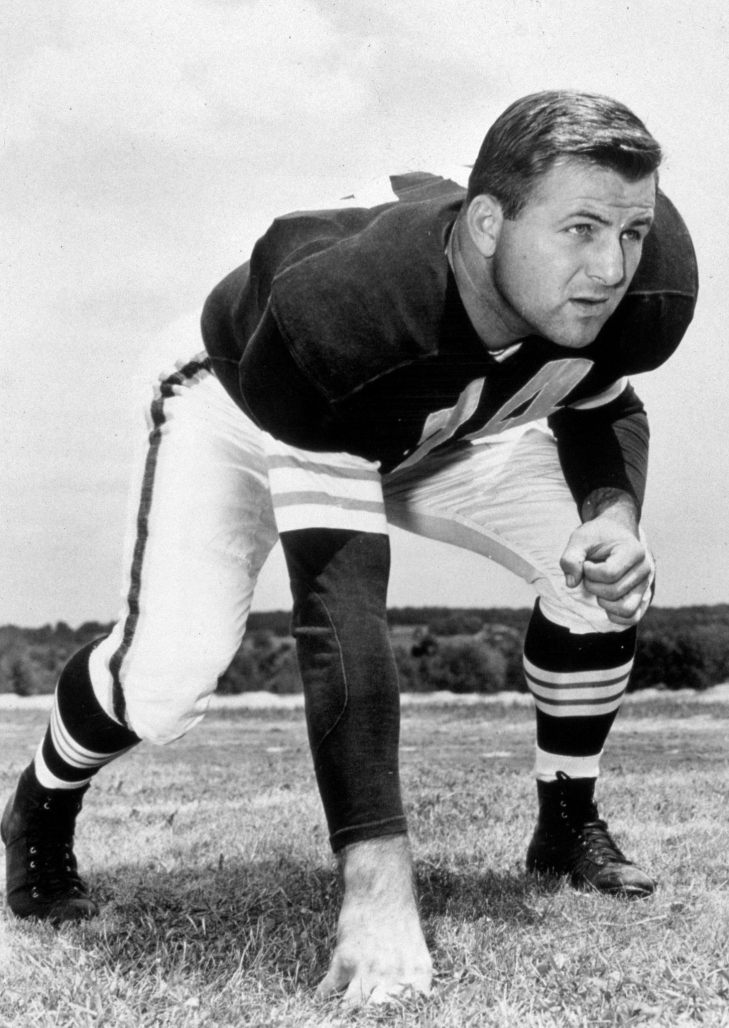
Mike McCormack played for the New York Yanks as a rookie, but he would leave them to serve his country in the Korean War. When he returned, the Yanks had folded, and the Baltimore Colts were created to replace them. McCormack signed with the Colts, but Cleveland Browns Head Coach, Paul Brown, remembered the Lineman and traded for him before he played for the Colts.
McCormack started at Middle Guard and then Right Tackle, helping Cleveland win the NFL Championship in both 1954 and 1955. The Browns were a very competitive team for McCormack's duration (until 1962), and he was named to five Pro Bowls and three Second Team All-Pros. Brown had referred to McCormack as the best Lineman that he ever coached, and that is as high praise as you can get. The Browns agreed and named him to their Ring of Honor in 2010.
16. Len Ford
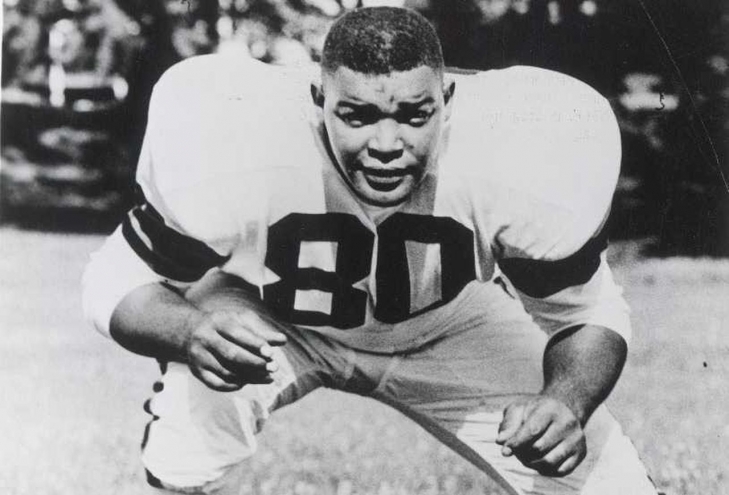
Selected in the 1950 AAFC dispersal draft after spending his first two professional seasons with the Los Angeles Dons, Len Ford arrived in Cleveland as a game-changing defensive force. Over eight seasons in brown and orange, Ford anchored the defensive line with unblockable edge power and relentless pursuit, fundamentally changing how the defensive end position was played in professional football.
Ford exhibited an uncommon combination of length, inherent strength, and acceleration in open space, cultivated during his tenure as a two-way end. Serving as Cleveland's principal right defensive end, his remarkable explosiveness at the start of plays compelled opposing offenses to modify their pass protection strategies. His impact was so profound that head coach Paul Brown and defensive coordinator Blanton Collier reconfigured their defensive formations to focus on him against edge rushers—thus laying the foundation for the contemporary 4-3 defensive scheme.
Ford overcame a severe facial injury early in his debut season in 1950 with Cleveland, returning in time for the championship game with a protective facemask that contributed to the Browns' victory in the 1950 NFL Championship. This display of resilience initiated an exceptional period of personal prominence, as Ford received four consecutive First-Team All-Pro honors and four consecutive Pro Bowl selections from 1951 to 1954.
He was a key defensive player for Cleveland, helping the team allow the fewest points in the NFL in six of seven seasons during the 1950s. Ford also played a big role in two more championship wins, contributing to back-to-back NFL Championship victories in 1954 and 1955. In the 1954 championship game against Detroit, he made a great start by catching two interceptions in a decisive 56–10 victory.
Ford left Cleveland after 1957 and played one last NFL season with the Green Bay Packers in 1958. Over nine seasons, he recovered 20 fumbles and was one of the top pass rushers of his era. Named to the NFL 1950s All-Decade Team, Ford was inducted into the Pro Football Hall of Fame in 1976. In 2010, Cleveland honored him by inducting him into the inaugural Browns Ring of Honor.
13. Mac Speedie
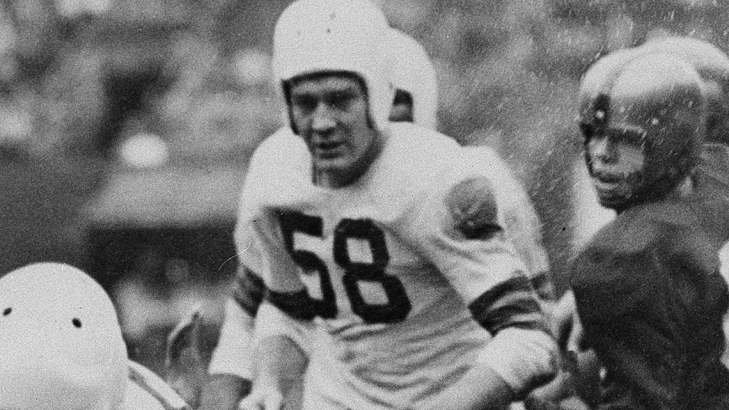
Selected in the 15th round (135th overall) of the 1942 NFL Draft out of Utah by the Detroit Lions, Mac Speedie chose to pause his professional football journey to serve in the U.S. Army during World War II. After returning, he eagerly tried out for Paul Brown's inaugural 1946 Cleveland Browns in the emerging All-America Football Conference (AAFC). Speedie secured a spot on the team and quickly became one of the top wide receivers of his time, teaming up with Dante Lavelli to form one of the most formidable receiving duos in professional football history.
Speedie showcased a graceful stride, perfect timing, and impressive control along the sideline. As Paul Brown’s main split-end threat, he skillfully ran sharp curl and post routes that caught defenses off guard, especially when they laid extra focus on Cleveland's strong ground game. His big hands and sharp tracking skills enabled him to catch passes while moving at full speed, transforming short throws into exciting long-distance touchdowns.
Speedie quickly made a big impact in the AAFC, playing a key role in helping the Browns secure all four AAFC Championships from 1946 to 1949. He was a standout receiver, leading the league in receiving yards twice—amassing 1,146 yards in 1947 and 1,028 yards in 1949—and topping the receptions chart for three straight seasons from 1947 to 1949. During the 1947 season, he even set a professional football record with an impressive average of 81.9 receiving yards per game.
When Cleveland joined the NFL in 1950, Speedie was right there with them. He caught 42 passes for 548 yards during the regular season and played a key role in helping Cleveland win the 1950 NFL Championship in their first year. He also earned Pro Bowl honors in 1950 and 1952, and in 1952, he led the entire NFL with 62 receptions for 911 yards and five touchdowns. Over his seven seasons in Cleveland, he was recognized twice as a First-Team All-Pro (1950, 1952) and also received three First-Team All-AAFC selections.
Following the 1952 season, a contract dispute with head coach Paul Brown prompted Speedie to leave the NFL for the Canadian Football League. He played three seasons in Canada with the Saskatchewan Roughriders and BC Lions before retiring from active play.
Speedie left Cleveland with 349 receptions for 5,602 yards and 33 touchdowns across 86 games. In 2020, he gained national recognition by joining the Pro Football Hall of Fame as part of the NFL's Centennial Class. That year, the franchise also honored him by adding him to the Cleveland Browns Ring of Honor.
12. Dante Lavelli
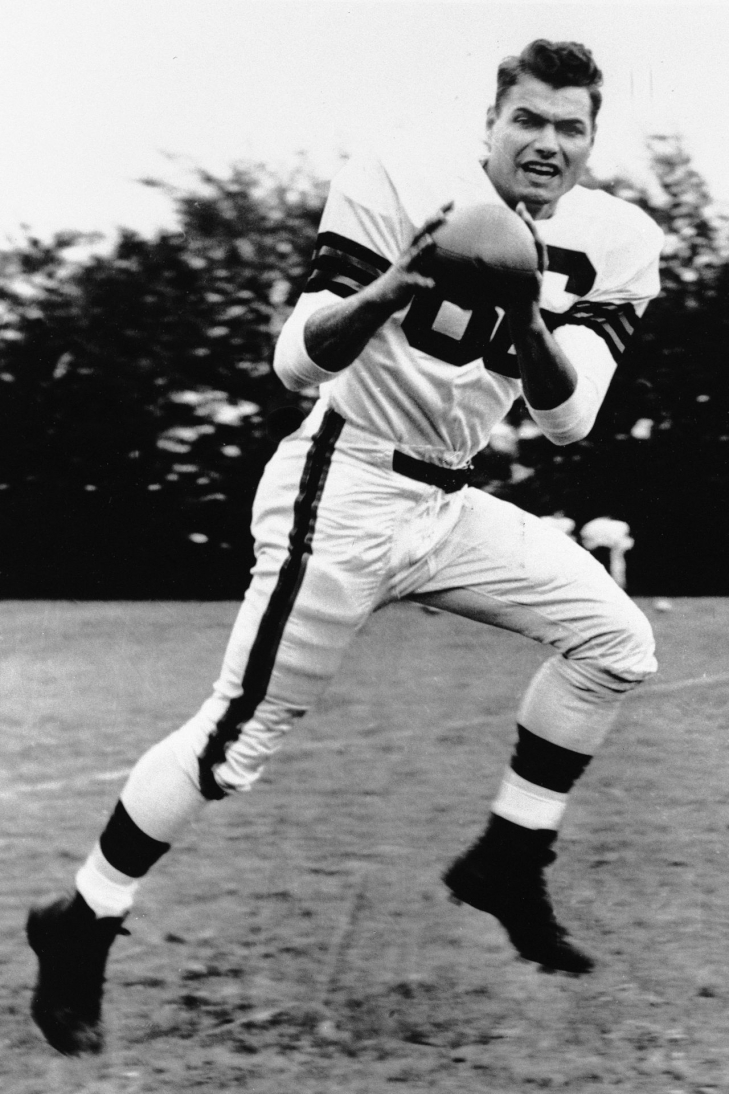
Playing for Paul Brown at Ohio State during their 1942 national championship season, Dante Lavelli put his football career on hold to serve in the U.S. Army during World War II, participating in the Battle of the Bulge. Upon returning home, he reunited with Brown on the inaugural 1946 Cleveland Browns, quickly earning the moniker "Gluefingers" for his miraculous hands and clutch big-play ability along the boundary.
Lavelli was known for his physical toughness, sharp route running, and remarkably strong hands. Playing as the main boundary end across from Mac Speedie, he was great at running crisp comeback routes and deep posts through heavy traffic, reliably catching contested throws from Otto Graham. His determination in run-blocking on the edge was just as important, helping to seal off defensive ends and create open lanes for Marion Motley and Motts Tonelli.
Lavelli quickly became the top receiving threat in the AAFC during its first season in 1946. He led the league with 40 receptions, 843 yards, and eight touchdowns. In the very first AAFC Championship Game, he caught the winning touchdown pass, setting the stage for an exciting four-year run where Cleveland proudly took home all four AAFC titles from 1946 to 1949.
When the Browns stepped into the NFL in 1950, Lavelli quickly became a key player in their passing game. During the 1950 NFL Championship Game, he caught eleven passes for 128 yards and two touchdowns, helping Cleveland achieve an exciting 30–28 win over the Los Angeles Rams. His outstanding performance earned him three straight Pro Bowl nominations from 1951 to 1953 and First-Team All-Pro honors in 1953, after he made 45 receptions for 647 yards and six touchdowns. He finished his career on a high note, helping Cleveland win back-to-back NFL Championships in 1954 and 1955.
Lavelli retired his athletic footwear following the 1956 season, thereby concluding an eleven-year career entirely with Cleveland. Throughout seven championship-winning seasons, he established a reputation as one of the most exceptional large-game pass catchers in early professional football history. In 1975, he was inducted into the Pro Football Hall of Fame. In 2010, the franchise permanently acknowledged his contributions by inducting him into the inaugural class of the Cleveland Browns Ring of Honor.
Overall, Lavelli played in 123 regular-season games, recording 386 receptions for 6,488 yards and 62 touchdowns.
11. Leroy Kelly
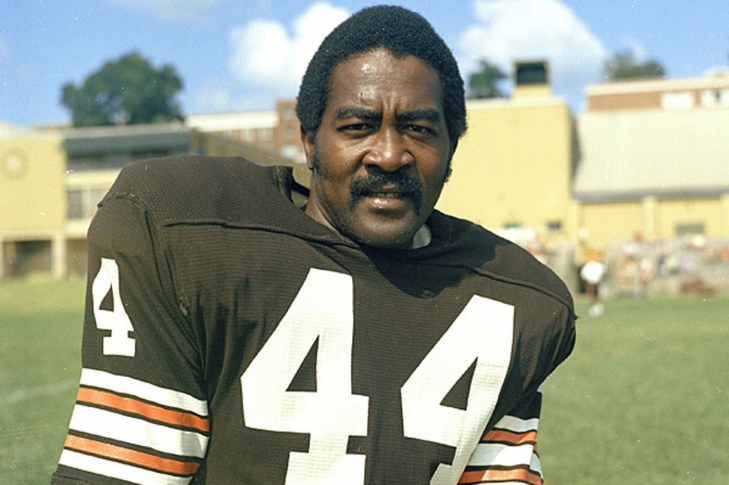
Drafted in the eighth round (110th overall) of the 1964 NFL Draft from Morgan State, Leroy Kelly confronted an extraordinarily challenging endeavor: succeeding Jim Brown. After dedicating two seasons as a distinguished contributor on special teams and serving as Brown's understudy, Kelly assumed the starting position when Brown unexpectedly retired prior to the 1966 season. Over the subsequent eight years, Kelly accomplished the remarkable—establishing his own distinguished career and affirming his status as a Hall of Fame athlete.
Kelly relied on exceptional balance, rapid first-step acceleration, and uncanny vision. Rather than overwhelming defenders with raw power, he excelled at setting up blocks for Cleveland's signature trap plays and perimeter sweeps, using subtle hip shifts to avoid tackles in the open field. His dual-threat versatility as a ball-carrier, pass-catcher, and return man made him a constant scoring threat from anywhere on the turf.
Kelly made an immediate impact as a full-time starter in 1966, rushing for 1,141 yards while leading the NFL with 15 rushing touchdowns and a 5.5 yards-per-carry average. He subsequently achieved consecutive NFL rushing titles in 1967 (1,205 yards) and 1968 (1,239 yards). During this exemplary three-year period from 1966 to 1968, he led the league in rushing touchdowns each season, accumulating a total of 42 touchdowns on the ground.
His consistency garnered him six consecutive Pro Bowl selections (1966–1971) and four First-Team All-Pro honors (1966–1968, 1971). Even as defensive strategies evolved to focus on stacking the box against Cleveland, Kelly persisted as the offensive key player, achieving three additional seasons with over 800 yards between 1969 and 1972.
Kelly finished his amazing ten-year journey with the Cleveland Browns after the 1973 season. When he retired, he had amassed 7,274 rushing yards, placing him just behind legendary players Jim Brown, Joe Perry, and Jim Taylor on the NFL's all-time rushing list. His remarkable contributions were honored in 1994 when he was inducted into the Pro Football Hall of Fame. Later, in 2010, Cleveland proudly welcomed him into the first-ever class of the Cleveland Browns Ring of Honor, celebrating his lasting impact.
Overall, Kelly had 7,274 rushing yards and 74 rushing touchdowns, while adding 2,281 receiving yards, 2,774 return yards, and 90 total touchdowns.
15. Clay Matthews Jr.
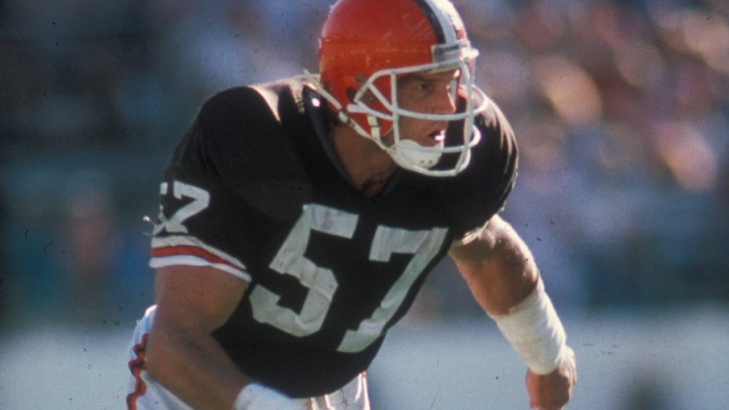
Clay Matthews Jr. carried on an unmatched football lineage. The son of four-year NFL veteran Clay Matthews Sr. and older brother to Pro Football Hall of Fame offensive lineman Bruce Matthews, Clay Jr. spent the first 16 of his 19 professional seasons in Cleveland after he was drafted 12th overall in 1978. He established himself as the ultimate defensive iron-man and a quintessential franchise leader, anchoring the Browns' linebacker corps throughout the late 1970s, 1980s, and early 1990s.
Matthews combined instincts, tactical reading of backfield flows, and rare physical durability. Operating as an outside linebacker in both 4-3 and 3-4 schemes, he possessed the lateral quickness to scrap over the top of blocks to shut down perimeter runs, while also boasting the bend and power to drop quarterbacks off the edge. His longevity and ability to play every down made him the emotional heartbeat of Marty Schottenheimer's physical defenses.
Matthews took over as a full-time starter in his second season in 1979. Over his 16-year run in Northeast Ohio, he recorded eight seasons with at least 100 tackles and led the NFL in combined tackles four times. He hit his pass-rushing stride in 1984, logging a career-high 12.0 sacks and earning Second-Team All-Pro honors.
His peak prime coincided with Cleveland's late-1980s surge, earning four Pro Bowl selections in a five-year span (1985, 1987–1989). Matthews was on the field for the franchise's most iconic AFC Championship battles. His signature postseason moment arrived in the 1989 AFC Divisional Playoff against Buffalo, when he intercepted Jim Kelly at the 1-yard line with seconds remaining to seal a 34–30 victory and propel Cleveland to the AFC title game.
Matthews departed Cleveland following the 1993 season, joining the Atlanta Falcons for three final years before retiring at age 40 as the oldest player in NFL history to record a sack (40 years, 282 days). Across his 232 regular-season games with the Browns, he accumulated 1,430 tackles, 62.0 sacks, 14 interceptions, and 24 forced fumbles. In 2019, Cleveland officially recognized his case for Canton by inducting him into the Cleveland Browns Ring of Honor.
10. Frank Gatski
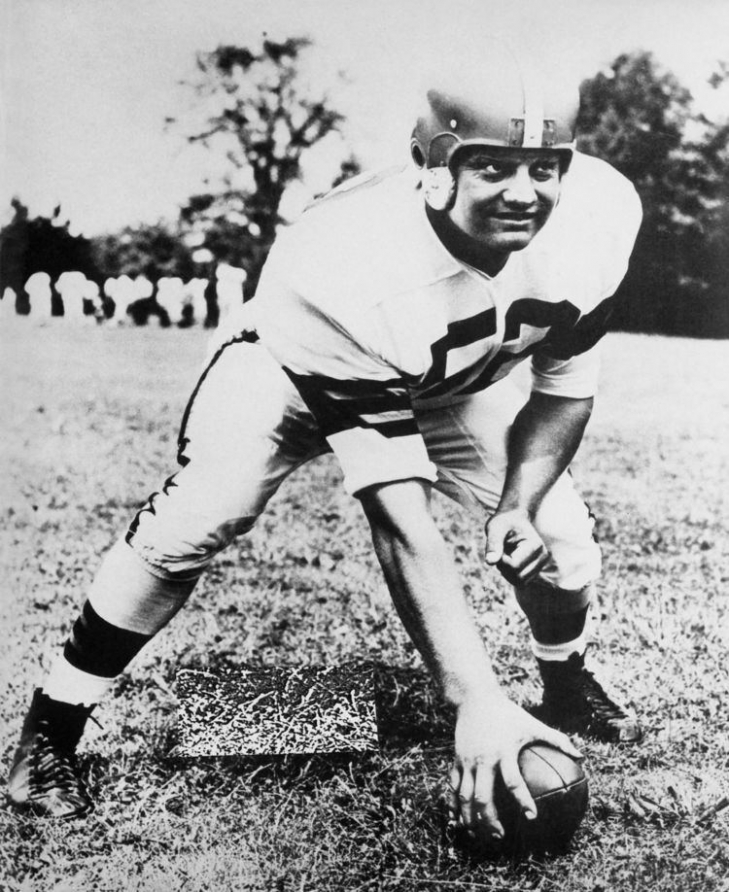
Joined by legendary head coach Paul Brown in 1946 after serving in the U.S. Army during World War II, Frank Gatski earned a spot on the inaugural Cleveland Browns through a walk-on tryout. Over 11 seasons in Cleveland, "Gunner" anchored the offensive line with relentless consistency and mistake-free mechanics, serving as the unsung offensive centerpiece for one of the greatest dynasties in pro football history.
Gatski drew on physical strength from his West Virginia coal-mining roots, leverage, and perfect mechanics. As the starting center, he ensured Otto Graham never experienced a botched exchange. His ability to snap, step, and instantly wall off interior nose tackles allowed Cleveland's trap-draw run scheme with Marion Motley to flourish, while his sturdy base kept the interior pocket clean against heavy blitzes.
Gatski became the Browns' full-time starting center in 1948 after two years backing up Mo Scarry. He led the line for an offense that secured all four AAFC Championships from 1946 to 1949, including a perfect 15–0 record in 1948. When the team transitioned to the NFL in 1950, Gatski continued to excel, starting every game as Cleveland won the 1950 NFL Championship in its first season.
His exceptional skills led to consecutive NFL Championship wins in 1954 and 1955. Widely regarded as the premier center of his era, Gatski received three first-team All-Pro honors (1952, 1953, 1955) and was selected for the Pro Bowl in 1956. Throughout his 12-year career, he appeared in 11 championship games, securing seven titles with Cleveland and adding an eighth after his trade to the Detroit Lions in 1957.
Gatski, renowned for his exceptional durability, supposedly never missed a practice or game during his high school, college, or 12-year professional football career. His achievements were cemented with his induction into the Pro Football Hall of Fame in 1985. Additionally, in 2010, the Cleveland Browns permanently honored him by inducting him into the first class of their Ring of Honor.
5. Lou Groza
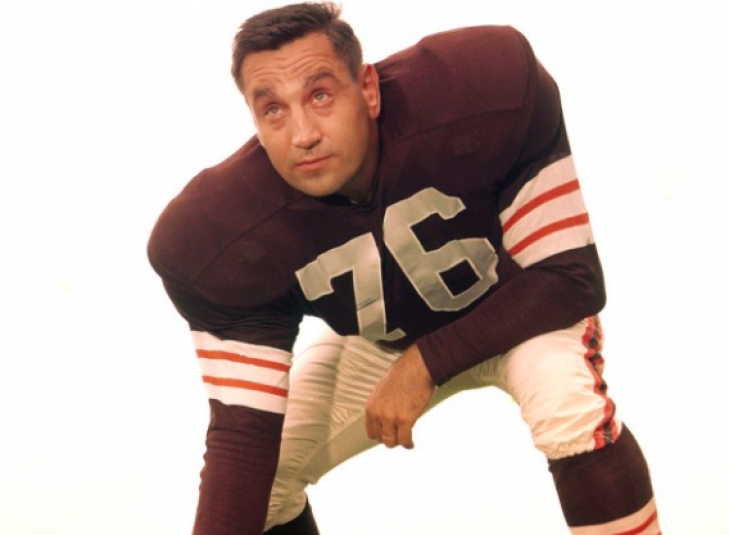
An original Cleveland Brown, Lou Groza was recruited by Paul Brown, primarily to act as the Browns’ Place Kicker. Groza led the AAFC in Points in his rookie year, and after two seasons, Groza also helped out on Cleveland’s Offensive Line, and he would perform a dual-role for the next twelve seasons.
The Browns won the first four AAFC Championships, and Groza helped them win the 1950, 1954, and 1955 NFL Titles. Groza evolved into an above-average Left Tackle, but his kicking talents were ahead of its time. "The Toe" was one of the first Kickers who could regularly get it through the uprights in further distances. Before Groza, Field Goals beyond 40 Yards were rarely attempted, but a new dynamic was added to the game with Groza as a weapon. He would be named a First Team All-Pro four years in a row (1952-55) with nine Pro Bowl appearances. Back issues compounded, and he retired after the 1959 Season.
Groza came out of retirement in 1961, rejoining Cleveland but only as their Kicker. For the fourth and fifth time, Groza led the NFL in Field Goal Percentage and helped the Browns win the 1964 Championship, making him the only player to win seven titles with Cleveland. He retired for good after the 1967 Season.
Graham entered the Pro Football Hall of Fame in 1974, and his number 76 is one of five retired by the team. He was also part of the inaugural Browns Ring of Honor in 2010. Groza is also a member of the 1950s All-Decade Team.
7. Gene Hickerson
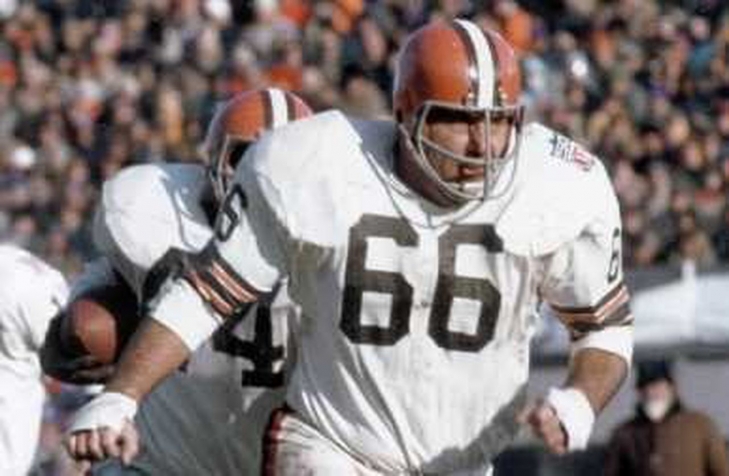
From Ole Miss, Gene Hickerson was chosen in the Seventh Round in the 1957 Draft, where Cleveland Browns Head Coach, Paul Brown, liked his speed and moved him to the Right Tackle position, where he became their starter in his second season. As Hickerson improved, his 1961 Season was taken from him due to a broken leg, but he returned the following season as a greater asset that protected Jim Brown and company.
Hickerson helped Cleveland win the 1964 NFL Championship, and as he turned 30, he defied time and grew into one of the top Guards in football. From 1965 to 1970, Hickerson put forth an Approximate Value of at least 11, peaking with 18 in 1968. In all of those six years, Hickerson went to the Pro Bowl and was a First Team All-Pro from 1967 to 1969. Hickerson played until the end of the 1973 Season, and he retired with the team he started with, finishing with 202 Games Played.
Hickerson received the Pro Football Hall of Fame call in 2007. Three years later, he was part of the first Browns Ring of Honor class. Notably, Hickerson was also named to the 1960s All-Decade Team.
4. Joe Thomas
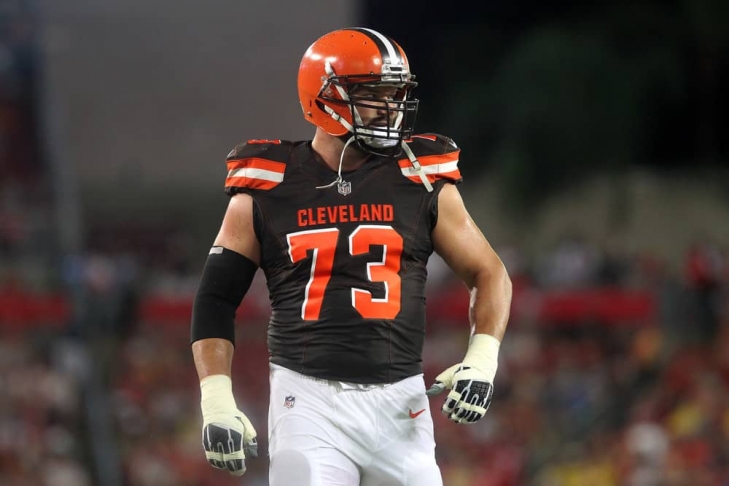
Drafted third overall in the 2007 NFL Draft out of Wisconsin—where he captured the 2006 Outland Trophy as college football's premier interior lineman—Joe Thomas arrived in Cleveland as a generational standard at left tackle. Joining a franchise navigating two decades of organizational turbulence, Thomas stood as an unbreakable pillar of perfection, delivering an era of unmatched individual brilliance on the Browns' offensive line.
At 6 feet 6 inches and 312 pounds, Thomas fundamentally reshaped how the offensive tackle position was played in the modern NFL. Eschewing traditional angled kick-slides, he pioneered an elite vertical pass set, getting out of his stance with explosive speed to square his hips pre-snap before defenders could gain leverage. Combined with his signature "shot-put" tight hand punch, Thomas mastered the mechanics of neutralizing power. Whenever pass rushers attempted to bull-rush, he dropped his hips into extreme ankle angles to absorb kinetic energy and lift the defender's center of gravity upright. Across 6,680 career pass-blocking snaps, Thomas allowed a total of just 30 sacks—meaning opposing edge rushers had less than a half-a-percent chance of reaching the quarterback against him.
Thomas joined the starting lineup as a rookie in 2007 and quickly made an impact, earning his first Pro Bowl and All-Rookie honors while protecting a 10-win Cleveland team. He improved in 2008 by earning Second-Team All-Pro recognition, then dominated from 2009 to 2011 with three straight First-Team All-Pro selections.
Despite coaching changes and scheme adjustments around him, Thomas remained completely unfazed. He secured his second Second-Team All-Pro honor in 2012 and then solidified his dominance with three straight First-Team All-Pro selections in 2013, 2014, and 2015. With an additional Pro Bowl appearance in 2016, Thomas uniquely became the only offensive lineman in NFL history to receive 10 consecutive Pro Bowl invites at the start of his career—while pass-blocking for 20 different starting quarterbacks.
Beyond his exceptional technical skills, Thomas created an unrivaled iron-man legacy in professional sports. From his debut snap on September 9, 2007, until October 22, 2017—when a torn triceps against the Tennessee Titans ended his career—he played 10,363 consecutive snaps without missing a single one. He endured torn knee cartilage, high-ankle sprains, and severe joint inflammation, never once stepping off the field.
Thomas retired following the 2017 season, having started 167 consecutive games and accumulating a franchise-leading 108 Approximate Value (AV) during the modern era. The Browns added "10,363" to the stadium honor roll and inducted him into the Cleveland Browns Ring of Honor. The NFL named him to the 2010s All-Decade Team, and in 2023, Thomas was elected to the Pro Football Hall of Fame on his first ballot—becoming the first player drafted by the expansion-era Browns to receive a gold jacket in Canton.
2. Otto Graham
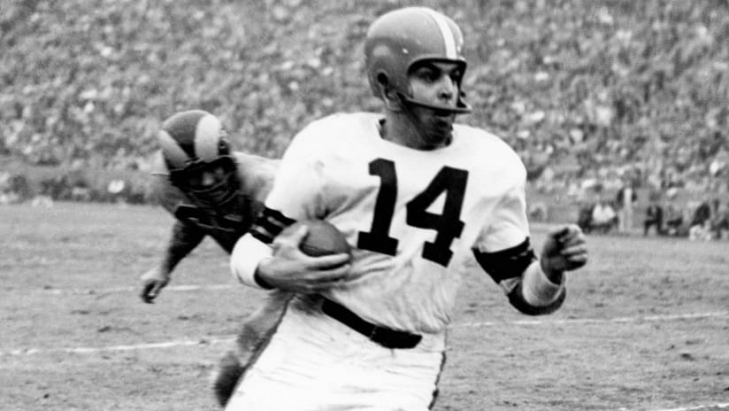
Long before Jim Brown arrived on Lake Erie, Otto Graham established the baseline of excellence for the Cleveland Browns. A multi-sport standout at Northwestern, Graham was named Big Ten Player of the Year in 1943 and finished third in Heisman Trophy voting. While enrolled in Navy flight school at Colgate, he continued to showcase his athletic versatility by playing professional basketball for the Rochester Royals—winning an NBL title in 1946—before legendary coach Paul Brown selected him to be the field general for his new pro football franchise in the All-America Football Conference (AAFC).
Graham possessed pinpoint passing accuracy, supreme poise under pressure, and a deep understanding of Paul Brown’s revolutionary, structured passing offense. Operating under center, "Automatic Otto" possessed a quick release, deadly deep-ball placement, and the mobility to run for clutch third-downs or short-yardage touchdowns. He set a standard for efficiency that fundamentally shifted professional football from a run-heavy league to a passing-dominated sport.
What truly defined Graham’s playing style was his ahead-of-his-time mastery of pocket mechanics and intermediate field vision. In an era when quarterbacks rarely had structured pass protection, Graham navigated collapsing pockets with light, rhythmic footwork, never taking his eyes off downfield coverage. He threw with exquisite touch, effortlessly dropping deep corner routes over tight coverage or driving fastballs into tight windows on comeback routes. His quick decision-making allowed Paul Brown’s scripted timing offense to operate with surgical precision, rarely giving pass rushers a chance to strike.
Graham's skills extended beyond his arm, as he brought a tough, gritty physicality to the quarterback role. With a background as a collegiate single-wing tailback, he served as a powerful goal-line runner, executing handoffs on bootlegs or sneaks into the end zone. A fearless leader, he embraced the rough physicality of 1950s football, often playing through severe injuries, and his steady, composed presence in fourth-quarter drives earned the complete trust of his teammates in the Cleveland huddle.
Since the franchise's inception in 1946, Graham transformed the AAFC into his personal domain. He led the Browns to win all four AAFC Championship Games (1946–1949) and topped the league in passing yards in the last three seasons before the league dissolved.
Throughout that four-year period, Graham was awarded three AAFC Most Valuable Player honors. Following the dissolution of the AAFC after the 1949 season and the subsequent merger of the Browns into the National Football League, critics anticipated that Cleveland’s expansive passing offense would falter against the seasoned defenses of the NFL.
Graham quickly silenced all skeptics in his 1950 NFL debut season. In the season opener against the reigning NFL champion Philadelphia Eagles—a game dubbed the "World Series of Football"—he shredded the Eagles for 346 passing yards and three touchdowns in a 35–10 rout. He capped the year by leading the Browns to the 1950 NFL Championship Game, throwing four touchdown passes and engineering a game-winning fourth-quarter drive in a 30–28 victory over the Los Angeles Rams, securing five consecutive league titles for Cleveland.
Over the subsequent three seasons, Graham remained the unequivocal benchmark at the quarterback position. He was awarded the UPI NFL Most Valuable Player accolade in 1951, guiding Cleveland to the championship game. In 1952, he led the NFL in completions with 181 and passing yards totaling 2,816. In 1953, he achieved a personal statistical zenith, earning his second NFL MVP award while leading the league in completion percentage (64.7%), passing yards (2,722), and attaining an impressive 10.55 yards per pass attempt.
Graham's career concluded with back-to-back championship masterclasses. In the 1954 NFL Championship Game, he delivered an all-time performance against the Detroit Lions, throwing for three touchdowns and rushing for three more in a 56–10 blowout win. Though he initially planned to retire, Paul Brown coaxed him back for one final season in 1955. Graham responded by earning his third NFL MVP award and leading the Browns back to the title game against the Rams, where he ran for two touchdowns and threw for two more in a 38–14 victory before walking off into retirement to a standing ovation.
Graham played in 126 regular-season games, compiling a staggering 105–17–4 record as a starter and leading the Browns to the league championship game in every season of his career. He threw for 23,584 yards and 174 touchdowns, adding 44 rushing touchdowns. His career average of 8.63 yards per pass attempt remains the highest mark in NFL history.
In 1965, Graham took his rightful place in Canton with his induction into the Pro Football Hall of Fame. The Browns retired his iconic No. 14 jersey, enshrined him in the inaugural class of the Cleveland Browns Ring of Honor in 2010, and commemorated his impact with a bronze statue outside Huntington Bank Field. He was also selected to the NFL 1950s All-Decade Team as well as the NFL's 75th and 100th Anniversary All-Time Teams.
9. Marion Motley
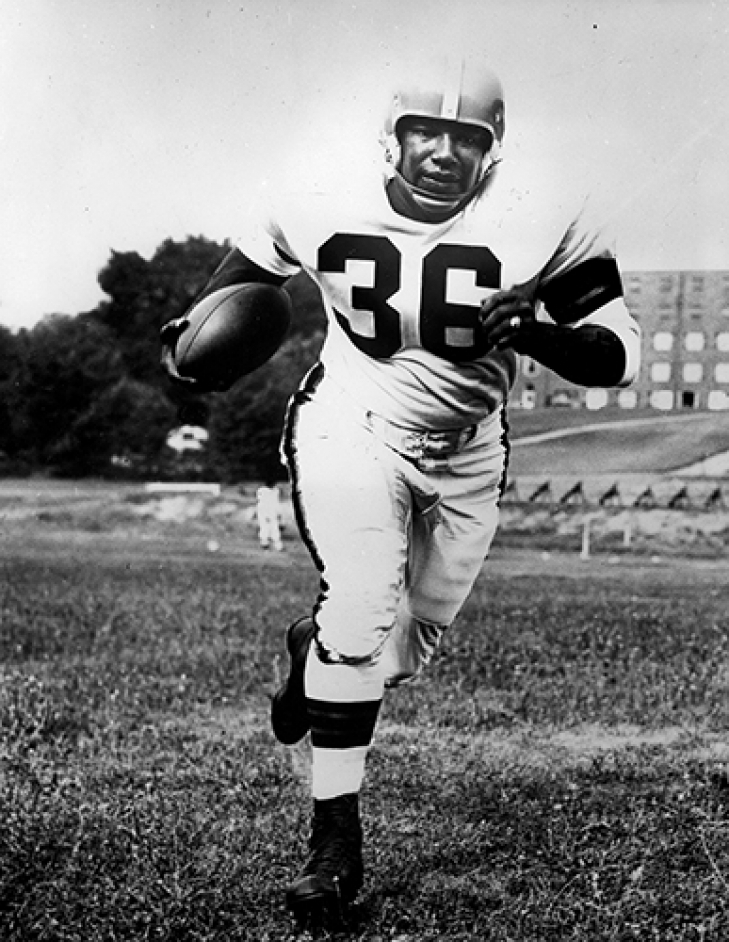
In 1946, Marion Motley signed with the Cleveland Browns, joining his teammate Bill Willis, and reentered professional football. Despite facing significant racial hostility, he emerged as one of the most formidable athletes of his time. During his eight-season tenure with Cleveland, Motley was recognized as an indomitable power runner and an elite pass protector, functioning as the key physical force within Paul Brown's offensive success.
Motley was constructed with the physique of a contemporary interior lineman, yet he played in a manner reminiscent of a backfield player from the 1940s. He exhibited a rare blend of raw power, lateral agility, and explosive speed. Employing the trap-draw formations pioneered by Paul Brown, Motley overwhelmed interior defensive lines through vigorous leg drive and second-level acceleration. In addition to his running capabilities, his blitz pickup was renowned for its physicality, effectively neutralizing rushing linebackers and providing Otto Graham with the unobstructed pocket necessary to execute down-the-seam passes.
Motley assumed leadership of the All-America Football Conference (AAFC) immediately upon entering the field. He secured the 1948 AAFC rushing title with 964 yards, significantly contributing to Cleveland's undefeated season. Throughout the Browns' four-year participation in the AAFC, Motley led the league in career rushing yards with a total of 3,024 yards, while Cleveland secured all four AAFC Championships.
When critics questioned whether the Browns could compete against the established NFL in 1950, Motley responded by securing the NFL rushing title with 810 yards on an impressive 5.8 yards per carry. His notable single-game performance occurred that season against Pittsburgh, where he rushed for 188 yards on only 11 carries (17.1 YPC). Cleveland concluded its inaugural NFL season by winning the 1950 NFL Championship, thereby establishing their position as the preeminent football team of the period.
Motley received his only Pro Bowl selection in 1950 and was honored with two First-Team All-Pro distinctions in 1950 and 1951. He concluded his tenure with Cleveland after the 1953 season, having accumulated 4,712 rushing yards and 31 rushing touchdowns, with an impressive average of 5.7 yards per carry—a record that continues to rank among the highest in the history of professional football.
In 1968, Motley became the second African American in the Pro Football Hall of Fame. In 2010, the Browns honored his groundbreaking career by naming him to the inaugural Cleveland Browns Ring of Honor.
6. Ozzie Newsome
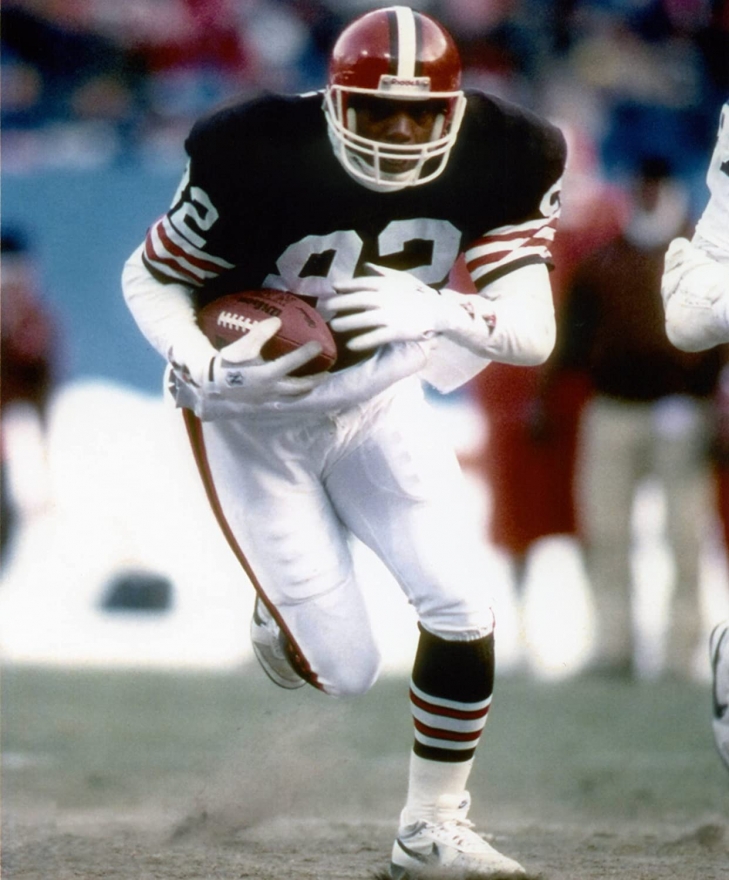
Selected 23rd overall in 1978 from Alabama, where he shined as an All-American under Bear Bryant, Ozzie Newsome made a remarkable impact in Cleveland, transforming the role of an NFL tight end. As a key part of a Browns team stepping into a competitive era, "The Wizard of Oz" led the offense with a blend of clever route-running, gentle hands, and powerful inline blocking for 13 seasons.
Newsome had a natural ability as a wide receiver, despite being built like a tight end. Back in a time when players who stretched the field from the flex position weren’t as common, he used his body control, awareness of his surroundings, and strong hands to get open against linebackers and safeties. Newsome ran precise routes through the gaps in zone defenses, handled tough hits over the middle with resilience, and was also a dependable blocker on the line in the run game.
Newsome quickly made a big splash by becoming the first rookie in 25 years to receive the Browns' Offensive Player of the Year award in 1978. He celebrated his first First-Team All-Pro honor in 1979, but it was in the early 1980s that his performance truly soared. In 1981, he achieved his first 1,000-yard receiving season with 69 catches for 1,002 yards, earning a well-deserved spot in the Pro Bowl.
His absolute peak came during two exciting seasons in 1983 and 1984. In 1983, he impressively caught 89 passes for 970 yards, and he continued his amazing performance in 1984 with another 89 receptions for 1,001 yards. These achievements earned him his second First-Team All-Pro honor and a second Pro Bowl invitation. Notably, he also set a franchise record for a single game with 191 yards against the New York Jets in 1984.
Newsome proudly achieved his third Pro Bowl selection in 1985. As Bernie Kosar's trusted safety valve, he played a key role in guiding the beloved "Kardiac Kids"into the late-80s powerhouse teams that wowed fans by reaching three AFC Championship Games within just four years (1986, 1987, 1989).
Newsome retired after the 1990 season, having played 198 consecutive games and catching a pass in 150 straight contests—a record streak for tight ends at that time. He left as the NFL's all-time leading receiver at the tight end position with 662 receptions for 7,980 yards and 47 touchdowns. These impressive numbers still stand as Cleveland's franchise records for catches and yards. In 1999, Newsome was honored with his induction into the Pro Football Hall of Fame in Canton. He was also named to the NFL 1980s All-Decade Team and was part of the inaugural class of the Cleveland Browns Ring of Honor in 2010.
8. Dick Schafrath
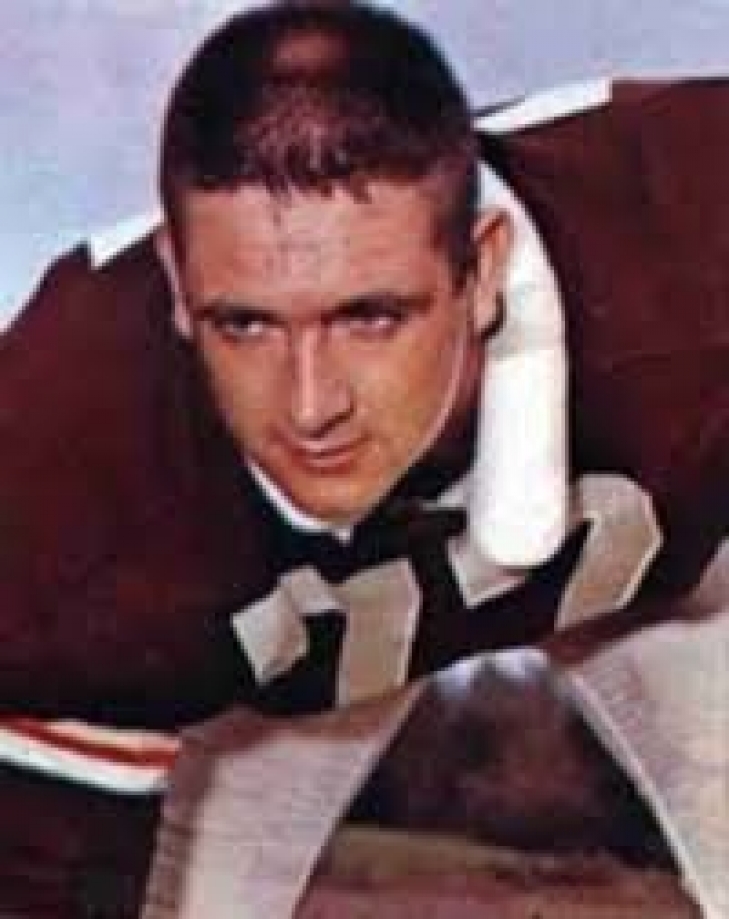
Drafted in the second round (23rd overall) of the 1959 NFL Draft from Ohio State—where he served as captain of a national championship team—Dick Schafrath entered the professional arena in Cleveland as a formidable force. Throughout a 13-year career exclusively with the Browns, "The Mule" upheld the left tackle position with exceptional leverage and superior mobility, facilitating one of the most formidable rushing eras in football history.
Schafrath demonstrated exceptional physical endurance complemented by meticulous technical skill during offensive engagements. Upon transitioning to the position of left tackle in his second season, he distinguished himself by effectively sealing off defensive ends and engaging linebackers during perimeter sweeps. His capacity to propel defenders away from the ball facilitated expansive and reliable running lanes for Cleveland's renowned backfield, while his proficient footwork secured the blindside protection for quarterbacks Frank Ryan and Bill Nelsen.
Schafrath assumed the role of primary starter in 1960 and swiftly established himself as one of the league's premier offensive linemen. His period of peak performance extended throughout the 1960s, during which he received four First-Team All-Pro honors (1963–1965, 1969) and was selected for seven Pro Bowls. In 1963, he was honored by his teammates with the title of Cleveland Browns' Most Valuable Player—a distinguished accolade rarely awarded to an offensive lineman.
His presence on the left side was crucial to Cleveland's historic rushing game; during his tenure, Browns running backs secured eight NFL rushing titles, with Schafrath protecting three future Hall of Famers: Jim Brown, Bobby Mitchell, and Leroy Kelly. The apex of his athletic career occurred in 1964, when he anchored the offensive line during Cleveland's 27–0 victory over the Baltimore Colts to claim the 1964 NFL Championship.
Schafrath continued to serve as a dependable starter throughout the 1971 season, retiring with the team that initially drafted him after participating in 176 regular-season games for Cleveland. Subsequent to his athletic career, he embarked on a distinguished public service trajectory, serving four terms as an Ohio State Senator and subsequently obtaining his bachelor's degree at the age of 69. In 2003, the franchise formally acknowledged his enduring contribution to the team's heritage by inducting him into the Cleveland Browns Legends.
1. Jim Brown
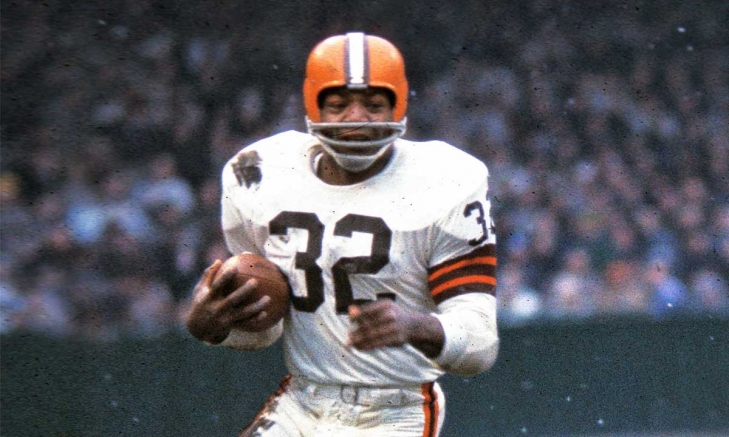
Jim Brown is a football god.
We could end it here, but out of deference to the man we think is not only the most outstanding rusher in the history of the game but the best offensive player ever, we will go through all the reasons why Jim Brown is the best player in franchise history, and arguably the greatest all-time player of any NFL franchise.
Before ever stepping foot on an NFL field, Jim Brown had already built a mythical reputation at Syracuse University as one of the greatest all-around collegiate athletes in American history. A dominant multi-sport phenom who starred in basketball and track and field and earned All-American honors in lacrosse, Brown’s primary playground remained the gridiron. His collegiate curtain call came in the 1957 Cotton Bowl, where he delivered a breathtaking 21-point performance against TCU—rushing for 132 yards, scoring three touchdowns, and kicking three extra points. Yet despite his overwhelming power, track-star speed, and peerless resume, five NFL teams somehow passed on him in the 1957 NFL Draft. Cleveland seized the opportunity at sixth overall, bringing an absolute force of nature to Lake Erie.
Sixth overall, and it was still a steal.
Brown was built like a modern edge rusher, yet he operated in a 1950s backfield. He possessed an extraordinary balance of crushing inner power and electric open-field speed. Rather than avoiding contact, Brown violently punished would-be tacklers with a legendary stiff-arm, leaving defenders dazed in his wake before pulling away into the secondary.
What truly set Brown’s playing style apart was his blend of supreme physical dominance and calculating tactical patience. He did not simply run over defenders; he probed defensive fronts with high-knee, gliding footwork before exploding through the hole at top speed. When contact came, Brown lowered his shoulders, drove through multiple defenders, and delivered a violent, stiff-arm that routinely knocked tacklers off their feet. Equally famous was his demeanor after the whistle: Brown was notorious for getting up from the turf in painful slow motion, dragging himself back to the huddle as if utterly exhausted, only to take the very next handoff and sprint 70 yards downfield past an already demoralized defense.
Brown made a remarkable rookie debut in 1957, quickly establishing himself in the league. He led the NFL with 942 rushing yards and nine touchdowns, earning both NFL Offensive Rookie of the Year and AP NFL MVP awards early in his career while guiding Cleveland to the NFL Championship Game. His standout moment came on November 24 against the Los Angeles Rams, when he broke the single-game rushing record with 237 yards and four touchdowns. This record remained unbroken for 14 years.
Entering his second season in 1958, expectations were extremely high, but Brown exceeded all of them. In only 12 games, he broke the NFL single-season rushing record with 1,527 yards and scored a personal best of 17 rushing touchdowns. He averaged an impressive 127.3 yards per game and 5.9 yards per carry, earning his second straight MVP award and cementing his position as the most dominant athlete in team sports.
Throughout three seasons, the league consistently sought strategies to limit number 32. Brown earned three straight rushing titles, with 1,329 yards in 1959, 1,257 yards in 1960, and 1,408 yards in 1961. Night after night, defensive coordinators would pack the box with eight or nine players, yet Brown consistently broke through the line, forcing defenders past it.
The only season Brown did not win the league rushing title was 1962, but he still displayed his versatile excellence. He finished second in rushing with 996 yards and significantly contributed to the passing game, setting personal records with 47 receptions for 517 yards and five touchdowns. That year, he amassed over 1,500 yards from scrimmage, proving he was equally dangerous in space as he was between the tackles.
Brown reached a legendary peak in 1963, putting together what remains one of the greatest rushing campaigns ever put on tape. He shredded opposing fronts for a mind-boggling 1,863 rushing yards and 12 touchdowns across 14 games, averaging an incredible 6.4 yards per carry. That historic campaign broke his own single-season record and established a new gold standard for backfield dominance that endured for a decade.
Brown’s team achievements peaked in 1964 when he led the league with 1,446 rushing yards and scored seven touchdowns. He played a key role in Cleveland's dynamic offense, which advanced to the championship game. In the 1964 NFL Championship facing the strong Baltimore Colts, Brown gained 114 yards on 27 carries, helping Cleveland secure a historic 27–0 shutout victory and claim the title for Ohio.
In 1965, Brown delivered a final masterclass that marked the pinnacle of his legendary career. He amassed 1,544 rushing yards and topped the league with 21 total touchdowns (17 rushing, 4 receiving), guiding Cleveland to yet another NFL Championship Game. For his outstanding performance, Brown was awarded his third AP NFL MVP title, ending his career at the peak of his athletic abilities.
At just 29 years old and coming off an MVP season, Brown shocked the sports world during the summer of 1966 by announcing his retirement from professional football while on the set of The Dirty Dozen. He left the game with 12,313 career rushing yards and 106 rushing touchdowns, holding every major career ground record by a massive margin. While other legends have since passed his total yardage marks, none matched his blistering pace or his career average of 104.3 rushing yards per game.
The sheer efficiency of Brown’s career remains unmatched. Across 118 regular-season games, he accumulated a career Approximate Value (AV) of 122—an astonishing figure considering AV was not retroactively calculated for his first three seasons (1957–1959), meaning that 122 AV was produced across just 82 recorded games.
He played nine seasons in the NFL, earned nine Pro Bowl selections, won eight rushing titles, and was named a First-Team All-Pro eight times. In nine years, he never missed a single game. Brown entered the Pro Football Hall of Fame in 1971 and was named to the 1960s All-Decade Team and the 50th-, 75th-, and 100th-Anniversary Teams. Brown's number 32 was retired by the team, and he was named to their Ring of Honor as part of the first group in 2010.
We will finish with one word…
Legend.
#36 Overall, Joel Bitonio, Cleveland Browns, Left Guard, #5 Offensive Lineman
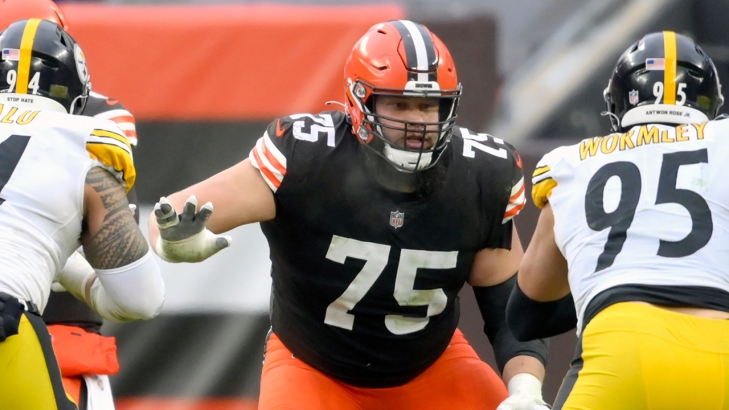
2024 Pre-Season Rank #46, 2023 Pre-Season Rank #60, 2022 Pre-Season Rank #91, 2021 Pre-Season Rank #143. Peak Period: 2018-22
Bitonio is now on a seven-year run of Pro Bowls, and three years ago, he put forth his best campaign to date with his second First Team All-Pro nod. No other Offensive Linemen have risen more over the last four seasons than the Guard, who has been Cleveland's most consistent offensive figure in the past seven years.
12. Mel Harder
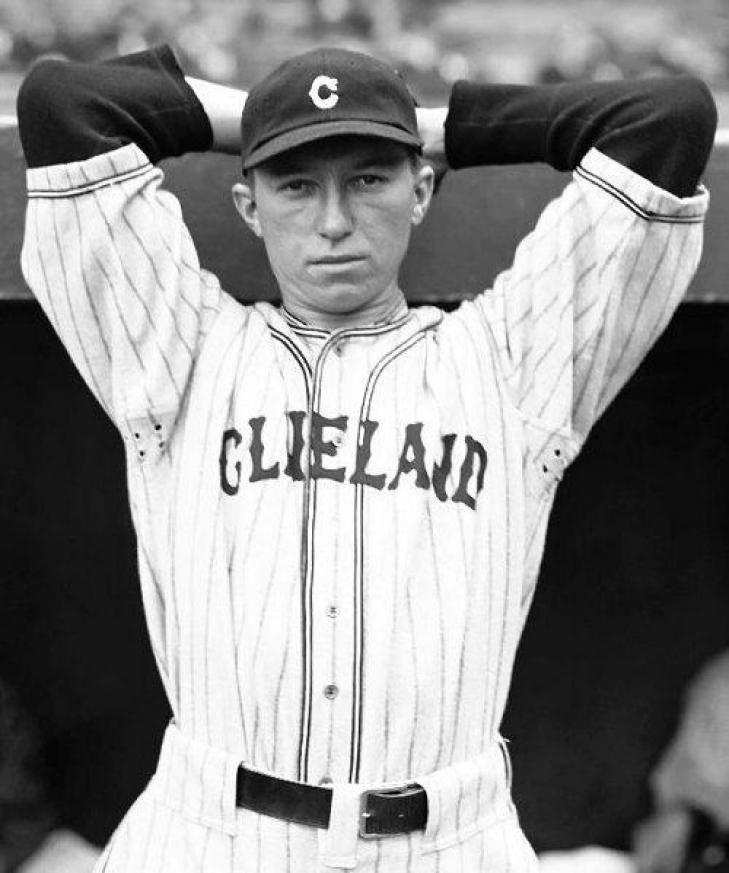
Harder’s journey in Cleveland began in 1928, and after a brief maturation period in the bullpen, he emerged as the definitive lifer of the rotation. He was the ultimate tactical technician, relying on a sharp curveball and a sinker that lived on the edges of the plate. He arrived as a young prospect from Nebraska and quickly evolved into a statistical titan, winning the American League ERA title in 1933. He was a four-time All-Star who provided a level of stability that few in the league could match, rattling off eight consecutive seasons with at least 15 victories during the heart of the 1930s.
The true genius of his game was found in his refusal to give away free passes. Harder was an efficiency machine, leading the league in fewest walks per nine innings in 1935 and finishing in the top ten in that category eight times over his career. Perhaps most impressively, he was a perennial leader in strikeout-to-walk ratio, a feat he achieved through pure location and sequencing rather than raw power, as he only eclipsed the 100-strikeout mark once. He was a master of run suppression who finished in the top ten in WHIP and ERA six times each, proving that in the "Live-ball" era, command was the ultimate equalizer.
Reliability and longevity were the hallmarks of his identity. Harder held a spot on the Cleveland roster for 20 consecutive seasons, a record of service that underscored his importance to the franchise. Even as his physical tools began to erode in the 1940s, his veteran savvy allowed him to remain a productive contributor until his retirement in 1947. He concluded his long journey with 223 wins, a total that remains near the absolute top of the franchise leaderboard. Whether he was navigating the power-heavy lineups of the 30s or helping a young Bob Feller find his footing, he was the steady pulse of the clubhouse.
The chapter of his playing days may have closed without a postseason appearance, but his impact on Cleveland baseball was impossible to ignore. He transitioned seamlessly into a legendary coaching career with the club, but his work on the mound had already secured his immortality. He left the game as a statistical pillar and a symbol of professional excellence.
In recognition of his twenty years of elite service, the organization named Harder to the inaugural class of the Cleveland Indians Hall of Fame in 1951.
#9 Overall, Myles Garrett, Cleveland Browns, Defensive End, #4 Defensive Lineman/Linebackers: Pass Rushers
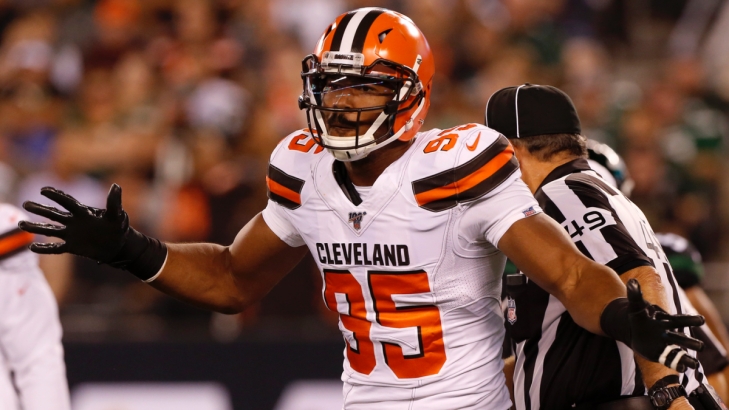
2024 Pe-Season Rank #17, 2023 Pre-Season Rank #34, 2022 Pre-Season Rank #53, 2021 Pre-Season Rank #99, 2020 Pre-Season Rank #144. Peak Period: 2020-24
What would the Cleveland Browns be without Myles Garrett over the last seven years?
In the off-season, Garrett asked for a trade, frustrated by the constant turmoil and failure of the organization to build around him, but he signed a contract extension with a fat contract to stay, and you can’t blame Cleveland for breaking the bank to keep him.
Garrett has been a First Team All-Pro four of the last five seasons, and the Defensive End won the 2023 Defensive Player of the Year, while finishing third last season. Breaking 100 Sacks last year, Garrett always seems to have a nose for wherever the ball is. He is also on a seven-year streak of at least 10 Sacks and 18 Tackles for Loss.
Garrett’s elite period rivals many Hall of Fame Defensive Ends, and he is only 30.
