

36. Steve Finley
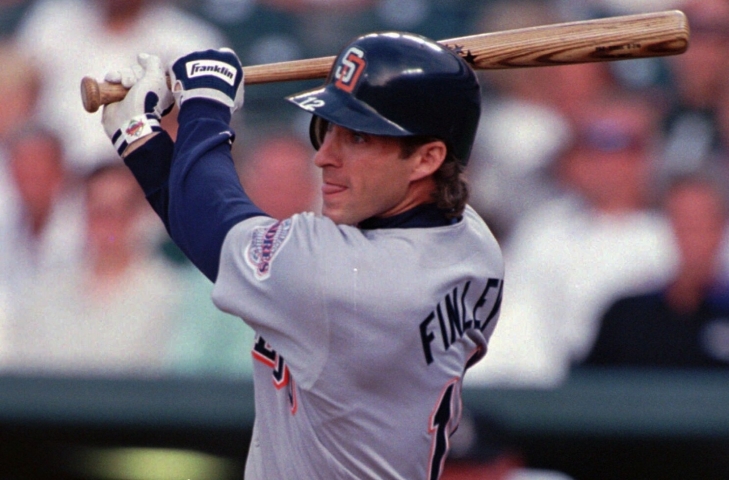
Few players have traveled the major leagues as extensively as the center fielder who played for eight teams. While Steve Finley later became a division champion and World Series winner in other teams, his early career in Southern California marked his rise from a potential asset to a superstar. Coming from the Astros before 1995 in a trade with Ken Caminiti, the left-handed hitter didn't just fill a defensive need but brought speed, power, and energy that changed the team’s trajectory.
His introductory 1995 campaign instantly proved that his natural toolkit was perfectly optimized for the spacious coordinates of his new home ballpark. Finley turned lashing line drives and tracking deep fly balls into a strict daily routine, hitting a career-high .297 with 167 hits, 104 runs scored, and a magnificent 36 stolen bases.
His sophomore year with the Padres marked his best season in baseball. Finley delivered an outstanding all-around offensive performance, setting career highs with 195 hits, 45 doubles, and 126 runs scored. Most notably, his power surged unexpectedly; previously never hitting more than 11 home runs in a season, he used a quick pull swing to hit 30 home runs and drive in 95 RBIs. This effort earned him tenth place in the National League MVP race and helped San Diego secure a surprising division title. He beautifully maintained that dynamic frontline baseline over the next two summers, weaponizing enough muscle to hammer 28 more home runs in 1997 to command his very first career All-Star selection.
Nevertheless, a thorough algorithmic review reveals his defensive contributions. While traditional voters praised his speed and impressive, wall-crashing plays—earning him consecutive National League Gold Glove Awards in 1995 and 1996—modern efficiency metrics and retrofitted defensive measurements tend to undervalue his hardware. They consider his overall route efficiency and deep-range coverage to be quite inconsistent, leading to a career -0.4 defensive bWAR with San Diego that significantly limits his overall advanced value.
He made 159 appearances in the 1998 pennant-winning season, but his offensive efficiency declined; his batting average dropped to.249, though his 40 doubles and 14 home runs helped the underdogs reach the Fall Classic against the Yankees.
The inevitable business exit occurred right after that last World Series appearance. With his contract ended and the front office unable to afford his rising market value due to an aggressive roster rebuild, Finley entered free agency. In December 1998, he made a clear business move by signing a lucrative deal with the regional rival Arizona Diamondbacks.
With San Diego, Finley compiled 662 hits, 134 doubles, 31 triples, 82 home runs, and 88 stolen bases.
9. Steve Finley
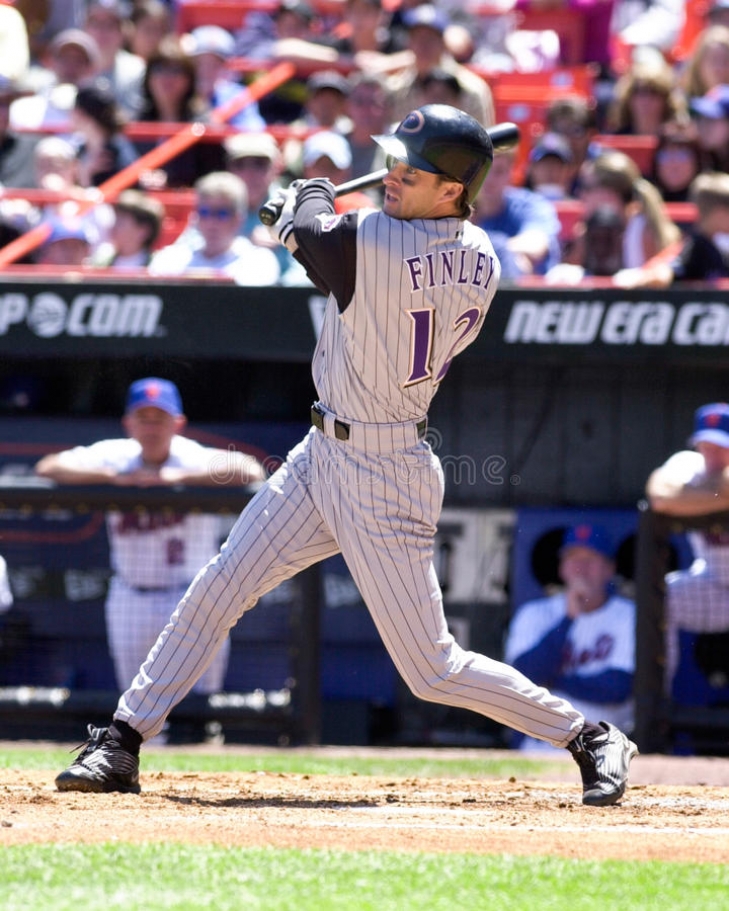
The signing of Steve Finley via free agency proved to be a fruitful one for the Arizona Diamondbacks, as the Outfielder would put forth some of his best offensive seasons playing in Arizona.
The “Third Man of the Offensive Corps” of Arizona’s World Series offense, Finley would have two 30 Home Run seasons and three more 20 Home Run years for the Diamondbacks, and provided a respectable Batting Average and On Base Percentage. Finley represented Arizona twice in the All-Star Game and also won a pair of Gold Gloves there.
Perhaps most significantly in this ranking is Finley's postseason performance in the 2001 World Series run, where he batted .421 in the Division Series, .286 in the Championship Series (with a .412 OBP), and .368 in the World Series (with a .478 OBP). Johnson, Schilling, and Gonzalez receive a lot of the credit for 2001, but Steve Finley was a major part of that championship season. After a few more good years, he was traded to the Dodgers during the 2004 Season.
Finley overall had 847 Hits, 153 Home Runs and batted .278 for Arizona.
47. Steve Finley
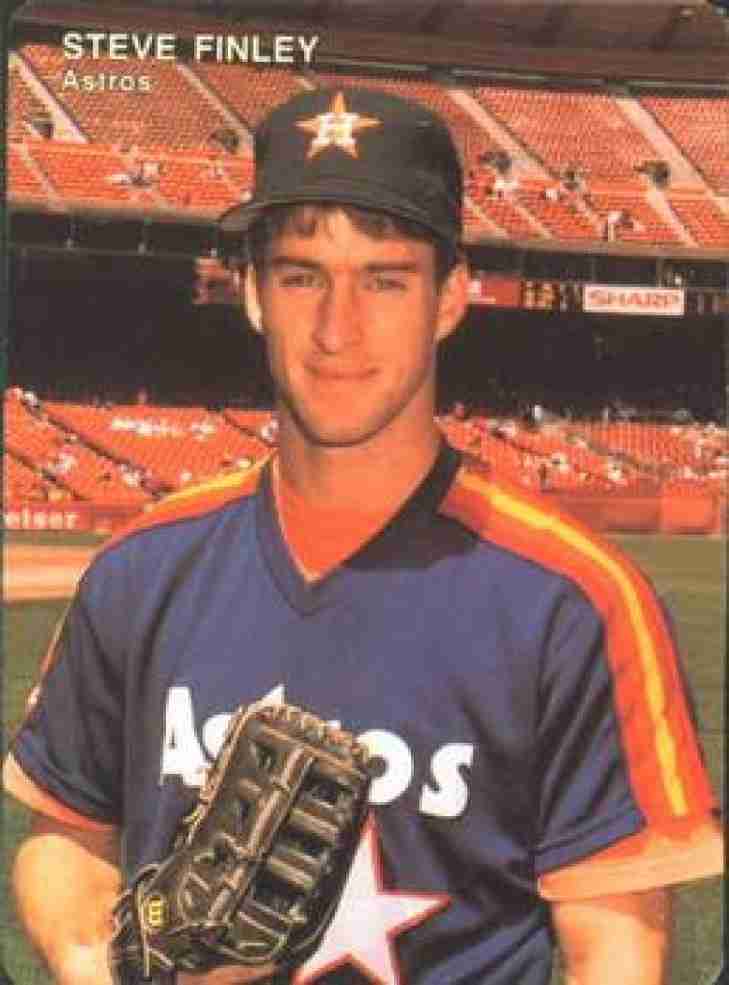
Steve Finley arrived in the Houston organization via a January 1991 blockbuster trade with the Baltimore Orioles, a deal that famously sent slugger Glenn Davis to the AL in exchange for Finley, Pete Harnisch, and a young Curt Schilling. While he had been a promising speedster in Baltimore, Finley evolved into a premier all-around threat in the National League.
Finley took over as the starting centerfielder in 1991 Spring Training, and in his second season with the Astros, Fonley used the vast dimensions of the Astrodome to his advantage, recording 13 triples and a career-high 44 stolen bases by appearing in all 162 games and recording 177 hits, finishing the year with a career-high 5.7 bWAR.
His tenure in Houston was equally defined by his specialized defensive quality in center field. While he would later gain national recognition for winning five Gold Gloves with other clubs, he actually recorded his highest career defensive efficiency in Houston, tallying a 5.0 dWAR over his four seasons with the club. Even as his power numbers remained modest compared to his later "30-homer" seasons, he remained a high-frequency contributor, leading the league in triples again in 1993 with 13.
Houston was, however, in the process of rebuilding. Finley was part of a massive 12-player trade to the San Diego Padres in December 1994, the same transaction that sent Ken Caminiti west. Finley compiled 595 hits, 110 stolen bases, and a 5.0 dWAR as an Astro.
