

24. Elmer Flick
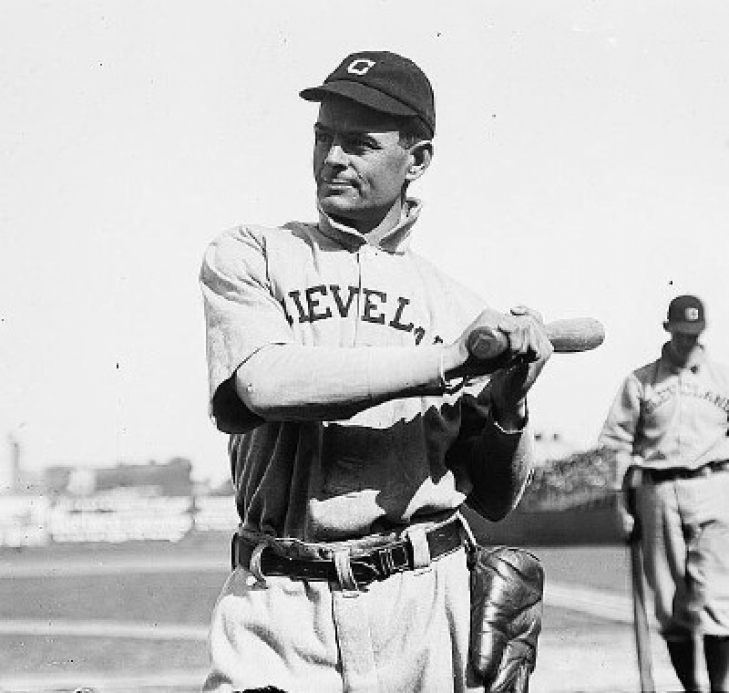
Flick’s path to Cleveland was forged in the chaos of the American League's birth. After jumping from the Phillies to the cross-town Athletics, a Pennsylvania injunction prohibited him from playing for any team within the state. To keep his career alive, he was sent to Cleveland alongside Lajoie in 1902—a move that secured the club's offensive identity for the next nine years. He emerged with a specialized, contact-heavy approach that relied on elite acceleration, maturing instantly into a premier leadoff threat. By 1905, he had reached a remarkable apex, capturing the American League Batting Title with a .308 average and proving that he was the most efficient table-setter in the Junior Circuit.
The most impressive aspect of his tenure was his total command of the most difficult hit in baseball. Flick was a master of the triples alley, authored by a historic three-year stretch from 1905 to 1907, where he led the American League in three-baggers annually. He wasn't just a threat to find the gaps; he was a tactical nightmare once he reached base, twice capturing the Stolen Base crown in 1904 and 1906. He was a model of specialized speed, serving as a high-frequency run producer who used his legs to pressure opposing batteries and turn routine singles into scoring opportunities.
Flick’s presence was defined by a quiet, professional resilience and a defensive grace that made him one of the premier right fielders of the early twentieth century. Flick remained the heart of the Cleveland outfield until 1910, navigating the era’s physical demands with a consistent, blue-collar approach that kept his career average at a near-elite .299 throughout his tenure. Whether he was manufacturing a run with a daring dash on the basepaths or lacing a line drive into the corner for another league-leading triple, he competed with a focused intensity that made him a central figure in the franchise’s formative years. He proved that a player could anchor a lineup through a rare combination of high-frequency contact and world-class velocity.
In 1910, health issues forced him to retire, but he left the organization as a statistical pillar of the deadball era. He departed with over 1,000 hits in a Cleveland uniform, having established a standard for speed and durability that few contemporaries could match.
With the Indians, Flick compiled 1,058 hits, 75 triples, and 188 stolen bases while maintaining a .299 batting average.. In 1963, both the organization and the game at large recognized his greatness; Flick was inducted into the National Baseball Hall of Fame in Cooperstown and simultaneously enshrined as a legend in the Cleveland Guardians Hall of Fame.
45. Elmer Flick
The detailed historical record of early 20th-century baseball features legendary figures deeply connected to the American League's origins. However, Elmer Flick’s greatness was built entirely during his time in Philadelphia. Although history primarily recalls "The Demon of the Stick" as a Cooperstown hero who reached his peak in Cleveland, it overlooks the exceptional and efficient debut he had in the majors during his four years with red pinstripes.
Arriving in 1898 to replace the injured Sam Thompson, the stocky, quick outfielder from Ohio not only survived but also mounted a vigorous offensive against National League pitching.
Flick turned offensive run creation into an absolute regular-season routine from the moment he arrived on Broad Street. Over his brief 537-game tenure with the Phillies, he orchestrated a breathtaking, high-volume .338/.419/.487 slash line, accumulating 683 hits, 102 doubles, and 57 triples.
The highlight of his time in Philadelphia was during a historic 1900 season, where he stood out as a top league performer. Flick delivered an outstanding offensive performance, hitting .367 with 11 home runs and a personal best of 200 hits, while leading the Senior Circuit with 110 RBIs. He paired his powerful middle-of-the-order batting with impressive speed, stealing 35 bases and successfully outpacing opponents.
Despite his impressive individual record, Flick’s time in Philadelphia was dramatically interrupted by intense political rivalry between the established National League and the emerging American League. After a stellar 1901 season where he scored 112 runs, he was drawn by the lucrative prospects of the new league and, along with teammate Napoleon Lajoie, transferred to Connie Mack’s Philadelphia Athletics before the 1902 season.
The transaction led to an immediate and historic legal upheaval. Enraged by losing his top players, Phillies owner Colonel John I. Rogers sued, leading to a case that reached the Pennsylvania Supreme Court. In April 1902, the court issued a broad injunction preventing the defecting players from playing for any team other than the Phillies within Pennsylvania.
After Flick logged a mere 11 games in an Athletics uniform, American League president Ban Johnson executed a brilliant, low-variance loophole. Recognizing that the state injunction was unenforceable beyond Pennsylvania's borders, the league abruptly assigned Flick and Lajoie to the Cleveland Bronchos (later the Naps). He would play the rest of his career in Cleveland, and in 1963, he was elected to the Baseball Hall of Fame.
