
The Pro Football Hall of Fame Revisited Project: 1970 Final VOTE
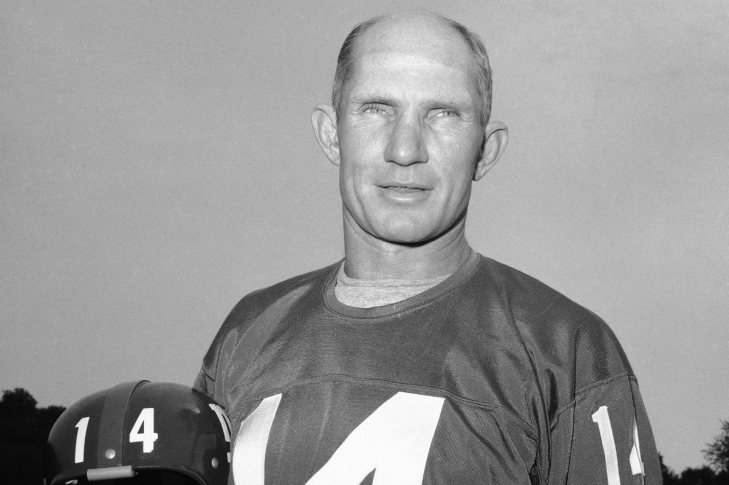
1970 Pro Football Hall of Fame Revisited Project Class.
Here we are! Again!!
If you have been following our Pro Football Hall of Fame Revisited Project, you know we have asked the rhetorical question: What if the PFHOF began in January 1946?
After soliciting and obtaining a passionate group of football fans and historians, we sent out a ballot for a Preliminary Vote, in which we asked each voter to give us 25 names as their semi-finalists and 5 in the Senior Pool. We then asked the group to vote for their 15 Finalists in the Modern Era and 3 in the Senior Category. The final stage was to vote for their five Modern Era inductee and one Senior inductee.
This is the result of the 25th official class;
Below are the final results of this project based on 32 votes.
Remember that the group took a vote in “1970”, and we have reverted to the top five candidates entering the Hall, PROVIDING THEY MAKE 50% of the vote. This will be put to a vote again in “1972”.
This is for the “Modern Era”
*Bold indicates they have been elected to the Pro Football Hall of Fame Revisited Class of 1970:
Player | Year of Eligibility | Vote Total |
Y.A. Tittle QB | 1 | 28 |
Frank Gifford HB-FL-DB-WR | 1 | 23 |
Yale Lary DB-P | 1 | 21 |
Andy Robustelli DE | 1 | 21 |
Hugh McElhenney HB | 1 | 14 |
Mike McCormack T-G | 3 | 11 |
Pat Harder FB | 12 | 8 |
Alan Ameche FB | 5 | 6 |
Charlie Conerly QB | 4 | 6 |
Marshall Goldberg FB | 17 | 5 |
Ward Cuff WB-QB-HB | 18 | 4 |
Gene Lipscomb DT | 3 | 4 |
Buckets Goldenberg G-BB | 20 | 2 |
Tank Younger FB-LB-HB | 7 | 2 |
Bruno Banducci G | 11 | 1 |
This is for the “Senior Era”,
*Bold indicates they have been elected to the Pro Football Hall of Fame Revisited Class of 1970.
George Christensen | 7 | 16 |
Whizzer White | 4 | 6 |
Al Nesser | 13 | 4 |
None of the Above | N/A | 6 |
This is for the “Coaches/Contributors”,
*Bold indicates they have been elected to the Pro Football Hall of Fame Revisited Class of 1970.
Paul Brown | 1 | 22 |
Bert Bell | 1 | 9 |
Buddy Parker | 1 | 1 |
About the 1970 Inductees:
Y.A. Tittle QB, BCL 1948-50, SFO 1951-60 & NYG 1961-62: Inducted in the Pro Football Hall of Fame Revisited Project in 1970 on his 1st Ballot. Inducted into the actual Pro Football Hall of Fame in 1971.
Beginning his career with the Baltimore Colts of the AAFC, Quarterback, Y.A. Tittle played 17 years of professional football. His accuracy and cerebral style of play, combined with his natural leadership skills, made him one of the best pivots of his day.
After the AAFC merged with the NFL, Tittle joined the San Francisco 49ers, and was one of the top Quarterbacks throughout the 1950s. Tittle was surprisingly traded to the New York Giants after being named the UPI MVP in 1957, and he would keep the Giants competitive while winning versions of the MVP in 1962 and 1963.
Frank Gifford HB-FL-DB-WR, NYG 1952-60 & 1962-64. Inducted in the Pro Football Hall of Fame Revisited Project in 1970 on his 1st Ballot. Inducted into the actual Pro Football Hall of Fame in 1977.
Frank Gifford was a former star at USC, and the Giants were lucky to grab him with their 11th Overall Pick in 1952.
Gifford played on both sides of the ball early in his career, but he would move mostly into an offensive role. Playing at Half Back, Gifford was a multi-threat player, and from 1953 to 1959, he was a Pro Bowl Selection, with four of those years earning a First Team All-Pro Selection.
His best season by far was 1956, where he had a career-high of 1,422 Yards from Scrimmage, which was enough to lead the NFL. That year, Gifford and the Giants would win the NFL Championship. Gifford had 9,870 All-Purpose Yards overall, an incredible total for his era. He also threw 14 Touchdown Passes, the most ever for a non-Quarterback.
Gifford’s career was derailed by a hit to the head from Chuck Bednarik took out 18 months of his career. He missed half of 1960 and all of 1961 but returned as a Flanker for three more years in the NFL.
A member of the 1950s All-Decade Team, Gifford’s #16 was retired by the team. He later became a successful broadcaster, commentating on Monday Night Football for 27 years.
Yale Lary DB-P, DET 1952-53 & 1956-64: Inducted in the Pro Football Hall of Fame Revisited Project in 1970 on his first Ballot. Inducted into the actual Pro Football Hall of Fame in 1979.
With the exception of two years serving his country, the multi-tasking Yale Lary played for the Detroit Lions from 1952 to 1964 and was a large part of the success of the organization’s success in the 1950s which brought Detroit three NFL Championships. The three-time NFL Champion was a five-time First Team All-Pro who was not just a Safety, but was exemplary as a Punter and a Returner.
Lary amassed 50 Interceptions, and 2,269 All-Purpose Yards and was a three-time league leader in Yards per Punt with 22,279 Punting Yards.
Andy Robustelli DE, RAM 1951-55 & NYG 1956-64. Inducted in the Pro Football Hall of Fame Revisited Project in 1970 on his 1st Ballot. Inducted into the actual Pro Football Hall of Fame in 1971.
From the tiny Arnold College, Andy Robustelli always seemed to be in a position to win on the professional level.
A two-time NFL Champion (one with the Rams and one with the Giants), the Defensive End appeared in eight NFL Championship Games, was a seven-time First Team All-Pro, and was the premier pass-rusher of his generation. Robustelli was exceptionally durable, only missing one game in his career, and was named the Bert Bell Award winner in 1962.
George Christensen G-T, PRT 1931-33 & DET 1934-38. Inducted in the Pro Football Hall of Fame Revisited Project in 1970 on his 7th Senior Ballot. Was never inducted into the actual Pro Football Hall of Fame.
A member of the 1930's All-Decade Team, George Christensen, was one of the better Tackles of the decade (obviously based on the above accolade).
Christensen signed with the Portsmouth Spartans in 1931 and stayed with the team as they relocated to Detroit to become the Lions in 1934. The Tackle would help Detroit win the NFL Championship in 1935, and he played his entire career with the organization, which spanned 95 Games.
Paul Brown Coach, CLE 1946-62 & CIN 1968-75. Inducted in the Pro Football Hall of Fame Revisited Project in 1970 on his 1st Coach/Contributors Ballot. Inducted into the actual Pro Football Hall of Fame in 1967.
Paul Brown received his first big league coaching opportunity with the Cleveland Browns of the All-American Football Conference, a new league with designs to challenge the NFL. Brown assembled a team full of players that he previously coached, and the Browns (named after him despite his objections) would win all four titles in the league's existence.
Paul Brown was a master strategist and innovator, creating the draw play and complicated routes for receivers. It was also from Brown's mind where the "pocket" derived, by which a quarterback is protected by his offensive line added precious seconds, allowing for greater protection and more high-potent offenses. A consummate professional, Brown was the first to have full-time assistants, and he developed his own scouting system.
The Browns and other AAFC teams were absorbed into the NFL in 1950, and the newer teams were not expected to challenge immediately for the NFL Championship. Brown did just that, winning in Cleveland's first year in the NFL and collecting two more titles in the 50s (1953 & 1954). As innovative and as brilliant as he was, some flaws would come to light by the early 60s.
Brown was considered cold and downright unfeeling by many of his players, and he did have a controlling nature. That would lead to his downfall and an acrimonious split between him and owner Art Modell. Brown was fired in 1962.
Six years later, Brown was a co-investor for a new NFL team, the Cincinnati Bengals, where he was their first head coach and general manager. Brown took the Bengals to the playoffs three times but never got a playoff win in Cincinnati. He retired after the 1975 season at age 67.
Love him or hate him, the game of football became exponentially better because Paul Brown was part of it.
8. Andy Robustelli

Andy Robustelli was already a proven defensive end with the Los Angeles Rams when he forced a trade to the New York Giants before the 1956 season. He had asked for time off after the birth of his child; the request was denied, and he demanded a change of scenery. The Rams complied, and the Giants acquired a 30-year-old pass rusher who still possessed elite ability. The move paid immediate dividends. Robustelli earned first-team All-Pro recognition for the third time in his career and helped New York win the NFL Championship in his first season with the team.
The Giants returned to the Eastern Conference title game five more times during his tenure, yet the 1956 championship remained the only one he won in New York. Even without additional titles, Robustelli continued to produce at a high level. He earned five Pro Bowl selections with the Giants and four first-team All-Pro honors. The recognition confirmed that his skills had not diminished after the move from Los Angeles. He remained a disruptive force on the edge, collapsing pockets and setting the edge against the run, and opposing offenses had to account for him on every snap.
In 1962, Robustelli won the Bert Bell Award, becoming the first defensive player to receive that version of the Most Valuable Player honor. The award underscored the impact he continued to have well into his thirties. He blended power and technique in a way that allowed him to win against both tackles and tight ends, and the Giants’ defense played with more stability on his side of the field throughout those years. Younger teammates looked to him for leadership, and his presence helped the unit remain competitive even as the supporting cast changed.
Robustelli retired after the 1964 season. He left New York after nine years as one of the most accomplished defensive ends in franchise history and as a player who had helped deliver a championship in his first season with the team. The trade acquisition, who arrived at age 30, remained productive and honored throughout his time in a Giants uniform.
With the Giants, he earned five Pro Bowl selections and four first-team All-Pro honors. Those recognitions, combined with his contribution to the 1956 championship and the Bert Bell Award, reflected both his individual excellence and the sustained impact he brought over nearly a decade in New York. He finished as one of the more decorated defensive linemen of his generation.
Robustelli entered the Pro Football Hall of Fame in 1971. The Giants placed him in their Ring of Honor in 2010 as part of the inaugural class.
48. Andy Robustelli
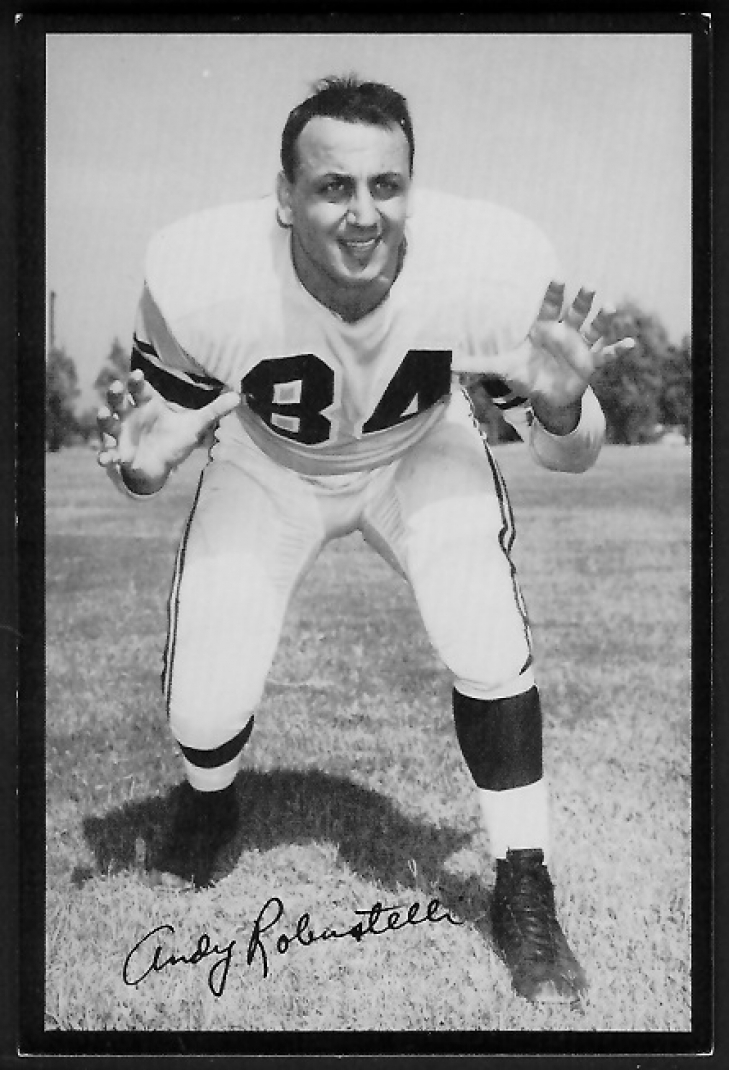
Andy Robustelli was a late-round pick from Arnold (the only player ever drafted from there), and he made the team at defensive end, where he would help the Los Angeles Rams win the 1951 championship. He blossomed into one of football's top defensive players and was a first-or second-team All-Pro for the next four years. It should have continued, but Robustelli clashed with Rams management over their refusal to let him take time off to be with his new child. He was traded to the New York Giants and went on to have a Hall of Fame career. Maybe they should have let him take a couple of days off, don’t you think?
The path to the Rams began in the 19th round of the 1951 NFL Draft. The tiny Arnold College in Connecticut had never produced an NFL player, and Robustelli—a two-way end who had also been offered a minor-league baseball deal—was a pure long shot. Drafted as a receiver behind established stars like Tom Fears and Elroy Hirsch, he shifted to defensive end, made the roster, and contributed immediately. As a rookie, he played on the team that beat the Cleveland Browns for the 1951 NFL championship. Over the next four seasons, he became one of the league’s best ends: second-team All-Pro in 1952 and 1954, first-team All-Pro in 1953 and 1955, and a Pro Bowl selection in 1953 and 1955. He missed only one game in those five years and recovered 13 fumbles while starting nearly every contest.
After the 1955 season, with a new child at home in Connecticut and a sporting-goods business to tend, Robustelli asked for a couple of extra days before training camp. Coach Sid Gillman refused. When Robustelli held firm, the Rams traded him to the New York Giants in July 1956 for a first-round draft pick (used on Del Shofner). Robustelli later said he would have taken the whole season off rather than leave his family early. The move worked out just fine for him.
With the Giants, he became a cornerstone of one of the era’s great defenses, winning another championship in 1956, earning five more first-team All-Pro honors, seven total Pro Bowls, and the 1962 Bert Bell Award. He was inducted into the Pro Football Hall of Fame in 1971.
The Rams got five strong seasons and a championship contribution out of a 19th-round flyer from a school that no longer exists. They also got the short end of a family-time dispute that sent a future Hall of Famer east. A couple of extra days with a newborn might have been the cheaper option.
