


Site Admin
1. Emmitt Smith
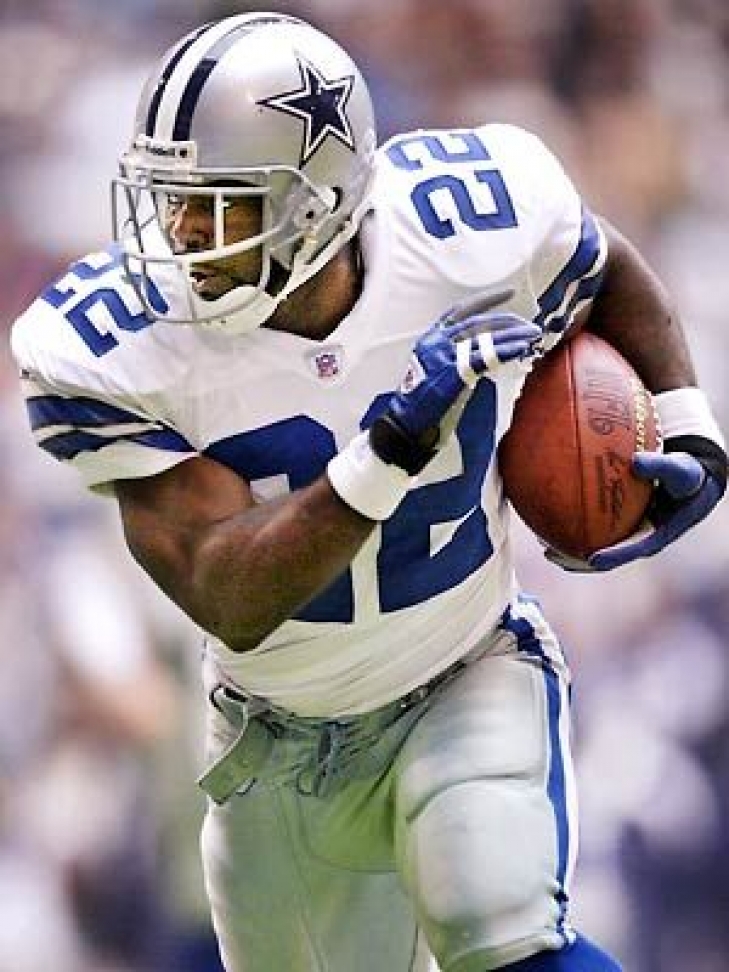
When you look at "America's Team," you have a team that not only had a lot of eyeballs on it but also produced a plethora of Hall of Famers. Choosing the greatest Dallas Cowboy wasn't easy, but in the end, we decided on the player who, statistically speaking, is the greatest Running Back of all time.
Emmitt Smith arrived in Dallas as the 1990 17th pick amidst skepticism surrounding his modest height and top-end speed. The former Gator quickly silenced critics by capturing NFL Offensive Rookie of the Year honors, embarking on an unprecedented run that cemented him as the cornerstone of the 1990s Cowboys dynasty and the all-time leading rusher in football history.
Smith had exceptional vision, a low center of gravity, and lateral agility. Instead of depending on pure speed, he mastered setting up blocks behind Dallas’ formidable offensive line, pushing the hole to displace linebackers before executing a decisive cut. Smith handled contact with ease, powered through initial tackles, and demonstrated legendary durability to sustain heavy workloads week after week.
Smith distinguished himself from others of his era through his exceptional, almost telepathic understanding of blocking schemes and outstanding body control upon contact. He excelled at the “press"—initially slashing toward a designated gap just enough to attract linebackers into the wash, then planting his outside foot, dropping his hips, and executing a jump-cut into a nearby lane before defenders could adjust. Instead of taking direct hits at full speed, he rolled off arm tackles, kept a low center of gravity, and kept his legs moving to gain two or three yards after contact on nearly every run.
His legendary physical toughness was exemplified in the memorable 1993 regular-season finale against the New York Giants. Despite playing with a separated shoulder, Smith had 32 touches for 229 yards in total, including 41 yards on a vital game-winning drive in overtime, securing the division title and home-field advantage. His readiness to endure punishment and stay central to team strategies centered on defense established him as the premier high-usage, clutch player.
After his rookie season, when he was named Offensive Rookie of the Year, Smith began a remarkable period of individual success in the NFL. In 1991, he won his first rushing title with 1,563 yards, then improved in 1992 to 1,713 yards and led the league with 18 rushing touchdowns. Playing alongside quarterback Troy Aikman and wide receiver Michael Irvin—known as the"Triplets"—Smith led a dominant offense that ended with a 52–17 victory over Buffalo in Super Bowl XXVII. He became the first player to earn both a league rushing title and a Super Bowl ring in the same season.
In 1993, following a contract holdout that prevented him from participating in the initial two games of the regular season, Smith demonstrated exceptional value. Over the course of merely 14 games, he led the National Football League (NFL) in both rushing yards (1,486) and scrimmage yards (1,900). He was conferred the AP NFL Most Valuable Player (MVP) award, guided Dallas to victory in Super Bowl XXVIII with a remarkable performance of 132 yards and two touchdowns, and was subsequently named Super Bowl MVP—becoming the sole player in NFL history to achieve the feat of winning the regular-season MVP, Super Bowl, Super Bowl MVP, and league rushing title within a single season.
Smith achieved his highest statistical performance during the 1995 season. Operating behind "The Great Wall of Dallas," he secured his fourth rushing title with a career-best 1,773 rushing yards and broke the NFL single-season record with 25 rushing touchdowns, in addition to 62 receptions for 375 yards. His fourth consecutive First-Team All-Pro selection culminated in a commanding postseason run, finalized by his two-touchdown performance against Pittsburgh in Super Bowl XXX, which secured the franchise's third Lombardi Trophy in four years.
As the Cowboys underwent roster changes in the late 1990s, Smith remained a reliable workhorse, recording 11 consecutive 1,000-yard rushing seasons. On October 27, 2002, against the Seattle Seahawks, he surpassed Walter Payton to become the NFL's all-time career rushing leader.
After 13 seasons in Dallas (1990–2002), Smith played his final two professional seasons with the Arizona Cardinals (2003–2004) before retiring from football. His time in Dallas yielded 17,162 rushing yards, 153 rushing touchdowns, and 3,012 receiving yards. He remains the NFL's all-time leader in both career rushing yards (18,355) and rushing touchdowns (164).
Smith was inducted into the Dallas Cowboys Ring of Honor in 2005 and joined the Pro Football Hall of Fame in Canton in 2010 on his first ballot.
50. A.J. Cann

Drafted in the third round (67th overall) of the 2015 NFL Draft following an All-SEC tenure at South Carolina, A.J. Cann brought power and durability to Jacksonville's interior line. The 315-pound guard quickly cracked the starting lineup during his rookie campaign, stepping in at right guard by Week 3 and anchoring the spot with steady, low-leverage run blocking.
Cann became an indispensable frontline worker over the next half-decade. Playing alongside center Brandon Linder and tackle Brandon Linder/Jawaan Taylor on the right perimeter, his broad frame and heavy-handed punch proved vital during Jacksonville's 2017 division-winning run, where he started 15 regular-season games and three playoff contests, propelling the franchise to the AFC Championship Game.
His dependability upfront was rewarded in March 2019 when Jacksonville signed him to a three-year contract extension. Cann rewarded that faith by logging consecutive 15-plus-game starting campaigns in 2019 and 2020, serving as a rare veteran constant during a period of heavy roster turnover and scheme adjustments.
An early-season MCL injury limited Cann to just four appearances in 2021, bringing his long-tenured Jacksonville run to an abrupt end. He departed in free agency to sign a two-year deal with the Houston Texans in 2022, starting 16 games in his lone season with the division rival before hanging up his cleats. Cann started 94 of his 95 games in Duval.
47. Ben Coleman

Selected in the second round of the 1993 draft by Arizona, Ben Coleman arrived in North Florida midway through the 1995 inaugural campaign without much fanfare. The 6-foot-5, 330-pound Wake Forest product quickly integrated into Tom Coughlin's interior rotation, offering immovable girth and heavy hands along the front line.
Coleman unlocked his potential once settled into the starting left guard job full-time in 1996. Paving massive lanes for Natrone Means and Mark Brunell's scramble drills, he served as a physical interior presence during the franchise's improbable run to the 1996 AFC Championship Game.
Over the next three seasons, Coleman formed a formidable left side of the line alongside tackle Tony Boselli. His finest personal campaign arrived in 1998, when his mauling run-blocking fueled Fred Taylor’s sensational 1,200-yard rookie breakthrough and helped cap off an 11–5 AFC Central title season. He remained a mainstay upfront in 1999, starting 15 games for a dominant 14–2 squad that captured a second consecutive division crown and returned to the AFC title game.
In free agency following the 1999 season, Coleman signed with San Diego, starting 16 games for the Chargers in 2000 before completing his nine-year NFL career in Washington. He started 65 of his 74 games in Jacksonville.
46. Rob Meier

Selected first overall in the 1999 CFL Draft out of Washington State, Vancouver-born defensive lineman Rob Meier bypassed a career in Canada to pursue his NFL ambitions. The Jacksonville Jaguars claimed him in the seventh round (241st overall) of the 2000 NFL Draft, adding a 6-foot-5, 305-pound versatile trench worker to their defensive front.
Meier carved out a long career by mastering inside-outside flexibility up front. Possessing the size to clog interior run lanes at defensive tackle alongside the footwork to set a physical edge at defensive end, he became an essential rotational anchor across multiple coaching regimes in North Florida.
While he started 49 contests during his tenure, Meier was a constant force in game-day rotations, appearing in 138 regular-season matchups over nine active playing seasons. His most disruptive year came in 2007, when he started nine games, recorded 4.5 sacks, and anchored an 11–5 defense that advanced to the AFC Divisional Round.
Though a foot injury during 2009 training camp sidelined him for what would have been a tenth season, Meier spent his entire active NFL career exclusively in a Jaguars uniform before his release in early 2010. Statistically, Meier had 21.5 sacks and 232 combined tackles.
